B2B SaaS Pricing Psychology: Anchors for Buying Committees
B2B SaaS pricing psychology built for buying committees: where anchoring, decoys and charm pricing break, plus real published prices and a 20-point audit.

Your pricing page tests well. The champion picks the middle tier on the demo call and says the number looks fair. Three weeks later the deal comes back at a discount off the tier below, procurement has asked for a multi-year commit, and nobody on your side can point to the moment the anchor collapsed. That collapse is what B2B SaaS pricing psychology actually has to solve, and the standard reading list does not attempt it.
Every popular article converges on the same six principles - anchoring, decoy effect, loss aversion, social proof, framing, charm pricing - and the same conclusion: build three tiers and badge the middle one “Most Popular.”
Those principles were measured on a shopper, and a shopper is not who buys your software. In B2B the person who feels the anchor is not the person who signs it, the price is re-pitched internally by someone who is not you, and it gets read a second time by a procurement team whose job is to attack it. Every classic bias either breaks or inverts under those three conditions, and the repair is structural every time: change the artifact the price travels in.
B2B SaaS Pricing Psychology in One Table
| Classic principle | What it assumes | What a buying committee does to it | The B2B fix |
|---|---|---|---|
| Anchoring | The buyer sees your highest price first | The champion sees it, finance only sees the quote | Put the full ladder in the artifact procurement reads |
| Decoy tier | A dominated option quietly nudges choice | Someone asks “why not the cheaper one?” out loud | Attach a stated reason to the badged tier |
| Charm pricing | Left-digit bias lowers perceived price | Cents multiply into an odd number on the order form | Round above the procurement threshold |
| Loss aversion | The buyer fears losing money | The champion fears losing credibility | Frame the loss as risk to the champion |
| Social proof | ”Most Popular” reassures the shopper | The committee asks: popular with whom? | Name the segment on the badge |
| Framing | A per-month figure softens the number | Finance converts it to an annual total anyway | Show both, and show total contract value |
Read that table as the argument in miniature. Nothing in the left column is wrong. All of it was designed for a decision made by one person in one sitting, and you are pricing for a decision that gets taken apart in meetings you never attend.
What Psychological Pricing Is, and Where the Textbook Version Breaks in B2B
Psychological pricing is the practice of setting a price for how it will be perceived rather than only for what it costs to deliver. The textbook version rests on three assumptions, and B2B breaks all three.
Assumption one: one person decides. The 2025 B2B Buyer Experience Report from 6sense, built on roughly 4,000 buyer responses, found that typical purchases involve 10 or more people, at a median purchase cost between $200,000 and $300,000. Buying group size scales with price, which means the more your pricing psychology matters, the less it is aimed at a single brain.
Assumption two: the price is seen at the moment of decision. It is not. The 2024 B2B Buying Disconnect report from TrustRadius, based on 2,164 verified buyers, describes the pattern plainly: buyers build a short list, usually go with their first choice, and then do research to justify that decision to the larger buying group. Most short lists hold two or three products, and 96% hold five or fewer. Your price is not being evaluated. It is being defended.
Assumption three: the price is final. In B2B it is an opening position that survives a legal review, a procurement negotiation and an annual renewal. Anything clever you did to the last digit gets renegotiated by someone paid to renegotiate it.
Two datasets on committee size disagree in a way worth noticing. TrustRadius found small and mid-sized companies peaking at two-to-three-person buying groups and enterprise peaking at four-to-five, while 6sense found 10 or more. The gap is deal size: 6sense required a minimum spend of $25,000 and saw a median purchase between $200,000 and $300,000. The practical read is that your committee grows with your price, so a ladder that converts at $9 per seat walks into a very different room at $90.
Price Anchoring When the Person Who Feels the Anchor Is Not the Person Who Signs
Price anchoring works. The problem is where you place the anchor. The default place to put it is the pricing page, which is the one artifact the economic buyer may never open.
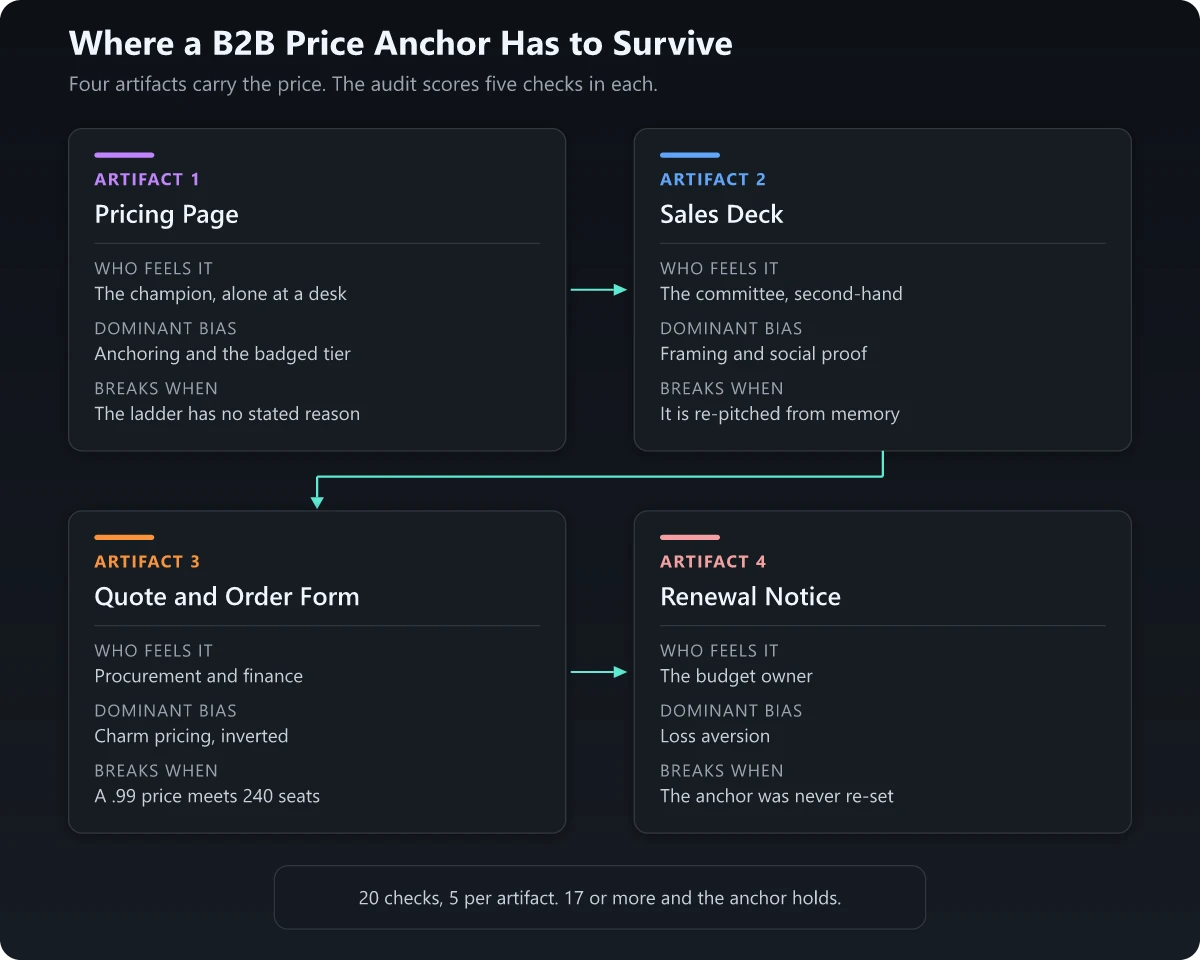
The chain a B2B price travels looks like this:
- The champion meets the anchor on your pricing page, usually before talking to anyone
- The committee meets it second-hand, in a slide or a Slack message the champion wrote from memory
- Procurement meets it in the quote, stripped of every design decision you made
- The budget owner meets it again at renewal, a year after everyone forgot the reasoning
6sense found buyers now engage sellers at about 61% of the way through their journey, which is the whole argument for taking the pricing page seriously. The anchor is set across the majority of the journey without you, then re-litigated with you.
That produces one operating rule. An anchor that cannot be repeated from memory is not an anchor. If your champion cannot say, in one sentence and without notes, why the tier above costs what it costs, the number will not survive the meeting you are not in.
Two tests for whether your anchor travels:
- The memory test. Ask a customer on a renewal call what your top tier costs and what it includes. If they cannot name the boundary, the ladder never got installed.
- The forward test. Can your champion forward one URL that shows the full ladder without a configurator, a login or a contact-us wall? If not, they will retype your pricing into a slide, and their version becomes the anchor.
Real B2B Prices, Read as Anchors
Here are nine published B2B ladders I pulled and checked, with the mechanic each one is running.
| Company | Product | Published ladder | The anchor mechanic |
|---|---|---|---|
| Salesforce | Sales Cloud | $25 / $100 / $175 / $350 / $550 per user per month | Five rungs. The $550 top makes $175 read as mid-market |
| HubSpot | Marketing Hub | $7 per seat, then $800/mo (3 seats), then $3,600/mo (5 seats) | The unit changes from seat to platform mid-ladder |
| Zendesk | Support and Suite | $19 / $55 / $115 per agent per month, then custom | A cheap Support-only rung sits beside the Suite ladder |
| Intercom | Customer service | $29 / $85 / $132 per seat, plus from $0.99 per Fin outcome | A seat anchor with a consumption unit priced in cents |
| Figma | Design | Full seat $16 / $55 / $90; Dev $12 / $25 / $35; Collab $3 / $5 / $5 | Three seat types per tier, and free viewers on paid plans |
| Atlassian | Jira | Free to 10 users, then $7.91 and $14.54 per user per month, then custom | Annual math shown to the cent, Enterprise deliberately unpriced |
| monday.com | Work Management | $9 / $12 / $19 per seat per month, then custom | The badge sits on Pro, and the ladder ends in a quote |
| Notion | Workspace | Free, then $10 and $20 per member per month, then custom | A clean doubling, with up to 20% off for yearly billing |
| Vercel | Hosting | $0, then $20/mo, then custom | The $20 is both the seat price and an included usage credit |
Four things fall out of that table.
- Five of the nine stop publishing before the top. Zendesk, Atlassian, monday.com, Notion and Vercel all end in a contact-us tier. That unpriced rung does anchoring work precisely because it has no number: it tells the reader something exists above what they were looking at, while giving them nothing to object to
- The four that publish the top are making the opposite bet. Salesforce goes to $550, HubSpot to $3,600 a month, Intercom to $132 and Figma to $90 per Full seat. Figma then undercuts its own headline with a $5 Collab seat and free viewers on paid plans, so the anchor and the real invoice are deliberately different numbers
- The unit switch is the strongest anchor move on the list. HubSpot’s Starter is $7 per seat; Professional is $800 per month with three Core Seats included and additional Core Seats from $45. You cannot compare those two prices without doing arithmetic, and the arithmetic favours the bigger plan
- Salesforce runs the widest published span. From $25 to $550 is a 22x range on one page, and it exists so that nobody negotiating $175 feels they are at the top of anything
For the mechanics of choosing which unit to bill on in the first place, I have covered the seven B2B SaaS pricing models separately. This piece assumes you already picked one.
The Decoy Tier Has to Survive a Committee Asking Why Not That One
The decoy effect relies on a buyer not interrogating the choice architecture. Committees interrogate it by design. Somebody in that room is measured on cost control, and their contribution to the meeting is the sentence “why can we not start on the cheaper plan?”
That sentence kills badge-only decoys. Look at how monday.com handles it: a three- or four-tier ladder runs across four products, and the “Most Popular” badge moves. It sits on Pro at $19 in Work Management, on Pro at $28 in monday CRM, on Pro at $45 in monday Service, and on Standard at $12 in monday Dev. The badge records a placement decision, taken product by product.
That is fine. It is also fragile, because a badge is not an argument. What survives a committee is a boundary with a reason attached:
- A capability the cheaper tier structurally cannot do. Doing less of the same thing reads to a committee as a volume difference, and volume differences get negotiated. Zendesk’s $19 Support Team plan is a support desk; the $55 Suite Team is a support desk plus messaging and voice. The gap between them is a change of category
- A risk the cheaper tier leaves open. Security, audit logs, data residency and SSO are the four boundaries that end negotiations fastest, because the person objecting on cost is not the person who owns that risk
- A number the champion can quote. “The tier below caps us at 1,700 automation runs a month and we ran 4,000 last quarter” wins arguments. “It is the most popular one” does not
Write the reason into the tier description on the page, in the customer’s units. If you cannot write that sentence, what you have is a price gap, and sales will close it with a discount.
How many tiers to build and how far apart to space them is a separate job, covered in good-better-best pricing. This section is only about making one boundary survive a committee.
Charm Pricing in B2B: Why .99 Damages Credibility on an Enterprise Quote
Here is the cleanest evidence in this piece, and it came from checking rather than theorising. Across the nine published pricing pages above, not one seat price ends in .99. The only cents anywhere are Atlassian’s $7.91 and $14.54, which read as an annual total divided by twelve rather than as persuasion, and Intercom’s $0.99 per Fin outcome.
That single exception is the rule. Charm pricing survives in B2B at the consumption unit and dies at the contract unit. Three reasons:
- Multiplication. A shopper sees $19.99. A procurement analyst sees 240 seats times 12 months, and $19.99 becomes $57,571.20. Cents do not shrink a number that gets multiplied. They make it look calculated to squeeze
- The credibility signal. A .99 price tells the reader you are optimising the last cent of their perception. On a six-figure quote that reads as retail tactics applied to an enterprise relationship, which is exactly the frame you do not want going into a negotiation
- The rounding reflex. Finance rounds it anyway when building the business case, so you lose the left-digit effect and keep the credibility cost
The operating rule: charm pricing below the procurement threshold, round numbers above it. Self-serve tiers a manager can expense can end in 9. Anything that generates a purchase order should not carry cents. And per-unit consumption prices are the one place $0.99 still works, because nobody anchors on the unit, they anchor on the monthly bill.
Loss Aversion Aimed at the Champion’s Reputation Risk, Not the Buyer’s Wallet
The standard B2B application of loss aversion is a countdown timer or an expiring discount. Both are the wrong loss.
Companies do not feel loss aversion. Budgets absorb spend and carry on. The champion feels it, and what they stand to lose is the credibility they spent internally recommending you. TrustRadius put it directly: most of the research buyers do exists to convince others in the buying group that their choice is right.
So aim the loss framing at that. Practical translations:
- Replace “this discount expires Friday” with “here is what your Q1 looks like if this slips a quarter.” One is a threat to the company, the other is a risk to your champion’s plan
- Give them a downside slide alongside the upside slide. Name what happens on the cheaper tier six months in, in their metrics. The champion needs to have already raised the objection before the CFO does
- Make the status quo the risky option. The committee’s real default is doing nothing, and doing nothing feels free until someone quantifies it
- Price-lock the renewal in writing. A written hold on the current rate for one renewal cycle converts an abstract future increase into a concrete thing being given away now. That is loss aversion pointed in your favour rather than at your throat
That last one carries a governance cost, and the price increase announcement mechanics are where you decide how long a hold you can afford to grant.
Pricing Page Psychology: What to Actually Change This Week
Here is the edit list, in the order I would work through it.
| Change | Why it works on a committee | Effort |
|---|---|---|
| Add a one-line reason under every tier boundary | Gives the champion a quotable sentence | Low |
| Name the segment on the badge, as in “most popular with 50 to 200-seat teams” | Turns social proof into a self-qualification cue | Low |
| Show the annual contract total beside the per-month rate | Finance calculates it anyway, so calculate it for them | Low |
| Remove cents from every seat and platform price | Kills the retail signal on the quote | Low |
| Make the full ladder shareable at one URL, no configurator | The page becomes the artifact your champion forwards | Medium |
| State what is free (viewers, guests, read-only seats) on the page | Pre-empts the seat-count objection before procurement raises it | Medium |
| Publish the top tier’s starting price if you possibly can | An unpriced tier anchors, but an unpriced tier also gets skipped | Medium |
| Put security, SSO and audit boundaries in the tier description | Moves the argument from cost to risk, where you win | Medium |
Two of those deserve a note.
The annual toggle is framing, and everyone uses it. Atlassian’s page offers up to 17% off for annual billing, Notion advertises up to 20% off with yearly, and HubSpot marks its annual option “BEST VALUE” on the plan card. That framing is fine. It stops being fine when the per-month figure is the only number on the page, because the buyer who has to raise a purchase order needs the annual figure and will go and find it somewhere less flattering.
Transparency has become a buying criterion in its own right. TrustRadius found self-serve information like demos and pricing rising to 19% of what buyers weigh most heavily when judging a review site, up from 13% the year before and now tied with review content itself, and buyers naming transparent pricing first when asked what they wish were different about tech buying.
The Tier Boundary Is What Manufactures the Anchor
A tier boundary reads as a claim about who you are, made to people deciding whether you are built for a company like theirs. They treat the feature list underneath it as evidence for that claim, and the label you put on the boundary is the first part of it they read.
What a committee infers from your boundaries:
- Where the unit changes tells them which customer you actually want. HubSpot moving from per-seat to per-platform between Starter and Professional says the Professional buyer is a whole department
- How many seat types you sell tells them how carefully you have thought about their org chart. Figma’s Full, Dev and Collab split is a statement that not everyone who touches a design file should cost the same
- Whether the top tier has a number tells them whether you expect to negotiate. Publishing it says the price is the price. Hiding it says bring your procurement team
- What is included versus metered tells them where the surprise bill lives. Vercel bundling a $20 usage credit into a $20 plan is a promise that the first month will not shock anyone
Deciding where those boundaries sit belongs to your pricing strategy work, and how wide the gaps between them should be is worked out in good-better-best pricing, not here. Doing the psychology first is how teams end up with a persuasive ladder built on the wrong value metric.
Holding the Anchor Under Discount Pressure: The One-Page Sales Brief
An anchor is only worth what your team will hold. If the discount ceiling lives in a rep’s head, the anchor is decorative. This is the brief I would put in front of a sales team, and it fits on one page.
Section 1: The ladder and one reason per rung. One plain sentence per tier explaining who it is for and what breaks below it. Feature names do not belong in this section.
Section 2: The three questions procurement will ask. Usually: what is your standard discount, what does a multi-year commit get us, and what happens if we start smaller. Scripted answers, agreed with finance, written down before the first call.
Section 3: The concession ladder. Every concession is a trade, and the trade is written next to it. Longer term for a lower rate. Case study rights for onboarding credit. Annual prepay for a locked renewal. A discount given without a trade is a permanent re-anchor, because next year’s negotiation starts from the discounted number.
Section 4: The floor, and who owns it. One named person approves anything below it, because escalation speed is what keeps the floor real.
Section 5: The re-anchor script. What a rep says when a buyer opens with a competitor’s price. The move is to restate the boundary: what that competitor’s price leaves out, in the buyer’s units. Defending the number keeps the whole conversation on price.
Feed that brief from your win-loss analysis rather than from opinion. The reasons buyers give for choosing a tier are the only raw material that tells you whether a boundary is doing work or just sitting there.
The B2B SaaS Pricing Psychology Audit: 20 Checks, Scored
Score one point per check. Twenty points total, five per artifact. It takes about 20 minutes with the four artifacts open in front of you.
Artifact 1: The pricing page (5 points)
| # | Check | Point |
|---|---|---|
| 1 | The highest published price is visible without a click | 1 |
| 2 | Every tier boundary has a one-line stated reason above its feature list | 1 |
| 3 | The badged tier names the segment it is popular with | 1 |
| 4 | Annual pricing shows the contract total beside the per-month equivalent | 1 |
| 5 | One shareable URL renders the full ladder, no configurator or login | 1 |
Artifact 2: The sales deck and business case (5 points)
| # | Check | Point |
|---|---|---|
| 6 | One slide restates the full ladder, including the tier you are not selling | 1 |
| 7 | The recommended tier’s reason is a sentence the champion can repeat verbatim | 1 |
| 8 | The deck names what the buyer gives up one tier down, in their metrics | 1 |
| 9 | There is a named-peer proof point at the same tier and segment | 1 |
| 10 | The ROI math uses numbers the customer supplied on the call | 1 |
Artifact 3: The quote and order form (5 points)
| # | Check | Point |
|---|---|---|
| 11 | No cents anywhere in a seat or platform price | 1 |
| 12 | List price and concession appear separately, with the trade named | 1 |
| 13 | Total contract value appears once, in a box, requiring no arithmetic | 1 |
| 14 | Seat types are itemised so procurement can see which seats are free | 1 |
| 15 | Ramp, minimums and overage rates appear on page one of the quote | 1 |
Artifact 4: The renewal notice (5 points)
| # | Check | Point |
|---|---|---|
| 16 | Current price, new price and effective date appear in the first 60 words | 1 |
| 17 | It lists what shipped since the last price change | 1 |
| 18 | Uplift is capped per account, and the cap was written before the first email | 1 |
| 19 | The CSM sees the account’s number before the customer does | 1 |
| 20 | A concession ceiling exists and the save desk knows what it is | 1 |
How to read your score
| Score | What it means |
|---|---|
| 17 to 20 | The anchor survives rooms you are not in. Move on to testing the gaps |
| 12 to 16 | It holds in the demo and leaks in procurement. Fix artifacts 3 and 4 first |
| 7 to 11 | The page carries the price and nothing else does. Start with checks 2, 3 and 7 |
| 0 to 6 | Sales is inventing the price on every call. Fix the brief before the page |
The bands are deliberately harsh on the back half. Expect artifact 1 to score better than artifact 3, because the pricing page gets designed and the order form gets inherited from whoever set up the billing system.
What Changing the Anchor Does to Existing Customers
One warning before you rebuild anything. A new ladder does not only anchor new buyers. It re-anchors your installed base.
- Legacy-plan customers become a comparison set, and the ones overpaying relative to your new ladder will find out
- A new top tier makes their current tier look smaller, which is an expansion opportunity and a renewal risk in the same motion
- Grandfathering is a pricing decision with a multi-year cost, not a courtesy
Sequencing and notice periods for that migration are a separate problem, and I would work through the price increase playbook before touching a live pricing page. Refresh your sales enablement materials in the same week you ship, ahead of the first customer email.
Conclusion: B2B SaaS Pricing Psychology Is a Committee Problem
The reframe is the whole point. B2B SaaS pricing psychology is not shopper psychology with bigger numbers. The person who feels your anchor is rarely the person who signs, the reason for your price gets delivered second-hand by a champion working from memory, and the whole structure is read again by a procurement team paid to find the seam.
That changes what each classic bias is for. Anchoring becomes a question of which reason repeats most reliably, and the decoy tier becomes a boundary with an argument behind it. Charm pricing retreats from the contract to the consumption unit. Loss aversion moves off the company’s balance sheet and onto your champion’s professional risk.
Score your four artifacts against the 20 checks above. If artifact 1 scores well and artifact 3 does not, you have not built an anchor. You have built a landing page, and it stops working the moment your champion closes the tab.
Frequently Asked Questions
What is an example of psychological pricing?
Salesforce publishes Sales Cloud at $25, $100, $175, $350 and $550 per user per month. Few buyers land on $550, and its job is to set a ceiling that every negotiation over $175 then happens well below. The persuasion is done by the published ladder itself, before a seller joins the conversation.
What companies use psychological pricing?
Almost every published B2B SaaS pricing page uses it. monday.com puts a Most Popular badge on a specific tier, HubSpot switches its pricing unit from per seat to per platform between Starter and Professional, and Figma splits each tier into Full, Dev and Collab seats so the headline price is not the real spend.
What are the advantages of psychological pricing?
It sets the reference point a buyer compares everything else against, which is worth more than any discount you can offer later. In B2B the bigger advantage is defensive: a well-built ladder gives your champion a sentence to repeat when the committee asks why the cheaper tier will not do.
When is price anchoring used?
Price anchoring happens the first time a buyer sees any number from you, which in most B2B deals is the pricing page rather than the sales call. By the time a seller joins the conversation, the reference point is already set and the job has shifted from setting it to defending it.
How does psychological pricing work?
It works by giving the brain a reference point and a reason, then letting comparison do the rest. In a B2B buying committee it only works if the reason survives being repeated second-hand, because the champion re-pitches your price internally from memory.