What Is Voice of the Customer? Program, Methods & Examples
Voice of the customer explained: the program framework, the collection methods that work, how to analyze the data, and how PMMs turn VoC into decisions.
Zendesk’s CX Trends 2026 report found that 85% of CX leaders say customers will drop brands over unresolved issues - even on the first contact. Companies do not lose customers because customers stayed quiet - they lose them because they listened to the wrong signals.
Executive intuition, the loudest sales rep, the last escalation - none of those is a structured read of what customers actually say. Voice of the customer is the discipline of closing that gap: a repeatable system for hearing customers at scale and turning what they say into decisions the company can act on.
What follows: what voice of the customer is, the five-stage program framework, the collection methods that work, how to analyze the data, and the playbook PMMs use to turn VoC into product and messaging decisions.
What Is Voice of the Customer?
Voice of the customer (VoC) is the structured discipline of collecting, analyzing, and acting on customer feedback. The underlying insight is older than the name: a small set of well-designed customer interviews surfaces most of the customer needs that drive purchase and retention decisions. You do not need 500 customers - you need the right 20.
Modern VoC has expanded beyond interviews. A working program pulls from:
- Solicited feedback - surveys, interviews, user research sessions
- Unsolicited feedback - reviews, social posts, support tickets, sales call notes
- Behavioural feedback - product usage data, feature adoption, drop-off points
The output is not a deck. It is a continuous flow of insight to the teams that can act on it - product, marketing, sales, customer success.
VoC vs Market Research vs Customer Insights
The terms overlap, which causes ownership fights. Here is the difference that matters in practice.
| Dimension | Voice of the Customer | Market Research | Customer Insights |
|---|---|---|---|
| Population | Existing customers, recent buyers | Market - including prospects and non-customers | Both |
| Cadence | Continuous / always-on | Discrete projects | Mixed |
| Output | Operational decisions, messaging, roadmap | Strategic decisions, sizing, segmentation | Synthesis layer across both |
| Owner | CX, PMM, Research | Strategy, Product, PMM | Insights / Research function |
| Time horizon | Days to weeks | Weeks to quarters | Quarters |
If you are a PMM at a SaaS company, VoC is the channel you live in every week. Market research is the channel you run quarterly to make positioning bets. Both feed your understanding of the ICP and buyer persona. The distinction is worth protecting on the calendar: VoC keeps this month honest, while the quarterly market research project is where pricing, segmentation and competitive bets get settled, and the strategic calls market research underwrites are the expensive ones to reverse.
What Is a Voice of the Customer Program?
A VoC program is the operational system that makes feedback repeatable. The components:
- Defined sources - which feedback channels are in scope
- Regular cadence - how often each source is reviewed
- Owner - one named person accountable for synthesis
- Analysis method - how raw input becomes themes
- Distribution loop - who receives what insight, and how often
- Closed-loop response - how customers are told their feedback was heard
Without the program wrapper, VoC becomes a one-off project that decays after the first deck. With it, VoC becomes the thing the company uses to decide what to build, what to message, and what to fix.
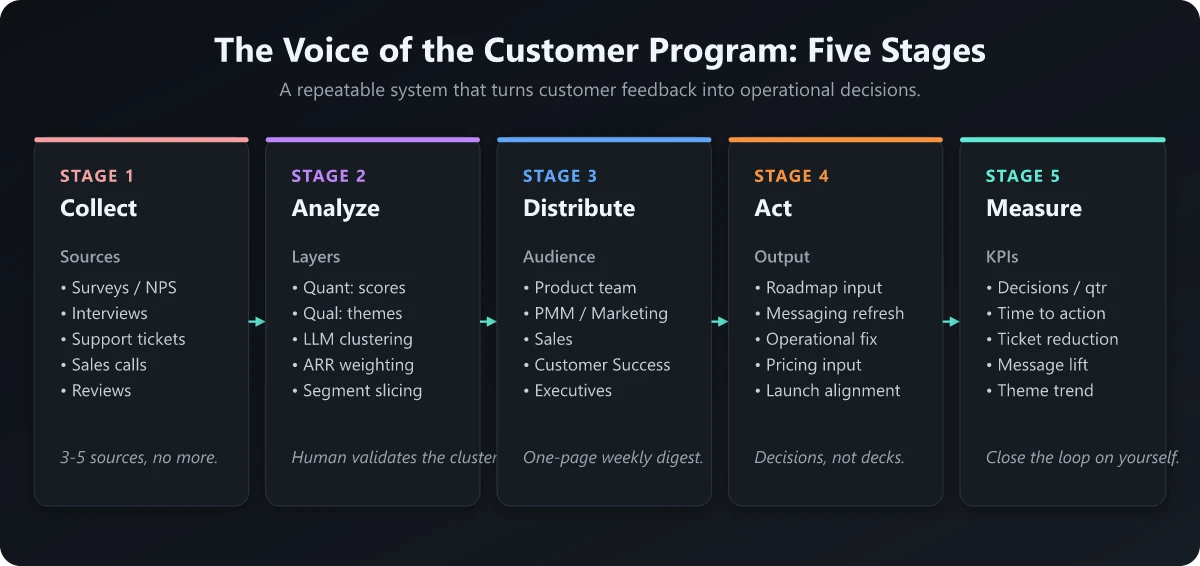
The Five Stages of a VoC Program
Stage 1: Collect
Pick three to five primary sources. More is not better - it means more noise to process without proportionally more signal.
| Source | What it gives you | Cadence |
|---|---|---|
| Post-purchase survey | First-impression friction, expectation gaps | Always-on, sample 10% |
| NPS survey | Loyalty trend, open-ended verbatims | Quarterly cohort |
| Customer interviews | Why decisions were made, mental models | 5-10 per month |
| Support tickets | Recurring pain, undocumented friction | Weekly review of top categories |
| Sales call recordings | Objections, competitor mentions, language | Weekly sample |
| Product usage data | Where customers actually invest time | Continuous, dashboard |
| Public reviews (G2, Trustpilot, App Store) | Unsolicited praise and complaints | Weekly scan |
The biggest unlock for most teams is sales call recordings. Tools like Gong and Chorus already transcribe every call. The recordings sit unused because nobody is assigned to mine them.
Stage 2: Analyze
Two layers - quantitative and qualitative.
Quantitative gives you the trend lines:
- NPS, CSAT, CES (Customer Effort Score)
- Feature adoption rates
- Support ticket volume by category
- Survey scoring distributions
Qualitative gives you the why. Code open-ended responses into themes - “onboarding confusion,” “missing integration,” “pricing surprise” - then count frequency and segment by customer tier.
Modern teams use LLMs to do the first-pass clustering of thousands of comments in minutes. The human job has shifted: it is no longer reading every comment. It is validating that the LLM clustered them into the right categories and catching the rare-but-critical signal that does not fit any cluster.
Stage 3: Distribute
The single biggest failure mode in VoC is the insight sits with the analyst and never reaches the team that can act on it. Build a distribution loop:
| Audience | Format | Cadence |
|---|---|---|
| Product team | Top 5 themes + verbatims, tied to roadmap areas | Monthly |
| Marketing / PMM | Customer language for messaging tests | Bi-weekly |
| Sales | Objections, competitor mentions, win language | Weekly |
| CS | Risk flags by account | Real-time on negative signals |
| Executives | Trend summary, biggest unmet need | Quarterly |
A common pattern: a one-page “VoC digest” emailed weekly with three themes and three customer quotes. It gets read. A 40-slide quarterly deck does not.
Stage 4: Act
Insight without action is the most expensive form of theatre in B2B SaaS. The acting takes three forms:
- Roadmap input - feed themes into the product prioritization process. Not as “the customer asked for X.” As “this theme appears in a meaningful share of negative NPS responses, and weighted by ARR it represents material pipeline risk.” The structure matters more than the exact numbers - tie qualitative theme to quantitative impact.
- Messaging refresh - the language customers use to describe value is the language that converts. Pull verbatim phrases into web copy, sales decks, and ad creative. Most positioning rewrites should start with three weeks of verbatim mining.
- Operational fix - if 14% of tickets are about the same friction, fix the friction. Track which fixes get shipped and how the underlying ticket category responds.
Stage 5: Measure
Close the loop on the program itself. Track:
- Number of decisions tagged “VoC-influenced” per quarter
- Time from signal to action on critical issues
- Reduction in support volume from VoC-driven fixes
- Adoption lift on messaging that used customer language
If the program cannot point at decisions it changed, it is not a program. It is a feed.
VoC Collection Methods That Actually Work
Customer Interviews
The highest-fidelity input. Done right, 8-12 interviews per quarter surface 80% of the strategic themes worth chasing.
Structure: 30 minutes, open-ended, recorded, transcribed. When the customers in question are developers, the question design changes enough to be worth its own instrument: see the developer experience survey question bank. Do not pitch product and do not ask leading questions. Ask the customer to walk you through the last time they used the relevant capability. VoC listens continuously across the whole base; when the goal is narrower, validating one new feature or segment before you commit to it, customer discovery covers how to recruit and run that shorter, sharper round.
The Jobs-to-Be-Done “switch interview” structure works well for VoC. Walk the customer through their last “switch” - the moment they hired your product or replaced an existing solution. To capture the answers in a form the rest of the team can reuse, the jobs to be done template has fields for the competing alternative and the four forces, which is where most switch interviews lose their value:
1. What was happening in your work when you started looking for a solution?
2. What were you actually trying to accomplish - what was the job?
3. What alternatives did you consider, and what almost stopped you from choosing us?
4. What does success with the product look like for you now?
Open-ended, chronological, focused on the customer’s situation - not your product.
When the same handful of accounts is worth hearing from every quarter, that cadence is usually better run as a standing board of named senior customers than as a fresh recruiting scramble before each round.
Surveys
Surveys are good for measuring known things at scale. They are bad for discovering unknowns.
Use them for:
- NPS trend tracking
- CSAT/CES after specific interactions
- Validating hypotheses already formed from qualitative work
Avoid the mistake of running a 30-question survey with the hope that something interesting will fall out. Long surveys reduce response rate and quality. Three questions answered by 800 people beats 30 questions answered by 80.
Mining Existing Channels
Most companies sit on a goldmine of VoC they never read:
- Support tickets - the raw transcript of what is actually broken
- Sales call recordings - the language buyers use, the objections they raise
- Churn exit surveys - the most underused source in SaaS
- Public reviews on G2, Capterra, Trustpilot - unsolicited verbatim by definition
Assigning one PMM hour per week to read 20 random support tickets and 10 sales calls beats any new survey program.
How to Analyze Voice of Customer Data
The analysis layer is where most programs collapse. Here is the workflow that works:
- Centralize the data - dump all sources into one system (a research repo like Dovetail, EnjoyHQ, or even a structured Notion database).
- Tag every input - source, customer segment, ARR band, sentiment, theme. Build a taxonomy of themes that stays stable over time so trends are comparable.
- Cluster open-ended responses - LLMs cut this from days to hours. Run a clustering pass, then have a human review the cluster labels.
- Quantify themes - count frequency per quarter, segment by customer tier, weight by revenue.
- Identify outliers - the rare comment from a high-value account often matters more than the common comment from a low-value one. Do not let frequency-only ranking bury strategic signal.
- Triangulate across sources - a theme that shows up in NPS verbatims, sales calls, and support tickets is real. A theme that shows up in one source is a hypothesis.
The output of analysis is not “here is what customers said.” It is “here are the three themes we believe are most actionable this quarter, here is the evidence, here is what we recommend doing.”
What VoC Looks Like in Practice
Public roadmap and voting portals. Companies like Atlassian and GitLab run public issue trackers where customers vote on bugs and feature requests, comment, and watch threads. The voting data feeds prioritization while the comment threads feed messaging. VoC becomes a continuous, public input rather than a quarterly project.
Always-on in-app feedback. Modern PLG products embed a contextual feedback widget on every page or after key actions. The volume is high. The signal-to-noise ratio is lower than interviews, but the freshness and specificity is unmatched - you find out about the broken empty state on the integrations page the day it breaks, not at the next NPS cycle.
Synthesised digests to leadership. The companies that make VoC load-bearing send a short, written digest of the top themes - with verbatim customer quotes - to product, marketing, sales, CS, and the exec team on a weekly cadence. The exec team starts asking about the themes, and the themes start showing up in roadmap reviews. VoC stops being a slide deck and starts being how decisions get made.
The pattern across all three: VoC is not a survey program. It is a habit of reading what customers say and do, then making that signal visible inside the company.
VoC for Product Marketers
PMMs sit at the intersection of customer language and product decisions. The VoC angles to own:
- Win-loss analysis - the structured VoC discipline applied to deals. Why we won, why we lost, in the customer’s own words. Covered in detail in the win-loss analysis playbook.
- Messaging verbatim library - the bank of customer phrases that goes into web copy, sales decks, ads, and emails.
- Positioning signal - what customers actually compare you against, in their own words, often differs from your competitive map.
- Launch readiness - before a launch, run a short VoC sweep to test message resonance with five customers in the target segment. Saves expensive launches that miss.
For more on how PMMs use customer input in strategy, see what does a product marketing manager do.
Common VoC Pitfalls
| Pitfall | Why it happens | Fix |
|---|---|---|
| Survey fatigue | Too many surveys, each too long | Consolidate. Three high-signal surveys, none over 5 questions |
| The vocal minority | Loud customers shape decisions disproportionately | Always segment feedback by ARR, tier, and recency |
| Insight that never ships | No distribution loop | Weekly digest, named owner per audience |
| Feature factory triggered by VoC | ”Customers asked for X” treated as roadmap | Translate requests into underlying jobs |
| One-off projects | VoC treated as a quarterly study | Always-on program with a cadence |
| Confirmation bias in analysis | Analyst finds what they expected to find | Use blind coding, multiple reviewers on critical themes |
Building Your First VoC Program in 30 Days
If you are starting from zero, here is the 30-day build:
Week 1 - Pick three sources. Suggested: NPS, support tickets, sales calls. Assign one owner.
Week 2 - Build the theme taxonomy. Categories you will use to tag everything. Keep it under 20.
Week 3 - Run the first analysis pass. Cluster, quantify, identify the top three themes.
Week 4 - Ship the first weekly digest: one page, three themes, three customer quotes. Send to product, marketing, sales, CS, and the exec team.
After 90 days you will have enough trend data to talk about whether themes are growing, stable, or declining. After 180 days you will have your first set of “we shipped X because VoC said Y, and the result was Z” stories. That is the moment the program becomes load-bearing.
Conclusion
Voice of the customer is not a survey, a deck, or a tool. It is the discipline of making customer reality the loudest voice in the room - louder than executive intuition, louder than sales escalations, louder than the team’s pet theories. Companies that build a working voice of the customer program out-decide companies that don’t, on roadmap, messaging, and pricing.
Start small: three sources, one owner, weekly cadence, one-page digest. Then expand once the loop is producing decisions you can point at. VoC is the lowest-cost competitive advantage in B2B SaaS - and the most consistently ignored.
Frequently Asked Questions
What is voice of the customer?
Voice of the customer (VoC) is the structured discipline of collecting, analyzing, and acting on customer feedback - what they want, what frustrates them, what they expect. It pulls from surveys, interviews, reviews, support tickets, sales calls, and product usage, then distributes the insight to the teams that can act on it.
What is a voice of the customer program?
A VoC program is the operational system that makes customer feedback repeatable - defined sources, a regular cadence, an owner, an analysis method, and a distribution loop to product, marketing, sales, and CS. Without the program wrapper, VoC becomes a one-off project that decays after the first deck.
How do you analyze voice of customer data?
Combine quantitative scoring (NPS, CSAT, CES) with qualitative coding of open-ended responses. Group themes, count frequency, segment by customer tier or use case, then weight by revenue impact. Modern teams use LLMs to cluster thousands of comments in minutes, but a human still validates the categories.
What is the difference between VoC and market research?
Market research is broad - it looks at the market, the category, prospects, and non-customers. VoC is narrower and continuous - it focuses on existing customers and recent buyers, runs always-on rather than as discrete studies, and feeds operational decisions rather than strategic ones.
Who owns voice of the customer?
It depends on the company stage. In early-stage SaaS, product marketing or the founder usually owns it. In mid-market, customer experience or research teams. In enterprise, a dedicated CX or Insights team. The non-negotiable: one named owner who synthesizes the input across channels - not five teams each running their own surveys in isolation.