What Are Brand Guidelines? Brand Book and Voice Examples
Brand guidelines explained: the 12 sections every brand book needs, how to define a brand voice writers can use, and what a modern brand book looks like now.
Lucidpress’s State of Brand Consistency report found that companies with consistent branding can see up to 33% more revenue. The strongest brands look, sound, and behave the same whether you encounter them on a billboard, a customer support reply, or a recruiter’s LinkedIn message. That consistency is not accidental - it is documented, distributed, and defended by a system called brand guidelines.
This guide explains what brand guidelines are, what a brand book includes in 2026, how to define brand voice (and find your own), and the 12-section structure every working brand uses.
What Are Brand Guidelines?
Brand guidelines are the documented rules for how a brand expresses itself across every touchpoint. A working set covers four expression layers:
- Visual - logo, color, typography, photography, iconography, motion
- Verbal - voice, tone, messaging, naming
- Behavioral - how the brand shows up in product UX, customer support, hiring
- Strategic - positioning, values, audience, the underlying “why”
The output is a single source of truth that lets a new designer, writer, or contractor produce work on-brand without a kickoff call. The point is not to constrain creativity. It is to make consistency cheap.
A brand without guidelines pays a tax on every asset. The agency redoes the logo. The copywriter invents a new tagline. The product designer picks a new gray. Multiply that by 100 assets a quarter and the cost is real.
What Is a Brand Book?
A brand book is the document that holds the brand guidelines. The terms are used interchangeably in practice. The format has changed:
- Old format: static PDF, 60-page deck, lives on a shared drive, updated annually
- New format: web-based hub (Notion, Frontify, internal docs site), continuously updated, linked from every brief and every Figma file
The web-based version wins on three dimensions. It updates without versioning. It serves as the searchable reference instead of a thing to skim once. It links cleanly into design tools and CMSs.
For a small brand, a single Notion page with the 12 sections below is enough. For a multi-product company, a dedicated brand site is worth the build cost.
The 12 Sections Every Brand Book Needs
After auditing dozens of brand books at companies from Stripe to one-person SaaS, the same 12 sections show up in every working version.
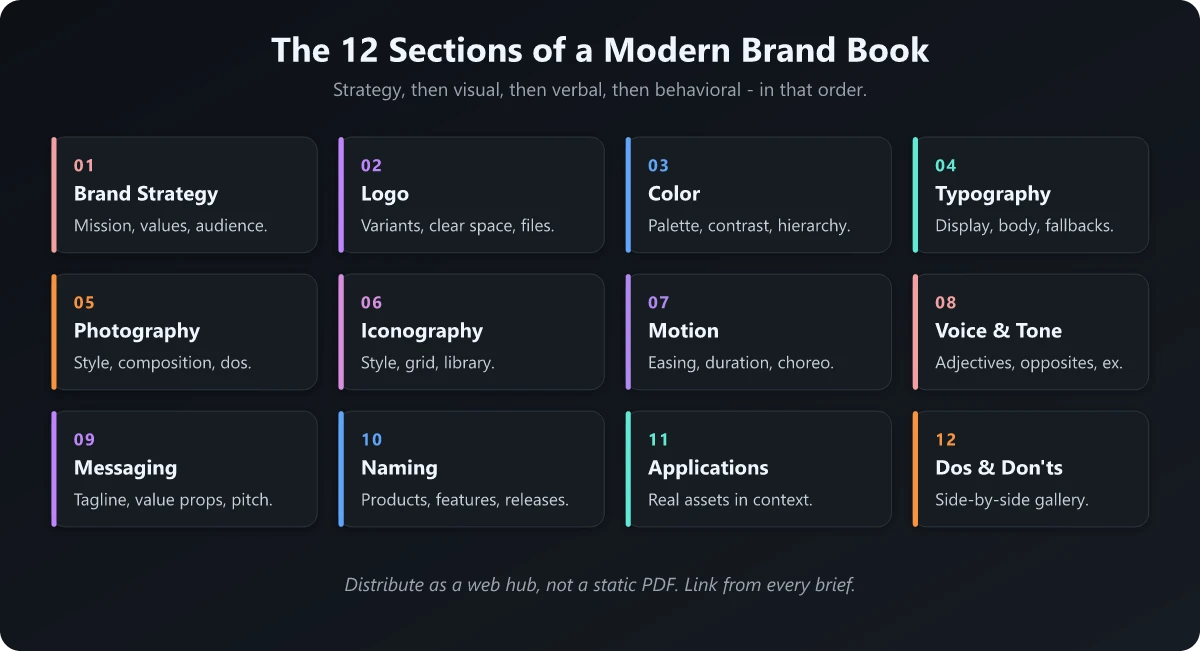
1. Brand Strategy
The “why” before the “how.” Includes mission, vision, values, audience, and positioning. One page is enough. The job is to make sure every visual and verbal decision downstream rolls up to a strategic intent.
2. Logo
Primary logo, monochrome variants, clear space, minimum size, what not to do (stretching, recoloring, adding effects). Include downloadable file formats - SVG, PNG at multiple sizes, EPS for print. If the logo includes a character, say how far it can change: in one of the recent campaigns that reset a brand mascot, KFC’s revamped logo swapped the Colonel’s usual grin for a scowl.
3. Color
Primary palette (3-5 colors), secondary palette (5-10 colors), accessibility notes (which color combinations meet WCAG AA contrast), and a usage hierarchy (when to use primary vs secondary). Hex, RGB, CMYK, Pantone for print.
4. Typography
Display font and body font (rarely more than two), weights, sizes, line heights, web fallbacks. Show real examples - a headline, a body paragraph, a UI label - not just the alphabet.
5. Photography and Illustration
The visual language for imagery. Include 6-10 example images that represent the look, plus dos and don’ts. Are people in frame? Looking at camera or away? Color-graded warm or neutral? Studio or environmental?
6. Iconography
If your brand uses icons, define the style (outlined vs filled, stroke width, corner radius, grid). Include the actual icon library or a link to it.
7. Motion
For brands with any video or animated UI work: motion principles (easing, duration, choreography), reusable transitions, and a “what we never do” list.
8. Voice and Tone
The linguistic personality. Voice adjectives, tone shifts by context, voice charts. Detailed below.
9. Messaging Architecture
Tagline, value propositions per audience, key messages by funnel stage, elevator pitch versions (10 words, 30 words, 90 seconds). For the underlying value prop work, see What Is a Value Proposition.
10. Naming Conventions
How to name products, features, releases, internal teams. Why this matters - inconsistent product names are a daily friction in marketing and engineering. Write these rules before the next launch needs them, since naming a product is mostly an elimination process across trademark, domain, category and search occupancy rather than a brainstorm.
11. Applications
Real examples of the brand in context: homepage hero, ad creative, sales deck, business card, T-shirt, conference booth. Showing applications closes the gap between abstract rules and “what does this actually look like.”
12. Dos and Don’ts
A side-by-side gallery of right vs wrong examples. The single most-used section by anyone making real assets. Keep it ruthlessly current.
What Is Brand Voice?
Brand voice is the consistent personality your brand uses in language across every channel. It is how you say things, not what you say.
A useful distinction:
- Voice is fixed. It does not change between a homepage hero and a security incident email.
- Tone shifts with context. The same voice can sound serious during a security comms email and playful in a social post.
- Messaging is what you say. The points, claims, and stories the brand makes.
A brand can have great messaging and a weak voice. Readers feel the writing was produced by a marketing committee rather than a person. That feeling tanks trust faster than any factual claim.
How to Find Your Brand Voice
The exercise that works in three steps.
Step 1: Pick 4-5 Adjectives
Write down 4-5 adjectives that describe the brand personality. Examples: confident, direct, warm, expert, irreverent, precise, plainspoken, generous.
The constraint: 4-5 maximum. A brand that wants to be eight things is none of them.
Step 2: Add the Opposite
For each adjective, write what it is not. The opposites make the rule concrete.
| We are… | We are not… |
|---|---|
| Confident | Arrogant |
| Direct | Blunt |
| Warm | Sappy |
| Expert | Academic |
| Irreverent | Snarky |
The opposite test prevents the universal failure mode of voice charts: vague adjectives that mean different things to different writers.
Step 3: Write Real Examples
For each adjective, write three sample sentences in three real contexts:
- A homepage headline
- An error message in the product
- A reply to a customer support ticket
Now writers and designers have a reference, not a theory. The brand voice exercise that ends at “we’re confident, direct, and warm” produces inconsistent copy. The one that ends with example sentences across real surfaces produces voice that holds up.
Brand Voice Examples Worth Studying
Five public brands whose voice is documented or recognizable enough to learn from.
| Brand | What is distinctive |
|---|---|
| Mailchimp | Casual, witty, never at the user’s expense. The voice and tone documentation is the gold standard. |
| Linear | Confident, technical, terse. Every word is a craft choice. |
| Slack | Warm, human, occasionally playful. The product copy is famously good. |
| GOV.UK | Plain, calm, accessible. The published guidance explicitly tells writers to target a 9 year old reading age - genuinely the opposite of corporate. |
| Apple | Confident, optimistic, declarative. Almost no hedging language. |
Steal the principle, not the words. A B2B fintech that copies Mailchimp’s voice will sound off-brand by the second sentence.
Brand Tone: How to Shift Without Losing Voice
Tone shifts with context while voice stays fixed. A useful tone matrix lists 5-8 common contexts and the tonal adjustments for each.
| Context | Tone shift |
|---|---|
| Marketing landing page | Confident, energetic |
| Onboarding email | Warm, encouraging |
| Error message | Calm, helpful, never blaming the user |
| Security incident comms | Serious, factual, no marketing language |
| Social media | Playful, in-the-moment |
| Sales follow-up | Direct, respectful of time |
| Support reply | Patient, plain, solution-focused |
| Recruiter outreach | Warm, specific to the candidate |
Build the matrix once. Reference it in every writing brief. Tone drift is the most common failure of brands that nailed voice and then handed off the writing.
Common Brand Guidelines Mistakes
After audits, these are the recurring failure modes.
- Visual-only guidelines. A 40-page deck on logo and color and zero pages on voice. Missing the verbal layer halves the value.
- Static PDF. The PDF is out of date the day it ships. Web-based or it does not get used.
- No examples. Rules without examples are theory. Every section needs at least 2-3 real applications.
- Built without distribution. A brand book that sits on a shared drive is not a brand book. It needs to be linked from every brief, every Figma file, every onboarding doc.
- Frozen voice. A brand that wrote its voice doc in 2019 and never updated it sounds 2019 in 2026. Voice should be reviewed annually.
The Brand Guidelines Workflow
A working brand guidelines program is not just a document - it is a workflow.
- Source of truth. One web hub. Linked from everywhere.
- Quarterly review. Brand owner walks through the doc, removes stale sections, adds new applications.
- Brief integration. Every creative brief - design, copy, video, social - links the relevant sections.
- Ship-time review. A “brand check” step in the workflow before any high-visibility asset goes live.
- Annual refresh. A bigger review every 12 months. Update voice examples, refresh the dos and don’ts gallery, retire applications no longer relevant.
The teams that compound brand strength run all five steps. The teams that ship guidelines and stop produce a document, not a brand.
If your team designs in Claude Design, the guidelines hub doubles as an input: Claude Design can build a brand design system from brand files in chat, and Anthropic’s setup guide says a finished landing page tells Claude more about a brand’s feel than a color palette alone, so upload real pages next to the guidelines.
For the broader strategic frame, see What Is Market Positioning and Product Positioning.
The Bottom Line
Brand guidelines are infrastructure. They make every downstream asset cheaper, faster, and more consistent. The cost of not having them shows up not in any single piece of work but in the cumulative inconsistency across hundreds of pieces - each one slightly off, each one slightly diluting recognition.
The brands that show up the same everywhere are the brands buyers remember. Document the rules, distribute the doc, defend it against the daily small drift. The compounding is the point.
Frequently Asked Questions
What are brand guidelines?
Brand guidelines are the documented rules for how a brand looks, sounds, and behaves across every touchpoint. A working set covers logo usage, color, typography, photography, iconography, motion, voice and tone, messaging, and the dos and don'ts of how the brand shows up in product, marketing, and HR.
What is a brand book?
A brand book is the document that holds the brand guidelines. The terms are used interchangeably. A modern brand book is rarely a static PDF anymore - most teams ship it as a web-based hub (Notion, Frontify, internal site) so it can be updated and linked from every brief.
What is brand voice?
Brand voice is the consistent personality your brand uses in language across every channel. It is not what you say (that is messaging) - it is how you say it. Voice is fixed; tone shifts with context. A brand might have a confident voice but a serious tone in security comms and a playful tone in social copy.
How do you find your brand voice?
Three steps. One, write down 4-5 adjectives that describe the brand personality (e.g., confident, direct, warm, expert, irreverent). Two, for each, write the opposite to make it concrete ('confident, not arrogant'). Three, write three sample sentences for each in real contexts (homepage hero, error message, support reply) so writers have a reference, not a theory.
How long should a brand guidelines document be?
Long enough to remove ambiguity, short enough to read. Most working brand books land between 30-80 pages or screens. Below 30 pages, writers and designers end up asking the same questions on every brief. Above 80, nobody reads it. The sweet spot is the minimum length that lets a new contractor ship on-brand work without a kickoff call.