What Is a GTM Engineer? Role, Skills, and Salary (2026)
What is a GTM engineer? A PMM's guide to what they actually do, the skills and salary, how to become one, and how the role differs from RevOps.

What is a GTM engineer? A GTM engineer builds and automates the systems that run a company’s go-to-market. They connect the CRM, sales tools, and data sources with code, APIs, and AI so revenue teams run faster. Sitting between RevOps and software engineering, they turn go-to-market strategy into working, automated pipelines instead of manual busywork.
The first time I watched a GTM engineer do their thing, they built in an afternoon a lead-routing and enrichment workflow that my marketing team had been asking for over a full quarter. I am a product marketer, not a GTM engineer, but I work next to this function every week, and I have a strong opinion after watching it emerge: the vendor guides describe the GTM engineer as a job title, when it is really a shift in who gets to turn go-to-market ideas into working systems. This guide is the practical version - what the role does, what it pays, and how to move into it - written from the seat right next to it.
What Is a GTM Engineer, Exactly?
A GTM engineer is a technical operator who designs and automates go-to-market systems end to end. Where a traditional marketer or sales rep files a ticket and waits, the GTM engineer opens the API docs and ships the thing.
The role sits at a specific intersection:
- From RevOps, they take the context: how the funnel works, what a good lead looks like, where the revenue leaks are.
- From software engineering, they take the method: code, APIs, data pipelines, and now AI agents.
The output is leverage. One capable GTM engineer can remove weeks of manual work from a sales and marketing org by wiring the stack together so data flows and actions trigger without a human copying rows between tabs.
What Does a GTM Engineer Actually Do?
Day to day, the work is less “campaign” and more “plumbing plus automation.” A typical week includes:
- Building enrichment and routing pipelines - pulling data from providers, scoring it, and pushing clean, assigned leads into the CRM automatically.
- Wiring tools together - connecting the CRM, sales-engagement platform, data vendors, and analytics through APIs so they act as one system.
- Shipping internal tools - small apps and scripts that do a repetitive revenue task at scale.
- Deploying AI in the workflow - using models to qualify, personalize, or summarize inside an automated pipeline, not as a toy on the side.
- Owning data hygiene at the source - fixing the pipeline that creates bad data instead of cleaning it by hand later.
If you want the strategy layer these systems are meant to serve, that is the go-to-market strategy for startups playbook. The GTM engineer is who makes that strategy run without an army of manual operators.
GTM Engineer vs RevOps: Build vs Run
This is the comparison people get stuck on, so here is the clean version. The shorthand is build versus run.
| Dimension | GTM engineer | RevOps |
|---|---|---|
| Core mode | Builds new systems | Runs and governs existing ones |
| Output | Automated workflows, pipelines, internal tools | Clean CRM, forecasting, process, SLAs |
| Core skill | Code, APIs, SQL, AI automation | Process design, reporting, governance |
| Question they answer | ”Can we automate this?" | "Is the revenue engine accurate and predictable?” |
| Fails when | It automates a process nobody validated | It maintains a stack but never improves velocity |
RevOps keeps the revenue machine accurate and predictable. The GTM engineer builds new machinery on top of it. Most companies need RevOps first and add GTM engineering once the manual workload outgrows what governance alone can fix. They are complementary, not competing.
GTM Engineer Skills
The skill set is a specific blend, and the technical half is what separates the title from a classic ops role. The core stack:
- SQL and data fluency - querying, joining, and shaping data is the daily bread.
- Working with APIs - reading docs, making requests, and handling responses without hand-holding.
- A CRM data model - deep fluency in Salesforce or HubSpot objects, fields, and automation.
- An automation and AI layer - tools like Clay and n8n plus LLMs to build workflows that run unattended.
- Systems thinking - mapping a process end to end before automating it, so you do not scale a broken one.
- GTM business sense - understanding ICP, lead scoring, outbound, and deliverability, so the automation serves revenue.
That last point is the one I would underline. The failure mode I see most is a technically strong build that automates a process no one validated. The best GTM engineers earn the “GTM” half of the title, not just the “engineer” half.
GTM Engineer Salary
Compensation reflects that demand is running ahead of supply. Reporting on the role puts GTM engineering salaries in the low-to-high six figures, varying with experience and market. Because the title is new and the skill blend is rare, comp tends to sit above comparable sales-ops or marketing-ops roles at the same level. The scarcity is the leverage.
How to Become a GTM Engineer
You rarely start here. Most GTM engineers arrive from an adjacent seat and add the technical layer.
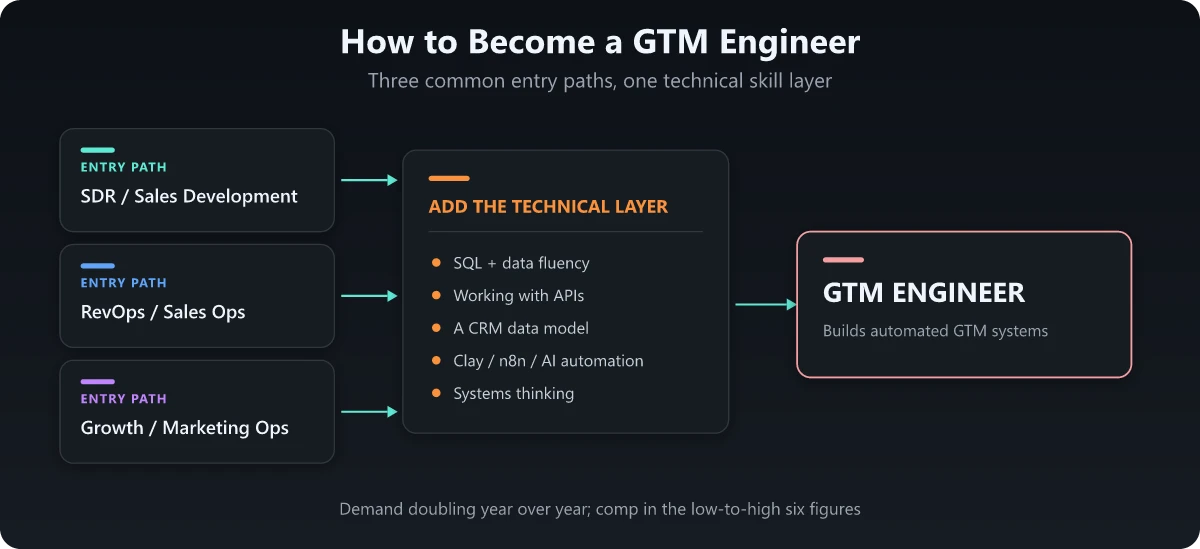
The common entry paths:
- SDR or sales development - you know the outbound motion, so you learn to automate it.
- RevOps or sales/marketing ops - you have the systems context, so you add the code.
- Growth or marketing ops - you know the funnel, so you learn to build on it.
The build order that actually works:
- Learn the data layer - SQL first, then how to read an API and make requests.
- Master one CRM’s data model - HubSpot or Salesforce, deeply.
- Pick up an automation stack - Clay, n8n, and AI tooling, learned by building.
- Ship real projects - a lead-scoring workflow, an enrichment pipeline, a routing system. Then show the outcome.
The last step is the whole game. A proof-of-work portfolio beats a stack of certifications, because the role is judged on systems that work. If you are weighing this against a more conventional path, my take on choosing a marketing career applies here too: I wrote it up in is product marketing a good career.
Why the GTM Engineer Role Is Exploding
The demand is not hype, it is in the postings. LinkedIn listed over 1,400 GTM engineering roles in mid-2025 and over 3,000 by January 2026, and the same reporting cites ZoomInfo data showing hiring for the role has doubled year over year for the last two years.
The reason is structural. Most B2B companies now run dozens of tools across sales, marketing, and customer success, and someone has to make them work as one system. AI made the automation ceiling much higher, and the person who can combine business context with the technical build is suddenly the highest-leverage hire on the revenue team. From my seat in product marketing, it has changed what I can ship: ideas that used to die in a backlog now become working systems in days.
The Takeaway
So, what is a GTM engineer? Not just a new title on the org chart. It is the person who finally closes the gap between a go-to-market idea and a system that executes it, by pairing revenue context with real technical build skill. RevOps runs the engine; the GTM engineer builds new parts for it; and the whole revenue team moves faster because of it.
If you are in an ops or SDR seat and drawn to the build, this is the highest-leverage move on the board right now: add the data and automation layer, ship real projects, and step into a role where demand is doubling every year and supply has not caught up. And if you are a marketer like me, the practical response is simpler - find your GTM engineer, and stop filing tickets for things you could ship together.
Frequently Asked Questions
What is a GTM engineer?
A GTM engineer builds and automates the systems that run a company's go-to-market. They connect the CRM, sales tools, and data sources with code, APIs, and AI so revenue teams move faster. Sitting between RevOps and software engineering, they turn go-to-market strategy into working automated pipelines instead of manual busywork.
What is the difference between a GTM engineer and RevOps?
RevOps runs and governs the existing revenue engine: CRM hygiene, forecasting, process, and SLAs. A GTM engineer builds new systems on top of it: automated workflows, data pipelines, and internal tools. The shorthand is build versus run. RevOps keeps the machine accurate and predictable; the GTM engineer ships new machinery.
How much does a GTM engineer make?
Salaries for GTM engineering roles range from low to high six figures depending on experience and market, per corridorcareers reporting on the role. Because the title is new and demand outpaces supply, comp tends to sit above comparable sales-ops or marketing-ops roles at the same level.
How do you become a GTM engineer?
Most people come in from sales development, RevOps, or growth/marketing ops, then add the technical layer: SQL, working with APIs, a CRM data model, and an automation stack like Clay or n8n plus AI tooling. The fastest route is building real projects (a lead-scoring workflow, an enrichment pipeline) and showing the outcomes, not collecting courses.
Do GTM engineers need to know how to code?
Yes, at a practical level. You do not need to be a full software engineer, but you need to read API docs, write scripts and SQL queries, and wire tools together with automation platforms and AI. The bar is building working systems, not passing a computer-science interview.