What Is Product-Market Fit? How to Measure It (2026)
Product-market fit explained: the four signals that predict PMF, the disappointment survey, how to measure it, and the playbook for getting there.

CB Insights’ analysis of 431 failed VC-backed startups found that 43% cited poor product-market fit as a top reason for failure - second only to running out of capital, which is usually a downstream symptom of the same problem. Product-market fit is the most discussed and least measured concept in early-stage SaaS. The phrase gets used to claim a state that has not arrived, defend a strategy that is not working, and pitch investors on traction that does not exist.
The honest definition is harder than the famous one: PMF is the state where the market pulls the product harder than the team pushes it. The signals that tell you are there are not opinions - they are observable in your data.
What follows: what product-market fit really means, the four leading signals that predict it, the disappointment survey in detail, how to measure PMF with the data you have, and the playbook for getting there if you have not yet.
What Is Product-Market Fit?
Product-market fit (PMF) is the stage at which a product satisfies a strong market demand. The shortest working definition: PMF is when the market pulls the product out of the team faster than the team can build it.
Sales close themselves and users invite other users. Retention curves flatten rather than decay to zero. The team stops debating whether the product is good enough and starts debating whether they can keep up.
Before PMF, every growth motion is friction. After PMF, every growth motion is amplification. The distinction is not subtle - but it is segment-specific, which is what makes it hard to measure on the aggregate.
Product-Market Fit vs Problem-Solution Fit vs Product-Channel Fit
The terms get used interchangeably. They are sequential stages.
| Stage | Question it answers | Evidence |
|---|---|---|
| Problem-solution fit | Is the problem real, and does our specific solution resolve it for early users? | Customer interviews, prototypes used willingly, early users return |
| Product-market fit | Does the market want what we built, repeatedly and at scale? | Retention curves flatten, organic acquisition, meaningful “very disappointed” share, sales cycles compress |
| Product-channel fit | Can we acquire those customers profitably and repeatably? | CAC/LTV stable, payback under 12-24 months, channel does not require constant artificial boost |
The mistake most teams make: jumping to optimizing channels before PMF. If retention is not solid, more top-of-funnel makes the leaky bucket leak faster. Fix PMF first.
The Four Signals That Predict Product-Market Fit
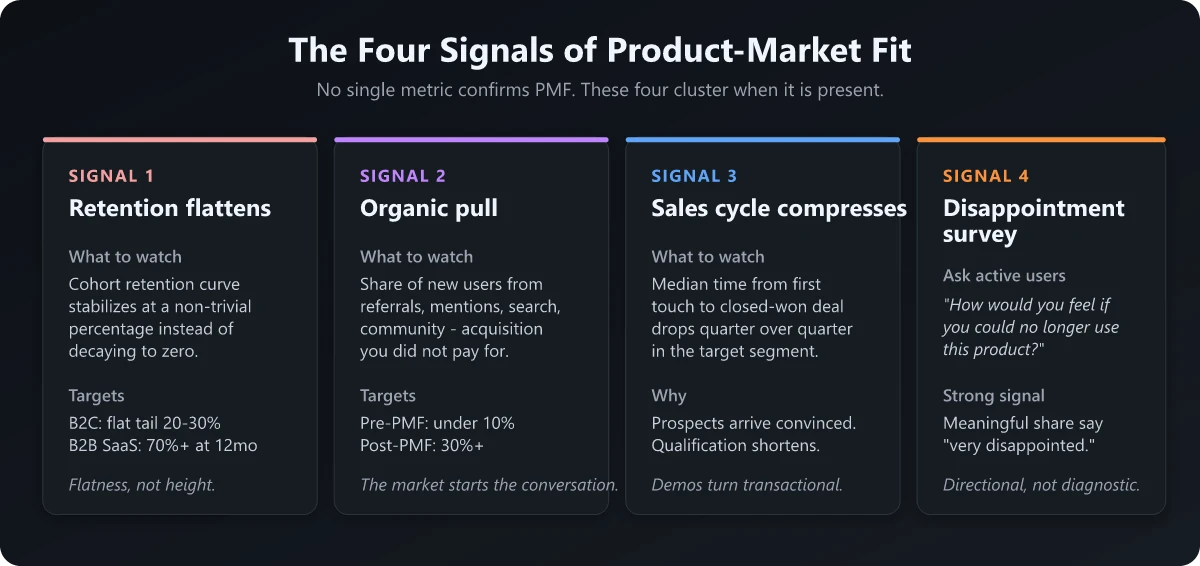
There is no single number that confirms PMF. There are four signals that cluster when it is present.
Signal 1: Retention Curves That Flatten
Plot weekly or monthly retention by cohort. If the curve decays to zero, you do not have PMF. If the curve flattens at a non-trivial percentage and stays there, you have a core audience that finds repeat value.
The flatness is the signal - it does not have to be high. For consumer apps, a flat tail at 20-30% is strong; for B2B SaaS, 70%+ logo retention at 12 months. The number varies by category, but flatness is the universal cue.
Most pre-PMF teams obsess over the height of the curve in week 1. Post-PMF teams obsess over whether the curve flattens at all.
Signal 2: Organic Word-of-Mouth Growth
If a meaningful share of new users come through invites, mentions, or referrals you did not pay for, the market is doing work for you. The shift is qualitative as well as quantitative - inbound starts arriving without you starting it, and the team notices the change before any dashboard does.
Quantify it: what percentage of new sign-ups or new opportunities cite a referral, a peer, a podcast mention, or a tweet? Pre-PMF, that number is usually under 10%. Post-PMF, it routinely passes 30%.
Signal 3: Sales Cycle Compression
For B2B, watch the sales cycle. Pre-PMF, deals stretch as prospects question whether the problem is worth solving. Post-PMF, deals compress as prospects arrive already convinced.
The qualification call gets shorter. The demo gets more transactional. The pricing question moves from “is this worth it” to “what tier do we need.”
Track median sales cycle by quarter. A consistent downward trend, especially when combined with growing deal size, is one of the cleanest PMF signals available.
Signal 4: The Disappointment Survey
The most widely used PMF survey in modern SaaS asks active users a single question with four fixed response options:
How would you feel if you could no longer use this product?

  ( ) Very disappointed
  ( ) Somewhat disappointed
  ( ) Not disappointed (it isn't really that useful)
  ( ) N/A - I no longer use it
The working heuristic: when a meaningful share of engaged users answer “very disappointed” - typically around four in ten in the target segment - the product has likely reached PMF for that segment.
Two caveats most teams miss:
- Survey only active, engaged users. Filter to users who used the product in the last 14-30 days and engaged with the core action. Mixing in casual signups pollutes the signal.
- The result is directional, not diagnostic. A single percentage point below or above the threshold does not flip the verdict. Use the result as a triangulation point with retention and organic growth, not as a binary.
How to Measure Product-Market Fit With the Data You Have
Most early-stage teams do not have enough sample size for clean cohort analysis. Use whatever data you do have:
| Available data | What to measure | What to look for |
|---|---|---|
| 50+ active users | Run the disappointment survey | Around four in ten “very disappointed” in target segment |
| Daily/weekly product usage | Retention curves by cohort | Flattening, not decay to zero |
| Pipeline (B2B) | Sales cycle length, win rate, deal size | Cycles compressing, win rates climbing in target ICP |
| Net Revenue Retention (SaaS) | Expansion vs churn | Net retention above 100% means the customer base is growing without new logos |
| Customer interviews | What users say when product disappears for an hour | Strong reactions = strong fit |
| Organic acquisition share | New users from non-paid sources | Trend up, even with paid pulled back |
The most honest test most teams skip: stop all paid acquisition for two weeks. If growth continues, you have organic pull. If it stops, you were renting growth. The result is a clean PMF read.
Why Product-Market Fit Is Segment-Specific
The single most common PMF mistake: averaging across all customers. PMF is rarely uniform. You usually have it for one segment and not for others.
Slice your data by:
- Company size band (SMB, mid-market, enterprise)
- Industry vertical
- Use case (the job they hired you for)
- Acquisition channel (organic vs paid vs referral)
You will often find a “PMF segment” - the slice of customers where retention is high, expansion is strong, and the disappointment score is well above the average. Then a long tail where PMF is weak. Writing that segment’s jobs, pains, and gains down on its own is what keeps the finding usable, so build one canvas per slice rather than a blended one - the moment you merge them, the strong fit disappears back into the average.
The strategic decision: double down on the PMF segment, or invest to win the others. Both can be right. Pretending the average is uniform is always wrong.
This is the same lens covered in ICP vs buyer persona - segment-level fit is the foundation for everything downstream in PMM.
How to Get to Product-Market Fit
There is no playbook that works for every company. There is a pattern:
1. Pick a Sharp ICP
Pre-PMF, your ICP should be narrower than feels comfortable. Specific industry, specific company size, specific job title, specific use case. Vague ICPs produce vague products that fit nobody.
2. Build for Burning Problems
Pre-PMF, the only problems worth solving are the ones the customer is willing to pay for today. “Nice-to-have” features pre-PMF are a tax. Ship the smallest version of the burning solution, then iterate from real usage.
3. Run Continuous Voice of Customer
Pre-PMF teams ship more not because they engineer faster but because they decide faster. They read what customers say in a continuous voice of the customer loop, watch what customers do in product, and pick the next thing to build with high signal. Customer interviews, support tickets, and usage data feed every iteration.
Teams past their first PMF have the opposite problem: plenty of customers to ask, and a strong prior about what the answer should be. Running customer discovery when you already have customers is mostly a discipline of not leading the witness, because the accounts closest to hand are the ones most likely to agree with you.
4. Measure Retention From Day One
Build the retention dashboard before you have retention. Once cohorts start, you will see the curve early - and adjust the product faster than competitors who measure only sign-ups.
5. Resist Pre-PMF Optimisation
Conversion rate optimisation, paid acquisition scaling, sales team build-out, brand campaigns - all of these are post-PMF activities. Doing them pre-PMF wastes capital and obscures the real signal.
6. Test the Pivot Threshold Every Quarter
If after a quarter of focused work, the four signals are not trending up, change something material - the segment, the wedge feature, the model. Pre-PMF, time is the asset you are spending. Do not spend another quarter doing the same thing if the signals are not moving.
What the PMF Pattern Looks Like in Practice
The companies that find PMF cleanly follow a recognisable pattern:
They identify a specific behaviour that predicts retention. Not a vanity metric like “weekly active users,” but a specific, measurable action - the integration connected, the report shared, the first project published. Once they find that behaviour, every onboarding decision, every email sequence, every in-app nudge points toward it.
They find PMF in a segment before they find it in a market. The disappointment score, the retention curve, and the organic acquisition share all look stronger inside a specific use case or customer type before they look strong in aggregate. The team that recognises this and doubles down on the segment compounds. The team that averages across all customers stays stuck.
They resist scaling acquisition until retention holds. Pre-PMF growth spend hides the leaky bucket. Pausing paid for two to four weeks and watching what happens to the curve is the cheapest, most honest read available.
The reverse pattern is just as recognisable: teams that ship feature after feature without retention moving, that chase paid acquisition while churn climbs, that point at sign-up totals while net revenue retention stays flat. Those are the pre-PMF tells.
What Comes After PMF
PMF is not the finish line. It is the starting line. Post-PMF, the work shifts:
- Channel scaling - figure out which acquisition channels work at scale (product-channel fit)
- Pricing optimisation - capture more of the value you are creating (see the pricing strategy playbook)
- Expansion - move from one segment to two, with intentional positioning per segment
- Defensibility - moats become real once growth is real
Most companies stall post-PMF by trying to scale before product-channel fit is solid. The discipline carries: pick a channel, prove it works, then add the next. Channel scaling is also where teams quietly swap a growth mandate for an ad budget, so decide early which of that work is paid acquisition and which is lifecycle experimentation.
Common PMF Mistakes
| Mistake | Why it happens | Fix |
|---|---|---|
| Claiming PMF on vanity metrics | Sign-ups, downloads, registrations | Use retention, organic share, and the disappointment survey |
| Measuring across all users instead of target segment | Easier to compute the average | Always segment by ICP and use case |
| Treating PMF as binary | Yes/no thinking | PMF is a spectrum and is segment-specific |
| Scaling acquisition pre-PMF | Pressure to show growth | Hold paid flat until retention is solid |
| Assuming PMF is permanent | Companies that hit PMF and coast | Re-test the four signals quarterly |
| Pivoting too fast | Reading noise as signal | Give a focused effort 60-90 days before judging |
The PMF Survey in Practice
If you want to run the disappointment survey today, the workflow:
- Define “active user” - someone who used the product in the last 14-30 days and completed the core action at least once.
- Send the survey to a representative sample (200+ if available, otherwise the full active list).
- Use exactly the four response options. Do not add a five-point scale.
- Segment results by ICP, industry, use case.
- Look at the segment, not the average. Find the highest-PMF segment.
- For “very disappointed” responses, follow up with an open-ended question: “What is the main benefit you would lose?” The answers become your messaging library.
The follow-up question is where the survey pays for itself. Customers in their own words describing why they need you is the most usable PMM artifact you can produce.
Conclusion
Product-market fit is not a metric. It is a state where the market pulls harder than the team pushes.
The four signals - retention flattening, organic word of mouth, sales cycle compression, and a meaningful share of “very disappointed” responses - cluster when PMF is present. The mistake is to wait for one definitive number; the discipline is to measure all four, segment them, and decide based on the cluster.
Pre-PMF, every optimisation is wasted effort on a leaky bucket. Post-PMF, every optimisation compounds. The strategic question is not “what should we build next” but “are we in PMF for the segment we are betting on - and if not, what is the smallest change that gets us there.”
Frequently Asked Questions
What is product-market fit?
Product-market fit (PMF) is the stage where a product satisfies a strong market demand - customers buy it without heavy persuasion, retain at high rates, and tell others about it. A working definition: PMF is the state where the market pulls the product out of the team faster than the team can build it.
How do you know you have product-market fit?
There is no single number, but the signals cluster: organic word-of-mouth growth, retention curves that flatten rather than decay to zero, shrinking sales cycles, and a meaningful share of engaged users saying they would be 'very disappointed' if the product disappeared. If you have to argue you have PMF, you probably do not.
What is the disappointment survey for product-market fit?
The most widely used PMF survey asks active users one question: 'How would you feel if you could no longer use this product?' with four fixed response options. A meaningful share of 'very disappointed' answers in the target segment - typically around four in ten - signals likely product-market fit for that segment.
Can you lose product-market fit?
Yes. Markets shift, competitors release substitutes, the customer's job-to-be-done evolves. Companies that assume PMF is permanent are the ones surprised by it eroding. The discipline is to re-test PMF regularly - not as a one-time milestone but as an ongoing read of the market.
What comes before product-market fit?
Problem-solution fit - evidence that the problem is real, painful, and that your specific solution resolves it for early users. Then comes product-market fit (the market wants what you built, repeatedly), and after that product-channel fit (you can acquire those customers profitably and repeatably).