Brand Messaging Framework: Five Layers, Matrix, Hierarchy
A PMM's brand messaging framework explained: the five layers from audience insight to activation, plus the messaging matrix and hierarchy template most guides skip.
Most guides that promise a brand messaging framework hand you three pillars and a proof point and call it a day. That is one layer of the structure, not the structure. A real brand messaging framework is the parent system that decides what your entire company says, in what order, to which buyer - and the part almost everyone skips is the matrix and the hierarchy that turn a static set of pillars into copy a rep, a marketer, and a landing page can each pull from without drifting.
A brand messaging framework has five layers:
- Audience insight - who you serve and what they actually struggle with
- Value proposition - the single reason you are the better choice
- Messaging pillars - the three or four themes that carry that value prop
- Proof points - the evidence that makes each pillar believable
- Activation - the messaging matrix and messaging hierarchy that flex it to every audience
I build these for products that have none and inherit ones that are really a feature list wearing a suit. This guide is the full framework from a working PMM, including the two assets the pillar-only guides leave out: a fill-in messaging matrix and a messaging hierarchy you can copy today.
Why the framework matters more than any single clever line: 85% of customers now expect consistent interactions across a company, per Salesforce’s State of the Connected Customer report. When sales, marketing, and support each improvise, the buyer notices the seams. The framework is how you close them.
What Is a Brand Messaging Framework?
A brand messaging framework is the single source of truth for what your company says and why it says it. It stacks audience insight, a value proposition, messaging pillars, proof points, and the activation layers that turn all of that into per-audience copy.
The word doing the work is framework. A tagline is a line. A pillar is a theme. A framework is the whole apparatus that produces every line and theme consistently, so the story holds whether it is a homepage, a sales deck, or a support macro.
Here is the distinction most content blurs. A brand messaging framework is not the same as a product messaging framework, though they nest. The brand layer answers “who is this company and what does it stand for.” The product layer answers “why should I buy this specific thing.” On a small team they collapse into one document; at scale the product framework inherits the brand framework’s voice and adds pillars per product.
The Five Layers of the Brand Messaging Framework
Every layer feeds the one below it. Skip a layer and the layers under it get shaky in exactly the same shape.
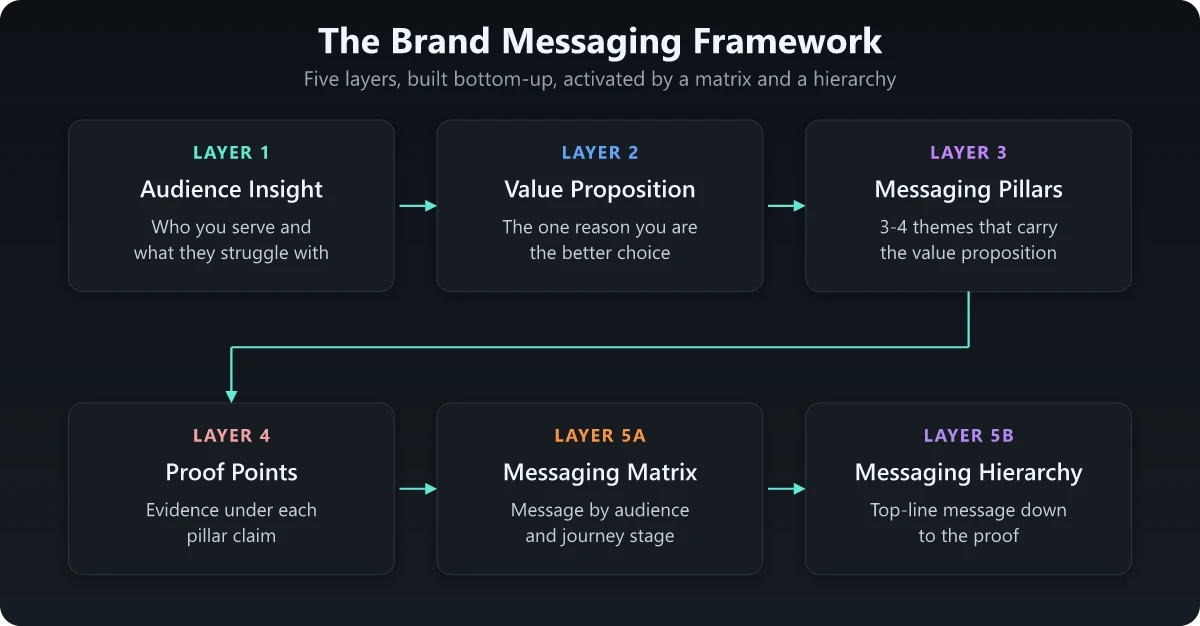
| Component | What it answers | Where it comes from |
|---|---|---|
| Audience insight | Who cares, and why | Win-loss notes, sales calls, reviews, voice of the customer |
| Value proposition | The one reason to choose you | Positioning plus the strongest buyer motivation |
| Messaging pillars | The 3-4 themes that carry it | Clustering the recurring reasons buyers say yes |
| Proof points | Why any of it is believable | Features, results, benchmarks, third-party validation |
| Messaging matrix | What to say to whom, when | Pillars mapped across audiences and stages |
| Messaging hierarchy | What to lead with | Ranking every message by priority |
The first four layers are the substance. The messaging pillars deep-dive covers layers one through four in detail, including how to name a pillar as an outcome and stack proof beneath it. This post is the hub above that spoke, so I will spend the rest of it on the two activation layers that pillar-only guides ignore: the matrix and the hierarchy.
One rule before we go further. You cannot write pillars until the value proposition is settled, and you cannot write a value proposition until you know the audience. If either is fuzzy, fix it first with a clear value proposition and locked product positioning. The framework only carries a message that already exists.
The Messaging Matrix: What to Say to Whom
A messaging matrix is a grid that maps your messages against your audiences and journey stages. Rows are message types, columns are buyer segments or funnel stages, and each cell holds the exact phrasing for that combination.
This is the asset that answers a question pillars alone cannot: the same pillar has to sound different to a CFO signing the check and the end user living in the product every day. The matrix is where one stable theme becomes many precise expressions without anyone reinventing the message on a Friday afternoon.
Here is the template I use. Copy this shape and fill the cells:
| Message | Economic buyer (VP / CFO) | Technical evaluator | End user |
|---|---|---|---|
| Top-line message | Cut cost and risk at scale | Fits your stack, no rip-and-replace | Do your job with less friction |
| Pillar 1 | Fewer tools to pay for and audit | One API, standards-based | One place instead of five tabs |
| Pillar 2 | Faster payback on the rollout | Deploys in a sprint, not a quarter | Live in an afternoon |
| Proof | Named customer ROI, security certs | Docs, uptime SLA, integration list | Ratings, adoption stats |
A few rules that keep a matrix useful instead of decorative:
- Columns are real segments, not made-up personas. Ground them in a genuine buyer persona built from research, or the cells fill with fiction.
- The theme stays constant down a column, the phrasing changes across it. If Pillar 1 becomes a different idea in the CFO column than the user column, you have two pillars pretending to be one.
- Every proof cell is specific to that audience. A CFO wants a dollar figure; an evaluator wants an uptime number. The same pillar, different evidence.
- Add a journey-stage version when the buying cycle is long: swap the columns for awareness, evaluation, and decision, and watch the message tighten as intent rises.
The Messaging Hierarchy: What to Lead With
A messaging hierarchy ranks your messages by priority, so anyone writing anything knows what to say first. It answers what the matrix does not: when you only get one sentence, one ad headline, or one opening line, which message wins.
The order runs top to bottom, most important to supporting:
- Top-line message - the one thing you want remembered if nothing else lands
- Messaging pillars - the three or four reasons that message is true
- Supporting messages - the secondary benefits and objection handlers
- Proof points - the evidence layer that backs all of it
The reason a message hierarchy matters is bandwidth. A homepage hero gets the top-line message. A paid ad gets the top-line message plus one pillar. A sales deck gets all four levels. A tooltip gets a single supporting message. Without the ranking, everyone guesses, and the guesses do not agree - which is exactly the inconsistency the framework exists to kill.
The hierarchy and the matrix are two views of the same pillars. The matrix slices by audience; the hierarchy slices by priority. Together they are the template layer that a plain pillars-and-proof house is missing.
How to Build a Brand Messaging Framework
The build order is the layer order, bottom of the input chain to top of the output. This is the sequence I run whether the product is brand new or being repositioned.
1. Start with audience insight
Pull the reasons real buyers chose you, in their words. Read win-loss notes, call transcripts, support tickets, and review sites. You are hunting for the recurring language, because the words buyers use are the words the framework should use back at them.
2. Write the value proposition
Compress the strongest reason to choose you into a single defensible claim. If you cannot say it in one sentence, the framework above it will inherit the fog. A value proposition template gives you the fill-in-the-blank version.
3. Build three or four messaging pillars
Cluster the reasons from step one into three or four non-overlapping themes, each phrased as an outcome the buyer gets. Three fits in a rep’s head; seven lives in a doc nobody opens.
4. Stack proof points under every pillar
For each pillar, list three to five pieces of evidence: features, customer results, benchmarks, certifications. A pillar with no proof is an opinion; a pillar with three proof points is an argument.
5. Build the messaging matrix
Take the pillars and proof and run them across your real audiences or journey stages using the template above. Fill every cell with the exact phrasing for that combination. This is the artifact sales will actually open.
6. Rank everything into a hierarchy
Order the whole set from top-line message down to proof. Now anyone writing a channel-specific asset knows what to lead with and what to cut when space is tight.
Brand Messaging Framework vs Messaging Pillars
These get used interchangeably, and that mix-up is why so many “frameworks” are just a pillar diagram. They are different scopes.
| Brand messaging framework | Messaging pillars | |
|---|---|---|
| Scope | The whole system | One layer inside it |
| Covers | Audience, value prop, pillars, proof, matrix, hierarchy | The 3-4 core themes and their proof |
| Output | Per-audience, per-channel copy | The talking points everything is written from |
| When you need it | Aligning a whole company | Getting the core story straight |
Build the pillars as a component and the framework as the system that carries them across every audience and channel. If you want the deeper mechanics of the pillar layer specifically - naming them as outcomes, the messaging house, worked SaaS examples - that is the messaging pillars guide. If you want the brand-versus-positioning distinction that sits above all of this, branding vs positioning draws that line.
A messaging framework tells the company what to say consistently. It will not, on its own, produce anything worth citing, because consistency and a defensible point of view are different jobs. Thought leadership content covers the second one, and it starts with a claim your competitors could disagree with.
The framework is also one system inside a larger machine. Messaging is the connective tissue of the wider product marketing framework that ties positioning, launch, and enablement together - the framework here is how the message stays identical from the first ad to the renewal call.
If the company name itself is what is changing, the framework stops being a document and becomes a migration, and the T-90 rebrand countdown covers the systems inventory, comms tiers and redirects that have to move with the new language.
Conclusion: The Framework Is the Template, Not Just the Pillars
A brand messaging framework is five layers, not three pillars on a slide. Audience insight feeds a value proposition, the value prop is carried by pillars, the pillars are backed by proof, and the whole thing only becomes usable once you add the two tools most guides skip: a messaging matrix that flexes the message across audiences, and a messaging hierarchy that ranks what to lead with.
Build all five and you get what the 85% consistency expectation demands - one company that sounds like one company, whether the buyer meets you in an ad, a demo, or a support ticket. Stop at the pillars and you are back to five people describing five products, just with a nicer diagram.
Frequently Asked Questions
What is a brand messaging framework?
A brand messaging framework is the single structure that decides what your company says and why. It stacks five layers: audience insight, a value proposition, three or four messaging pillars, proof points under each pillar, and an activation layer - the messaging matrix and messaging hierarchy that turn all of it into per-audience copy. Messaging pillars are one layer inside it, not the whole thing.
What is a messaging matrix?
A messaging matrix is a grid that maps your messages against your audiences and journey stages. Rows are message types (top-line message, each pillar, proof), columns are your buyer segments or funnel stages, and each cell holds the exact phrasing for that combination. It is how one set of pillars flexes to a CFO, an end user, and a cold-traffic ad without drifting.
What is the difference between a brand messaging framework and messaging pillars?
Messaging pillars are one layer of the framework. The brand messaging framework is the parent structure that also covers audience insight, the value proposition the pillars express, the proof beneath them, and the matrix and hierarchy that turn them into per-audience copy. Build pillars as a component; build the framework as the system that carries them.
What is a messaging hierarchy?
A messaging hierarchy ranks your messages by priority so people know what to lead with. The top-line message comes first, then the pillars, then supporting messages, then proof at the bottom. It answers the question a matrix does not: when you only get one sentence, which message wins.
What should a product messaging framework include?
A product messaging framework should include who the message is for, the value proposition, the pillars that carry it, provable evidence under each pillar, and a template - a matrix and a hierarchy - so sales, marketing, and product all pull the exact same phrasing for the same audience.