YouTube Ads Cost in India: What Google Bills, by Format
YouTube ads cost in India has no Google rate card. See what each format is billed for, why rupee CPV and CPM estimates disagree, and what Studio Promote costs.
Two guides to YouTube ads cost in India price the same skippable view differently. Mega Digital (Kaylin Hoang, 5 June 2026) says a view costs “around ₹2”, with skippable in-stream ads at ₹2 to ₹3. The Media Ant (page titled 2026, no dated byline) says ₹0.50 to ₹3. Per 1,000 impressions the two do not overlap at all: Mega Digital says advertisers “typically pay around ₹400 to ₹900”, and The Media Ant says “about ₹40 to ₹150”.
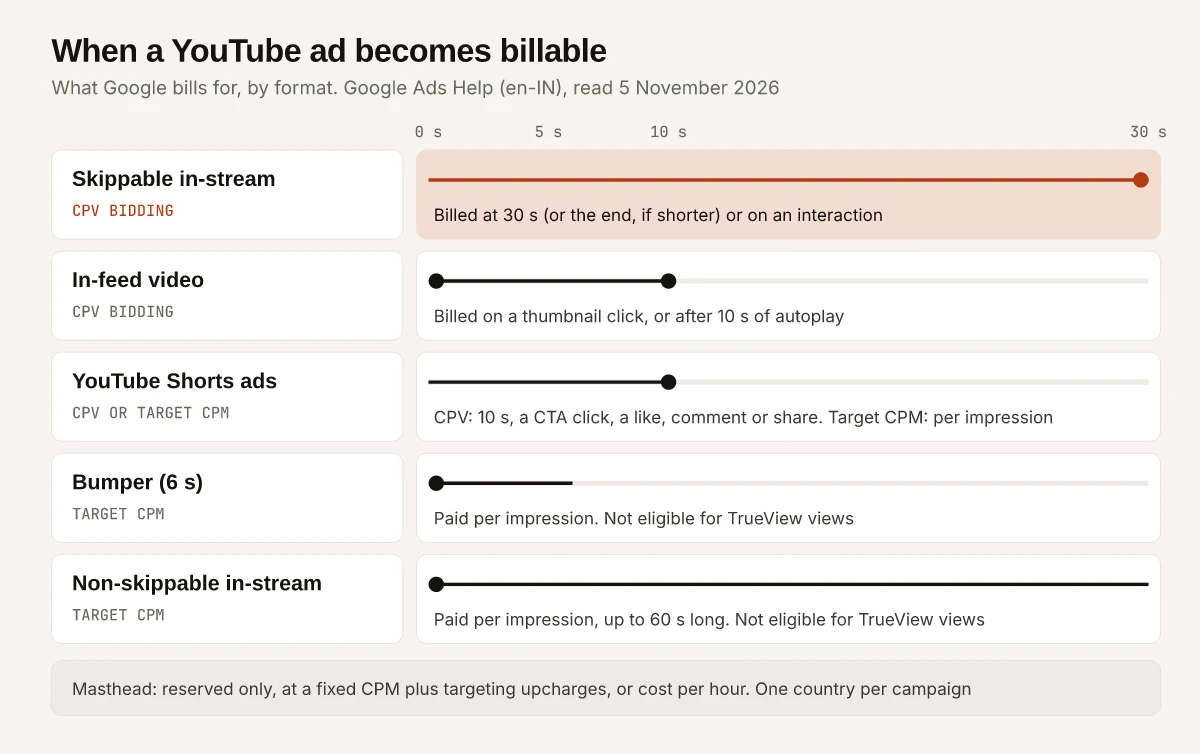
Neither range is Google’s, and I think both answer the wrong question. Google bills each YouTube format for a different event: a skippable ad charges at the 30-second mark (or an interaction), a Shorts or in-feed ad at 10 seconds or a click, and bumper and non-skippable ads are bought per impression and cannot earn a billed view at all. Ask first what Google bills you for in each format; a rupee estimate for that unit only means something after that. Google’s en-IN Help pages quoted here were read on 5 November 2026; prices and rules change, so check them again before you plan a budget.
| YouTube ad format | What Google bills you for | When a billed view counts |
|---|---|---|
| Skippable in-stream | TrueView views (CPV), or impressions on Target CPM | 30 seconds watched (or the whole ad if shorter), or an interaction |
| In-feed video | A click to watch, or a 10-second autoplay in video view campaigns | Thumbnail click, or 10 seconds of autoplay |
| YouTube Shorts ads | An impression, a TrueView view or an engagement | 10 seconds, a CTA click, or a like, comment or share |
| Bumper (6 seconds) | Impressions (Target CPM) | Never: not eligible for TrueView views |
| Non-skippable in-stream | Impressions (Target CPM) | Never: not eligible for TrueView views |
| Masthead | Reserved impressions at a fixed CPM, or cost per hour | Not sold per view |
Every row comes from Google’s About video ad formats and CPV bidding pages, as of November 2026.
How Much Do YouTube Ads Cost in India?
There is no Google price: you choose the budget and the bid, and the auction sets what each view or impression costs. Google’s India campaign budget page puts it as “With Google Ads, you decide how much you spend on your campaigns”, and its budget calculator works in “IN Rupee (₹)” without listing a YouTube rate.
The rupee numbers you will find come from agencies and media sellers. Here are the rupee figures the two pages give per YouTube ad unit, side by side, as of November 2026:
| Unit | Mega Digital (5 June 2026) | The Media Ant (page titled 2026) | Do they agree? |
|---|---|---|---|
| Cost per view, average | ”around ₹2.00” | - | - |
| Cost per view, skippable in-stream | ₹2.00 to ₹3.00 | ₹0.50 to ₹3 | Overlap only at ₹2 to ₹3 |
| CPM, general | ₹400 to ₹900 | about ₹40 to ₹150 | No overlap |
| CPM, non-skippable in-stream | ₹500 to ₹900 | - | - |
| CPM, bumper | ₹250 to ₹400 | ”Usually higher per 1,000 than skippable” | Mega’s bumper range ends where its general range starts |
| CPM, Shorts | ₹350 to ₹450 | ”Costs vary by audience and competition” | - |
| CPM, display | ₹100 to ₹300 | - | - |
| Suggested start | about ₹500 per day | ₹500 per day | Yes |
Before you trust either column, check where each page’s figures come from and how it describes billing:
- Only Mega Digital links sources, and its own text says India data is limited. The Media Ant links no source for its rupee figures. Mega Digital links its ₹2.00 average to a Digital Applied article titled “YouTube Ads Benchmarks 2026: CPV, CPM and CTR Explained”, which mentions neither India nor rupees, and its ₹400 to ₹900 range to a Store Growers benchmarks page. It also says “India-specific YouTube Ads benchmarks are limited” and shows an industry table from Owlclaw in US dollars, with CPVs from $0.010 to above $0.040.
- The Media Ant’s own page has more than one CPM. Besides ₹40 to ₹150, its at-a-glance table lists video ads bought through The Media Ant “From ₹0.10 per impression (₹100 per 1,000)” and CTV at ₹10 to ₹100 per 1,000 as “typical”.
- Mega Digital describes the billing rule differently from Google. It says “You pay when viewers watch your entire ad or click on it”; Google’s pages set the skippable threshold at 30 seconds or an interaction, whichever comes first, so a viewer who watches 30 seconds of a 2-minute skippable ad is already a billed view.
YouTube Ads Cost per View in India: What Counts as a Billable View
Cost per view (CPV) applies to formats that can earn a TrueView view. Google’s CPV bidding page says “With CPV bidding, you’ll pay for TrueView views and interactions (such as clicks on call-to-action overlays, cards and companion banners)”, and defines the view per format:
| Format | A TrueView view is counted when |
|---|---|
| In-stream | Someone watches 30 seconds (or to the end if the ad is shorter than 30 seconds) or interacts, whichever comes first |
| In-feed | A viewer clicks the thumbnail to watch, or watches the ad autoplay for at least 10 seconds (or to the end if shorter) |
| Shorts | Someone watches 10 seconds (or to the end if shorter) or clicks the call to action |
The rules around that bid, from the same pages:
- Target CPV is an average, not a cap. You set “the average amount that you’re willing to pay for each TrueView view”, and Google adds: “Some TrueView views may cost more or less than your target.”
- Target CPV lives in video view campaigns. The CPV definition page says “The target CPV bidding option is only available when you choose to run video views campaigns.” The CPV bidding page places it under the “YouTube reach, views and engagements” objective, for video views or ad sequence campaigns.
- The estimate shows up while you build. Google says the view estimate for your bid “is available on the right side of the screen in the campaign construction flow”, and warns that “Using a bid that is too low will inhibit your campaign from effectively participating in the auction.”
- You pay the actual CPV. Google calls the final amount for a view the actual CPV, and says it will “try to charge you only what’s necessary for your ad to appear on the page.”
- Shorts bills once per impression. The video ad formats page says that even if a viewer likes and watches for 10 seconds in one playback, “you are only charged for one TrueView view per ad impression”, and a looping creative is charged once.
Billed Views vs the View Count on Your Video
The number under your video and the number on your invoice are counted differently. Google’s CPV bidding page says YouTube public views “are counted the moment a video ad starts to play across Shorts ads and in-stream ads (skippables, non-skip and bumper)”, while TrueView views need the thresholds above. Since October 2025 the billed metric has been labelled “TrueView views” in Google Ads; Google’s formats page says the rename “won’t impact how you’re billed”. Divide spend by public views and the cost per view can come out lower than what Google charged per TrueView view.
YouTube Ads Cost per 1,000 Impressions: Bumper, Non-Skippable and Shorts
Bumper and non-skippable ads are priced per 1,000 impressions (CPM), and neither can earn a TrueView view. Google’s formats page says each “use Target CPM bidding, so you pay based on impressions”, and its CPV bidding page says these formats “aren’t eligible for TrueView views”. A CPV figure for a bumper campaign is therefore a number Google never billed.
| Format | Length rule (Google) | Bidding (Google) | Agency CPM estimate (source, date) |
|---|---|---|---|
| Bumper | Five to six seconds, non-skippable | Target CPM | ₹250 to ₹400 (Mega Digital, 5 June 2026) |
| Non-skippable in-stream | 60 seconds or shorter | Target CPM | ₹500 to ₹900 (Mega Digital, 5 June 2026) |
| Shorts on Target CPM | Under 60 seconds recommended | Target CPM, or CPV | ₹350 to ₹450 (Mega Digital, 5 June 2026) |
| Skippable in-stream on Target CPM | No maximum length | CPV, Target CPM, Target CPA or Maximise conversions | Not given separately |
Before you compare CPMs, read these rules from Google’s formats page:
- Skippable ads can be bought per impression too. The formats page says “With Target CPM, Target CPA and Maximise conversions bidding, you pay based on impressions.” The bid strategy, not the format alone, decides the billing unit.
- A Shorts impression starts at play. Google counts a Shorts impression “when your Shorts ad begins to play in the YouTube Shorts feed”, and a viewable impression typically when “at least 50% of the ad is on screen for a minimum of two continuous seconds”.
Mega Digital’s FAQ (5 June 2026) answers “Are YouTube Shorts ads cheaper than standard in-stream ads?” with “Yes” and says Shorts ads “usually have lower CPMs than standard in-stream ads”. Google’s pages state no such comparison, so treat it as one agency’s estimate.
A ₹10,000 YouTube Budget at Each Published Estimate
This is my arithmetic on the two agencies’ own ranges, not a forecast and not a Google figure. It shows how far apart the estimates are once they are turned into views and impressions for one ₹10,000 campaign total:
| Estimate used | Source | Rate | ₹10,000 buys |
|---|---|---|---|
| Low CPV | The Media Ant (page titled 2026) | ₹0.50 per view | 20,000 views |
| Average CPV | Mega Digital (5 June 2026) | ₹2 per view | 5,000 views |
| High CPV (both) | Mega Digital (5 June 2026), The Media Ant (page titled 2026) | ₹3 per view | 3,333 views |
| Low CPM | The Media Ant (page titled 2026) | ₹40 per 1,000 | 2,50,000 impressions |
| High CPM | The Media Ant (page titled 2026) | ₹150 per 1,000 | 66,666 impressions |
| Bumper CPM | Mega Digital (5 June 2026) | ₹250 to ₹400 per 1,000 | 25,000 to 40,000 impressions |
| Shorts CPM | Mega Digital (5 June 2026) | ₹350 to ₹450 per 1,000 | 22,222 to 28,571 impressions |
| Non-skippable CPM | Mega Digital (5 June 2026) | ₹500 to ₹900 per 1,000 | 11,111 to 20,000 impressions |
The spread is the finding: the same ₹10,000 buys anywhere from 3,333 to 20,000 views depending on which guide you believe, a sixfold gap. Your own bid estimate in the campaign builder is the first number tied to your audience.
How a budget paces from day to day is a Google Ads budget question, and the Google Ads cost guide has the daily and monthly ceilings Google sets for most campaigns, so I will not repeat them here.
YouTube Masthead Price in India
Google sells the Masthead on reservation and publishes no rupee price. Its YouTube Masthead page gives the pricing model, as of November 2026:
| Question | Google’s answer |
|---|---|
| How is it bought? | CPM Masthead: “a reserved and fixed volume of impressions”. Cost-Per-Hour (CPH) Masthead: “100% share of voice (SOV)” during the hours you buy |
| Who sells it? | CPM: “through your Google representative or directly in YouTube Programmatic Guaranteed via instant deals or Google Ads reservation”. CPH: “Available only through your Google representative” |
| What sets the price? | ”Mastheads have a fixed CPM price and will include upcharges depending on the targeting criteria used” |
| How many countries? | ”Rates vary by market, so you can only target one country per campaign” |
| Where do I see the price? | ”You can check your final CPM price in the quote session during campaign construction” |
| What if it under-delivers? | “you’ll only pay for the impressions served in case your campaign didn’t spend the entire budget” |
Google’s two pages word the buying route differently: the formats page says Masthead ads “are only available on a reservation basis through a Google sales representative”, while the Masthead page also lists Programmatic Guaranteed and Google Ads reservation for the CPM version. The only rupee Masthead figure in the two guides above is a media seller’s: The Media Ant (page titled 2026) lists “₹12,00,000 minimum billing on The Media Ant” for a one-day placement. That is its booking minimum, not a Google rate.
YouTube Promotion Cost: What Promote in YouTube Studio Charges
Promote has no list price: you set a budget and an end date, and you are never billed more than that budget. This is the route behind “YouTube promotion cost” searches, the Promote button inside YouTube Studio rather than a campaign built in Google Ads. The facts below come from YouTube’s Help pages on creating and managing promotions, getting started with Promote and troubleshooting Promote, and Google’s India-edition Promote creator playbook (PDF, undated), as of November 2026:
| Cost question | What Google says |
|---|---|
| Is there a fixed price? | No. Under Budget you “Define your budget and end date” |
| Can it overspend? | The Cost metric is “The amount that you’ve spent on the promotion so far, which will not exceed your set budget”; the playbook says “You’ll never be charged more than the total budget you set for your campaign” |
| What is the minimum? | The India playbook, in US dollars: “You can get results with as little as $5 USD, but we generally recommend at least $100 USD”. No rupee figure is given |
| Who bills you? | Your Google Ads account. “Billing will depend on the settings that are selected in Google Ads with either automatic or manual payments” |
| When does spend start? | After an automatic ad review that “may take one to two days” |
| Which videos qualify? | Public or unlisted, at least 10 seconds long, and within Google’s ad policies; YouTube Help says Promote covers “your videos and Shorts” |
The $5 and $100 figures are the dollar amounts printed in Google’s India playbook. I have not converted them, because Promote charges through a Google Ads account and the playbook gives no rupee equivalent.
How to Start a Promotion and What You Choose
YouTube Help lists the steps on a computer: sign in to YouTube Studio, select Content, open the Promotions tab and click New promotion. YouTube Help also lists the three-dot menu on any of your videos and the Promote button on the watch page, and the playbook shows the three-dot route in the YouTube and Studio apps on Android. Then:
- Account: link an existing Google Ads account or create one. Only one Google Ads account can be linked to the Promotions tab at a time.
- Goal: audience growth (subscribers), video views or website visits.
- Video: headline and description are filled in from the video and can be edited.
- Targeting: language, country, age, gender or interests.
- Budget: total budget and end date; set up billing first on a new Google Ads account.
The troubleshooting page also limits who can use Promote: on a Brand Account only the primary owner can link the Google Ads account and set up the first promotion, you need an Owner, Manager or Editor role, and “Promote is currently unavailable for manager accounts (MCC) and Google Grants accounts.”
YouTube Ads Cost per Subscriber: What Promote Reports
Google publishes no price per subscriber. Promote reports Subscribers, defined in YouTube Help as “The number of people subscribed to your channel after watching at least 10 seconds of your video or clicking your promotion within the past 3 days”, next to Cost. Cost divided by Subscribers is the cost per subscriber for that promotion; you calculate it, and Promote does not bid on it.
Those subscribers do not help monetization. YouTube Help says “Subscribers and watch time earned through Promote don’t contribute towards YouTube Partner Programme eligibility.” The exception is follow-on views: organic views from people who go on to watch your videos after seeing an audience growth promotion, which YouTube Help says “count towards YPP eligibility”. If the promoted video is a Short, the Shorts monetization thresholds for India set how many qualified Shorts views YPP asks for.
Promote vs a Video Campaign in Google Ads
| Promote in YouTube Studio | Video campaign in Google Ads | |
|---|---|---|
| Where you build it | YouTube Studio or the Android apps | Google Ads |
| Bidding | No bid step in YouTube Help’s setup list; budget and end date | Target CPV, Target CPM and other strategies by format |
| Spend control | Total budget, never exceeded | Daily or campaign total budgets |
| Where you manage it | ”Promotions created from YouTube can only be managed on YouTube and are not accessible through Google Ads” | Google Ads |
| Same product? | The playbook says Promote’s Audience Growth goal and YouTube Engagements optimising for channel subscriptions “are the same product” | Engagements in Google Ads “have more robust reporting and campaign settings”, per the playbook |
Paying for YouTube Ads and Reading the Results
The bill for either route lands in a Google Ads account, so the India payment rules are the Google Ads ones: Google Ads payment methods in India covers the payment settings and methods. If the account is new, check the Google Ads sign-up offers for Indian advertisers before the first rupee is spent, since those offers run on their own spend conditions.
After the campaign runs, GA4 sorts the traffic by campaign type: a video campaign’s clicks land in Paid Video, while Demand Gen and Performance Max traffic shows up as the Cross Network channel in GA4. Compare cost against results in the channel that campaign type reports under, not under Paid Search. Meta prices its ads on different rules again, which the Instagram ad cost guide for India lays out.
YouTube Ads Cost in India Starts With the Billing Unit
YouTube ads cost in India comes down to two decisions you make before any rupee estimate matters: the format, which decides whether you pay per view or per 1,000 impressions, and the budget, which caps what you spend in total. A ₹2 CPV quote means nothing for a bumper campaign, and a ₹400 CPM means nothing for a skippable campaign bought on CPV.
For a creator boosting one video, Promote’s total budget is the whole cost, and it never goes over. For a business, pick the format first, then read the estimate in the campaign builder against the agency ranges above. Write down the billing unit before you write down a budget.
Frequently Asked Questions
How much do YouTube ads cost per view in India?
Google publishes no rupee cost per view. You set a target CPV and pay for each TrueView view, which on a skippable in-stream ad means 30 seconds watched or an interaction. Agency estimates, read in November 2026: about ₹2 per view (₹2 to ₹3 for skippable ads) from Mega Digital (5 June 2026), and ₹0.50 to ₹3 from The Media Ant (page titled 2026).
How much does YouTube promotion cost?
Promote in YouTube Studio has no fixed price: you set a budget and an end date, and YouTube Help says the cost will not exceed your set budget. Google's India creator playbook says results are possible with as little as $5 USD and recommends at least $100 USD, billed through your linked Google Ads account.
What is the YouTube ads cost per 1,000 impressions in India?
Bumper and non-skippable in-stream ads use Target CPM bidding, and Google lists no rupee CPM for them. Mega Digital (5 June 2026) puts typical CPMs at ₹400 to ₹900 (bumper ₹250 to ₹400, Shorts ₹350 to ₹450), while The Media Ant (page titled 2026) says about ₹40 to ₹150 per 1,000 impressions.
How much does a YouTube Masthead ad cost in India?
Google does not publish a Masthead price. Its Help page says Mastheads have a fixed CPM with upcharges for targeting, rates vary by market, one country is allowed per campaign and the final CPM appears in the quote during campaign construction. The Media Ant (page titled 2026) lists a ₹12,00,000 minimum billing for a Masthead booked through it.
Do subscribers from YouTube Promote count toward monetization?
No. YouTube Help says subscribers and watch time earned through Promote do not count toward YouTube Partner Programme eligibility. Follow-on views, the organic views that come after someone sees an audience growth promotion, do count, per the same Help Centre.