Demand Generation vs Lead Generation: Which One You Need
Demand generation vs lead generation, explained by a PMM: what each actually does, where teams confuse them, and how to run both without wasting budget.

The fastest way to start a fight in a marketing team is to ask whether a webinar is “demand gen” or “lead gen.” Half the room says it builds awareness. The other half points at the registration form and says it captures leads. They are both right, and that is exactly why the demand generation vs lead generation debate stays confused.
I have run both motions, and I have watched teams burn quarters arguing over labels that should have been settled in a single afternoon. The terms are not interchangeable, but they are also not opposites. This guide explains what each one actually does, where the real boundary sits, and how to run both without the two halves of your team sabotaging each other.
It helps to start with a number that reframes the whole debate. At any given time, only about 5% of your potential buyers are in the market and ready to act - the Ehrenberg-Bass Institute estimates the other 95% are out of market and will not buy for months or years. Lead generation competes for that 5%. Demand generation is how you reach the 95% before they ever raise a hand.
Demand Generation vs Lead Generation: The Core Difference
Here is the cleanest way I know to separate them.
Demand generation creates and grows interest. It makes a market aware that a problem exists, that a category solves it, and that you are the credible name in that category. It works on people who are not ready to buy yet, and most of them never fill out a form while they are paying attention to you.
Lead generation captures interest that already exists. It converts a person from anonymous to known by collecting contact information, usually through a form, a gated asset, or a demo request. It works on people who have decided to identify themselves.
The simplest test I use: if the tactic produces a name in your CRM, it is doing lead gen work. If it changes how people think about your category before they ever give you a name, it is doing demand gen work.
That distinction is why this question is really about when in the buyer’s journey you are operating, not which team should own the budget.
Upstream vs downstream
Demand gen is upstream. It is everything that happens while a buyer is forming an opinion, often silently, often for months. You can rarely tie a single podcast appearance or a great LinkedIn post directly to a closed deal, and that ambiguity scares finance teams.
Lead gen is downstream. It is the moment of capture and everything engineered to trigger it. It is satisfying precisely because it is countable. You can see the form fills tick up in real time.
The trap is that countable does not mean valuable. A team optimizing only for what it can measure will starve the upstream work that fills the funnel in the first place.
Demand Generation vs Lead Generation: A Side-by-Side Comparison
When I onboard a new team, I put this table on the wall. It ends most of the arguments before they start.
| Dimension | Demand generation | Lead generation |
|---|---|---|
| Primary goal | Create and grow interest in the category | Capture contact details from interested people |
| Where in the journey | Upstream, before the buyer self-identifies | Downstream, at the moment of self-identification |
| Audience | The whole addressable market | Self-selecting, in-market prospects |
| Typical tactics | SEO, organic social, podcasts, communities, ungated content, PR | Gated ebooks, webinars, demo forms, paid search, lead ads |
| Output | Awareness, intent, branded demand | Named contacts, MQLs, form fills |
| Time horizon | Months to quarters | Days to weeks |
| Attribution | Hard, mostly influenced | Easy, mostly direct |
| Common failure | No connection to revenue, so it gets cut | Volume of low-quality leads sales ignores |
Notice that several tactics could sit in either column depending on how you run them. A webinar gated behind a form is doing both jobs at once: the content builds intent, the form captures it. That overlap is normal and healthy. The problem is only when you pretend the two jobs are the same and measure them the same way.
Why Teams Confuse the Two
The confusion is not stupidity. It comes from how marketing is funded and how attribution tools are built.
Attribution rewards the last click
Most analytics setups give credit to the touchpoint closest to the form fill. So the paid search ad that captured an already-decided buyer gets the glory, while the year of content that created the decision gets nothing. Over time, budget migrates to the capture layer because that is where the dashboard says the wins are. The labels are blurrier than the dashboard suggests: a Performance Max click that closed the form fill lands in GA4’s Cross Network row rather than Paid Search, which is why one Google Ads channel can hide YouTube, Gmail and Discover placements behind what looks like a clean last-click search win.
I have watched this play out as a slow strangling of demand gen. The numbers look fine for a few quarters, then pipeline quality drops because nobody is filling the top of the funnel anymore. By the time leadership notices, the brand has gone quiet in its own category.
Lead gen is easier to defend in a budget review
When a CFO asks “what did we get for the money,” a number like cost per lead is easy to produce. “We grew category awareness” is true but harder to put on a slide. So lead gen wins the budget fight even when demand gen is what the business actually needs.
If you want to protect demand gen, you have to give it leading indicators that hold up under scrutiny. I cover those below.
The same person owns both, so the line blurs
In small teams, one marketer runs the webinar, writes the ebook, and manages the paid search. With one person doing everything, the conceptual line between creating demand and capturing it stops mattering day to day, and the discipline of knowing which job each tactic does gets lost.
How the Two Work Together
This is the part most “versus” articles miss. Demand gen and lead gen are not rivals. They are stages in a single motion, and each one is weaker without the other.
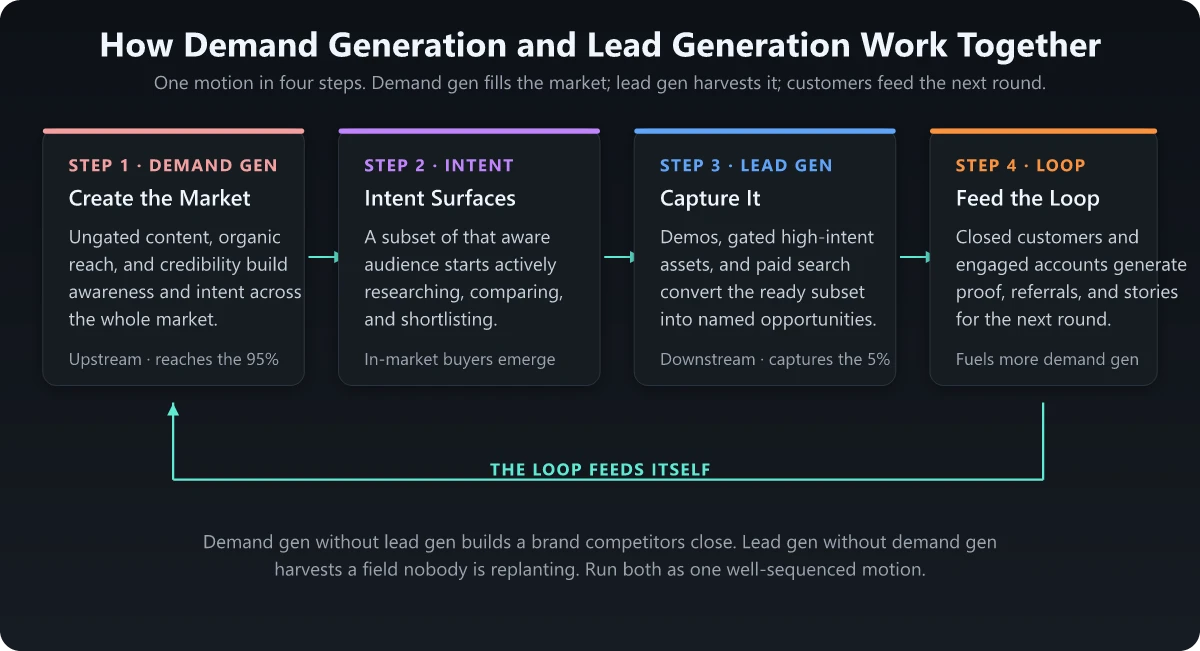
Demand gen without lead gen produces a famous brand that competitors close. You build an engaged audience, then have no mechanism to convert the ones who are ready, so they go shopping and buy from whoever asked for the meeting first.
Lead gen without demand gen produces a hungry capture machine with nothing to capture. You optimize forms and bid on intent keywords, but the pool of in-market buyers who already know your category is finite. Eventually you are paying more and more to harvest a field nobody is replanting.
The healthy pattern looks like this:
- Demand gen creates the market. Ungated content, organic reach, and credibility build awareness and intent across the whole addressable market.
- Intent surfaces. A subset of that aware audience starts actively researching, comparing, and shortlisting.
- Lead gen captures it. Demos, gated high-intent assets, and targeted paid search convert the ready-to-act subset into named opportunities.
- The loop feeds itself. Closed customers and engaged accounts generate proof, referrals, and stories that feed the next round of demand gen.
If you want the upstream half of this in depth, I wrote a full breakdown in what is B2B demand generation, and a more tactical version for software companies in the SaaS demand generation playbook.
How to Run Both Without Wasting Budget
Here is the operating model I use to keep the two halves from cannibalizing each other.
1. Define the boundary in writing
Decide, as a team, which tactics are demand gen and which are lead gen, and write it down. Put webinars, gated assets, and other hybrids in the column where their primary job sits, then accept that they contribute to both. Ambiguity is where the budget fights live, so kill the ambiguity first.
2. Give each motion its own scoreboard
Do not judge demand gen on form fills. Do not judge lead gen on brand awareness. Use separate, honest metrics for each:
- Demand gen indicators: branded search volume, direct traffic, growth in high-fit accounts engaging with your content, and sourced plus influenced pipeline over a quarter.
- Lead gen indicators: form fills, MQL volume, cost per lead, and especially lead-to-opportunity conversion rate, which is the quality check that volume alone hides.
The lead-to-opportunity rate is the one I watch hardest, because it is where a lead gen team optimizing for cheap volume gets exposed. One blended rate still hides where accounts actually fall out, so track the conversion between adjacent stages as well - the walkthrough of the five gates a B2B buying group passes through shows why a weak lead-to-opportunity number is usually a handoff problem rather than a traffic one.
3. Protect the upstream budget on purpose
Because attribution will always favor the capture layer, you have to ring-fence demand gen spend before the budget review, not after. Treat it like R&D for pipeline. If you let it fight last-click metrics head to head every quarter, it loses every quarter, and then the funnel quietly empties.
4. Hand off cleanly to sales
The moment a lead is captured, the quality of the handoff decides whether the work was worth it. A great captured lead that sales mishandles is wasted demand gen and wasted lead gen at the same time. Tight definitions of what counts as sales-ready, plus the right collateral at the right stage, are what make the handoff hold. My sales enablement checklist walks through that handoff, and the sales enablement KPIs guide covers how to measure whether it is working.
5. Make your capture assets worth the trade
A form is a transaction: the buyer gives you their contact details, you give them something worth more than the friction. Weak gated content poisons both motions, because a bad first exchange teaches the market that handing you their email is a mistake. If your lead gen leans on email, the B2B lead generation email templates post has ready-to-adapt sequences that respect that trade.
Which One Does Your Business Need More Right Now
The honest answer depends on where your demand sits today.
If your category is new or your brand is unknown, you have a demand problem, not a capture problem. Adding more forms to a site nobody visits will not save you. Invest in demand gen first and accept the slower feedback loop.
If you have real awareness but weak conversion, you have a capture problem. The market knows you and is researching, but you are leaking ready buyers because the path to identifying themselves is clumsy. Fix lead gen first.
If you are not sure, look at your branded search and direct traffic. If they are flat or shrinking while you keep buying intent keywords, you are harvesting demand you are not replenishing, and that is a demand gen warning light.
For founders making this call at the earliest stage, I tied it into the broader sequencing question in go-to-market strategy for startups.
The Takeaway
The whole demand generation vs lead generation debate dissolves once you stop treating it as a choice. Demand gen creates interest; lead gen captures it. One is upstream and hard to attribute, the other is downstream and easy to count, and a business that funds only the countable half will slowly starve the funnel that feeds it.
So do not pick a side. Define the boundary clearly, give each motion its own honest scoreboard, protect the upstream budget from last-click attribution, and make the handoff to sales tight. Run demand gen to fill the market and lead gen to harvest it, in that order, and the two stop fighting over budget and start compounding instead.
The teams that win the demand generation vs lead generation question are the ones who stopped asking it and started running both as a single, well-sequenced motion.
Frequently Asked Questions
What is the difference between demand generation and lead generation?
Demand generation creates and grows interest in your category and product across a market. Lead generation captures contact information from people who are ready to identify themselves. Demand gen is upstream and harder to attribute; lead gen is downstream and easy to count. Most strong B2B teams run both, with demand gen feeding the pipeline that lead gen later harvests.
Is demand generation better than lead generation?
Neither is better. They solve different problems. If nobody knows your category exists, more lead-capture forms will not help, so you need demand gen. If you have strong intent in the market but no way to convert it, you need lead gen. The mistake is treating them as a choice instead of two stages of one motion.
Does demand generation include lead generation?
In modern practice, yes. Lead generation is best understood as the capture layer inside a broader demand generation program. Demand gen creates the awareness and intent; lead gen records the people who raise their hand. Splitting them into rival teams with separate goals is where most measurement fights start.
How do you measure demand generation vs lead generation?
Measure lead generation on volume and quality of captured contacts: form fills, MQLs, cost per lead, and lead-to-opportunity rate. Measure demand generation on leading indicators of intent and pipeline: branded search growth, direct traffic, share of high-intent accounts engaged, and sourced plus influenced pipeline. Judging demand gen on this month's form fills is the classic error.
Should a startup focus on demand generation or lead generation first?
Early on, most startups overweight lead generation because it produces countable results fast. But if your category is new or your brand is unknown, you will run out of ready-to-buy prospects quickly. Build a small, consistent demand gen motion early so there is awareness for lead gen to convert later.