Messaging Pillars: How to Build Them, With Examples (2026)
A PMM's practical guide to messaging pillars: what they are, how they sit in the messaging house, how to build them in steps, and worked SaaS examples.

Ask five people in a company to describe what your product does and you will get five different answers, usually five different products. The sales rep pitches speed, the founder pitches vision, the website pitches something a copywriter wrote in 2023, and the buyer walks away confused. Messaging pillars are how you end that, by giving the whole company three or four load-bearing themes that everyone says the same way.
I have built messaging pillars for products that had none and inherited pillars that were really just a feature list in a trench coat. The difference between the two is the difference between a team that sounds like one voice and a team that sounds like a focus group. This guide covers what messaging pillars actually are, where they sit in the messaging house, how to build them step by step, and what good ones look like with worked examples.
Here is the reframe that makes this urgent. According to Gartner research cited in Harvard Business Review, B2B buyers now spend only 17% of their entire purchase process talking to potential suppliers. Most of the buying decision happens while you are not in the room, which means your messaging pillars have to do the selling for you when no rep is there to explain anything.
What Are Messaging Pillars?
Messaging pillars are the three or four core themes that carry your value proposition. Each one names a distinct reason a buyer should choose you, phrased as an outcome they care about, and each one is backed by specific proof so the claim survives scrutiny.
Think of them as the answer to a simple question repeated a few times: “Why should I care?” Every time the buyer asks, a pillar answers with a different, non-overlapping reason. Together they cover the full case for your product without repeating themselves.
The key word is themes. A pillar is not a feature, not a metric, and not a slogan. It is a durable theme that stays true across a year of releases, holds up whether you are writing a homepage or a cold email, and flexes to different audiences without losing its shape.
Good messaging pillars share a few traits. They are distinct from each other, so there is no overlap. They are outcome-led, so they speak to the buyer’s world and not your feature roadmap. And they are provable, because a claim with no evidence behind it is just noise the market has learned to ignore.
Why three or four, never seven
The constraint is the point. If you cannot compress your entire value proposition into three or four pillars, you do not yet understand what matters most about your product.
I have watched teams try to run with six or seven pillars because every internal stakeholder wanted their pet theme included. The result is that nobody remembers any of them, and reps quietly go back to improvising. Three pillars fit in a rep’s head. Seven live in a document nobody opens.
The Messaging House: Where Pillars Fit
Messaging pillars do not float on their own. They live inside a structure called the messaging house, and understanding that structure is what keeps your pillars honest.
The messaging house has three layers. The roof is your positioning statement, the single sentence that defines who you are for and why you are different. The pillars are the columns holding that roof up. And beneath each pillar sits the foundation of proof points that make the pillar believable. The house itself sits inside a broader brand messaging framework that adds a messaging matrix and hierarchy on top of these pillars.
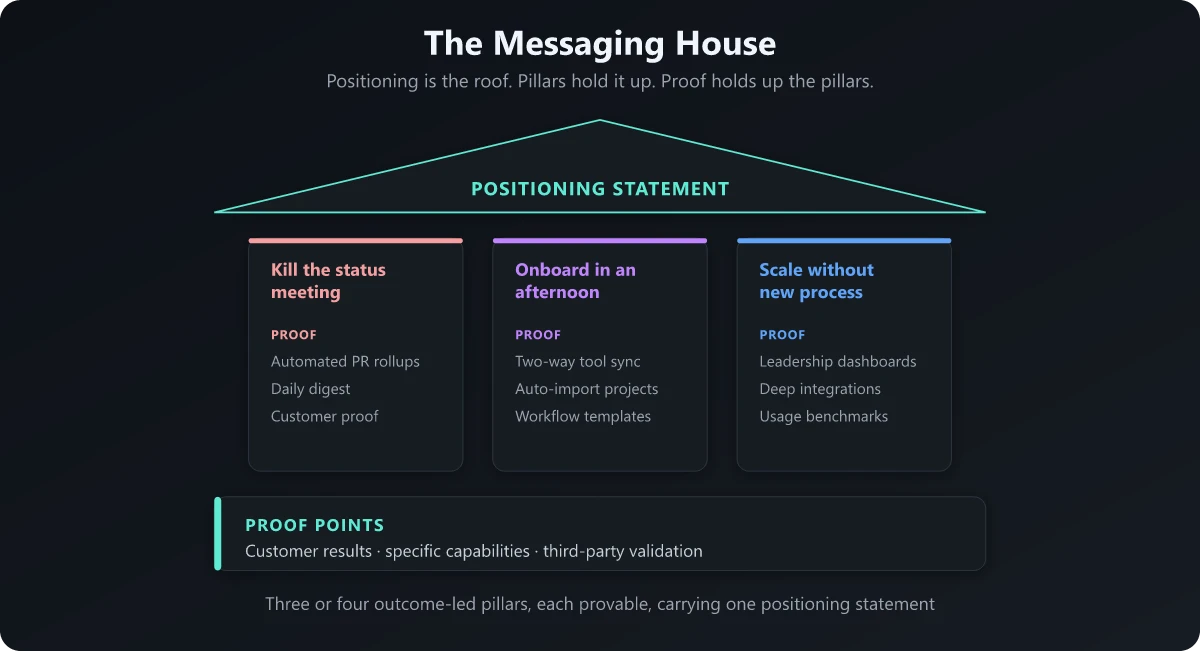
The roof comes first, always. You cannot write pillars until you know your positioning, because the pillars are just the reasons your positioning is true. If you have not nailed that layer yet, my guides on product positioning and market positioning walk through how to define the roof before you build the columns.
The foundation matters just as much as the roof. A pillar with no proof beneath it collapses the moment a skeptical buyer pushes on it. Proof points are the customer results, the specific capabilities, the third-party validation, and the concrete details that turn a claim into something a buyer will actually believe.
The house has to sit on a real value proposition
The whole structure only works if the positioning underneath is sound. Your messaging pillars are a way of expressing a value proposition, not a substitute for having one.
If your value proposition is fuzzy, your pillars will be fuzzy in exactly the same way, just in triplicate. Before you build pillars, make sure you can articulate a clear value proposition, and if you want a repeatable format for that, the value proposition template gives you the fill-in-the-blank version I use.
Pillars vs Features vs Taglines
This is where most messaging goes wrong, so it is worth being precise. Messaging pillars, features, and taglines are three different things, and confusing them is the fastest way to build a house that falls down.
| Messaging Pillar | Feature | Tagline | |
|---|---|---|---|
| What it is | A core theme in your value prop | A thing the product does | A short, memorable brand line |
| Answers | ”Why should I care?" | "What does it do?" | "Who are you, in a phrase?” |
| Lifespan | A year or more | Changes every release | Multi-year, rarely changes |
| Count | 3 to 4 | Dozens | One |
| Backed by | Proof points | Nothing, it is the proof | The pillars beneath it |
| Example | ”Ship faster without breaking things" | "One-click rollback button" | "Deploy with confidence” |
The trap is treating a feature list as a pillar list. “Real-time collaboration,” “SSO,” and “API access” are features, not pillars. The pillar is the outcome those features add up to, and the features become proof points that live underneath it. When a candidate pillar keeps coming back as a feature name, one-line tests for features, benefits and value show which tier it has reached, and the fix is to write the tier above it: a benefit for a feature line, a value line for a benefit.
A tagline is the opposite mistake in the other direction. It is a memorable line, but it is not working substance. You cannot brief a sales team on a tagline or write a landing page from it. The tagline is the tip of the iceberg; the pillars and proof are the mass beneath the water that hold it up. Whether a short line is a tagline at all, or a slogan written for one campaign, is a separate call, and I make it by checking where the line runs and how long it lasts. If you want the deeper distinction between the brand layer and the positioning layer, I unpack it in branding vs positioning.
How to Build Messaging Pillars in Six Steps
Here is the process I run every time, whether the product is brand new or being repositioned.
1. Lock your positioning first
You cannot build columns before you have a roof. Confirm your positioning statement: who the product is for, what category it competes in, and why it is different. Every pillar you write has to be a reason that positioning is true, so this has to be settled before anything else. If you are not certain which of the two layers is actually broken, diagnose that first in positioning vs messaging.
2. Mine the raw material from customers
Pull the reasons real buyers chose you, in their words. Read win-loss notes, sales call transcripts, support tickets, and review sites. You are hunting for the recurring reasons people say yes, because those are your pillar candidates.
The language matters as much as the substance. The words your buyers use to describe why they picked you are the words your pillars should use back. Pillars written in a conference room using internal jargon almost always miss.
3. Cluster the reasons into themes
You will end up with a messy list of twenty or thirty reasons. Group them. Reasons that are really the same underlying idea collapse into one theme, and after clustering you should see three or four clear buckets emerge naturally.
If you cannot get below five clusters, two of them overlap and you have not pushed hard enough. If you only have two, you may be describing a single feature rather than a full value proposition.
4. Name each pillar as an outcome
Give each cluster a name phrased as something the buyer gets, not something you built. “Enterprise-grade security” is a category; “Pass audits without slowing your team” is a pillar. The name should make a buyer feel understood, not read like a spec sheet.
Keep the names short and human. A pillar name a rep cannot say out loud in a meeting is a pillar name that will die in a slide deck.
5. Stack proof under every pillar
For each pillar, list three to five proof points that make it believable. These are your features, customer results, integrations, benchmarks, and third-party validation. This is where features finally belong, as evidence, not as headlines.
A pillar with no proof is an opinion. A pillar with three specific proof points is an argument. Always build the foundation before you present the pillar to anyone.
Before the named pillars go anywhere near a deck, put the candidate wordings in front of people outside the building and score them. Message testing examples has the question bank, the four axes worth scoring on, and what a gap has to clear at a realistic B2B sample size before it means anything.
6. Pressure-test with sales
The final test is whether a rep can use the pillars in a live conversation. If your sales team cannot repeat them back and build a pitch from them, they are too abstract and you go back to step four. Messaging that only works on a slide is not messaging, it is decoration. The cheapest place to run that test across the whole team at once is the annual sales kickoff, where a positioning relaunch followed by certification against a published scoring rubric tells you within a day which pillars reps can actually carry into a call.
Where all of this sits in the wider go-to-market picture is worth understanding too. Messaging pillars are one component of a larger product marketing framework that connects positioning, messaging, launch, and enablement into a single system.
Worked Examples: Messaging Pillars in Action
Abstract rules only get you so far. Let me show you real pillars on a fictional but realistic SaaS product, so you can see how the pieces connect.
Meet “Cadence,” an imaginary project management tool built for fast-growing engineering teams. Its positioning roof: for scaling engineering teams who are drowning in status meetings, Cadence is a project tool that keeps everyone aligned without a single standup.
Example pillar 1: outcome plus proof
Pillar: Kill the status meeting. This is the emotional core of the product, phrased as the thing the buyer most wants.
Underneath it sit the proof points that make it believable: automatic progress rollups from linked pull requests, a daily digest that replaces the standup, and a customer story where a 40-person team cut its recurring meetings to a handful. Notice that the features live here as proof, not as the headline.
Example pillar 2: the same pillar, flexed by audience
The power of a good pillar is that it holds its shape while flexing its expression. Here is “Kill the status meeting” written for two different buyers.
| Element | Pillar theme | For the VP of Engineering | For the individual developer |
|---|---|---|---|
| The claim | Kill the status meeting | ”Get visibility without stealing your team’s focus time" | "Stop reporting status you already logged in your commits” |
| The proof | Automated rollups | Team-level dashboards for leadership review | Zero manual updates, it reads your PRs |
| The feeling | Time back | Fewer meetings on the calendar | Fewer interruptions to deep work |
Same pillar, same proof engine, two completely different framings. That is what a pillar is for: one stable theme that a marketer, a rep, and a landing page can each express in the language of whoever is listening.
Example pillar 3: distinct, not overlapping
Cadence’s third pillar is “Onboard in an afternoon, not a quarter.” This is deliberately distinct from the first pillar because it answers a different objection, the fear of a painful migration.
Its proof points are a two-way sync with the tools the team already uses, an import that pulls in existing projects automatically, and templates that match common engineering workflows out of the box. If this pillar started leaning on “save time in meetings” it would collapse into pillar one, so it stays firmly in the adoption-and-migration lane.
Three pillars, each answering a different buyer question, each with its own proof. That is a complete messaging house, and everything else Cadence ever writes, from ads to sales decks to its own brand guidelines, gets written from these three columns.
Common Messaging Pillar Mistakes
A few patterns break pillars every time, and I have made most of them.
Feature lists in disguise. If your pillars read like the navigation menu of your product, you skipped the translation into outcomes. Push each one until it names a reason the buyer cares.
Overlapping pillars. Two pillars that are really the same idea waste a column and confuse the story. Every pillar must answer a different question, or it should merge with its twin.
No proof underneath. A pillar with nothing beneath it is a claim the market will not believe. If you cannot list three proof points, the pillar is not ready.
Too many. Six or seven pillars means none of them get used. Ruthlessly cut to three or four, because a pillar a rep cannot remember is a pillar that does not exist.
Written internally, never tested. Pillars drafted from a whiteboard instead of customer language sound like you, not your buyer. Mine the raw material from real conversations first.
Conclusion: Make Your Messaging Pillars Do the Selling
Messaging pillars are the three or four load-bearing themes that carry your value proposition, backed by proof, arranged inside a messaging house with your positioning as the roof. Build them from customer language, name them as outcomes, stack real proof beneath each one, and cut ruthlessly to a number a rep can actually remember.
Get this right and every asset your company produces starts pulling in the same direction, because it is all written from the same three columns. Get it wrong and you are back to five people describing five different products.
The reason this matters more than ever comes back to that number: buyers spend most of the journey deciding without you. Strong messaging pillars are how you stay persuasive in the rooms you never enter, which is exactly where most B2B deals are now won or lost.
Frequently Asked Questions
What are messaging pillars?
Messaging pillars are the three or four core themes that carry your product's value proposition. Each pillar names one distinct reason a buyer should care, and each one is backed by concrete proof points. Together they turn a single positioning statement into repeatable talking points a whole company can use.
How many messaging pillars should you have?
Three is the sweet spot, and four is the ceiling. Fewer than three usually means you are describing a single feature rather than a value proposition, and more than four means nobody on your team will remember them or use them consistently. If you have five candidates, two of them are almost always the same idea.
What is the difference between messaging pillars and features?
A feature is something your product does. A messaging pillar is a reason the buyer cares, phrased as an outcome, with features listed underneath as proof. Features change every release; pillars should hold steady for a year or more. If your pillar is just a feature name, you have skipped the translation into value.
What is a messaging house?
A messaging house is a one-page framework that stacks your positioning statement as the roof, three or four messaging pillars as the supporting columns, and specific proof points beneath each pillar as the foundation. It is the standard way product marketers organize a value proposition so sales, marketing, and product all say the same thing.
How are messaging pillars different from a tagline?
A tagline is a short, memorable line built for recall and brand feel. Messaging pillars are working substance: the load-bearing themes and proof that everything else is written from. A tagline might be derived from a pillar, but a pillar is never just a clever phrase, it has to survive a skeptical buyer asking why they should believe you.