Company Boilerplate Examples (2026): 95 Releases Measured
Company boilerplate examples from 95 B2B software and AI press releases sent 29 Sep to 1 Oct 2026 show the median length, a first-sentence test and a template.
The median company boilerplate in 95 B2B software and AI press releases sent between 29 September and 1 October 2026 ran 78 words. I took one About paragraph per company from PR Newswire and GlobeNewswire, counted every word, and checked each paragraph against its live release on 2 October. The company boilerplate examples below all come from that sample, picked for contrast rather than polish.
Length is the part these companies mostly get right: 76 of the 95 sit inside the widest of four published length rules, Prezly’s 50 to 150 words (the other three say around 100, 50 to 100 and 75 to 125). The first sentence is where most of them miss. Only 22 of 95 say both what the company sells and who buys it, and I read that sentence as the positioning statement with the template stripped off: if it skips the category and the buyer, the word count is beside the point.
What Is a Company Boilerplate?
A company boilerplate is the standard “About [Company]” paragraph at the end of a press release: a fixed description of what the company sells, who buys it and where to learn more, reused in every release. In the 95 releases measured here, the middle half ran 60 to 95 words.
Company Boilerplate Examples: 14 From the Sample, Annotated
Each entry quotes from the boilerplate verbatim, with dashes, quote marks and trademark symbols set as plain text, and links the release it ran in. “Category” and “buyer” follow the coding rules in the first-sentence section below.
| # | Company | Words | First sentence names | Proof in the paragraph | The one change |
|---|---|---|---|---|---|
| 1 | Datasite | 80 | Category and buyer | 50 years of experience | Add a customer count to sentence two |
| 2 | PULPO WMS | 44 | Category and buyer | Order errors down by up to 99% | None |
| 3 | OpenMetal | 13 | Category | None | Name the buyer |
| 4 | Limble | 78 | Category | 3,500 customers | Move the industries into sentence one |
| 5 | OnBoard | 36 | Category | 7,000 organizations | Move the customer types into sentence one |
| 6 | Fresha | 86 | Category and buyer | 130,000 partner businesses | Cut “world’s leading” and “AI-powered” |
| 7 | Bentek | 77 | Buyer | 98% retention, NPS of 84 | Move the category into sentence one |
| 8 | Gong | 78 | Buyer | 5,000 organizations | Add a category to sentence one |
| 9 | Clio | 127 | Category | 100+ bar associations | Swap “global leader” for the endorsement |
| 10 | Workday | 76 | Buyer | 11,500 organisations | Add a category, unless the name carries it |
| 11 | WinMagic | 103 | Neither | Nearly three decades | Open with the category, mission second |
| 12 | Plutou | 48 | Neither | None | Swap the first two sentences |
| 13 | Semperis | 194 | Category and buyer | 1,200 organizations | Move the event and free tools into the release |
| 14 | Bloomberg and Canoe | 61 and 116 | Category (Bloomberg) | None in Bloomberg’s | None: the parent is in the second heading |
1. Datasite: Category and Market in Seven Words
“Datasite is the essential infrastructure for M&A.”
Datasite’s paragraph runs 80 words in a GlobeNewswire release of 29 September: the seven-word first sentence carries a category (deal infrastructure) and the market it serves, and the second names the buyers, “companies, investors, and advisors”. Copy those two sentences; the only proof comes in the fifth (“more than 50 years of experience”), and a customer count in the second would complete it.
2. PULPO WMS: One Category, Three Buyer Types
“PULPO WMS is a cloud-based warehouse management system for e-commerce brands, fulfillment companies and third-party logistics providers.”
This is the “[Company] is a [category] for [buyer]” shape with nothing added, from a 44-word paragraph in a GlobeNewswire release of 30 September. The second sentence brings reach (warehouses in more than 20 countries) and an outcome figure, “reducing order errors by up to 99%“.
3. OpenMetal: The Whole Boilerplate in 13 Words
“OpenMetal (https://openmetal.io/) delivers dedicated cloud and GPU infrastructure without the public cloud markup.”
That is the entire paragraph, from a PR Newswire release of 30 September, and at 13 words the shortest in the sample. It names the category and the alternative it beats, “without the public cloud markup”, which does the job of the “Unlike [primary alternative]” sentence in a classic positioning statement in five words; it skips the buyer. The same release carries a 22-word paragraph for Economize, the company OpenMetal bought.
4. Limble: The Median, at 78 Words
“Limble is the modern maintenance and asset management platform trusted by over 3,500 customers globally.”
Limble’s paragraph in this PR Newswire release of 1 October runs 78 words, the sample median, and its first sentence pairs a category with a proof number. The buyer waits for the third sentence, as a list of industries: “From manufacturing and facility management to healthcare and hospitality”.
5. OnBoard: Proof Before the Product
“Serving more than 7,000 organizations across 60 countries, OnBoard provides board management software for meeting preparation, collaboration, and governance records.”
In this PR Newswire release of 30 September, the customer count leads and the category follows in the same sentence. The buyers come one sentence later: “public companies, healthcare systems, universities, nonprofits, and financial institutions”.
6. Fresha: Everything in One Sentence, Stock Phrases Included
“Fresha is the world’s leading AI-powered booking platform for beauty and wellness, trusted by over 130,000 partner businesses across more than 120 countries.”
This PR Newswire release of 1 October fits category (booking platform), market (beauty and wellness) and proof (130,000 partner businesses) into the top sentence of an 86-word paragraph. That sentence also carries the two most common kinds of stock phrase in the sample, a leadership claim (“world’s leading”) and an AI adjective (“AI-powered”). Delete both and it loses nothing a buyer would check.
7. Bentek: A Retention Rate Instead of a Customer Count
“Bentek maintains a 98% client retention rate and an NPS of 84.”
That is the third sentence of a 77-word paragraph in a PR Newswire release of 1 October. Bentek’s first sentence names the buyer, “public sector organizations”, and its second the category, “benefits administration technology”.
8. Gong: The Buyer Without the Category
“Gong harnesses the power of AI to transform how revenue teams win.”
A 78-word paragraph in a PR Newswire release of 30 September starts with this line. The buyer is clear (revenue teams), but the product only arrives in the second sentence, by name (“Gong Revenue AI”) and as “a single, trusted system”. Gong is one of 10 companies whose first sentence names a buyer without a category, and its proof comes in the third: “more than 5,000 organizations around the world”.
9. Clio: A Leadership Claim in Eight Words
“Clio is the global leader in legal AI.”
Eight words open a 127-word paragraph in a PR Newswire release of 30 September. The category (legal AI) is there, but the claim doing the work is “global leader”, one of 22 leadership claims in the sample. Clio’s checkable proof sits further down, “endorsed by over 100 bar associations and law societies worldwide”, and in the first sentence it would carry evidence instead of a rank.
10. Workday: The Name Does the Category’s Job
“Workday operates at the heart of the enterprise, HR, finance, and IT - where the margin for error is effectively zero.”
In a 76-word paragraph from this PR Newswire release of 1 October, that sentence names three departments, which count as a buyer under the rules below, and no category. It assumes the reader already knows what Workday sells, and the third sentence backs that up: “More than 11,500 organisations worldwide, including more than 65% of the Fortune 500, trust Workday to deliver.” I would not copy this shape without that level of recognition.
11. WinMagic: Mission First
“WinMagic’s mission is to secure the digital world through high standards and strong ethics.”
The category in this 103-word paragraph from a PR Newswire release of 30 September waits for the second sentence, framed as history: “For nearly three decades, the organization has led innovation in encryption and endpoint security.” Three first sentences in the sample are pure mission or vision statements: WinMagic’s, Netwrix’s and Plutou’s.
12. Plutou: Mission First, Recovered by the Second Sentence
“Plutou is on a mission to change how the world deals with waste. Its AI-native operations platform helps collection companies plan routes, manage locations and run field operations in a single system, serving textile, book and donation collection networks across the US and Europe.”
That is the whole 48-word paragraph apart from its web address, from a GlobeNewswire release of 1 October. If a mission line has to lead, this is the version that still works: the second sentence delivers the category (operations platform), the buyer (collection companies), the jobs it does and the markets.
13. Semperis: The Longest, at 194 Words
“Semperis is the identity-driven cyber resilience and crisis management company trusted by the world’s largest enterprises and government agencies to protect critical identity systems.”
This PR Newswire release of 1 October carries the sample’s longest paragraph, and its first sentence still names both a category and a buyer. The other 170-odd words cover supported identity platforms, the product, a conference, a podcast, two free tools, a customer count (“More than 1,200 organizations”), headquarters and a social-media line.
14. Bloomberg and Canoe Intelligence: Parent and Acquired Company
The PR Newswire release of 1 October announcing Bloomberg’s completed acquisition of Canoe ran a 61-word Bloomberg paragraph and a 116-word second one, headed “About Canoe Intelligence, a Bloomberg Company”. Canoe’s paragraph begins:
“Canoe Intelligence, a Bloomberg company (‘Canoe’), is the data management and intelligence platform for smarter alts management.”
The acquired company’s paragraph is nearly twice the length of the parent’s.
How Long Should a Boilerplate Be? Four Rules Against 95 Real Ones
Somewhere between 60 and 100 words: the middle half of this sample ran 60 to 95, and 74 of the 95 came in at 100 or under.
| Rule | Who says it | Inside the rule | Share of 95 |
|---|---|---|---|
| ”around 100 words long” | PR Newswire’s boilerplate guide | 35 within 80 to 120 | 37% |
| “50-100 words maximum” | eReleases, updated 1 May 2026 | 59 | 62% |
| Around 50 to 150 words | Prezly, updated 12 Aug 2026 | 76 | 80% |
| “about 75 to 125 words” | compose.ly, published 5 Jan 2026 | 48 | 51% |
PR Newswire gives a target rather than a range, so I counted 80 to 120 words as inside it.
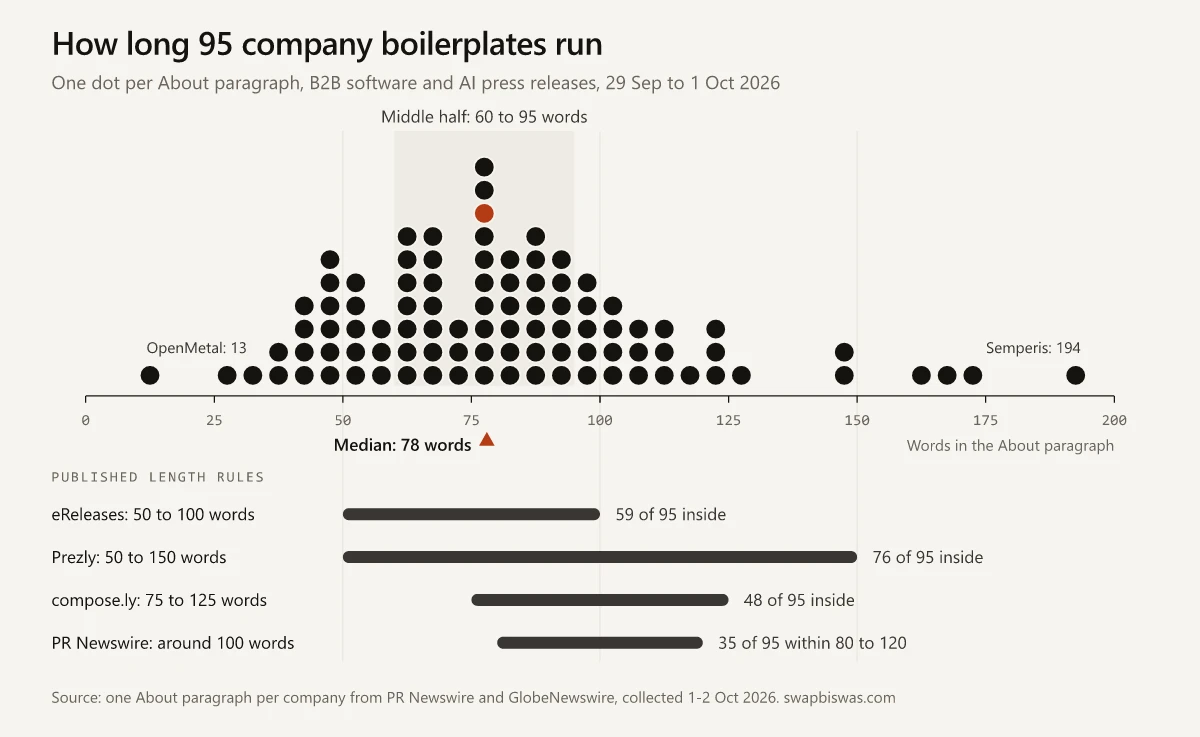
None of these four guides counts across a sample, and neither does propllr’s guide. Prezly and propllr give word counts for single examples; the others give a rule and hand-picked examples.
- 15 of 95 ran under 50 words and 21 ran over 100. Only 4 went past 150.
- Length did not separate strong first sentences from weak ones. The 22 boilerplates whose first sentence named a category and a buyer had a median of 78 words; the 26 that named neither had a median of 85.
My rule for paragraphs over 100 words: cut event plugs, founding stories and social handles before you cut proof.
The First Sentence in 95 Company Boilerplate Examples
Of the 95 first sentences, 59 name a category, 32 name a buyer, 22 name both and 26 name neither. Each is a judgment call against the rules below, and every call is in the per-company file with the phrase behind it.
| Code | Counts | Does not count |
|---|---|---|
| Category (what is sold) | A product type tied to a job (“warehouse management system”, “data loss prevention platform”), or a field narrow enough to name the product (“legal AI”, “breach containment”) | A sector label (“a global cybersecurity company”), a term that does not say what is sold (“unified resilience”), a line about what the company does (“stops more email attacks”) |
| Buyer (who buys it) | A named customer group, team or department (“revenue teams”; “HR, finance, and IT”), or a “for [market]” phrase (“for M&A”, “for population health management”) | Generic words (organizations, businesses, enterprises, customers), size badges (“Fortune 500 companies”), an industry word that only labels the product (“legal AI”), a “for” phrase that names the product’s own job (“for privileged access”), a technology or an era (“for enterprise AI”, “for the Agentic Era”), or assets and places rather than buyers (“critical infrastructure”) |
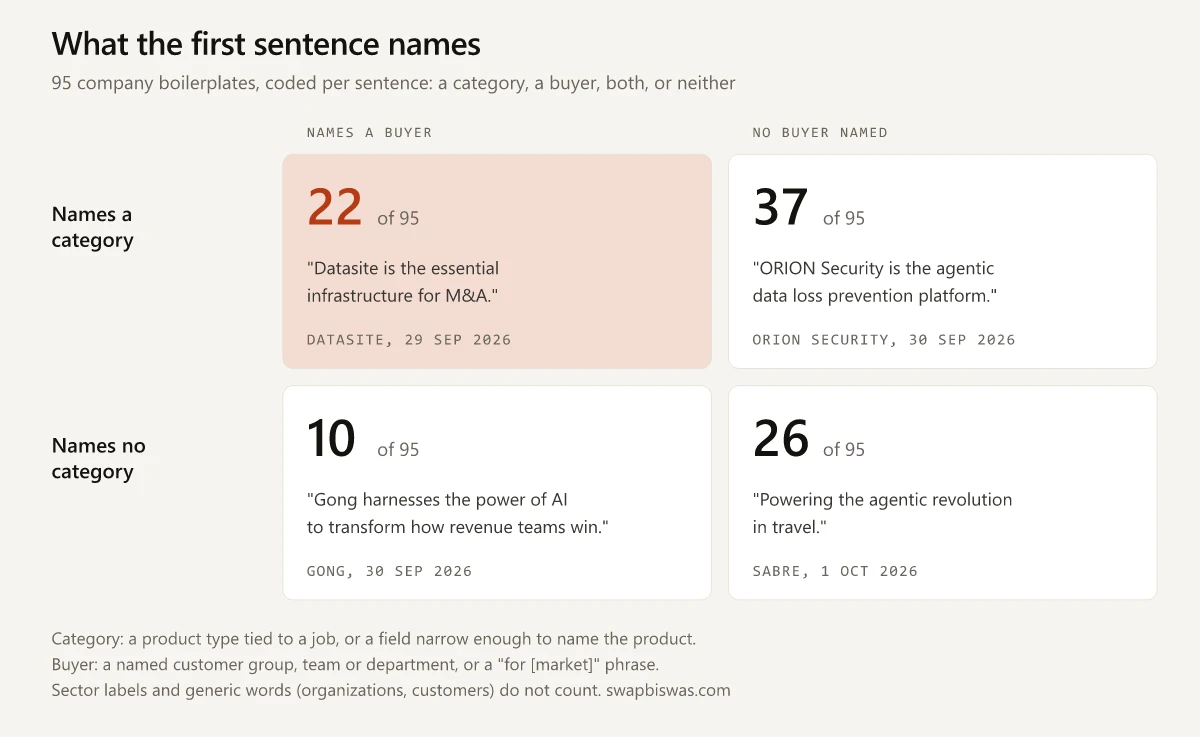
The two right-hand examples come from ORION Security’s release of 30 September and Sabre’s of 1 October; the other two are examples 1 and 8 above.
compose.ly’s guide tells writers to “open with a distilled version of your mission statement”, and propllr’s formula starts with aspiration. I would put the mission second. eReleases’ core description opens “[Company Name] is a [type of business] that [what you do] for [target audience]”, and all three mission-first openers in this sample leave the category to the second sentence. That eReleases opening carries the two parts of the “For [target audience] who [pain point/need], [product name] is a [category]” statement from my notes on writing a product positioning statement: the category and the “for”. 73 of the 95 first sentences drop at least one of those two.
| If the first sentence names | Boilerplates | Change this |
|---|---|---|
| A category and a buyer | 22 | Keep it. Put one proof number in the second sentence |
| A category only | 37 | Add “for [buyer]“ |
| A buyer only | 10 | Add the category before the verb |
| Neither | 26 | Rewrite it, and move the mission or the slogan to the second sentence |
If you cannot tell whether the line you opened with is a slogan or a tagline, a Wayback Machine check a year after launch settles it: a line still beside the company name a year later is doing a tagline’s job.
If press coverage keeps putting you in a category you did not choose, run the check in positioning vs messaging that compares your category line against your last three briefings and your boilerplate. When the boilerplate is the odd one out, fix the boilerplate first, since every release repeats it.
What Goes in a Press Release Boilerplate: 14 Elements Counted
Each row is counted across all 95 paragraphs. The pattern or coding rule behind each one is in the method section, and the per-company file shows which elements every boilerplate matched.
| Element | Boilerplates | Share |
|---|---|---|
| A web address | 62 | 65% |
| A mention of AI (the company’s own name excluded) | 62 | 65% |
| A category in the first sentence | 59 | 62% |
| A buyer in the first sentence | 32 | 34% |
| A customer or user count | 23 | 24% |
| “Leader” or “leading” about the company or its product | 22 | 23% |
| AI-powered, AI-driven, AI-native or AI-enabled about the company or its product | 21 | 22% |
| “Trusted by” | 16 | 17% |
| “Headquartered” | 15 | 16% |
| A stock ticker | 11 | 12% |
| A founding or launch year | 11 | 12% |
| A word built on “innovat” about the company or its product | 8 | 8% |
| Named investors or a funding amount | 6 | 6% |
| An outcome or satisfaction figure (errors, costs, retention, NPS, CSAT) | 4 | 4% |
The rarest element is proof beyond scale: four paragraphs give an outcome or satisfaction figure, against 23 that give a customer count. Only two report a result their customers got: PULPO WMS (order errors down by up to 99%) and AppZen, whose paragraph says CFOs “are reducing operating costs by up to 50 percent”. The other two are Bentek (98% retention, NPS 84) and Netwrix (a 95% customer satisfaction rating).
The Stock Phrases: Leading, AI-Powered, Innovative
- 22 of 95 call themselves or their product a leader or leading. 19 of those put it in the first sentence, and only 7 of the 19 also name a buyer there.
- 21 describe themselves or their product as AI-powered, AI-driven, AI-native or AI-enabled. Four more use the same words about customers or the world around them, which I did not count.
- 8 use a word built on “innovat” about themselves or their product; counting every use, 12 do.
compose.ly advises “Avoid vague claims or overused phrases about innovation or leadership.” The propllr guide, written after its author “looked at a ton of boilerplates”, files “leading” under bragging. Neither publishes a count. Counted the same way, about the company or its product, the leadership claim (22) turns up almost three times as often as the innovation one (8).
Two Boilerplates in One Release: 17 Cases in the Sample
19 of the 95 releases carried more than one About paragraph. Two of the extras described a study and a conference, so 17 releases ran a boilerplate for a second organization or product.
| Why the second paragraph is there | Releases | Example pairs |
|---|---|---|
| Acquisition | 4 | Bloomberg and Canoe Intelligence; OpenMetal and Economize; Electric Power Group and Grid Protection Alliance; Modaxo and Conduent, the seller of two businesses Modaxo bought |
| Partner, reseller or industry body | 6 | Huntress and ALSO; Guesty and Column; Definitive Healthcare and the NAI |
| Customer | 4 | Parambil and CM Injury Trial Lawyers; TechSee and Glintt Life |
| Product brand | 2 | Neutrinos and Kamios; Caelith AI and Fypro.ai |
| Award bodies | 1 | Rokt with Fortune Media and Great Place To Work |
Bloomberg’s release puts the parent’s name in the second heading and in the acquired company’s first sentence (“Canoe Intelligence, a Bloomberg company”). The Electric Power Group release and OpenMetal’s do not: Grid Protection Alliance’s 48-word paragraph never mentions its buyer, and neither does Economize’s, although OpenMetal’s release says it “has acquired” Economize.
My rule for the acquired company: once the deal closes, add the parent to the heading and to the first clause, and keep the acquired company’s own category line after it. If the deal also renames the company, add the boilerplate to the Day 0 swaps in a rebranding rollout plan, next to the press release and the homepage flip.
Method and Limits of the 95-Release Sample
- Sample: one About paragraph per company from PR Newswire (70) and GlobeNewswire (25) releases dated 29 September to 1 October 2026, from B2B software, SaaS and AI companies. Software-testing and QA vendors were left out. Business Wire is missing: its release pages refused connections from my collection script.
- Check: on 2 October every paragraph was matched against its live release. The 70 PR Newswire paragraphs matched character for character. The 25 GlobeNewswire pages would not load in my script, so I checked them through a headless browser, where they matched once quote marks, dashes and trademark symbols were normalized.
- Word count: whitespace-separated tokens that contain at least one letter or digit, so a standalone dash is not a word and a URL is one.
- First-sentence coding: a judgment call per sentence against the rules in the first-sentence section, not a pattern match. Every call is in the file below with the phrase that earned it, so you can disagree row by row. As a cross-check, the category pattern in the block below matches 43 first sentences, 37 of them coded as naming a category: it misses categories that do not follow “is a” (“provides board management software”) and catches sector labels (“a global cybersecurity company”).
- Limits: three days of releases, one sector group, first-sentence calls that were not double-coded, and wire releases only, not website About pages. Read it as a picture of B2B software and AI boilerplates in early autumn 2026, not of press releases in general.
The element patterns, case-insensitive unless noted:
web address     https?://|www\.|[a-z0-9-]+\.(com|io|ai|net|org|co|app|tech|cloud|security|tv)\b, each match checked in context; 2 that only hit a name spelled as a domain (Coupler.io) removed
AI mention      \bAI\b (case-sensitive)|GenAI|artificial intelligence|agentic|machine learning|\bLLMs?\b|generative, after removing the company's own name
leader          \b(leading|leader)\b, each match checked in context; 5 uses about customers, partners or another firm removed
AI adjective    \bAI[- ](powered|driven|native|first|enabled)\b, each match checked in context; 4 uses about others removed
innovation      \binnovat\w*, each match checked in context; 4 uses about customers, other firms or innovation in general removed
investors       backed by|funded by|\binvestors?\b|\braised\b|\bfunding\b, each match checked in context; 5 that name no investor or amount removed
trusted by      \btrusted by\b
headquartered   \bheadquarter(ed|s)\b
ticker          a bracket containing NASDAQ, NYSE, TSE, TSX, LSE, ASX or OTC
founding year   (founded|established|since|launched), then a year within 25 characters
category check  \b(is|are)\s+(a|an|the)\b.*?\b(platform|company|provider|system|software|solution)s?\b, first sentence only
Customer counts and outcome or satisfaction figures were coded per paragraph: a specific number of customers, users or organizations served counts, while “thousands of” or “Fortune 500 companies” does not. Download the per-company CSV (95 rows: release URL, word count, each element, the first-sentence codes with their notes, any second About paragraph, and the first sentence).
A Company Boilerplate Template in One Line
[Company] is a [product category] for [buyer]. [One proof number: customers, outcome or scale]. [What it does, in the buyer's words]. Learn more at [web address].That line puts the category and the buyer in the first sentence, which is where most of the company boilerplate examples above fall short. No customer count yet? 6 of the 95 name their investors instead. Hold the whole paragraph between 60 and 100 words, where just over half of this sample landed.
Three first sentences from the sample, rewritten with that line and only facts printed in the same paragraph (my rewrites, not the companies’):
| Company | First sentence as published | Rewrite |
|---|---|---|
| Gong | ”Gong harnesses the power of AI to transform how revenue teams win.” | Gong is a revenue AI system that unifies data, insights and workflows for revenue teams. |
| Limble | ”Limble is the modern maintenance and asset management platform trusted by over 3,500 customers globally.” | Limble is a maintenance and asset management platform for manufacturing, facility management, healthcare and hospitality teams, trusted by over 3,500 customers. |
| Clio | ”Clio is the global leader in legal AI.” | Clio is a legal AI platform for solo practitioners, law firms, in-house teams and government, endorsed by over 100 bar associations and law societies. |
Re-test the line whenever a press release goes onto your product launch checklist, since a new product line can change which category is true.
Fix the first sentence before you count a single word.
Frequently Asked Questions
What is a boilerplate in a press release?
It is the standard About paragraph at the end of a press release, also called a boilerplate company description: a fixed description of the company that runs unchanged under every announcement. PR Newswire defines it as 'a standardized paragraph at the end of a press release that provides key information about your organization.'
How long should a company boilerplate be?
Aim for 60 to 100 words. In 95 B2B software and AI press releases sent from 29 September to 1 October 2026, the median About paragraph ran 78 words and the middle half ran 60 to 95. Published rules range from eReleases' 50 to 100 words to Prezly's 50 to 150.
What should a press release boilerplate include?
A first sentence that names the category and the buyer, one proof number, and a web address. In the 95-release sample, 62 boilerplates carried a web address and 23 a customer or user count, but only 22 named both a category and a buyer in the first sentence.
What is an example of a company boilerplate?
PULPO WMS ran a 44-word boilerplate in a GlobeNewswire release of 30 September 2026. It opens 'PULPO WMS is a cloud-based warehouse management system for e-commerce brands, fulfillment companies and third-party logistics providers.' A second sentence adds its reach and an outcome figure.
Is there a company boilerplate template?
Yes, in one line: '[Company] is a [product category] for [buyer]. [One proof number: customers, outcome or scale]. [What it does, in the buyer's words]. Learn more at [web address].' Hold the whole paragraph to 60 to 100 words.