Positioning vs Messaging: Which One Is Broken?
Positioning vs messaging, resolved at the artifact level: who owns which document, and a symptom diagnostic that names the layer to fix before you rewrite.
The word positioning gets attached to at least three different objects in a normal week: a strategy document, a slide in a board deck, and the headline at the top of the homepage. Messaging gets attached to the same three. The definitions are settled, and April Dunford’s quickstart guide is blunt about them: “Positioning is not equivalent to messaging. It isn’t a tagline.” That settles the words. It does not settle what positioning vs messaging means when you have to open a file and change something.
When a launch lands flat, the question is which of those three objects you open.
The pair is only useful when it ends in an artifact and an owner. Below is the artifact map, a symptom diagnostic that names the broken layer before anyone opens a doc, and the whole split shown on one company’s live pages.
What Is the Difference Between Messaging and Positioning?
Positioning is a decision about where you compete. Messaging is the language that carries that decision to one audience in one channel.
Positioning has a small, fixed set of variables: the competitive alternative, the differentiated capability, the value that capability creates, the best-fit customer, and the market category. That is the five-component structure April Dunford publishes, and it is why positioning fits on one page.
Messaging has no fixed length. One positioning statement produces a homepage hero, a pricing page, three or four pillars with proof under each, a sales narrative, an objection response for every competitor, and a subject line. All of them are messaging.
The concept-level split (scope, lifespan, owner) is already laid out in what market positioning is, and the six-part framework plus statement format sits in product positioning. This post picks up where those stop: at the artifact.
The dependency is asymmetric, and the asymmetry is the whole operating rule:
- Change positioning and every message downstream is now wrong. New category noun, new alternative, new segment, so the hero, the pillars, the deck and the battlecards all need rewriting.
- Change messaging and positioning is untouched. Better words for the same decision.
- A copy edit that changes who you say you beat is not a copy edit. That is a positioning decision made by whoever happened to hold the pen.
Positioning vs Messaging: The Artifact Map
Arguments about positioning vs messaging are usually arguments about a document nobody has assigned. This table assigns them. The layer column decides the sign-off, and the tell column is what you notice first when the artifact has drifted.
| Artifact | Layer | Sign-off | Reopen every | The tell that it has drifted |
|---|---|---|---|---|
| Category line (“we are a ___“) | Positioning | Founder or CEO, drafted by PMM | 1-3 years | Buyers compare you against a different category |
| Competitive alternatives list | Positioning | PMM with sales leadership | 2 quarters | Lost deals name a competitor absent from the list |
| Best-fit customer definition | Positioning | PMM plus sales leadership | 2-4 quarters | One segment’s win rate drops while the rest hold |
| Differentiated value and its proof | Positioning | PMM with product | 2 quarters | Deals collapse into a price comparison |
| Positioning statement (one page) | Positioning | PMM, CMO signs | Annual | Product and marketing describe the thing differently |
| Value proposition | Messaging | PMM | 2 quarters | The homepage reads as a feature list |
| Messaging pillars and proof points | Messaging | PMM | 2 quarters | Each rep leads with a different reason to buy |
| Homepage hero and subhead | Messaging | PMM with web or growth | Monthly | Traffic the deck would convert bounces |
| Sales deck narrative | Messaging | PMM with enablement | Quarterly | The demo stalls right after the setup slides |
| Battlecards | Messaging | PMM with competitive intel | Monthly | Objection handling gets improvised on calls |
| Ad, email and campaign copy | Messaging | Demand gen, PMM reviews | Weekly | Click-through holds, qualified pipeline does not |
| Release notes and changelog | Messaging | PM writes, PMM reviews | Per release | Customers are surprised by their own product |
Two rules fall out of the map.
Positioning has one document and many dependents. If two positioning artifacts disagree, the positioning statement wins and the other one gets corrected the same day. Messaging can hold several true variants at once, because a CFO and an end user need different sentences for the same decision.
Sign-off follows blast radius, not seniority. The category line and the best-fit customer constrain the roadmap and the sales plan, so they need the founder on them. Pillars, hero copy and battlecards belong to product marketing outright, provided they stay inside the positioning already agreed.
The Positioning vs Messaging Diagnostic
The usual answer is to rewrite something and see what happens, which costs a quarter and returns a result nobody can attribute. The table below routes a symptom to a layer using evidence you already have in the CRM.
Some symptoms only one layer can produce. Others both can, and where the broken-layer column carries two verdicts, the distinguishing test is what picks between them.
| Symptom | Distinguishing test | Broken layer | Change this | Leave alone |
|---|---|---|---|---|
| Deals stall at or right after the demo | Pull the last 10 stalled deals. Did the champion have an internal case that named what they were choosing against? | No named alternative: positioning. Named it but could not repeat your differentiator: messaging | Alternatives list, or pillar proof | The homepage |
| Prospects compare you to the wrong competitor | Count how many of the last 20 opportunities named an alternative that is not on your list. Five or more is the threshold | Positioning | Category line and alternatives list | Ad copy, which is faithfully carrying a wrong category |
| The deck tests well, the website does not convert | Read the deck’s first three sentences beside the hero and subhead. Do they make the same promise? | Messaging | Hero, subhead, and the first screen of proof | The positioning statement |
| Win rates fall in one segment only | Compare segment win rates over two full quarters, then compare the alternatives named in the losing segment against the others | Positioning, at the best-fit customer | Segment definition and a segment-specific position | Pillars, which are probably fine elsewhere |
| Three reps give three different answers to “what is it” | Ask each to write one sentence, cold, no doc. Three different categories is positioning; one category with three different value claims is messaging | Either, and the test tells you which | Positioning statement, or pillars and proof | Whichever one the test cleared |
| Traffic and demo requests are healthy, closed-won is flat | Compare the promise on the acquisition page to the first five minutes of the demo | Consistent promise: positioning attracted the wrong segment. Mismatched promise: messaging over-promised | Best-fit customer, or the acquisition page | The sales narrative until the source is settled |
| Analysts and press file you under a category you did not choose | Check whether your own category line appears verbatim in your last three briefings and your boilerplate | Positioning | Category line and the proof that earns it, then rebrief | Taglines |
| A competitor’s launch flattens your pipeline | Split recent losses into “lost to them” and “lost to no decision” | Lost to them: positioning at differentiated value. Lost to no decision: messaging at value and urgency | Differentiated value and proof, or the value proposition | The category, which the competitor just validated |
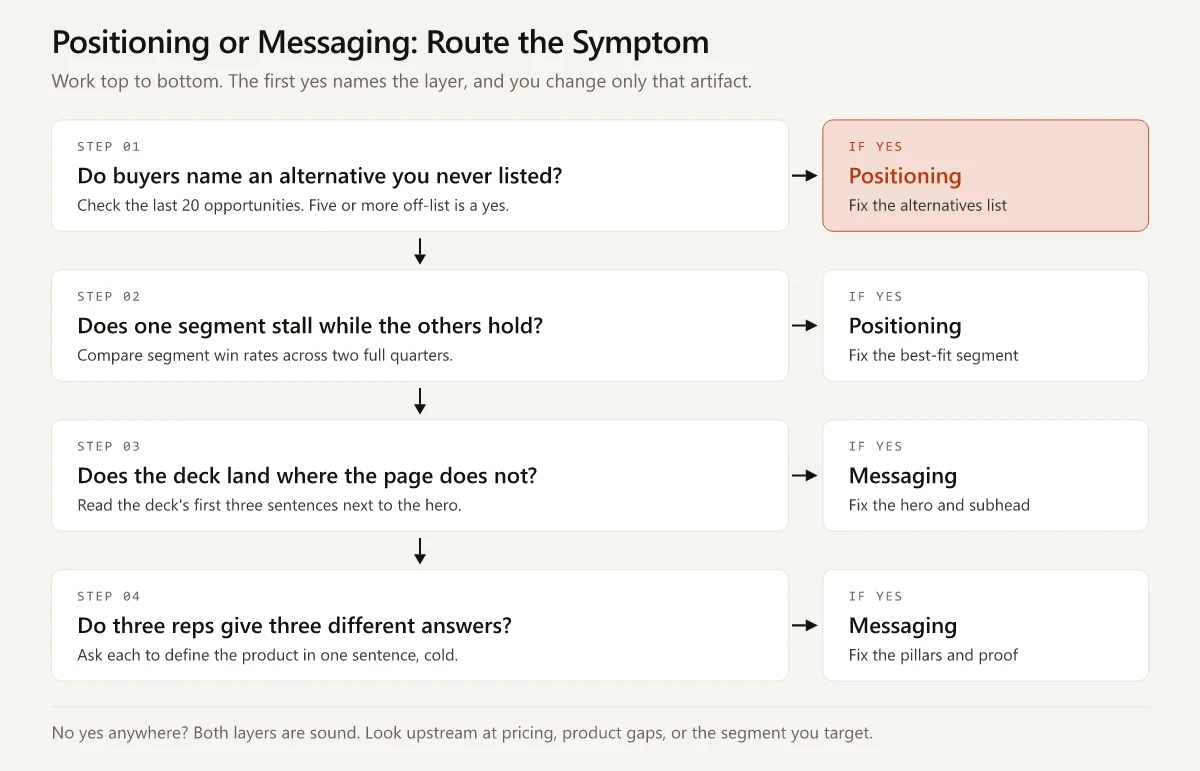
Run the ladder top to bottom, stop at the first test that fires, and change only that layer’s artifact. A run where nothing fires still tells you something: the symptom belongs to pricing, a product gap, or the segment you aimed at, and no rewrite of either layer will move it.
The Twenty-Deal Check Before Any Rewrite
This is the cheapest version of the diagnostic and takes an afternoon. Pull the last 10 closed-won and 10 closed-lost opportunities, and for each one write down the alternative the buyer considered, in the buyer’s words rather than yours.
Then run these in order and stop at the first that fires, the same rule the ladder uses:
- Fifteen or more of the 20 naming the same two alternatives, with the losses reading as “we could not see the difference”. Buyers have you on the right shelf and cannot tell you apart. Messaging, at differentiated value and proof.
- Ten or more naming something that is not a product: a spreadsheet, an internal build, or nothing at all. You are being compared to the status quo rather than to a vendor, so the value has to beat doing nothing before it beats anyone. Positioning, at differentiated value.
- More than four distinct alternatives, with no single one named in more than five of the 20 deals. Buyers are sorting you onto different shelves. Positioning, at the category line.
- Wins and losses naming the same alternatives at similar rates. The layers are not the variable. Look at pricing, the sales process, or timing.
The interview questions that produce quotable buyer language are in win-loss analysis questions, and the mechanics of running the program properly sit in what win-loss analysis is. For the segment comparison in step two of the ladder, SaaS win rate benchmarks give you a reference point for what a real drop looks like against normal variance.
The twenty-deal check tells you what buyers revealed under pressure. If you want the stated-preference half as well, before a rewrite rather than after it, message testing examples carries the survey instrument and the rule for what to do when the scores and the lost deals disagree.
Product Positioning and Messaging Examples: Linear
The split is checkable from outside the company. Linear’s public pages carry both layers, checked on 10 September 2026.
The Linear homepage headline reads “The product development system for teams and agents”, with the subhead “Purpose-built for planning and building products. Designed for the AI era.”
Three positioning variables are visible in nineteen words:
- Category: a product development system, a wider claim than a tracker or a project management app.
- Best-fit customer: teams and agents, which puts software agents alongside humans in who the system is built for.
- Differentiated value: “purpose-built”, a claim about how the system was made rather than a feature it has.
Now the same positioning, flexed for a different buyer. The Linear enterprise page headline reads “An AI product system for modern enterprises”, with the subhead “Linear gives teams and agents shared context for planning and building products at scale.” Further down, the page names the alternative outright: “Linear replaces legacy issue trackers with a fast, purpose-built system designed for AI-native product development.”
Compare the two pages variable by variable. The category noun holds: both call it a system. The buyer pair holds: teams and agents on both. The differentiator holds: “purpose-built” on both. What moved is the audience qualifier (“modern enterprises”), the stakes (“at scale”), and the proof the page reaches for.
That is a messaging change with positioning constant, which is what a healthy second page looks like.
For the contrast, look at the same homepage four years earlier. The archived Linear homepage from 31 May 2022 headline reads “The issue tracking tool you’ll enjoy using”, under a meta description promising help with “software projects, sprints, tasks, and bug tracking.”
Category noun in 2022: issue tracking tool. Category noun today: product development system. And the 2022 noun reappears on the enterprise page inside the alternative Linear now names: “legacy issue trackers”. Those are positioning variables moving, and when they move, every downstream artifact in the map has to move with them: the hero, the pillars, the deck, the analyst briefing.
One company, both changes, both visible from outside. That is the practical test of whether you are looking at a positioning change or a messaging one: check whether the category, the alternative or the segment moved.
The Positioning and Messaging Framework in One Page
A positioning and messaging framework is a stack rather than a document, and each layer is an input to the one below it:
- Positioning inputs: competitive alternatives, differentiated capabilities, the value those capabilities create, best-fit customers, market category.
- A positioning statement, one page, one owner, signed by the founder or CMO.
- A value proposition, which is the single strongest reason for the best-fit buyer, written for them. Fill-in structures are in the value proposition template.
- Three or four messaging pillars carrying that value proposition, each with proof underneath.
- Activation: the matrix and hierarchy that flex the pillars per audience and channel, covered in the brand messaging framework.
Drawing it as a stack rather than a checklist shows how far any change propagates. Edit layer 1 and everything below is stale. Edit layer 5 and nothing above it moves.
Layer 3 is where the two disciplines are easiest to confuse, because a value proposition is written like messaging and constrained like positioning. Test it this way: if a competitor could honestly say your value proposition back to the same buyer, the problem is in layer 1, not in the sentence.
The Rewrite Sequence After a Flat Launch
Changing the wrong layer is expensive in different ways, which is why the sequence matters.
Rewriting messaging when positioning is broken is cheap and useless. You get better-worded confusion, three weeks gone, and a team now convinced the copy was never the issue.
Rewriting positioning when messaging is broken is expensive and destabilizing. Sales retraining, an analyst rebrief, a website rebuild, and a quarter where nobody can describe the product with confidence.
So the sequence after a launch misses:
- Do not touch copy for ten working days. Collect evidence instead: the 20-deal check, three cold rep definitions, the deck-versus-hero read.
- Run the ladder and name one layer. Write the name down. A launch review that names two layers has named none.
- If positioning: fix the statement first. Get sign-off, then rewrite pillars, then channel copy, in that order. Budget a quarter, and expect the sales narrative to lag the website by two weeks.
- If messaging: fix the pillar and its proof first. Then the hero, then the deck, then ads. Two to three weeks is realistic.
- Re-measure the original symptom. Not a new metric that happens to look better. If demos stalled, measure demo-to-next-step, not traffic.
The sequencing question shows up again at the next launch, which is why the product launch checklist puts positioning sign-off ahead of asset production rather than beside it.
Brand Positioning and Messaging vs the Product Level
Brand positioning and messaging sit above the product layer and move on a slower clock. The brand promise, the identity and the voice change on a five to ten year horizon; a product’s category line and competitive alternatives can move twice in that span.
The failure mode is treating a product-level finding as license for a brand-level change. A single segment’s win rate falling is a product positioning signal. It is not a reason to reopen the brand.
The full comparison of the strategic decision against its market-facing expression is in branding vs positioning. If you are running several products under one name, the branded house or house of brands decision sets how much of the brand layer each product inherits before its own positioning starts.
One more boundary worth naming: the best-fit customer in your positioning is a firmographic and behavioral choice, while the persona in your messaging is a person with a job title and a vocabulary. Confusing them produces positioning written for a buyer persona, which is how ICP and buyer persona get collapsed into one slide that serves neither.
Start With the Layer, Not the Document
The next time positioning vs messaging comes up in a launch post-mortem, resist the urge to open a doc. Spend the afternoon on the 20-deal check, run the four tests in order, and write down one layer name.
Then change the one artifact the map assigns to it, and measure the symptom you started with.
Frequently Asked Questions
What is the difference between positioning and messaging?
Positioning is a decision about where you compete: the category you claim, the segment you serve best, the alternative you beat, and the value that makes you the better choice. Messaging is the language that carries that decision to one audience in one channel. Positioning has one document. Messaging has dozens.
Does positioning come before messaging?
Yes, and the dependency runs one way. Every positioning change forces a messaging rewrite, because the category, the alternative and the segment all changed underneath the copy. A messaging rewrite does not touch positioning. If a copy edit changes who you say you beat, that was a positioning decision made by whoever held the pen.
Who owns positioning and messaging?
Product marketing owns both, but the sign-off differs. The category line and the best-fit customer need the founder or CEO on them because they constrain the roadmap and the sales plan. Messaging pillars, hero copy and battlecards are product marketing's to change without a committee, provided they stay inside the positioning.
How do I tell whether positioning or messaging is broken?
Run four tests in order. If buyers keep naming an alternative missing from your list, positioning. If one segment stalls while the rest hold, positioning. If the sales deck lands where the website does not, messaging. If three reps define the product three ways, messaging. The first test that fires names the layer.
What is a positioning and messaging framework?
A stack, not a document. Positioning inputs (alternatives, differentiated value, best-fit customer, category) produce a positioning statement. That statement produces a value proposition, three or four messaging pillars, and proof under each. The pillars then flex per audience and channel through a messaging matrix.