Tagline vs Slogan vs Motto: Differences and B2B Examples
Tagline vs slogan vs motto, defined and then tested on real lines: Anthropic's Super Bowl ad, 12 B2B software homepages from 2022 to 2026, and two company mottos.
“Ads are coming to AI. But not to Claude.” ran under Anthropic’s Super Bowl ads in February 2026, and a spot from that campaign won the Super Clio. So which is it: a tagline, a slogan or a motto? Put it through the tagline vs slogan vs motto test that Brand Vision publishes, and it comes out a slogan.
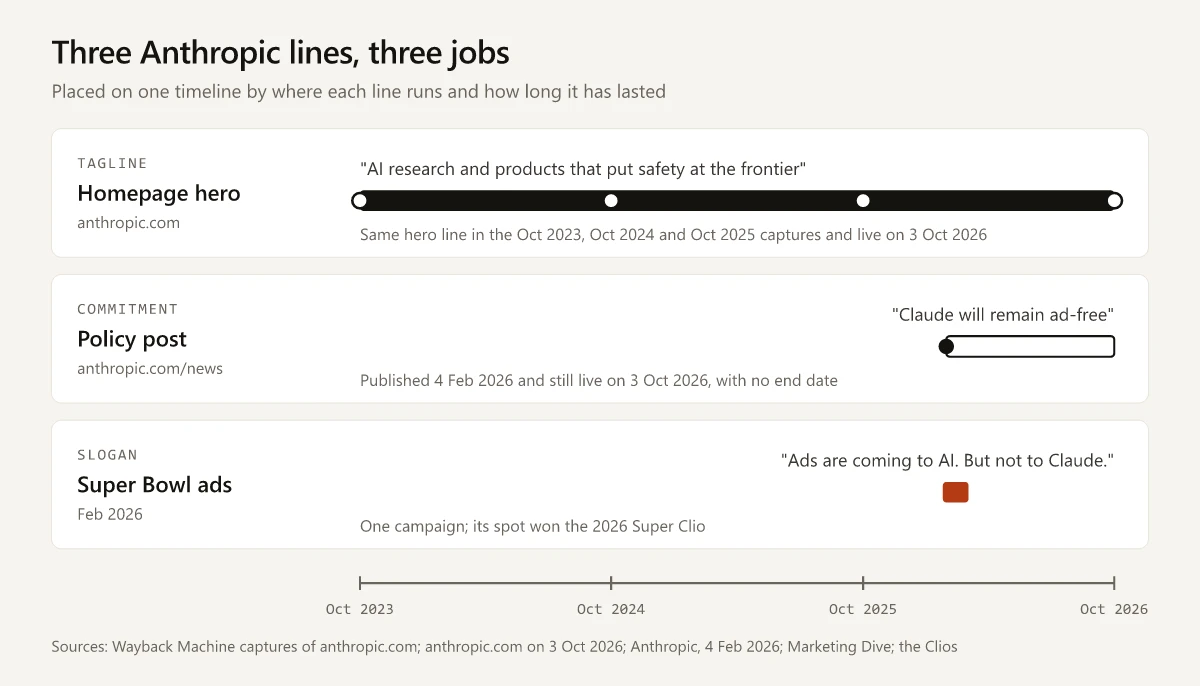
I classify a line by its record rather than by how it sounds: where it ran, who it was written for, and whether it was still there a year later. On that record, Anthropic’s tagline is a plainer sentence that has headed its homepage since at least October 2023, and the Super Bowl line is a slogan standing on a written commitment. Twelve B2B software homepages, compared across four years further down, show how few hero lines keep that record for long.
Tagline vs Slogan vs Motto: The Definitions
A tagline is the line a brand keeps beside its name for years. A slogan is written for one campaign, offer or launch and retires when it ends. A motto is a guiding principle written for the people inside an organization, which customers may never see.
| Tagline | Slogan | Motto | |
|---|---|---|---|
| Written for | Customers and the market | Customers, during one campaign | Employees and members |
| Lifespan | Years, until a rebrand | One campaign, offer or launch | As long as the values hold |
| Where it appears | Beside the logo, in the homepage hero, in the title tag | Ads, end cards, launch pages, sales collateral | Values pages, codes of conduct, careers pages |
| Question it answers | Who is this brand? | Why pay attention now? | How do we behave? |
| AI or B2B example | Anthropic: “AI research and products that put safety at the frontier” | Anthropic: “Ads are coming to AI. But not to Claude.” | Google: “don’t be evil” |
Every example in the table is checked and dated in the classification table further down. A tagline also sits above the messaging work: how a tagline differs from a messaging pillar is covered in the pillars guide.
Is a Tagline the Same as a Slogan?
In brand strategy, no: a tagline outlasts campaigns and a slogan belongs to one. In everyday English and in the ad trade the words overlap, as these sources show:
- Merriam-Webster’s entry for slogan gives “a brief attention-getting phrase used in advertising or promotion” as one sense, lists motto among its synonyms, and traces the word to the Scottish Gaelic sluagh-ghairm, an army’s cry, with a first known use in 1513.
- Marketing Dive’s review of the first half of 2026 introduces Anthropic’s Super Bowl line with “reads a tagline”, using the word in its ad-trade sense, for a line inside one campaign’s ads. On this page, tagline means the line a brand keeps.
- Marketing Dive’s September 2026 report on Staples calls “That was easy!” a “catchphrase”, a fourth word for a line Marketing Dive says TV commercials made recognizable.
- GitHub’s 1 October 2022 homepage markup (the capture linked in the table below) put the rotating words after “Let’s build from here” in a CSS class named
home-tagline-appendix, so its developers called the hero line a tagline.
The practical habit: when a colleague asks for a “tagline”, ask which of the three jobs they mean before you write anything.
Brand Vision’s Test and Who Owns Taglines and Slogans
Brand Vision’s guide to taglines, slogans and mottos (Dana Nemirovsky, February 2026) publishes a four-rule test, quoted here in full:
- “Is the line meant to identify the brand across years and channels? Choose a brand tagline.”
- “Is the line meant to support one campaign, offer, or launch? Choose a brand slogan.”
- “Is the line meant to guide internal decisions and standards? Choose a brand motto.”
- “If more than one answer is yes, write more than one line.”
Ownership is published too. Stephen Houraghan’s tagline vs slogan guide at Brand Master Academy says the brand strategist “develops a tagline in the initial stages of the brand strategy”, while “the marketing team, overseen by the brand manager and nearly always working with copywriters, develops a slogan during the creative stages of a marketing campaign.” The same guide describes how a slogan becomes a tagline: the audience adopts it first, and the brand often “adopts the highly popular slogan in place of its original tagline”.
The test sorts clean cases. The harder lines land on its fourth rule: a campaign line can carry a lasting commitment, and a homepage hero line can last one product cycle. For those I add two checks of my own:
- Record check. Open the line’s page in the Wayback Machine a year after launch. A line still beside the name is doing a tagline’s job, whatever the brand guide calls it.
- Source check. If the line restates a commitment published on a permanent page, such as a policy post or a values page, label the line by where it runs and track the commitment separately. The line can retire while the commitment holds.
The Edge Case: Anthropic’s Super Bowl Line
Here is “Ads are coming to AI. But not to Claude.” against Brand Vision’s questions:
| Question | Answer | Evidence |
|---|---|---|
| Identifies the brand across years and channels? | Not yet | It ran with one campaign, the February 2026 Super Bowl ads, per the Marketing Dive review linked above |
| Supports one campaign? | Yes | Marketing Dive quotes it as the line in those ads; the campaign’s spot won the 2026 Super Clio (the Clios) |
| Guides internal decisions? | The commitment behind it does | ”Claude will remain ad-free” (Anthropic, 4 February 2026) |
Against my checks:
- Record check: Anthropic’s homepage on 3 October 2026 opens with “AI research and products that put safety at the frontier”, the same hero line as the Wayback Machine captures from 2 October 2023, 2 October 2024 and 1 October 2025. That sentence passes; the Super Bowl line has not had its year yet.
- Source check: the ad-free commitment has its own page, which adds “Should we need to revisit this approach, we’ll be transparent about our reasons for doing so.” The slogan can come off the air while the commitment stays the thing users hold Anthropic to.
The ads sold Claude, the product brand, and claude.com has its own hero line: “Think fast, build faster” in the Wayback Machine capture of 1 October 2026 and on the live page on 3 October 2026. That line has not had a record check here; the dated tagline in this post is the company’s.
My verdict: a slogan, with the commitment underneath it and the company’s tagline on anthropic.com. The campaign’s dates and sources are in my roundup of recent innovative marketing examples, where it is one of the B2B entries. If Anthropic keeps the line beside the Claude name for years, it will have made the slogan-to-tagline move Brand Master Academy describes, and the record check will show it.
Tagline vs Slogan Examples From 12 B2B Homepages
On 3 October 2026 I fetched the homepages of 12 B2B software companies and compared each hero line with the Wayback Machine captures closest to 1 October 2022 and 1 October 2023. The hero line is the first H1 in each page’s hero section, skipping the navigation H1s some pages put first; Asana’s 2022 page kept its only H1 in the footer, so its row uses the hero H3 (marked). Slack, Salesforce and Stripe redirect by country, so their 2026 column uses the Wayback Machine’s US captures; the Slack and Stripe pages I was served carried the same hero line. Every 2026 link is a capture from 1 to 3 October 2026, and Figma’s 2023 link is its 5 October capture, the nearest one whose HTML carries the hero text.
Salesforce’s October 2023 check uses its capture from 3 October 2023.
What the 12 rows show:
- 0 of 12 October 2022 hero lines appeared anywhere in the October 2026 HTML of the same site.
- 2 of 12 were still the hero line a year later, in the October 2023 captures: Mailchimp and GitHub. HubSpot’s had moved down into the subhead, “Software that’s powerful, not overpowering.”
- 7 of 12 October 2026 hero lines name AI, agents or “agentic”: Slack, Salesforce, Notion, Zapier, Linear, Asana and Intercom.
- Claims outlived the wording. Salesforce’s 2022 page described “the world’s #1 CRM”, and its 2026 US title tag reads “Salesforce: The #1 Agentic AI CRM”; Stripe’s hero line kept “infrastructure” while “Payments” became “Financial”.
None of the 12 lasted four years, but Mailchimp’s and GitHub’s lines were still in place a year later, so by the record check they did a tagline’s job for at least a year before they were replaced. A hero line can earn tagline status and still lose it, so file it in the brand guide with a review date rather than as permanent. I picked these 12 as well-known B2B software brands, so read the result as a pattern in that group, not a rate for the whole market.
B2B and AI Lines, Classified and Dated
Each line below comes with where it runs, its source or the date I checked it, and the label the checks give it. Homepage lines change, so recheck any row before you quote it.
| Line | Company | Where it runs | Source or check date | Label |
|---|---|---|---|---|
| ”AI research and products that put safety at the frontier” | Anthropic | Homepage hero | Captures from Oct 2023 to Oct 2025; live 3 Oct 2026 | Tagline |
| ”Ads are coming to AI. But not to Claude.” | Anthropic | Super Bowl ads, Feb 2026 | Marketing Dive, 7 Jul 2026 | Slogan |
| ”Claude will remain ad-free” | Anthropic | News post | Published 4 Feb 2026; live 3 Oct 2026 | Commitment behind the slogan |
| ”The #1 Agentic AI CRM” | Salesforce | Title tag | US capture, 2 Oct 2026 | Lasting claim, rotating modifier |
| ”That was easy!” | Staples | Easy Button TV commercials, from more than 20 years ago | Marketing Dive, 17 Sep 2026 | Slogan that became a brand asset |
| ”Hard vs. Easy” | Staples | Name of the September 2026 campaign platform: spots on streaming services, social, out-of-home, display, and collateral for Staples’ sales teams; audience is business decision-makers and frontline workers | Marketing Dive, 17 Sep 2026 | Campaign platform the CMO calls “a platform more than just a campaign”; recheck before calling it a tagline |
| ”Unleash your teams and their agents” | Atlassian | Homepage hero | 3 Oct 2026 | Positioning headline (one check; record check due Oct 2027) |
| “Open company, no bullshit” | Atlassian | Values page | 3 Oct 2026 | Motto |
| ”don’t be evil” | Last line of the Code of Conduct | Updated 16 Jul 2026 | Motto | |
| ”A marketer who builds.” | Swapnil Biswas | LinkedIn banner | Since 25 Sep 2026 | Personal tagline |
| ”I write the brief, then I build it” | Swapnil Biswas | LinkedIn headline | Since 25 Sep 2026 | Personal tagline and working rule |
The last two rows are mine. The banner line sits beside my name and photo with no end date, on a LinkedIn banner I render from HTML, so it is a personal tagline that has had eight days and has not passed a record check. The headline line does two jobs: on the profile it sits next to my name, and in the brief-first steps behind building this site it is the working order I follow. Brand Vision’s fourth rule would split it into two lines; on a one-person profile, the headline carries both.
Tagline vs Motto: Lines Written for the People Inside
A motto can be public and still be a motto, as long as it is written for the people inside.
- Google’s Code of Conduct, last updated 16 July 2026, says it expects “all Googlers to be guided by both the letter and the spirit of this Code” and ends: “And remember… don’t be evil, and if you see something that you think isn’t right - speak up!” The phrase appears once in the document.
- Atlassian’s values page says its five values “guide what we do, why we create, and who we hire”, and that “these five values remain constant”. The first is “Open company, no bullshit”; the others include “Don’t #@!% the customer” and “Play, as a team”.
Atlassian shows the split between a buyer-facing line and a motto inside one company. Its homepage hero on 3 October 2026, “Unleash your teams and their agents”, speaks to buyers about the product. “Open company, no bullshit” speaks to the people deciding how to work there, and a buyer could miss it without losing anything.
Taglines, Slogans and Mottos in a PMM’s Messaging Stack
A product marketer touches all three lines, and each sits on a different layer of the messaging work. The brand, campaign and culture rows follow the promise, campaign and culture layers in Brand Vision’s guide; the rows above them are the PMM work a tagline is written from.
| Layer | What sits there | Changes when | Where this site covers it |
|---|---|---|---|
| Positioning | Buyer, category and difference in one statement | The market or the buyer shifts | Writing a positioning statement |
| Company description | The first sentence of the press boilerplate | The category changes | First sentences in 95 boilerplates |
| Messaging | Value proposition, three or four pillars, proof | Positioning changes | The five-layer brand messaging framework |
| Homepage hero | A positioning headline, or the tagline once it passes the record check | Positioning changes | The 12-homepage table above |
| Brand | Tagline | A rebrand | This post |
| Campaign | Slogan | Every campaign | This post |
| Culture | Motto | The values change | This post |
If you are drafting a line for sales, the “One-line tagline” field in the product one-pager template takes a product headline, which by this post’s split is a positioning headline; note a review date beside it.
Tagline vs Slogan vs Motto: Read the Record
Anthropic’s three lines show the method: the company tagline on anthropic.com is in every yearly capture since 2023, the Super Bowl line has not had its year, and the ad-free commitment is tracked on its own page. Your own tagline vs slogan vs motto calls take the same evidence. For a line already live, look it up in the Wayback Machine before it goes into the brand guide, and if it was gone a year after launch, file it as a slogan or a positioning headline with an end date. For a new line, set a review date a year after launch. Start with your homepage’s hero line.
Frequently Asked Questions
Is a tagline the same as a slogan?
In brand strategy, no. A tagline stays beside the brand name for years, while a slogan is written for one campaign and retired when it ends. Everyday usage blurs the two: Marketing Dive introduced Anthropic's Super Bowl line with 'reads a tagline', using the ad trade's sense of the word for a line inside one campaign.
What is the difference between a slogan and a motto?
A slogan speaks to customers during a campaign. A motto is a guiding principle for the people inside an organization: Google's Code of Conduct, last updated 16 July 2026, closes with 'don't be evil', and Atlassian's values page says its five values 'guide what we do, why we create, and who we hire'.
What is the difference between a tagline and a motto?
A tagline speaks to customers and stays beside the brand name for years. A motto is a principle written for the people inside an organization. Atlassian shows the split: its homepage hero speaks to buyers about the product, while the values on its values page are written for the people who work there.
Can a slogan become a tagline?
Yes, when the brand keeps the line beside its name after the campaign ends. Brand Master Academy describes audiences adopting a popular slogan and the brand then using it in place of its original tagline; the record check shows it has happened when the line is still beside the name a year later. Staples' 'That was easy!' went part of the way: Marketing Dive says the catchphrase became 'a recognizable asset' thanks to TV commercials more than 20 years ago, and the Easy Button is back in Staples' September 2026 B2B campaign.
Do B2B software companies have taglines?
Some do, and the record shows which. Anthropic's homepage hero line has run since at least October 2023. Of 12 well-known B2B software homepages I compared in Wayback Machine captures, none kept its October 2022 hero line until October 2026, though Mailchimp and GitHub still had theirs a year later. Claims lasted longer than wording: Salesforce's '#1 CRM' and Stripe's 'infrastructure' appear in the 2022 and 2026 versions of their pages.