How to Prioritize Accounts in ABM: Fit-and-Intent Framework
How to prioritize accounts in ABM using fit and intent - a tiering framework to focus effort on the accounts most likely to buy, not just the biggest logos.

The fastest way to kill an account-based program is to refuse to prioritize accounts in ABM, and instead treat all 300 logos on the target list as equal. I have watched teams buy a six-figure ABM platform, load a list the sales director assembled from memory, and then fire the same three ads and the same nurture email at every account on it. Six months later the pipeline looks exactly like it did before, and everyone blames the software.
The real failure was never the tooling. It was the refusal to rank those accounts by which ones actually deserve the effort.
The hard part of ABM is not personalization or channel mix or creative. It is deciding which accounts deserve the expensive, hand-built effort and which ones get the cheap programmatic version.
If you cannot answer that with a straight face, you are not doing account-based marketing. You are running spray-and-pray with a bigger invoice.
This is exactly why disciplined account prioritization beats a sprawling list. Demandbase’s State of ABM 2026 report found that companies tracking 3-4 buying groups see a 48.5% higher win rate compared with organizations taking a broader, less structured approach.
Focus is not a nice-to-have. The teams that concentrate effort on the right accounts convert at a materially higher rate than the teams trying to court everyone at once.
The fix is a repeatable system. You score every account on two axes, fit and intent, plot them into a simple matrix, and let each account’s position decide how much effort it earns. No vibes, no favorite-logo bias, no frozen list you set in January and forget by March.
Why You Have to Prioritize Accounts in ABM
The premise of ABM is concentration: you spend more on fewer accounts because the deals are big enough to justify it. The moment you start treating the list as a flat spreadsheet, you have thrown away the only structural advantage the model gives you.
Here is the trap I see most often. A team builds a target list of a few hundred accounts, then runs one campaign against all of them.
The strategic logos that deserve a custom microsite get the same banner ad as the mid-market accounts that will never close. Effort is spread like peanut butter, thin and even, and nothing gets enough of it to move.
The fix is to accept that not every account is worth the same investment, then prove which ones are worth more with data instead of opinion. That is what it means to prioritize accounts in ABM: you rank the list so effort flows to where it will actually convert.
Before any of this works, the definition of a good account has to be real. If your target list is fuzzy, prioritization just sorts noise. Get the ICP and buyer persona foundation locked first, because the fit score you are about to build is only as good as the ideal customer profile behind it.
Building the Fit Score
Fit answers one question: how closely does this account resemble the customers you already win and keep? It is a slow-moving, structural signal that rarely changes week to week, which is why it belongs on its own axis, separate from fast-moving intent.
I build it from three layers. Weight them however your data supports, but keep the model simple enough that a sales rep can see why an account scored the way it did.
Firmographics and the obvious filters
Start with the structural basics: industry, company size, revenue band, geography, and business model. These filters decide whether an account can even become a good customer.
A 40-person startup is a bad fit for an enterprise-priced product, no matter how excited the founder is. Firmographics are the coarse cut, and they keep you from wasting a one-to-one play on an account your product was never built to serve.
Fit scoring ranks accounts inside a segment. Deciding which segments deserve their own motion in the first place is a separate exercise, and B2B customer segmentation covers the test I use to keep that list short enough to actually run.
Fit also predicts which accounts can grow after the first deal, not just which ones will sign it. Where the expansion path is the point, land and expand covers what has to be true of the entry package for a small first contract to be a strategy rather than a discount.
Tech stack and use-case fit
This is where the fit score gets sharp. An account running a complementary tool in their stack, or a competitor’s product approaching renewal, is a far better fit than a look-alike with no relevant technology in place. Tech-stack data, plus your own win-loss analysis dashboard showing which profiles actually convert, turns a generic firmographic match into a specific, defensible reason to prioritize.
Use-case fit is the last layer. Two companies can share the same size and industry and still differ wildly in whether they have the specific problem you solve. The accounts whose pain maps cleanly onto your differentiated value sit at the top of the fit axis, and combining all three layers separates them from the ones that merely look the part on a firmographic filter.
Building the Intent Score
Fit tells you which accounts are worth pursuing. Intent tells you which ones to pursue right now. A high-fit account with zero intent is a great account with bad timing, and one-to-one effort there this quarter usually just burns budget while the account ignores you.
Intent is the sum of the signals that a buying group is in motion. I build it from four sources, and the more an account trips at once, the hotter it is.
Third-party intent surges
Third-party intent data, drawn from platforms that watch research behavior across the web, tells you when accounts are studying your category on sites you do not own. A surge means the buying group has started shopping, often before they have touched anything of yours. It is the earliest at-scale signal you get.
First-party engagement and product signals
First-party engagement is the intent you can see on your own properties: repeat visits to pricing pages, content downloads, demo requests, webinar attendance, ad clicks deanonymized to the account. Noisier per event, but more reliable in aggregate because it happens on your turf.
Product signals matter most if you run any product-led motion. Multiple users from one company starting a trial, a workspace hitting a usage limit, a key feature getting adopted across a team: these are among the strongest buying signals in B2B because the account is already experiencing the value.
Engagement from the buying group, and job changes
The signal I trust most is engagement spread across multiple people at the same account, not one champion clicking everything. ABM is a buying-group game, so intent across several roles is worth more than the same volume from one contact.
Job changes are the wildcard. When a former customer or power user lands at a new company that fits your ICP, that is a near-instant intent spike, because the person already knows your product works and now has budget somewhere new. It is one of the highest-intent signals you get all year, and easy to miss.
The Fit and Intent Matrix
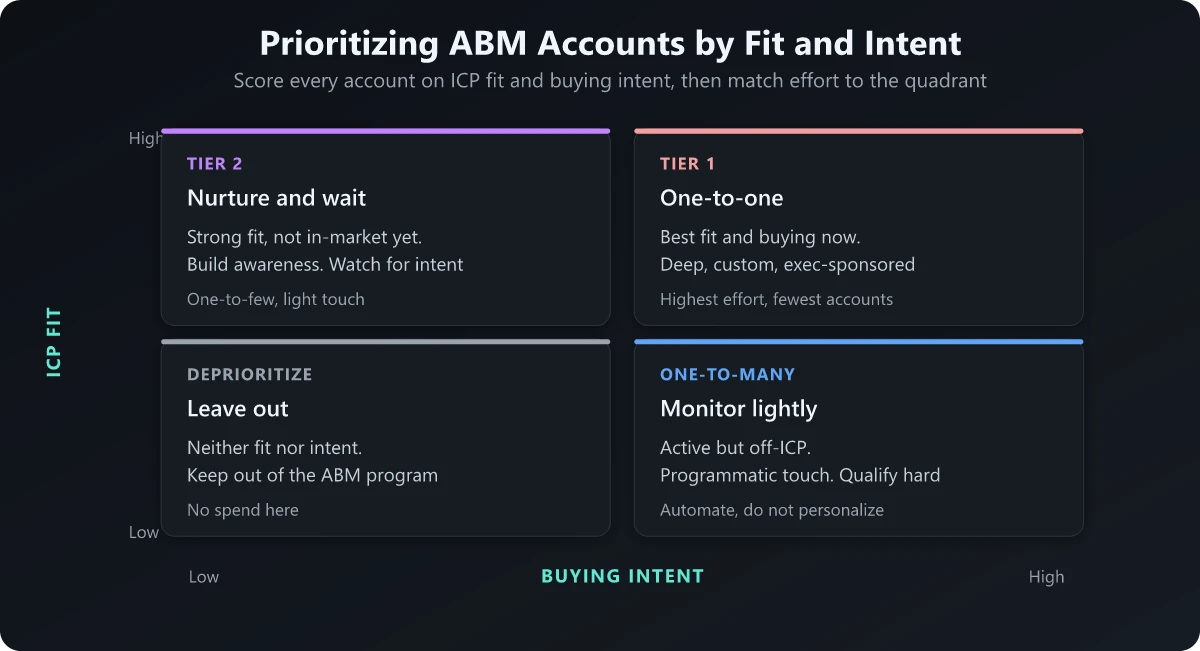
Now you have two scores per account. Plot fit on one axis and intent on the other, and every account falls into one of four quadrants. This 2x2 is the heart of account prioritization, because position on the grid maps directly onto how much effort an account earns.
High fit, high intent. Your priority accounts. They look like your best customers and they are in-market right now, so one-to-one effort belongs here: custom hubs, executive touches, the full weight of the program. There will not be many, and that is the point.
High fit, low intent. Great accounts, wrong timing. Do not spend one-to-one budget here.
Keep them warm with efficient one-to-few plays and watch for the intent spike that promotes them into the top quadrant. Patience is the play, not intensity.
Low fit, high intent. Tempting and dangerous. The account is active but does not look like a customer you win and keep. A little programmatic air cover is fine, but do not let a hand-raise pull your best people off the accounts that actually convert.
Low fit, low intent. These do not belong on the list. If an account sits here, demote it out of the program and reclaim the budget.
The matrix does the arguing for you. When a rep insists a favorite logo deserves a custom campaign, you point at the grid: if it is low intent, it waits. That is the whole discipline.
How to Prioritize Accounts in ABM by Mapping Tiers to Effort
Quadrants are the logic. Tiers are how you operationalize that logic into cadence and spend. Each quadrant maps onto one of the three classic ABM tiers, and the tier decides how personalized the effort gets and how many accounts a team can realistically cover.
Tier 1, one-to-one. Deep, custom work for a handful of high-fit, high-intent accounts. Bespoke content, named-account research, sometimes executive-to-executive involvement. High effort, tiny list, usually 5 to 20 accounts.
Tier 2, one-to-few. Light personalization for clusters of similar accounts, grouped by industry or use case. You build one asset for the cluster and run it against 10 to 50 accounts. This is the tier most teams under-invest in, and usually the highest-leverage one.
Tier 3, one-to-many. Programmatic reach across the long tail, powered by intent data and dynamic personalization so you cover hundreds of accounts without hand-building anything per account.
Here is the mapping in one view, the table I put in front of teams when they ask where to start.
| Quadrant | Tier | Effort model | Typical count | Cadence |
|---|---|---|---|---|
| High fit, high intent | Tier 1, one-to-one | Custom hubs, exec touches, bespoke content | 5 to 20 | Weekly, high-touch |
| High fit, low intent | Tier 2, one-to-few | Cluster campaigns, watch for intent spike | 10 to 50 | Monthly, nurture |
| Low fit, high intent | Tier 3, one-to-many | Programmatic ads, light SDR follow-up | Hundreds | Automated, signal-triggered |
| Low fit, low intent | Off the list | Demote and reclaim budget | n/a | None |
The effort is never uniform: a Tier 1 account gets a hand-built experience and a named human, a Tier 3 account gets a well-targeted ad and an automated alert. Matching effort to tier is the difference between ABM that concentrates and a target list that just sits there. If you want concrete plays to run once accounts are sorted, the tiered ABM campaign examples walk through what to ship at each level.
When to Promote and Demote Accounts
The biggest mistake in account prioritization is treating the list as static. Fit is slow-moving, but intent changes weekly, which means an account’s rightful tier changes too. A model that never moves accounts is just a fancier version of the frozen January list.
Promotion is the happy path. A high-fit account in the one-to-few tier trips an intent surge, several stakeholders start engaging, and it graduates to one-to-one. The tiers are a conveyor belt, not three separate roads, so catch the account the week it heats up and move it before a competitor does.
Demotion is the discipline nobody enjoys. When a Tier 1 account goes quiet for a quarter and the deal stalls, it needs to move down so its budget flows to an account that is actually in motion. Holding it in Tier 1 out of hope or sunk cost is how programs slowly clog with dead weight.
Set a review cadence, monthly for intent-driven moves and quarterly for a fuller fit review, and make promotion and demotion a normal, unemotional part of the rhythm. The list should breathe.
The Mistakes That Wreck Account Prioritization
A short field guide to the traps, because I have stepped in most of them.
Chasing big logos with no intent. The most seductive error. A famous account gets one-to-one treatment because leadership wants it, despite showing zero buying signals. Fit without intent is a great account at the wrong time, and treating it like a live deal wastes your best people.
Confusing intent with fit. The mirror-image error. A low-fit account spikes on intent and gets promoted, even though it will never be a customer you keep.
Both scores have to clear the bar before an account earns real investment. One high number does not carry an account by itself.
Freezing the list. A model you build once and never revisit is worse than no model, because it gives you false confidence. Accounts that were hot in Q1 are cold by Q3, and the reverse. If nothing moves between tiers, you are not prioritizing, you are sorting once and calling it strategy.
Scoring the individual, not the group. If your intent score is really one champion clicking a lot of emails, you are measuring a person, not an account. Depth across roles beats volume from one contact every time.
Skipping the demand foundation. ABM concentrates demand that already exists; it does not manufacture awareness from nothing. If no one in your market knows the category exists, prioritization has nothing to concentrate.
The tension between broad reach and focused capture sits at the center of B2B demand generation, and prioritization lives on the capture side. For why account depth beats raw lead volume, the contrast in ABM vs inbound marketing makes it concrete.
Conclusion: Score, Plot, and Prioritize Accounts in ABM With Discipline
The reason most account-based programs stall is not weak creative or the wrong platform. It is that every account on the list gets treated the same, so effort spreads thin and nothing converts. The way out is to prioritize accounts in ABM on two axes: fit, the slow structural signal of how much an account resembles your best customers, and intent, the fast signal of whether the buying group is in motion right now.
Score every account on both, plot them into the fit and intent matrix, and let each quadrant dictate its tier and its effort. High fit and high intent earn one-to-one investment; the rest get exactly what they have earned and no more. Then keep the list breathing, promoting accounts that heat up and demoting the ones that go cold.
Here is the next action. Take your current target list this week and score just the top 30 accounts on fit and intent, even roughly.
Plot them into the four quadrants. The accounts that land in high-fit, high-intent are where your one-to-one effort should already be going, and the mismatches between that quadrant and where your team is actually spending time will tell you everything about why the program has felt stuck.
Frequently Asked Questions
How do you prioritize accounts in ABM?
Score every target account on two axes: fit, meaning how closely it resembles your best customers based on firmographics, tech stack, and use case, and intent, meaning whether the buying group is actively researching right now. Plot both scores into a fit-versus-intent matrix and give the most effort to accounts that score high on both.
What is the difference between fit and intent in ABM?
Fit is a slow-moving, structural signal of how well an account matches your ideal customer profile. Intent is a fast-moving signal of whether that account is in-market and buying right now. Fit tells you which accounts are worth pursuing, and intent tells you which ones to pursue this week.
How many accounts should a Tier 1 ABM program target?
A one-to-one Tier 1 program usually runs against roughly 5 to 20 strategic accounts, because each one gets deep, hand-built effort. One-to-few clusters sit at around 10 to 50 accounts, and one-to-many covers hundreds of accounts programmatically.
What data do you use to score account fit?
Fit scoring combines firmographics like industry, company size, and geography with tech-stack signals such as a complementary tool in the stack or a competitor product nearing renewal, plus use-case fit that checks whether the account actually has the problem you solve. Combining all three separates real prospects from accounts that only look right on a surface filter.
When should you remove an account from an ABM list?
Demote or remove an account when it scores low on both fit and intent, or when a Tier 1 account has gone quiet for a full quarter with a stalled deal and decaying intent. Freeing that budget lets it flow to accounts that are actually in motion.