9 Biggest Risks of Launching a New Product (2026)
The 9 biggest risks of launching a new product, from no market need to weak positioning and sales misalignment, and how product marketers de-risk each one.

The saddest launch I ever watched shipped with a countdown timer pinned to the internal wiki, and it taught me what the risks of launching a new product really look like. The product was good and the demo landed in every practice run. Then launch day came, the announcement channel lit up for about forty minutes, and by the following Tuesday nobody inside the company was talking about it.
It did not fail with a bang. It just went quiet. That quiet is what the risks of launching a new product actually feel like from the inside: not a flameout but a slow fade, the thing you spent two quarters building never finding the market you built it for.
That fade happens more often than launch retrospectives admit. Euromonitor International, using its AI-powered new-product-development tracking platform, found that 25% of new product launches tracked across key FMCG categories and markets in 2023 and 2024 were inactive by the end of 2024.
That figure is fast-moving consumer goods rather than software, so treat it as a directional signal, not a law. The lesson still travels: even with modern tracking, real budgets, and experienced teams, a quarter of launches quietly go dark.
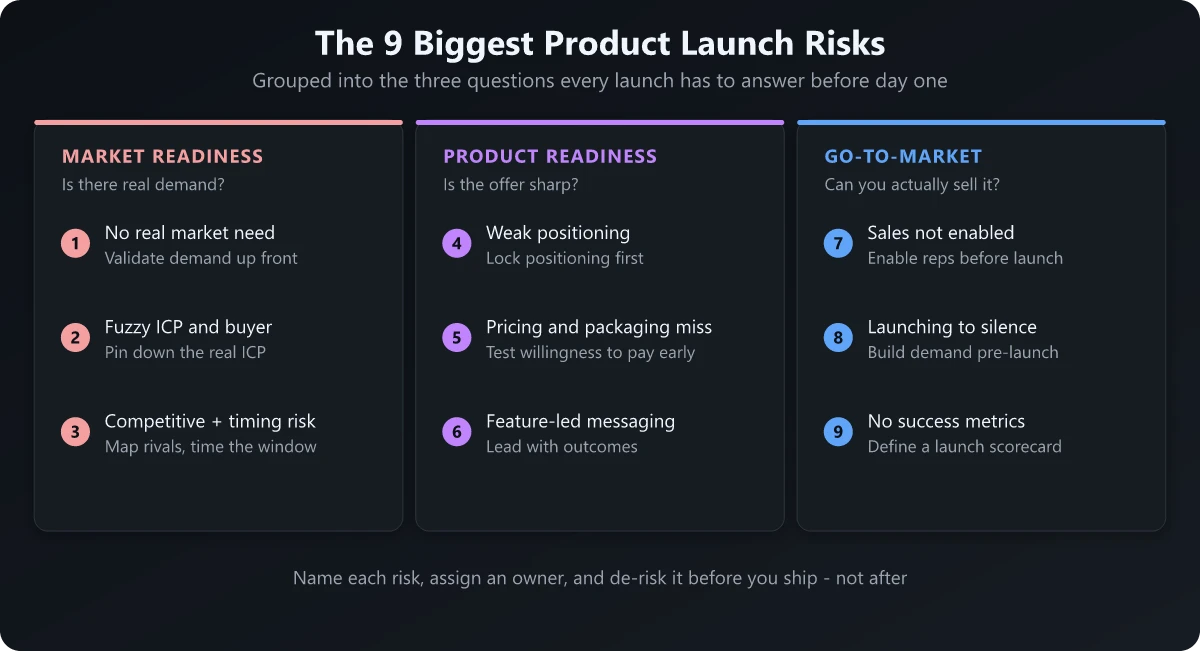
A launch almost never fails for a mysterious reason. It fails for one of a small set of nameable causes, and a product marketer’s whole job is to spot each one and defuse it before launch day. Below are the nine biggest risks of launching a new product, grouped into market, product, and go-to-market readiness, with what each looks like, why it kills launches, and how to de-risk it.
Why Most of the Risks of Launching a New Product Are Predictable
The failure modes repeat. Different companies, different categories, the same nine ways to bleed out.
These are not bad-luck outcomes; they are risks, which means they can be surfaced, ranked, and reduced on purpose. Ranking them is the part that needs evidence rather than opinion, and the risk-reduction case for market research is exactly that: it replaces the loudest voice in the room with a number you can argue with. The best product marketers run a pre-mortem the way an engineer runs a load test: assume the launch failed, then work backward to name every reason it could have.
I treat it as a readiness problem in three layers. Is the market ready to want this? Is the offer sharp enough to buy?
Is the go-to-market machine ready to sell and sustain it? If you want the operational task list underneath all three, my product launch checklist breaks the timeline into the concrete steps a team runs in the weeks before and after go-live.
Market Readiness: The Biggest Risks of Launching a New Product Nobody Wants
The first three risks live upstream of anything you can design or write. They decide whether there is a market to launch into at all.
Risk 1: No real market need or weak product-market fit
What it looks like: A product built from internal conviction or a roadmap promise rather than a validated customer pain. The demo dazzles, prospects nod politely, and nobody changes their behavior or their budget.
Why it kills launches: This is the most common cause of a dead launch. If the underlying need is weak, every lever you pull just amplifies a message the market does not care about. You cannot out-market a product people can live without.
How to de-risk it: Validate demand before you commit to a date, not after. Talk to real buyers, find the ones already hacking together a workaround, and watch whether they will pay or pilot rather than just praise. If you are unsure, my guide on what product-market fit actually is walks through the signals that separate real pull from polite interest.
Risk 2: A fuzzy ICP and target buyer
What it looks like: Ask five people on the launch team who this is for and you get five answers. The messaging tries to speak to enterprise and startups, technical and non-technical, all at once, so it lands with nobody.
Why it kills launches: A fuzzy ideal customer profile makes every downstream decision fuzzy. Your channels, ad targeting, talk track, and demo all need a specific human to point at. When the target is a blur, spend scatters and conversion craters.
How to de-risk it: Force specificity before launch. Name the ideal customer profile, the buyer, and the person who feels the pain most acutely, then deliberately exclude the segments you are not for. A narrow target that converts beats a broad one that flatters your total addressable market and closes nothing.
Risk 3: Ignoring competitive and timing risk
What it looks like: A launch planned in a vacuum. The team never maps who else solves this problem, or ships into a moment when buyers are frozen, distracted, or already locked into an incumbent’s contract cycle.
Why it kills launches: Buyers never evaluate you in isolation. They compare you to the current alternative, including the alternative of doing nothing. Launch into a crowded moment or against an entrenched incumbent with no reason to switch, and your announcement gets filed under noise.
How to de-risk it: Map the real competitive set, status-quo inertia included, and pick your timing with intent. Know the switching costs you are asking a buyer to absorb and have an answer ready before the calendar decides for you.
Product Readiness: Risks in the Offer Itself
The middle three risks are about the offer. The market may want the outcome, but if the product story, price, and message are muddy, buyers cannot say yes even when they want to.
Risk 4: Weak or undifferentiated positioning
What it looks like: A homepage that could belong to any of ten competitors, with words like all-in-one, seamless, and powerful doing the work a real point of view should be doing. Prospects grasp what the product is and still cannot say why it beats what they use now.
Why it kills launches: Undifferentiated positioning turns your launch into a features announcement in a category the buyer already thinks is solved. With no answer to why you and why now, you compete on price and lose the accounts you most wanted.
How to de-risk it: Lock positioning before you write a line of launch copy. Name the category you compete in, the alternative you beat, and the one differentiated value only you deliver. If that is vague at launch, the whole campaign inherits the vagueness.
Risk 5: A pricing and packaging misfire
What it looks like: A price set by copying a competitor or by gut feel, packaging that buries the thing people want behind a tier they will not buy, or a free plan so generous nobody upgrades.
Why it kills launches: Pricing is where positioning converts into money, and a misfire quietly caps everything. Price too low and you signal low value while starving the business; too high without proof and you stall deals; package badly and you hide your best value from the people ready to pay for it.
How to de-risk it: Treat pricing and packaging as a launch deliverable, not an afterthought. Test the price against how buyers perceive value, align each tier with a distinct segment, and make the path from free or trial to paid obvious. You can adjust price later, but a structure that hides your value is hard to unwind.
Risk 6: Feature-led messaging instead of value and outcomes
What it looks like: Launch copy that reads like a release note. A wall of new capabilities, specs, and toggles, with the buyer left to reverse-engineer why any of it matters. Every sentence starts with we built rather than you can now.
Why it kills launches: Buyers do not purchase features. They purchase the outcome a feature unlocks and the pain it removes. Feature-led messaging asks the prospect to do the translation, and most will not bother.
How to de-risk it: Lead with the outcome and let the feature be the proof. For every capability you announce, write the so-what: the job it gets done, the time or money it saves, the frustration it ends. A feature vs benefit vs value worksheet turns each so-what into a pass or fail check: a benefit line passes when it names a task from the user’s job, and a value line when it names the change to a goal or number the buyer already reports on. The feature list belongs in the launch, just not at the front.
Go-to-Market Readiness: The Risks of Launching a New Product Into Silence
The final three risks turned my countdown-timer launch into a ghost town. The market wanted it and the offer was sharp, but the go-to-market machine was not ready to carry it to an audience nobody had prepared.
Risk 7: Sales and marketing misalignment
What it looks like: Marketing ships a beautiful campaign and sales hears about it from a customer. Reps have no talk track, no updated deck, no objection handling, and no idea which accounts to call. The demand marketing creates has nowhere to convert.
Why it kills launches: A launch is a handoff, and a dropped handoff wastes every dollar spent creating attention. If the people who close deals cannot sell the new thing the day it goes live, the pipeline the campaign generates evaporates.
How to de-risk it: Enable sales before you go public, not on launch morning. Deliver the talk track, demo flow, objection handling, and target account list early enough for reps to practice. A tight go-to-market strategy template keeps marketing, sales, and product on the same plan so nobody learns about the launch from a prospect.
Risk 8: Launching to silence with no demand built beforehand
What it looks like: The big-bang fantasy. Everything is held in secret until launch day, the announcement goes out, and the team waits for a rush that never comes because the market has no idea the problem is solvable, let alone that you solve it.
Why it kills launches: Demand is not created on launch day; it is harvested on launch day. If you have not built awareness, warmed an audience, or primed a waitlist in the weeks prior, your announcement drops into a void that attention cannot fill in a single press moment.
How to de-risk it: Build demand before the date. Run a pre-launch content and audience program so a warm crowd is ready to act when you go live. My playbook on marketing strategy for a new product covers how to seed that demand across channels ahead of time, so a launch feels like opening a door people are already waiting behind.
Risk 9: No success metrics or launch scorecard
What it looks like: A launch with no agreed definition of winning. Everyone celebrates the ship, then two weeks later nobody can say whether it worked, because there was never a number to hit or a baseline to compare against.
Why it kills launches: Without a scorecard you cannot tell a slow start from a real failure, so you either kill things that needed patience or keep funding things already dead. Worse, you learn nothing transferable and repeat the same mistakes at full price next time, when a win-loss analysis dashboard tracking the resulting deals would have shown you exactly why the launch converted or stalled.
How to de-risk it: Define success before launch and instrument it. Pick the two or three metrics that actually indicate traction, whether that is activated accounts, qualified pipeline, or adoption of the new capability, and set the checkpoints where you will read them. A scorecard turns a launch from a one-day event into a program you can steer.
The 9 Risks of Launching a New Product at a Glance
When a team asks where to start de-risking, I put this table on the wall and ask which signal they can already see in their own launch. Every risk has a symptom you can detect and a single move that reduces it.
| # | Risk | Signal it is present | De-risk move |
|---|---|---|---|
| 1 | No real market need | Prospects praise but do not buy or pilot | Validate demand and pull before setting a date |
| 2 | Fuzzy ICP and buyer | Five people name five different targets | Force specificity, exclude who you are not for |
| 3 | Competitive and timing risk | Launch planned with no map of alternatives | Map the real competitive set, choose timing on purpose |
| 4 | Weak positioning | Homepage could belong to ten rivals | Lock category, alternative, and one differentiator |
| 5 | Pricing and packaging misfire | Price set by copying or gut feel | Test price against value, align tiers to segments |
| 6 | Feature-led messaging | Copy reads like a release note | Lead with the outcome, use features as proof |
| 7 | Sales and marketing misalignment | Reps hear about the launch from a customer | Enable sales fully before going public |
| 8 | Launching to silence | Big-bang reveal with no pre-launch demand | Build a warm audience in the weeks prior |
| 9 | No success metrics | No agreed definition of a win | Set two or three metrics and checkpoints upfront |
Not one of these rows needs a bigger budget to fix. Each is a decision or a piece of preparation, which is exactly why they are risks you can retire rather than accidents you can only regret.
How to Sequence Your De-Risking
You will not fix all nine at once, and you should not try. The order matters because the risks stack. Market readiness comes first, since a sharp offer and a flawless go-to-market cannot rescue a product nobody needs.
Work top to bottom: confirm the need and the buyer, then sharpen positioning, pricing, and message, then ready the enablement, demand, and scorecard. A weakness at a higher layer poisons everything below it. Contradictions between the layers only become visible when the layers sit side by side, so draft all of them on a single-sheet GTM plan where segment, positioning, pricing, channels, and metrics share one page and a buyer that none of your chosen channels actually reaches is impossible to miss.
Run it as a pre-mortem two to three weeks out: gather the launch team, walk the nine risks, and rate your honest readiness on each. The ones that score low are your launch plan for the remaining runway.
Conclusion: De-Risk Before You Launch, Not After
Launches feel like a gamble because most teams treat the risks of launching a new product as bad weather, something that either strikes or spares you. It is not weather. It is a short, knowable list of failure modes, and every one can be surfaced and reduced before launch day by a product marketer paying attention.
So do the unglamorous work first. Take the nine risks, rate your launch against each one honestly, and turn the low scores into a to-do list before you spend another dollar on execution.
The best launch I have run since the countdown-timer disaster was not louder or better funded. We refused to go live until we could look at all nine risks of launching a new product and say, with a straight face, that we had defused each one. Pick the single riskiest gap in your next product launch this week, and close it while it is still cheap.
Frequently Asked Questions
What is the biggest risk of launching a new product?
The biggest risk is launching something with no real market need or weak product-market fit. If the underlying pain is not strong enough that buyers will pay or switch, no amount of positioning, pricing, or promotion downstream can rescue the launch. Validate genuine demand before you commit to a date.
Why do most new product launches fail?
Most launches fail for a small set of predictable reasons rather than bad luck: no real market need, a fuzzy target buyer, weak positioning, a pricing misfire, sales and marketing misalignment, no pre-built demand, feature-led messaging, missing success metrics, or ignored competitive and timing risk. Nearly all of them can be spotted and reduced before launch day.
How do you reduce the risk of a product launch?
Run a pre-mortem two to three weeks out. Assume the launch failed, name every reason it could have, and rate your honest readiness across market, product, and go-to-market layers. The low scores become your launch plan, because each risk is a decision or a piece of preparation you can fix cheaply before you go live.
What is the difference between market risk and go-to-market risk in a launch?
Market risk is whether anyone actually wants the product, covering demand, the target buyer, and the competitive and timing landscape. Go-to-market risk is whether your machine can sell and sustain it, covering sales enablement, pre-built demand, and success metrics. Market risk sits upstream, so a strong go-to-market cannot save a product the market does not need.
When should you check for launch risks?
Check early and continuously, not on launch morning. The cheapest time to fix a risk is weeks before go-live, when positioning, pricing, and enablement are still in draft. A final pre-mortem two to three weeks out catches the gaps that are still affordable to close before the launch is locked.