Jobs to Be Done Template: 12 Fields and 3 Examples
Most jobs to be done templates stop at a job statement. This one adds the competing alternative, the four forces, and a measurable success test. Copy it free.
Most versions of the jobs to be done template you can copy off page one capture a wish. They hand you one sentence to complete, the when / I want to / so I can line, and the exercise ends there. What comes back is a persona bio with the demographics stripped out: a customer who would like your product to be good at the thing your product already claims to do.
That sentence is the cheapest part of the method and the weakest part of the output. It states an aspiration nobody in the room will argue with, which is why it clears every review and changes no roadmap.
A jobs to be done template starts working when it also records what the customer fired in order to hire you, the forces that pushed them out of the old way and the ones that held them in it, and the measurable test that proves the job is finished. Those additions are what separate a quotable sentence from an input to pricing, onboarding and the first line of your homepage.
The blank template is below, with a fill rule for every field and three filled examples, including the one Christensen’s team ran inside a fast-food restaurant.
What a Jobs to Be Done Template Must Capture
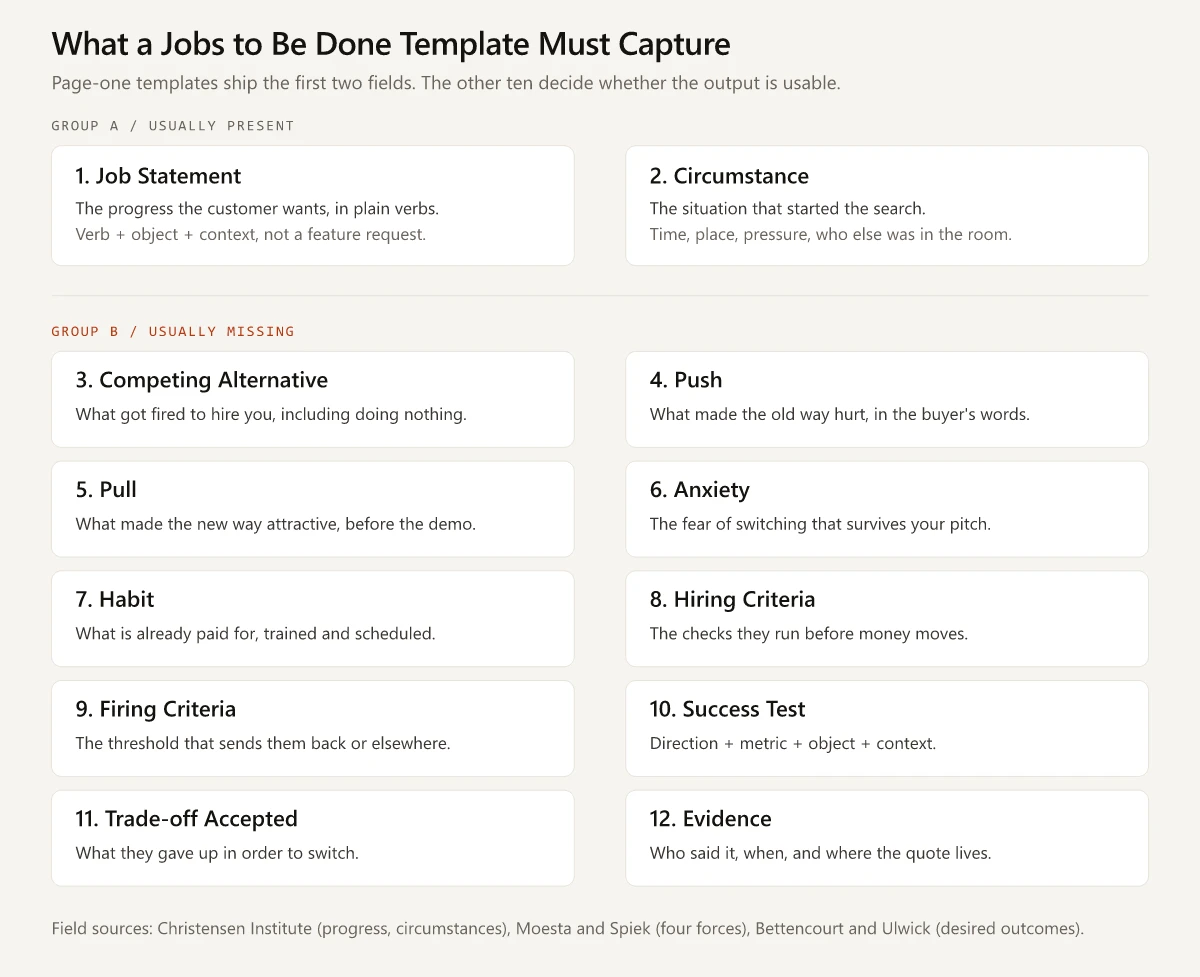
A usable jobs to be done template carries twelve fields:
- Job statement - the progress the customer is trying to make, written as verb, object and context.
- Circumstance - the situation that started the search, pinned to a time, a place and a pressure.
- Competing alternative - the named thing that got fired to hire you, including doing nothing.
- Push - what made the old way hurt, in the customer’s own words.
- Pull - what made the new way attractive, before they saw your demo.
- Anxiety - the fear of switching that survives agreement with your pitch.
- Habit - what is already paid for, already trained and already scheduled.
- Hiring criteria - the checks they ran before money moved.
- Firing criteria - the threshold at which they go back or go elsewhere.
- Success test - the measurable result that proves the job is done.
- Trade-off accepted - what they gave up in order to switch.
- Evidence - who said it, when, and where the raw quote lives.
The first two fields are what most templates ask for. The other ten turn a sentence into something a product marketer, a designer or a sales rep can act on without translating it first.
The Copy-Paste Jobs to Be Done Template
Here is the full template with the rule for each field. Fill one of these per job, per segment, not one per product.
| Field | What goes in it | Fill rule |
|---|---|---|
| Job statement | The progress the customer wants | Verb, object, context. No product names, no adjectives |
| Circumstance | The moment the search started | A date, a place and a trigger event you can name |
| Competing alternative | What they used before you | The specific tool, workaround or person, plus “nothing” if that was real |
| Push | The pain in the old way | A sentence the customer said, not your summary of it |
| Pull | The attraction of the new way | The outcome they pictured, before they saw your demo |
| Anxiety | The fear of switching | Migration, data, learning curve, looking foolish internally |
| Habit | The gravity of the current way | What is already paid for, already trained, already scheduled |
| Hiring criteria | The checks before commitment | Security review, pilot scope, reference call, budget owner |
| Firing criteria | What would make them leave | The threshold at which they go back or go elsewhere |
| Success test | Proof the job is done | Direction of improvement, metric, object, context |
| Trade-off accepted | What they gave up to switch | Price, features, control, a relationship |
| Evidence | Provenance | Interview ID, date, timestamp, verbatim quote |
Copy the blank version straight into your notes app or research repo:
JOB TO BE DONE
Segment:            [role, company type, or consumer segment]
Interview date:     [YYYY-MM-DD]     Interview ID: [ID]

1.  JOB STATEMENT
    [verb] + [object] + [context]

2.  CIRCUMSTANCE
    Trigger event:  [what happened]
    When / where:   [time, place, who was present]

3.  COMPETING ALTERNATIVE
    Fired:          [named tool, workaround, person, or "nothing"]
    Why it lost:    [the specific failure]

4.  PUSH            "[verbatim quote about the old way]"

5.  PULL            "[verbatim quote about the new way]"

6.  ANXIETY         "[verbatim quote about the risk of switching]"

7.  HABIT           [what the old way already had going for it]

8.  HIRING CRITERIA
    Checks run:     [list, in the order they happened]
    Budget owner:   [role]

9.  FIRING CRITERIA [what would send them back or elsewhere]

10. SUCCESS TEST
    [direction] the [metric] of [object] when [context]
    Baseline today: [number]     Target: [number]

11. TRADE-OFF ACCEPTED
    [what they gave up]

12. EVIDENCE
    Source:         [interview ID + timestamp, call recording, ticket, review URL]
    Confidence:     [1 interview / 3+ interviews / pattern across 10+]
The confidence line at the bottom is the field teams skip and then regret. A job written from one enthusiastic customer and a job written from a pattern across a dozen interviews look identical on the page and carry completely different weight in a roadmap argument.
How to Fill Each Field Without Guessing
Every field has a failure mode that still looks like a completed field. This is the list I check against when I read someone else’s filled template.
| Field | Failure mode that still looks complete | Fix rule |
|---|---|---|
| Job statement | Contains your product: “run automated tests faster” is a feature request | Rewrite it so it stays true if your company shut down tomorrow |
| Circumstance | Turns into a persona: age, seniority, tool stack | Name the trigger: the audit that failed, the person who quit, the renewal date, the day the spreadsheet hit its row limit |
| Competing alternative | Written as a category: “they were using spreadsheets” | Name the artefact: one Google Sheet the finance manager rebuilt every month from three CSV exports |
| Push | Paraphrased, or skipped because the customer opened with the pull | Go back to the week before the search started and ask what happened |
| Pull | Recorded from the demo instead of from before it | Ask what they pictured being different, not what they liked in your product |
| Anxiety | Left blank because nobody volunteers it | Ask what almost stopped them: migration, data, and looking foolish internally are the usual three |
| Habit | Confused with anxiety | Habit is the sunk investment in the old way; anxiety is the fear of the new one |
| Hiring criteria | Stops at the economic buyer | List every check between “we should do this” and money moving |
| Firing criteria | Written as a feeling rather than a threshold | Name the event that sends them back, such as two closes where the sync drops lines |
| Success test | Written as an adjective: “a faster close” | Rewrite it as a measurable outcome, using the grammar below |
| Trade-off accepted | Left blank because it is uncomfortable to ask | Ask what they gave up; the answer is your competitor’s next talking point |
| Evidence | ”Customer interviews” | Interview ID, date, timestamp, verbatim quote |
Some of those rows need more than a fix rule.
Strategyn’s format for a job statement is verb plus object of the verb plus contextual clarifier, and their worked example is “listen to music while commuting to work”. Nothing in that sentence names a product, a channel or a price point, which is why the same statement held when the artefact was a Walkman and holds now that it is a pair of earbuds paired to a streaming service. Age, seniority and tool stack belong one document over, in an ideal customer profile, which answers a different question than a persona does.
Doing nothing belongs in the competing alternative row, and it is the entry most templates omit. If the honest answer is that the customer would have carried on as before for another two quarters, write that down. It changes the message from “better than the alternative” to “here is why now”.
Anxiety and habit are the two rows I would read first when a deal stalls. A prospect who cannot picture the migration will not switch even when they agree with every word of the pitch, and more pull does not move them. Hiring criteria feed a different asset: the list of checks between “we should do this” and money moving is the raw material for a buying-committee-aware persona that sales will actually open.
The success test is the field that keeps the whole template honest, and it has a grammar. Strategyn’s structure for a desired outcome statement, set out on the same template page, is direction of improvement plus metric plus object of control plus contextual clarifier. Written that way, the outcome is what Strategyn calls “solution-free, measurable, and stable over time”. It does not go out of date when you ship a feature, and two people reading it will agree on whether it has been achieved.
Jobs to Be Done Examples: Three Filled Templates
Two of these are drawn from published research and one is an illustrative fill showing what a completed template looks like at the level of detail the rows demand.
Example 1: The Morning Milkshake
Retellings of this study drift, so it is worth separating what the two sources record from what gets repeated. Carmen Nobel’s February 2011 account for HBS Working Knowledge reports that 40 percent of the milkshakes were purchased first thing in the morning by commuters who ordered them to go. The underlying research is Christensen, Anthony, Berstell and Nitterhouse in MIT Sloan Management Review, Spring 2007, which describes a researcher spending a day inside one of the chain’s restaurants documenting who bought milkshakes and whether they drank them on the premises. Neither account names the chain, and neither describes a drive-through.
| Field | Filled |
|---|---|
| Job statement | Occupy a hand and a mouth during a long solo drive |
| Circumstance | Early morning commute, alone in the car, not yet hungry but expecting to be by 10 a.m. |
| Competing alternative | A bagel or a doughnut, which the account records the shake beating |
| Push | A long, boring commute with one hand free |
| Pull | Something that stays interesting and lasts the whole drive |
| Anxiety | Mess on work clothes, and nothing left to get through to noon |
| Habit | Whatever the driver grabbed on the way out of the house |
| Hiring criteria | Blank - a counter purchase with no approval step to record |
| Firing criteria | Blank - the study does not follow customers who stopped buying |
| Success test | Extend the share of the commute that is occupied, without spillage |
| Trade-off accepted | Blank - the account records what was hired, not what was surrendered |
| Evidence | HBS Working Knowledge, 14 February 2011; MIT Sloan Management Review, Spring 2007 |
The account also records that the shake had to stave off hunger until noon, and that it won partly on being relatively tidy and appetite-quenching. Read that through a job statement alone and you get “commuters want a satisfying breakfast”, from which no product decision follows. Read it through the competing alternative and the anxiety rows and you get a brief: make it thicker, make it last longer, put it somewhere a driver can reach without queueing.
Example 2: The Power Tool User
Ulwick’s version of the method starts in the same place and ends in a number. The Bosch power-tool outcomes documented by Strategyn cluster in the prepare and confirm steps of the job rather than in the drilling itself: selecting the correct bit, minimizing the likelihood of snagging the cord on material, and minimizing the time it takes to make blade angle adjustments.
| Field | Filled |
|---|---|
| Job statement | Make a clean hole of the right size in a given material |
| Circumstance | On site, mid-task, with the material already in position |
| Competing alternative | Trial and error with the bits already in the case |
| Push | Wrong bit chosen, hole ruined, material wasted |
| Pull | Getting it right first time without stopping to check |
| Anxiety | Buying a system that only works with one brand of bit |
| Habit | The old case of bits that is already paid for |
| Hiring criteria | Blank - the outcome research covers the job, not the purchase |
| Firing criteria | Blank - not covered by the outcome research |
| Success test | Minimize the time it takes to identify the correct drill bit size for the material being drilled |
| Trade-off accepted | Blank - not covered by the outcome research |
| Evidence | Strategyn, Jobs-to-be-Done template, Bosch Power Tools worked example |
That success test is the whole point of the format: an engineer can build against it and a marketer can claim it without stretching. Notice that both documented examples go blank in the same three rows. Published research covers the job and rarely covers the purchase, so hiring criteria, firing criteria and the trade-off row will only ever come from interviews you run yourself.
Example 3: A Finance Team Buying Expense Software (Illustrative)
This one is constructed for the article rather than researched. It exists to show the level of specificity each row demands once a real interview is behind it. Copy the shape, not the content.
| Field | Filled (illustrative) |
|---|---|
| Job statement | Close the month without chasing receipts by hand |
| Circumstance | First close after headcount doubled; the November close ran four days long |
| Competing alternative | A shared spreadsheet plus a Slack channel plus the corporate card portal |
| Push | ”I spent two evenings matching card lines to photos of receipts” |
| Pull | ”I want the close to be boring again” |
| Anxiety | ”If the import breaks in month one, I have no fallback and the auditors are in March” |
| Habit | The spreadsheet already has every cost centre coded correctly |
| Hiring criteria | SOC 2 report, sandbox import of last quarter, one reference in the same industry, CFO sign-off over 15k |
| Firing criteria | Two consecutive closes where the sync drops lines |
| Success test | Reduce the number of working days from period end to sign-off, at current headcount |
| Trade-off accepted | Fewer custom report layouts than the spreadsheet allowed |
| Evidence | Illustrative - constructed for this article, not a real interview |
Read down that column and notice that no row could describe a different customer. That is the bar an interview has to clear before the template is worth filing.
Jobs to Be Done Framework Template: Where Each Field Comes From
The fields above are not one person’s invention. Three research traditions supplied them, and a fourth supplied the format most templates ship instead.
What Clayton Christensen Actually Said About Jobs to Be Done
The Clayton Christensen Institute defines it as “the progress they’re trying to make as they strive toward a goal or aspiration within particular circumstances”, and adds that the theory “goes beyond superficial categories to expose the functional, social, and emotional dimensions that explain why people make the choices they do” (Jobs to Be Done Theory).
Two words in that definition do the work. Progress means the job is a direction rather than a state, so it can be measured. Circumstances means the job belongs to a situation rather than to a person, so a jobs to be done template is filled per job and never per persona.
Christensen set the argument out with Taddy Hall, Karen Dillon and David S. Duncan in the September 2016 issue of Harvard Business Review. Keep the functional, social and emotional dimensions in view while you fill the anxiety row. The social dimension is the one to ask about directly: whether the person who championed the purchase would look bad if it failed. No other row on the page will catch that.
Bob Moesta, Chris Spiek and the Forces of Progress
Bob Moesta, president and CEO of The Re-Wired Group, helped develop the framework alongside Christensen in the mid-nineties. The Re-Wired guide lists eight core elements: context, struggling moments, pushes and pulls, anxieties and habits, desired outcomes, hiring and firing criteria, key trade-offs, and basic quality. Five of those eight sit in group B of the diagram above: pushes and pulls, anxieties and habits, desired outcomes, hiring and firing criteria, and key trade-offs. Group B is where most templates go quiet.
The forces model gives those fields their shape, and it gets its own section below.
Tony Ulwick and the Measurable Outcome
Ulwick’s contribution is the grammar. Lance Bettencourt and Tony Ulwick’s job map, published in Harvard Business Review in May 2008, breaks any job into eight universal steps: define, locate, prepare, confirm, execute, monitor, modify and conclude. Desired outcome statements attach to each step, and Strategyn’s version of the map lays the steps out with an example against each one.
That is why the success test row exists. Without it, a filled template ends with a sentence everyone nods at. With it, the template ends with a number you can move and then report on.
Alan Klement and the Job Story
The familiar when / I want to / so I can line comes from a guest post. Alan Klement wrote the job story format up on the Intercom blog on 23 December 2013, crediting Paul Adams with first raising the idea on the same blog. The diagram in that post sets the format out as: When [situation], I want to [motivation], so I can [expected outcome].
It is good at what it was designed for, which is giving a design and engineering team something specific to build against. What happened afterwards is the problem: the format got extracted from the interview method that fed it and shipped on its own as the whole template.
Jobs to Be Done Template vs Persona, Use Case and User Story
These four documents get treated as substitutes, which is how teams end up with four artefacts that all describe the same customer and none of which settle an argument. Each answers a different question.
| Document | Question it answers | Unit | Goes stale when |
|---|---|---|---|
| Jobs to be done template | What progress is the customer after, and what did they fire to get it? | A job inside a circumstance | The circumstance changes |
| Buyer persona | Who decides, what do they object to, how do they buy? | A role on the buying committee | The role or the org chart changes |
| Ideal customer profile | Which companies are worth pursuing at all? | An account profile | Your win data shifts |
| Use case | What can the product be used for? | A product capability | You ship a new feature |
| User story | What should the team build next sprint? | A backlog item | The ticket closes |
The practical test is what the decision depends on. If it turns on who signs the contract and what they will ask for, reach for the persona. If it turns on what the customer would do if your company did not exist, reach for the job.
The two documents share one row on purpose. Hiring criteria belong in both, written from the same interviews, because that row is the only place the research and the sales process touch the same evidence.
Choosing Which Jobs to Fill First
Any product more than a year old has more candidate jobs than the team has interview time. Rank the candidates on three questions before spending an interview slot.
| Question | A low score means | A high score means |
|---|---|---|
| Volume: how many customers in this segment hit this circumstance in a year? | The job fires once per customer per year, so acquisition carries the whole weight | The job fires weekly, so pricing and retention can carry it too |
| Distance: how far is today’s success test from where the customer wants it? | Customers already get this done well, so there is little to sell against | The gap between baseline and target on the success test row is the size of the opportunity |
| Reach: can you name a place where people in that circumstance already look for help? | No searchable trigger, so the job goes to product rather than demand generation | A named channel exists and a message can be aimed at it |
Score each job one to five on the three, multiply, and fill templates in that order. The multiplication matters more than the arithmetic looks: a job scoring five on volume and one on reach lands below a job that scores three across the board, which is usually the correct call.
I would not carry more than four active job templates per segment. Past four, nobody rereads them, the rows stop being maintained, and the set turns back into a slide.
How to Write a Jobs to Be Done Statement
Three formats are in common use and they answer different questions. Pick by what you need the sentence to do.
| Format | Structure | Best for |
|---|---|---|
| Ulwick job statement | Verb + object + contextual clarifier | Roadmap and market sizing, because it stays stable for years |
| Klement job story | When [situation], I want to [motivation], so I can [expected outcome] | Feature and interface decisions inside a squad |
| Christensen progress framing | The progress someone seeks in a circumstance | Category definition and positioning arguments |
Whichever format you pick, the sentence has to clear the same checks:
- Stays true without your product.
- Uses the customer’s noun. “Reconcile the card statement” beats “achieve financial visibility”.
- Names one job. A statement with an “and” in the middle is two jobs sharing a row, and they will have different competing alternatives.
- Is falsifiable. Somebody should be able to interview a customer and come back saying the statement is wrong.
A before-and-after on the same finding. Weak: “Users want a more efficient way to manage their expenses.” Stronger: “Close the month without chasing receipts by hand, when headcount has grown faster than the finance team.”
Four Forces to Record Before You Call the Template Done
The four forces are the reason this template has more rows than a job story. Bob Moesta and Chris Spiek’s model puts two forces behind the switch and two against it: push is “the problem with the current situation”, pull is “the magnetism of the new way”, anxiety is “the fear of the unknown”, and habit is “the comfortable inertia of what people already know and do”. The switch happens when push and pull outweigh anxiety and habit.
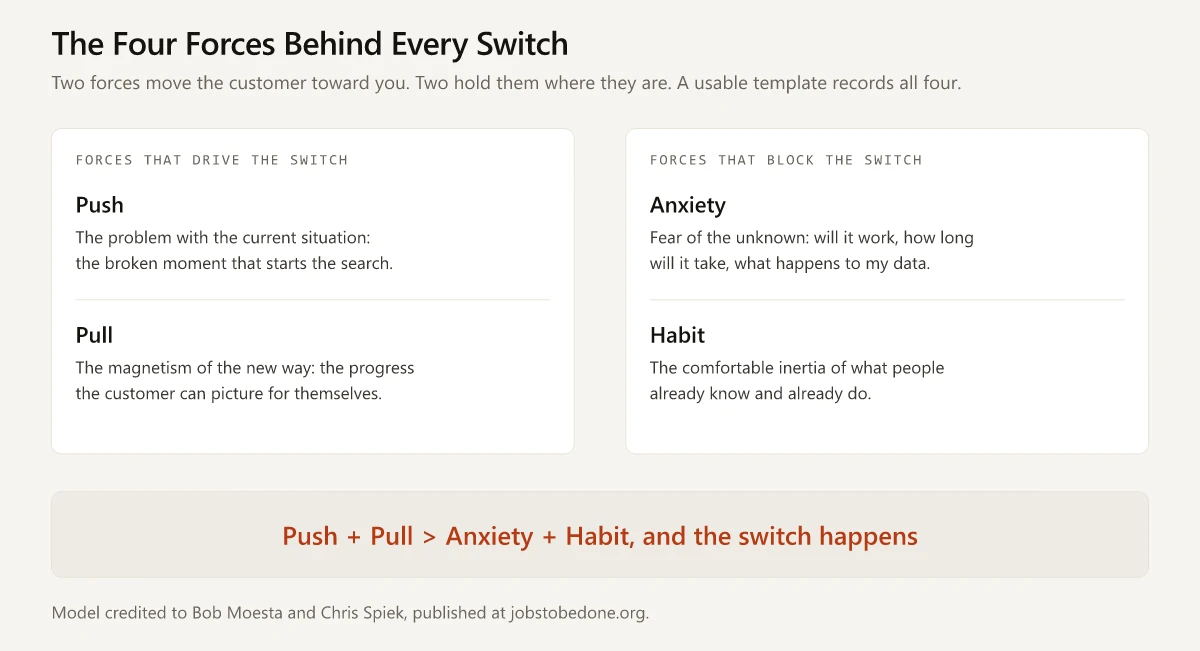
Moesta and Spiek name the imbalance on that page: “Most teams obsess over making their product more attractive (pull) while ignoring the two forces that actually kill most deals: anxiety and habit.” Campaigns pile on pull, another benefit and another proof point, while the anxiety and habit columns sit empty in the research doc. A template that records all four tells you which force is blocking the deal.
How Do You Turn a Filled Template Into Messaging?
Map each row to the asset it feeds, then write the asset.
| Row | What it becomes |
|---|---|
| Job statement | The headline promise |
| Circumstance | The trigger the campaign targets and the moment the ad has to catch |
| Competing alternative | The comparison the copy has to win, named rather than implied |
| Push | The problem line above the headline |
| Pull | The outcome picture in the hero section |
| Anxiety | The reassurance block and the first three steps of onboarding |
| Habit | The switching-cost argument on the comparison page |
| Hiring criteria | The security, pilot and reference material sales sends mid-cycle |
| Firing criteria | The alert a customer success team watches for |
| Success test | The proof point and the number on the case study |
| Trade-off accepted | The objection to answer before a competitor raises it |
| Evidence | The quote that goes in the deck, sourced |
A filled template feeds the value proposition directly, so I would fill one before opening a value proposition template rather than after. The job statement and the success test supply the two halves a value proposition needs: what progress is being made, and how anyone would know it happened.
For the structured version of that step, the value proposition canvas generator maps jobs, pains and gains against your offer, and the buyer persona generator turns the circumstance and hiring criteria rows into a profile a sales team can read.
A single filled template is a hypothesis about one customer, and messaging written off it will be wrong in a way that is hard to spot. Aggregating three or four from the same segment is what gives you a message, and the same job recurring across a whole segment is one of the earlier signals that you are approaching product-market fit.
Interview Questions That Fill Each Field
Fields do not fill themselves from a survey. These questions map to specific rows, and they work best in a recorded conversation with someone who bought in the last 90 days.
| Question | Field it fills |
|---|---|
| When did you first think about changing something? | Circumstance |
| What were you doing before this? Walk me through the last time. | Competing alternative |
| What happened the week before you started looking? | Push |
| What did you picture being different afterwards? | Pull |
| What almost stopped you from going ahead? | Anxiety |
| What was already working about the old way? | Habit |
| Who else had to say yes, and what did they ask for? | Hiring criteria |
| How would you know, in a number, that this worked? | Success test |
| What did you give up by choosing this? | Trade-off accepted |
| What would make you go back? | Firing criteria |
Ask for the last specific instance rather than the general pattern, because people describe their routines inaccurately and their last Tuesday accurately. Then stay silent after the answer, because the sentence that arrives after the pause is usually the one worth quoting.
Where Jobs to Be Done Templates Break
The filled templates that end up unused tend to fail in the same places:
- It gets filled in a workshop. Nobody in the room bought the product, so every row is a guess and the confidence line honestly reads “zero interviews”. A workshop is a fine place to review filled templates and a poor place to create them.
- One template gets written per product. Jobs belong to circumstances, so a product serving three circumstances needs three filled templates, and they will disagree with each other in useful ways.
- The success test row gets skipped. Nothing in the template can then be wrong, and nothing in it will change a decision.
- Only won deals get interviewed. Talk to the accounts you lost and the customers who churned, or the competing alternative row will only ever hold the thing you already beat.
- It gets filled well and then never reread. Put the interview ID in every row so the next person can trace a claim back to a recording, and set a date to refill the top three jobs each year.
Run the Jobs to Be Done Template on One Customer This Week
Pick one customer who bought in the last quarter, book 30 minutes, and fill every row of the jobs to be done template from that single call, including the rows you have to leave blank. The blanks are the finding. They show which force you never asked about.
Then run it twice more with the same segment and compare the competing alternative rows. Three filled templates is enough to write a headline you can defend.
Start with the interview you have been putting off.
Frequently Asked Questions
What is a jobs to be done template?
A jobs to be done template is a fixed set of fields you fill in after customer interviews so the research turns into decisions. A usable one captures the job statement, the circumstance, the competing alternative that got fired, the four forces pushing and blocking the switch, the hiring and firing criteria, a measurable success test, the trade-off the customer accepted, and the source of every quote.
How do you write a jobs to be done statement?
Strategyn's format is verb plus object of the verb plus contextual clarifier, as in 'listen to music while commuting to work'. Keep the solution out of it, keep it in the customer's language, and make sure it stays true if your product disappears tomorrow.
What did Clayton Christensen say about jobs to be done?
The Christensen Institute defines a job as the progress a person is trying to make as they strive toward a goal or aspiration within particular circumstances, with functional, social and emotional dimensions. Christensen set the theory out with Taddy Hall, Karen Dillon and David S. Duncan in the September 2016 Harvard Business Review.
What are some jobs to be done examples?
The best documented one is the milkshake study Christensen's team ran for an unnamed fast-food chain, where 40 percent of milkshakes were bought first thing in the morning by commuters who ordered them to go. Tony Ulwick's Bosch power tool example is another: minimize the time it takes to identify the correct drill bit size for the material being drilled.
What is the difference between a job story and a job statement?
A job statement names the progress in the abstract, using verb, object and context. A job story, the format Alan Klement wrote up on the Intercom blog in December 2013, adds the situation and the expected outcome so a design or engineering team can build against it.