Value Proposition Template: 3 Fill-in-the-Blank Frameworks
A value proposition template gives you a fill-in-the-blank structure to say why buyers should choose you. Frameworks, examples, and the writing process.
I have watched founders spend three weeks debating their homepage headline and still ship a sentence that could belong to any of their competitors. The problem is almost never the writing. It is that they start with a blank page instead of a structure.
A value proposition template fixes that. It is a fill-in-the-blank frame that forces you to name the customer, the job they are doing, the outcome you deliver, and the one thing a rival cannot honestly say back. In this guide I will walk through the templates I actually reach for, when each one wins, and the step-by-step process to fill them in without producing something generic.
Getting this right is not cosmetic. In CB Insights’ study of failed startups, poor product-market fit was behind 43% of failures - companies that built something the market never clearly wanted, or could never explain why it mattered. A sharp value proposition is where you catch that problem early.
Why You Need a Value Proposition Template at All
Most teams skip the structure because they think they already know their value. Then they write a sentence, everyone nods, and six months later the homepage still says “the leading platform for X.”
A template does three things a blank page cannot. It makes the missing piece obvious, it kills the temptation to lead with features, and it gives a committee a shared shape to argue inside of. The disagreement becomes “is this the right differentiator?” instead of “I just do not love it.”
If you want the conceptual foundation before you start filling in blanks, read what a value proposition actually is first. A template is only as good as your understanding of the four parts it is built from.
The Anatomy Every Template Shares
Strip the branding off any of these frameworks and you find the same four blocks underneath. The order changes. The blocks do not.
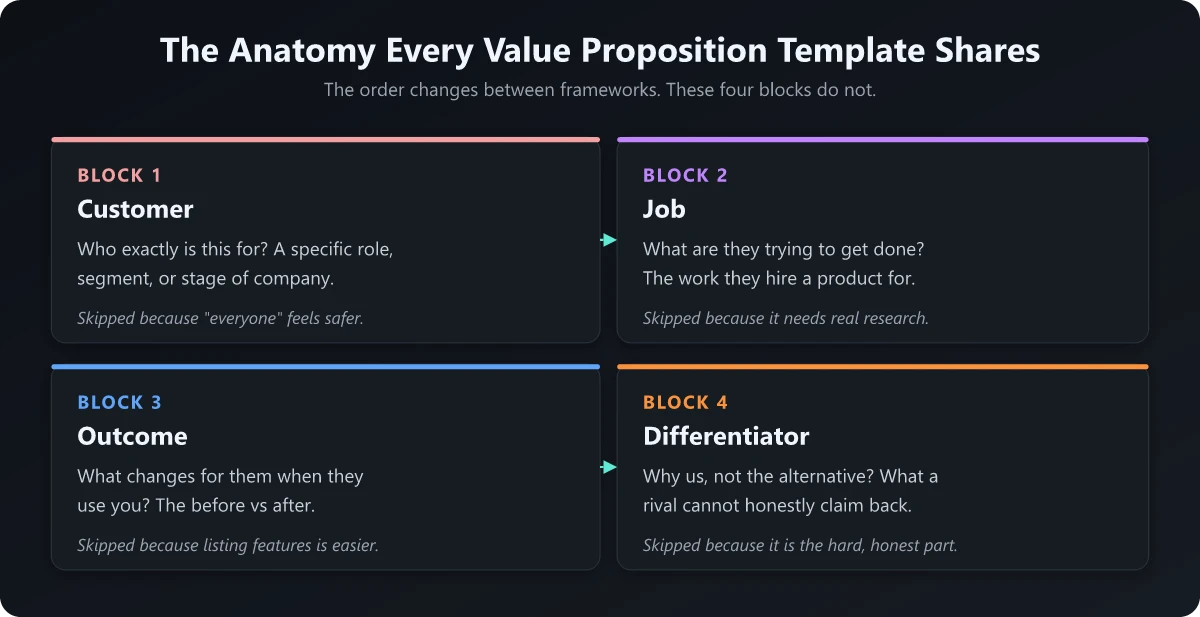
| Block | What it answers | Why teams skip it |
|---|---|---|
| Customer | Who exactly is this for? | ”Everyone” feels safer than choosing |
| Job | What are they trying to get done? | It requires real customer research |
| Outcome | What changes for them? | Easier to list features instead |
| Differentiator | Why us, not the alternative? | This is the hard, honest part |
Almost every weak value prop nails the first three and fluffs the fourth. Without a differentiator a competitor cannot match, you have written a description, not a proposition. Keep this table next to you as you fill in any of the templates below.
Template 1: The Steve Blank XYZ Formula (Fastest Draft)
This is the one I use to break a blank page. It comes from Steve Blank and reads like a single sentence with three slots.
We help [X] do [Y] by [Z].
- X is the specific customer, not a market
- Y is the job or outcome they care about
- Z is your mechanism or point of difference
Filled in, it might read: “We help RevOps leaders forecast deals accurately by analyzing every customer conversation, not just CRM fields.” It is rough, but in one line you can already tell whether you have a real differentiator or just a category label.
Use this template when you need a draft in ten minutes, when you are pressure-testing a new product idea, or when a stakeholder keeps describing the company instead of the value. Its weakness is that “by [Z]” tempts people to drop in a feature. If Z is a feature rather than a reason to choose you, the draft is not done.
Template 2: The Geoff Moore Positioning Template (Most Rigorous)
When the stakes are higher - a category launch, a repositioning, a board-level narrative - I move to the template from Geoff Moore’s Crossing the Chasm. It is longer on purpose.
For [target customer] who [statement of need or opportunity], our [product name] is a [product category] that [key benefit]. Unlike [primary competitive alternative], our product [primary differentiation].
This template earns its length by forcing two things most teams avoid. It makes you name a category, which sets buyer expectations, and it makes you name the alternative you are beating. That “unlike” clause is where positioning and value proposition meet.
If you are working on the broader narrative, not just the headline, pair this with my breakdown of product positioning and the wider discipline of market positioning. The Moore template is really a positioning statement that happens to contain your value prop.
When the Moore template is overkill
Do not put the full Moore statement on a homepage hero. It is a strategic artifact, not headline copy. Use it internally to align the team, then compress it down to a Blank-style sentence for the page. I treat Moore as the source and XYZ as the publishable version.
Template 3: The “So That” Template (Most Natural to Read)
This one sits between the two. It is close to the Moore structure but trims the category and competitor clauses so it reads like real copy rather than a fill-in form.
For [customer] who [need], [product] delivers [benefit] so that [outcome they care about].
The “so that” is the part I love. It pushes you past the feature and past the immediate benefit into the thing the buyer is actually buying. “Faster reports” is a benefit. “So that you walk into the board meeting already knowing the number” is an outcome. People buy the second one. If a draft blurs the benefit and the outcome together, the feature benefit value ladder gives each rung a pass or fail test, and the “so that” clause is where a passing value line goes.
How to Fill In Any Template Without Sounding Generic
The template is the easy part. Filling it with something true and specific is the work. Here is the order I follow, and the order matters.
- Start with the customer, not the product. Write the most specific buyer you can defend. “RevOps leader at a 50-rep SaaS company” beats “sales teams.”
- Find the job in their words. Pull language from sales calls, reviews, and support tickets. If you are inventing the phrasing, you are guessing. A filled-in jobs to be done template is the cleanest source for this line, because it already separates the job from the feature request it arrived disguised as.
- Write the outcome, then push it one level deeper. Use the “so that” test until you hit something the buyer would say out loud.
- Name the alternative honestly. Often the alternative is a spreadsheet or doing nothing, not a named competitor.
- Write the differentiator a rival cannot claim. If your competitor’s homepage could run your exact sentence, delete it and start the line again.
- Compress to one sentence. The internal version can breathe. The published version cannot.
This is also where the value proposition template stops being a writing exercise and becomes a research exercise. The blanks are easy. The truth that goes in them is what separates a homepage that converts from one that decorates. If the research is thin, the fix sits upstream of the template: mapping customer jobs, pains, and gains against what you actually sell produces the raw material all three of these formulas are asking you to compress into one sentence.
Picking the Right Value Proposition Template for the Job
I do not have a favorite. I have a default for each situation, because each template optimizes for something different.
| Template | Best for | Watch out for |
|---|---|---|
| Blank XYZ | Fast drafts, idea validation, headlines | ”by [Z]” turning into a feature |
| Geoff Moore | Launches, repositioning, B2B alignment | Too long for a live homepage |
| The “so that” template | Polished, natural-reading copy | Can drift vague without a real outcome |
In practice I often run the same input through all three in twenty minutes. The Moore version exposes whether my positioning holds, the “so that” version tells me how it reads, and the XYZ version becomes what ships. Same truth, three pressures applied to it.
If this kind of structured messaging work is new to you, it is worth understanding what a product marketing manager actually does, because owning the value proposition usually lands on that desk. And if you are doing this for software specifically, the templates plug directly into a broader SaaS product marketing strategy.
A Worked Example, Filled Three Ways
Take a fictional product: a tool that cuts data-pipeline downtime for engineering teams. Here is the same proposition pushed through each template.
XYZ: “We help data engineering leads cut pipeline downtime by catching broken data before it reaches dashboards.”
Moore: “For data engineering leads who cannot trust their pipelines, our product is a data observability platform that flags broken data before it spreads. Unlike manual monitoring and alert sprawl, our product traces every issue back to its source automatically.”
So that: “For data leads who keep getting paged at 2am, our platform catches bad data upstream so that you stop explaining outages to the business.”
Notice the truth never changed. The customer, the job, and the differentiator stayed constant. Only the framing flexed to fit the use - one for the board deck, one for the homepage, one for the sales call.
The Takeaway
A value proposition template will not write your messaging for you, and it should not. What it does is remove the two failure modes I see most: leading with the product, and skipping the differentiator that makes the whole thing worth reading.
Pick the template that matches your situation - XYZ to draft, Moore to pressure-test, “so that” to publish - and fill the blanks in customer-first order. Do the research so the words you drop in are your buyer’s words, not yours. Get that right and the template becomes less a fill-in-the-blank exercise and more the sharpest strategic decision your marketing makes all year.
Frequently Asked Questions
What is a value proposition template?
It is a fill-in-the-blank structure that forces you to name the customer, the job they are doing, the outcome you deliver, and what makes you different. The template does not write the value prop for you. It just makes sure you do not skip the part that actually matters.
What is the best value proposition template?
There is no single best one. The Steve Blank XYZ template is the fastest for getting a rough draft, the Geoff Moore positioning template is the most rigorous for B2B, and the so-that template reads the most naturally on a homepage. Pick by where you are stuck.
How do you fill in a value proposition template?
Start with the customer and the job they are trying to do, not your product. Then write the outcome in the buyer's words, and only at the end add the differentiator that a competitor cannot honestly claim back. Most weak drafts get filled in product-first, which is the wrong order.
What is the difference between a value proposition and a value proposition statement?
The value proposition is the underlying truth about who you serve and why you are different. The statement is the written one-sentence articulation of it. A template helps you produce the statement, but only if the underlying proposition is sound.
Can I use the same value proposition template for B2B and B2C?
The structure carries over, but the emphasis shifts. B2B templates lean on the job-to-be-done and the point of difference because buying is committee-driven. B2C templates lean harder on the outcome and emotional payoff because the decision is faster and more personal.