Product Marketing Brief Template With a Filled Example
A product marketing brief template with fields others leave thin: messages paired with proof, claims we will not make, enablement asks, plus a filled example.
“Claims we will not make” is the field I would add first to any product marketing brief template. It lists the sentences nobody working on the launch may write or say, the reason each one is off limits and the line to use instead. A product marketer needs it because the brief is the page that web, content, sales and an agency all write from, and a brief that only lists what to claim leaves every writer to guess where the limit sits.
Three published templates show how close they get. Noah Cisneros’s PDF template has a “Compliance Guardrails” box for “Key compliance/legal concerns for bank product”, and keeps its proof points in a section of their own, apart from the key messages.
Smartsheet’s template has a Requirements box asking what “must be” included in the product and the promotion, and no box for what stays out. The meetingnotes.com template credited to Delyn Simons of Shopify has a Core Message and a Secondary message with no proof under either, and its nearest thing to a limit is a Notes box for “Key things to be aware of”.
My view is that a product marketing brief should hold only the decisions every asset built from it inherits, and nothing the launch plan already holds. Tier, dates, owners, channels and goals have a home in the plan, so the brief links to it instead of copying it, and the space that frees up goes to proof and to the claims we will not make.
What Is a Product Marketing Brief?
A product marketing brief is the internal document a product marketer writes after the product manager’s product brief and before any launch asset exists. It fixes the audience, problem, competitive alternative, positioning statement, each message with its proof, the claims we will not make, enablement asks and open questions.
Asana’s template page defines the product brief that comes first as “an internal document that summarizes a product’s scope, goals, and direction”, and adds that “Usually, the product manager creates the product brief during the planning stage.” Asana’s definition also covers “how you’ll bring it to market” in a single clause. The product marketing brief is where that clause turns into a positioning statement, messages and proof, and it is the launch brief at the top of the positioning and messaging block, weeks -12 to -8, in my product launch checklist.
The Product Marketing Brief Template, Field by Field
Copy the block into a doc and fill sections 3, 5 and 6 first, since the positioning statement in section 4 is built from 3 and 5, and section 6 goes to legal with the first draft. The header links the launch plan, the messaging framework and, for a new product line, the GTM strategy instead of repeating them. Sections 3, 5, 6 and 7 are the ones the three templates above leave out or leave thin.
PRODUCT MARKETING BRIEF

Product / release:  ____________________   Version: ___   Date: ________
Brief owner (PMM):  ____________________   Approver: _______________
Launch plan:        [link] - tier, date, owners, channels, goals,
                    milestones and risks live there, not here
Messaging:          [link] - the messaging framework holds the full
                    matrix and pillars
GTM strategy:       [link] - new product line only: pricing,
                    packaging, sales motion

1. AUDIENCE
   Buyer (signs):   ________________________________________________
   User (uses it):  ________________________________________________
   Segment:         ________________________________________________

2. PROBLEM, IN THE BUYER'S WORDS
   Quote:   "_______________________________________________________"
   Source:  interview / sales call / ticket / review    Date: ________

3. COMPETITIVE ALTERNATIVE
   What the buyer uses today (a named product, a spreadsheet,
   an agency, or nothing): _________________________________________
   What it costs them:     _________________________________________

4. POSITIONING STATEMENT
   For [audience] who [problem], [product] is a [category] that
   [key benefit]. Unlike [the alternative from section 3],
   [product] [the difference, backed by proof in section 5].

5. MESSAGES AND PROOF
   Primary message:      __________________________________________
     Proof:              ____________________  Lives in: __________
   Secondary message A:  __________________________________________
     Proof:              ____________________  Lives in: __________
   Secondary message B:  __________________________________________
     Proof:              ____________________  Lives in: __________

6. CLAIMS WE WILL NOT MAKE
   Claim | Why not | Say instead | Unlock when
   1. ______________________________________________________________
   2. ______________________________________________________________
   3. ______________________________________________________________

7. ENABLEMENT ASKS
   Team | The ask (to them or from them) | Format | Due
   Sales:             ______________________________________________
   Customer success:  ______________________________________________
   Support:           ______________________________________________
   Web and content:   ______________________________________________

8. OPEN QUESTIONS (empty before sign-off)
   Question | Who decides | By when
   ________________________________________________________________
Each section passes or fails on a check a reviewer can make in under a minute:
| Section | Done when | Fails when |
|---|---|---|
| 1. Audience | Buyer and user are named roles, with a company size | It says “SMBs” or “marketing teams” |
| 2. Problem | It is a sentence a buyer said, with a source and a date | It restates the feature list |
| 3. Competitive alternative | It names what the buyer does today, a spreadsheet or nothing included | It lists every vendor in the category |
| 4. Positioning statement | The “Unlike” clause names the alternative from section 3 | The “Unlike” clause is missing or names no one |
| 5. Messages and proof | Every message has proof a reviewer can open, and the place it lives | The proof is an adjective |
| 6. Claims we will not make | Every row has a reason, a replacement line and an unlock condition | It bans words and offers nothing to say instead |
| 7. Enablement asks | Every team has one ask, a format and a due date | One line reads “enable sales” |
| 8. Open questions | Every question has a person and a date, and the list is empty at sign-off | It says “TBD” |
Section 4 uses the statement shape from my product positioning guide, with the “Unlike” clause pointing back to section 3, so the alternative is named once and used twice. In section 5, proof is anything a reviewer can open: a capability your docs state (the bottom rung of feature vs benefit vs value is the test), a customer result you have permission to use, or a benchmark someone else could rerun.
How to Fill the Claims We Will Not Make Section
Atlassian’s guide to product requirements documents already asks product managers for a list like this. It gives a PRD a section called “What we’re not doing”, telling the team to stay focused “by clearly calling out what you’re not doing” and to “Flag things that are out of scope at the moment, but might be considered at a later time.”
The website brief in step one of building a personal website with Claude Code keeps the PRD version of this row, “Out of scope”. Section 6 applies the same idea to launch copy: a claim goes in when its proof will not exist on the day the asset ships, and it comes out when the proof arrives.
What an unsupported number can cost is on the public record. In April 2025 the FTC proposed an order against Workado, which it said had promoted its AI Content Detector as “98 percent” accurate, while independent testing put its accuracy on general-purpose content at 53 percent, according to the agency’s complaint (FTC press release, April 2025). The order bars Workado from effectiveness claims unless it has “competent and reliable evidence to support the claim at the time it is made”, and the FTC approved it as final in August 2025.
| Put a claim in section 6 when | Example line | Say instead | Unlock when |
|---|---|---|---|
| A number has no test behind it on the ship date | ”98% accurate” | The figure your test supports, with the test named | The test is run and written up |
| It says the product replaces a person or a profession | ”Replaces your marketing analyst” | The task it takes off their desk, with the time saved | Never in this wording |
| It is a first, a best or a number one | ”The first AI analyst for finance teams” | The capability, with the date it shipped | A source you can cite says it |
| It credits AI with work the product does by rules | ”AI-powered lead routing" | "Routes leads by territory and deal size” | A model ships and its accuracy is measured |
| A certification or audit is unfinished | ”SOC 2 Type II certified" | "SOC 2 Type II audit in progress” | The auditor issues the report; then write “SOC 2 Type II report available”, never “certified” |
| The feature is still on the roadmap | ”Native Salesforce sync” | Nothing in launch copy | It ships |
| It names a competitor | ”3x faster than RivalCo” | Your own measured number with its source, and no multiple; the battlecard lists the multiple as do-not-say | Legal approves a test you would publish |
The replace-a-person row has an FTC case behind it as well. In its Operation AI Comply announcement of September 2024, the FTC said DoNotPay claimed to offer “the world’s first robot lawyer”, but “the product failed to live up to its lofty claims that the service could substitute for the expertise of a human lawyer.” Lina Khan, FTC Chair at the time, said “there is no AI exemption from the laws on the books”.
The Commission approved the final DoNotPay order on January 16, 2025. It requires DoNotPay to pay $193,000 in monetary relief and prohibits it from advertising that its service performs like a real lawyer unless it has sufficient evidence to back it up.
I would hold every launch, B2B or consumer, to the Workado order’s rule: competent and reliable evidence at the time the claim is made.
The unlock column keeps section 6 from turning into a permanent ban list. When the auditor issues the SOC 2 report, the row leaves section 6 and the report becomes proof under a message in section 5. That message names a report, not a certificate: the AICPA’s SOC 2 guide is titled “Reporting on an Examination of Controls at a Service Organization”, and CPAs issue SOC 2 as an assurance report, so the line is “SOC 2 Type II report available”.
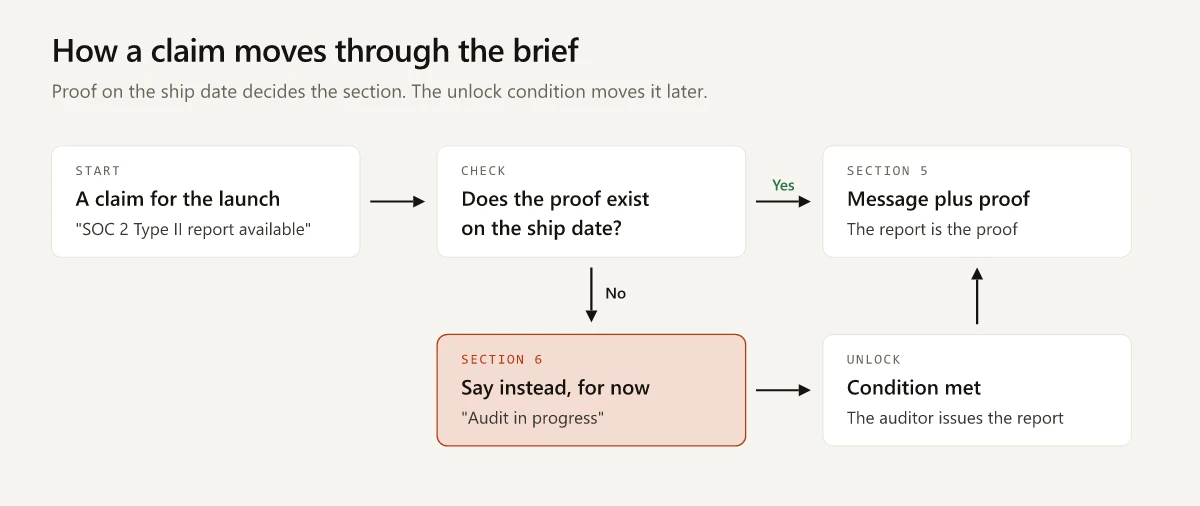
Send section 6 to legal with the first draft of the brief, so the review happens once, on one list, before any asset is written.
A Filled Product Marketing Brief Template for Acme Insights
Acme Insights is fictional. It is the sample product five of the free tools on this site load as placeholder data, a revenue attribution platform for demand generation leaders, so every name, quote and number below is sample data rather than a result. Due dates count days before launch, so T-14 is two weeks out.
Header and Sections 1 to 4
| Section | Acme Insights v2 |
|---|---|
| Header | Launch plan and messaging framework: linked. Owner: the PMM. Approver: the VP of Marketing |
| 1. Audience | Buyer: VP of Demand Generation at a 200-2,000 employee B2B SaaS company. User: the marketing ops manager who builds the quarterly attribution report |
| 2. Problem | ”Every quarter the board asks which channels made pipeline, and my ops lead spends three days in spreadsheets on an answer I still can’t defend.” Sample interview, VP of Demand Generation, dated two weeks before kickoff |
| 3. Competitive alternative | A quarterly CRM export reconciled by hand in a spreadsheet. Second: a legacy attribution suite, six months to implement and $80K to license, per lost-deal notes |
| 4. Positioning statement | For VPs of Demand Generation at 200-2,000 employee B2B SaaS companies who must explain channel spend to the board every quarter, Acme Insights is a revenue attribution platform that ties pipeline to the channel that sourced it in under 45 days, without engineering. Unlike a quarterly spreadsheet built from CRM exports, Acme Insights reconciles every closed deal against the CRM every night |
Section 5: Messages and Proof
| Message | Proof | Lives in |
|---|---|---|
| Primary: attribute pipeline to channel in under 45 days, without engineering | Kickoff-to-first-report time logged for every design partner; adding or reweighting a channel needs no engineering ticket | Implementation tracker; setup guide |
| Secondary A: answer the board’s channel question in 30 minutes instead of three days | NorthWind Labs: “We cut attribution work from 3 days to 30 minutes a quarter.” | Signed quote approval |
| Secondary B: channel numbers that match the CRM | Closed-won totals reconciled against Salesforce or HubSpot every night, with a variance report | Product docs; demo account |
Section 6: Claims We Will Not Make
| Claim | Why not | Say instead | Unlock when |
|---|---|---|---|
| ”AI-powered attribution” | v2 assigns credit with weighting rules the customer sets; no model is trained | ”Weighting rules you set and can explain to your CFO” | A trained model ships and its accuracy is measured |
| ”Proves marketing ROI” | v2 credits channels by rule and runs no holdout test, so it cannot show what would have happened without a channel | ”Shows which channels sourced and influenced pipeline” | Never in this wording |
| ”SOC 2 Type II certified” | The audit period ends after launch day, so no report exists yet, and a SOC 2 is a CPA’s report, not a certificate | ”SOC 2 Type II audit in progress” | The auditor issues the report; then “SOC 2 Type II report available" |
| "Works with your whole stack” | 60+ native integrations still leaves out any tool not on the list | ”60+ native integrations, including HubSpot, Salesforce, Segment and GA4” | Never; keep the count current |
| ”4x faster to implement than [legacy suite]“ | The six-month figure comes from lost-deal notes, not a test anyone could repeat | ”Live in under 45 days” in every asset, the battlecard included; the lost-deal notes stay internal context, never a talk track | A published, repeatable implementation benchmark |
Section 7: Enablement Asks
| Team | Ask | Format | Due |
|---|---|---|---|
| Sales | Certify on the new talk track; each AE brings one deal lost to “we’ll keep the spreadsheet” | 45-minute session plus a recorded pitch | T-14 |
| Sales development | Rewrite sequence openers around the primary message, with “AI” removed from every step | Sequence copy for review | T-10 |
| Customer success | Name five customers willing to take a reference call about the 45-day claim | Account list with owners | T-21 |
| Support | One macro for “does it integrate with X” that links the integrations page | Help desk macro | T-7 |
| Web and content | Launch page and post that use the primary message word for word, checked against section 6 | Page and post drafts | T-10 |
Section 8: Open Questions
- Can NorthWind Labs be named in paid ads, or only on the website? Customer marketing decides by T-30.
- Does “under 45 days” still hold once 20 implementations are in? The PMM and the implementation lead decide by T-21.
The “Say instead” lines in section 6 go straight into the sales talk track, the integrations line into the support macro, and the T-10 web and content ask is where section 6 gets checked against real copy before anything ships.
Product Brief vs Marketing Brief vs PRD: Which Brief Is Which
Five documents get called a brief or sit next to one, and they differ by owner, reader and timing. The product brief and PRD rows follow Asana and Atlassian, linked above; the other three rows are the split I recommend. Some templates sold as a marketing brief belong in the creative brief row: JotForm’s marketing brief template says the document “summarizes the marketing strategy for a specific campaign.”
| Document | Owner | Main reader | What it settles | When |
|---|---|---|---|---|
| Product brief | The product manager | Stakeholders “from the product team to product marketing executives” (Asana) | The “why” and “what”, in Asana’s FAQ | Planning stage |
| PRD | The product manager, with the team | The team building the product | ”the purpose, features, and behavior of a product” (Atlassian); Asana calls it the “how” | After the product brief |
| Product marketing brief | The product marketer | Everyone who writes, designs or sells for the launch | Audience, alternative, positioning, messages with proof, claims we will not make, enablement asks | After the product brief, before any asset is briefed |
| Launch plan | The launch owner, often the PMM | The launch team | Tier, date, owners, channels, goals, milestones, risks | Alongside the product marketing brief |
| Creative brief | A marketing or creative lead | Designers, copywriters, an agency | One asset or campaign, with its “project requirements, objectives, and deliverables” (Atlassian’s creative brief template) | Per asset, after the product marketing brief is approved |
Asana’s FAQ adds that “Most effective product briefs are one to three pages.” Keep a product marketing brief to two pages, because the launch plan and the messaging framework carry the detail it links to.
The Field-to-Asset Map
Seven of the eight sections feed an asset built after the brief; open questions feed nothing because they are empty at sign-off. The table adds the template or guide on this site for building each asset.
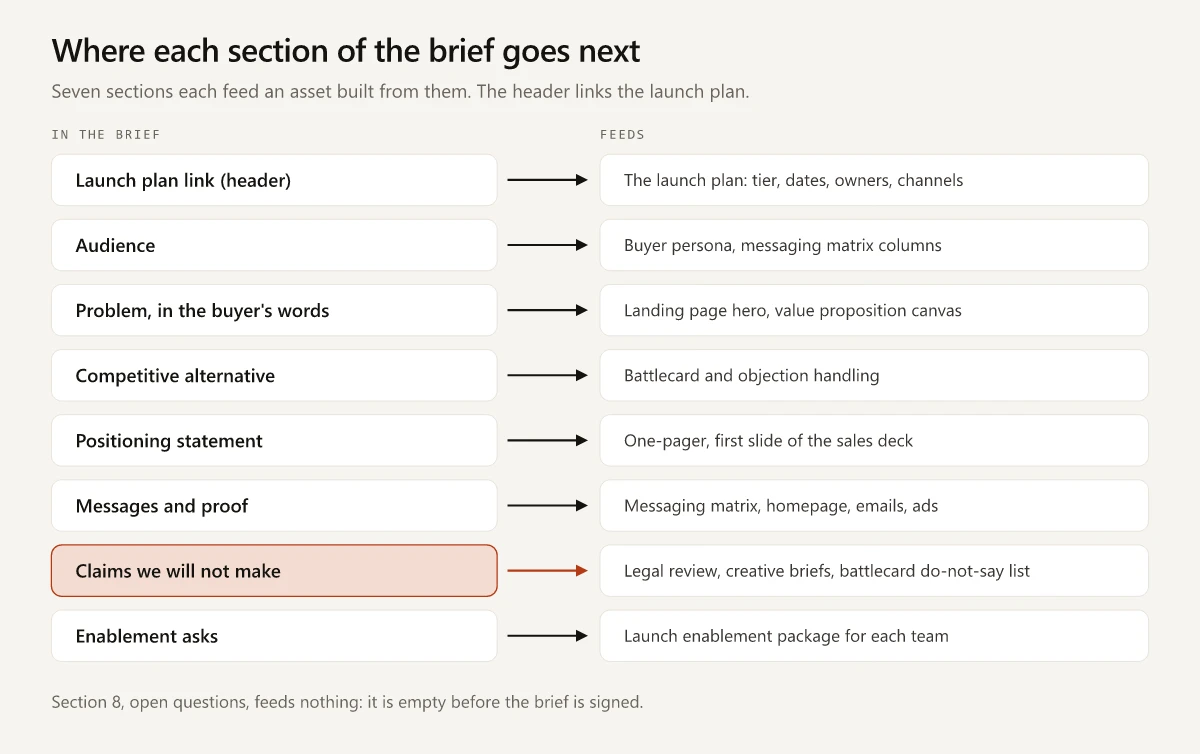
| Brief section | Feeds | Build it with |
|---|---|---|
| Header: launch plan link | Everything the launch plan holds, listed in the which-brief table above | Product launch plan template |
| 1. Audience | Buyer persona; the columns of a messaging matrix | Buyer persona generator |
| 2. Problem | Landing page hero; the pains on a value proposition canvas | Value proposition canvas generator |
| 3. Competitive alternative | Battlecard; objection handling | Competitive battlecard template and the battlecard generator |
| 4. Positioning statement | One-pager; the first slide of the sales deck | Product one-pager template |
| 5. Messages and proof | Messaging matrix and hierarchy; homepage, emails, ads | Brand messaging framework |
| 6. Claims we will not make | Legal review; every creative brief; the battlecard’s do-not-say list | Stays in the brief |
| 7. Enablement asks | The launch enablement package | Sales enablement checklist |
Pricing, packaging and the sales motion belong to the go-to-market strategy, which the header links for a new product line and the brief should not restate.
Launch Brief, Messaging Brief or GTM Brief: Cutting the Template
The same document travels under several names, and each request needs a different cut:
| If you were asked for | Keep | Move out |
|---|---|---|
| A full product launch brief | All eight sections | Nothing; the header already links the launch plan |
| A one-page launch brief, like the one in my SaaS launch playbook | A why-now line you add, then sections 2 to 4, the primary message and the goals from the launch plan | Everything else, linked from the page |
| A messaging brief | Sections 1 to 6 | Enablement asks go to the enablement plan, open questions to the kickoff agenda |
| A go-to-market brief for a new product line | All eight sections, with the header’s GTM strategy link filled in | Pricing and packaging, which stay in the linked strategy |
| A brief for a Tier 3 release | Sections 1, 5 and 6 | Positioning and enablement, unless the release changes either |
| A creative brief for an agency | A creative brief of its own, with sections 5 and 6 pasted in | Everything else stays internal |
Fill Sections 3, 5 and 6 First
A product marketing brief template is worth copying when it holds what the assets built from it cannot decide for themselves and links the launch plan for everything else. Section 6 is the part the three published templates above leave out or shrink to a compliance box. Before your next launch kickoff, fill sections 3, 5 and 6, then send section 6 to legal with the draft. Write its first row today.
Frequently Asked Questions
What is a product marketing brief?
A product marketing brief is the internal document a product marketer writes after the product manager's product brief and before any launch asset exists. It fixes the audience, problem, competitive alternative, positioning statement, each message with its proof, the claims we will not make, enablement asks and open questions.
What is the difference between a product brief and a marketing brief?
A product brief is usually the product manager's document, and Asana defines it as an internal document that summarizes a product's scope, goals, and direction. A product marketing brief comes after it and settles how the launch is positioned, which messages and proof every asset uses, and which claims we will not make. Some templates sold as a marketing brief, such as JotForm's, are campaign briefs that summarize the strategy for one campaign, and those sit downstream of both.
What should a product launch brief template include?
A full launch brief covers the audience, the problem in the buyer's words, the competitive alternative, a positioning statement, messages paired with proof, the claims we will not make, enablement asks per team and open questions, with a link to the launch plan for tier, dates, owners, channels and goals. A one-page version adds a why-now line and keeps the problem, the alternative, the positioning statement, the primary message and the goals.
What goes in a messaging brief or go-to-market brief template?
A messaging brief keeps the first six sections of a product marketing brief: audience, problem, competitive alternative, positioning statement, messages with their proof, and the claims we will not make. A go-to-market brief keeps all eight sections and links the GTM strategy for pricing, packaging and the sales motion.
How long should a product marketing brief be?
Two pages at most. Asana puts a product manager's product brief at one to three pages, and a product marketing brief can stay shorter because launch logistics live in the launch plan and the full messaging matrix lives in the messaging framework.