B2B Buyer Persona: Build One Sales Actually Uses (2026)
A B2B buyer persona is only useful if sales acts on it. Here is how to build one from real research, structure it for the buying committee, and keep it alive.
I have read a lot of B2B buyer personas that nobody in the company has opened since the offsite where they were made. They sit in a slide deck, they have a stock photo and a name like “Marketing Mary,” they list her age and her favorite podcasts, and they are completely useless to the rep on a discovery call at 4pm.
A B2B buyer persona is not a character study. It is a tool that helps marketing write copy that lands and helps sales handle the objection before it is raised. If your persona does not do those two jobs, it is decoration.
In this post I will walk through how I actually build one, what to put in it, what to throw out, and how to keep it from rotting in a folder. The goal is a persona sales reaches for on purpose.
It matters more in B2B than anywhere else, because you are never selling to one person. Forrester’s 2024 State of Business Buying found that, on average, 13 people are involved in a B2B buying decision. A B2B buyer persona that captures only the economic buyer ignores the other dozen people who can stall or kill the deal.
What a B2B Buyer Persona Actually Is
A buyer persona is a research-based profile of a specific role in the buying decision. Not a real individual, not a vague “small business owner,” but a composite of the people who repeatedly show up in your deals doing a particular job.
The B2B part matters more than people admit. In B2C you often sell to one person who buys for themselves. In B2B you sell to a buying committee: an economic buyer, a champion, an end user, a technical evaluator, and at least one skeptic who can kill the deal. Each of them weighs your product differently.
So a single “the customer” persona almost never survives contact with a real B2B sale. You need a small set of personas that map to the committee, because the VP signing the contract cares about completely different things than the analyst who will use the product daily.
This is also where people confuse two related ideas. If you want the full breakdown, I wrote a dedicated piece on ICP vs buyer persona, but the short version is below.
Persona vs ICP vs Segment
These three terms get used interchangeably, and that sloppiness is why so many personas are bad. Here is how I keep them straight.
| Defines | Level | Answers | |
|---|---|---|---|
| ICP | The right company to pursue | Account | ”Should we spend effort on this account?” |
| Buyer persona | A specific role in the decision | Individual | ”How do I talk to this person?” |
| Segment | A group with shared traits | Market | ”Which slice of the market is this?” |
| Buying committee | All roles in one deal | Deal | ”Who else has to say yes?” |
The ICP filters accounts. The persona shapes the conversation. Get them backward and you end up with a beautiful persona for a company that will never buy, or a sharp account list you have no idea how to sell into.
Why Most Buyer Personas Fail
Before the how, it is worth being honest about why these documents fail so often. I have made every one of these mistakes.
- They are built from imagination, not interviews. A team gathers in a room, guesses what the buyer wants, and writes it down with confidence. Confidence is not evidence.
- They lead with demographics. Age, gender, and “drinks oat milk lattes” tell a rep nothing about how to close a deal. Decision criteria and objections do.
- There are too many of them. Twelve personas is not rigor, it is a way to guarantee none of them get used. If two personas would hear the same pitch, they are one persona.
- They never get updated. The market moves, the product moves, the buyer’s priorities move, and the persona stays frozen in the quarter it was born.
- Sales was never in the room. If the people who talk to buyers every day did not help build the persona, do not be surprised when they ignore it.
The fix for all five is the same discipline: build from real conversations, lead with what changes the sale, keep the set small, and revisit it on a schedule.
How to Build a B2B Buyer Persona Step by Step
Here is the process I run. It is not glamorous and it is mostly listening, which is exactly why it works.
Step 1: Start From Real Buyers, Not a Template
Pull a list of your most recent closed-won deals and a handful of closed-lost ones. These are your richest source because the decision is fresh and the stakes were real.
- Interview five to ten recent buyers. Ask what triggered the search, who else was involved, and what almost stopped them.
- Talk to people who chose a competitor. Lost deals expose your weak spots faster than won ones.
- Sit with sales and customer success and ask which patterns repeat. They already have a persona in their head; your job is to make it explicit.
If you have never structured these conversations, my notes on voice of the customer cover how to run interviews that produce usable quotes instead of polite vagueness, and the customer discovery walkthrough has the question set I use when the goal is validating a new segment rather than describing an existing one.
A persona describes who the buyer is. It does not capture what made them move. For that, a jobs to be done template records the competing alternative they fired and the forces that pushed them, which is the part sales actually needs to reproduce.
Step 2: Mine the Data You Already Have
You are sitting on a goldmine before you book a single interview. Call recordings, support tickets, win-loss notes, sales emails, and chat logs are full of the buyer’s actual language.
- Pull recurring objections from call recordings and notes.
- Note the exact phrases buyers use to describe their problem. That language belongs in your copy verbatim.
- Look for trigger events: a funding round, a new hire, a tool that broke, a compliance deadline.
A structured win-loss analysis is the single highest-leverage input here, because it tells you why deals actually turned, not why you hope they did.
Step 3: Map the Buying Committee
Now sort what you have learned by role. For each role that meaningfully changes the conversation, sketch a separate persona.
- Economic buyer: signs off, cares about outcome and risk, rarely uses the product.
- Champion: wants the deal to happen, needs ammunition to sell it internally.
- End user: lives in the product, cares about whether it makes their day easier.
- Technical or security evaluator: looks for reasons to say no.
You do not need a persona for every chair in the room. You need one for every chair whose pitch is genuinely different.
Step 4: Fill In Only the Fields Sales Will Use
This is where personas live or die. Build around the fields that change behavior, and cut the rest.
- Job and what they are measured on. A VP measured on pipeline hears a different pitch than one measured on cost.
- Goals and the job to be done. What outcome are they hired to deliver?
- Pains and frustrations. In their words, not yours.
- Objections. The reasons they hesitate, and the answer to each.
- Decision criteria. What they actually compare on when choosing.
- Trigger events. What makes them start looking now.
- Channels and sources. Where they go to learn and who they trust.
- A real quote. One sentence in the buyer’s voice anchors the whole thing.
Notice what is not on that list: age, hobbies, a stock headshot. None of it survives a discovery call. The discipline that makes this list usable is a hard cap on each field, because a rep can hold three pains in their head on a live call but will skim a list of ten, which is why the persona builder I put together locks you to three goals, three pains, three decision factors, two objections, and one quote before it exports the persona as a PNG.
Step 5: Validate, Then Ship It Into Workflows
A persona only earns its keep if it leaves the document. Validate it against a fresh batch of deals, then wire it into the places work actually happens.
- Put objections and rebuttals into your sales enablement checklist and battlecards.
- Feed pains and trigger events into campaign briefs and ad copy.
- Use decision criteria to sharpen your value proposition so the message and the buyer line up.
The Fields That Make a Persona Sales Will Use
It is worth slowing down on the difference between a persona sales ignores and one they reach for, because it usually comes down to which fields you led with.
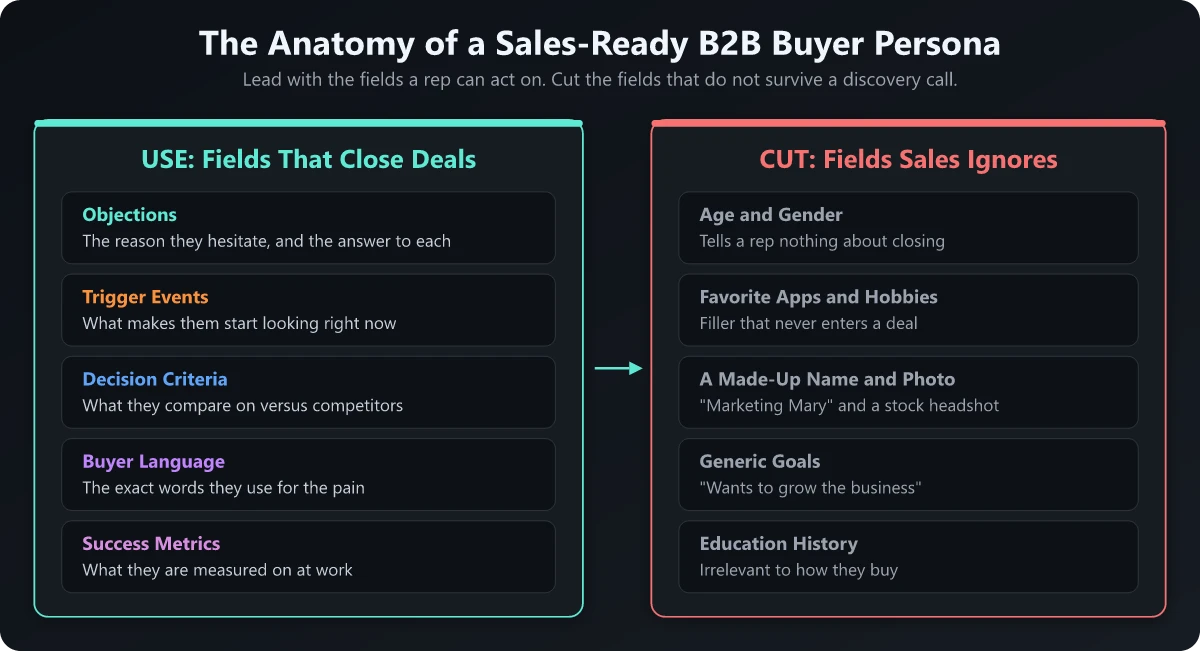
| Field sales ignores | Field sales uses |
|---|---|
| Age and gender | What they are measured on |
| Favorite apps and hobbies | Trigger events that start a search |
| A made-up name and photo | The objection that stalls the deal |
| Generic “wants to grow the business” | The exact words they use for the pain |
| Education history | Their decision criteria versus competitors |
The left column feels like a persona because it looks like the templates everyone copies. The right column is what a rep can act on in a live conversation. Build the right column first, and add the left column only if it genuinely informs targeting.
This connects directly to how you position the product. A persona tells you what the buyer cares about; product positioning tells you how to frame your product against those cares. The two documents should read like they were written by people who talked to each other, because they were.
Keeping the Persona Alive
A persona is not a deliverable, it is a living document. The teams that get value from personas treat them like a product that needs maintenance.
- Review on a cadence. Once or twice a year, pull fresh win-loss notes and check whether the objections and triggers still hold.
- Watch for drift. If reps keep hearing an objection your persona does not mention, that is a signal, not noise.
- Tie it to launches. Every time you ship something meaningful, ask whether it changes any persona’s decision criteria.
- Keep one owner. Personas with no owner die. Give them to whoever owns messaging.
The point is not to chase perfection. It is to keep the persona close enough to reality that sales trusts it. The moment a rep catches the persona being wrong about a buyer, they stop using all of them.
Conclusion: A B2B Buyer Persona Is Only Worth What Sales Does With It
A B2B buyer persona is not a creative exercise and it is not a slide for the board. It is a working tool that helps marketing write copy that resonates and helps sales answer the objection before it lands.
If you take one thing from this, make it this: build the persona from real buyer conversations, lead with the fields that change the sale, keep the set small enough to remember, and put it where work happens. A persona that lives in objection-handling, campaign briefs, and positioning docs is worth a hundred that live in a folder.
So before you spend another offsite inventing “Marketing Mary,” go listen to ten real buyers, write down their exact words, and build a B2B buyer persona your reps actually reach for. That is the only version that pays for itself.
Frequently Asked Questions
What is a B2B buyer persona?
A B2B buyer persona is a research-based profile of a specific role inside the companies you sell to. It captures that person's goals, the pressures they answer to, the objections they raise, and how they prefer to buy, so marketing and sales can tailor messaging to them.
How is a B2B buyer persona different from an ICP?
An ICP describes the kind of company worth pursuing, using firmographics like industry, size, and tech stack. A buyer persona describes an individual decision-maker inside that company. You need both: the ICP picks the account, the persona shapes how you talk to the people in it.
How many buyer personas should a B2B company have?
Most B2B teams need one persona per role in the buying committee that genuinely changes your messaging, which is usually a few, not a dozen. If two personas would receive the same pitch, merge them. More personas almost always means less use.
How do you research a B2B buyer persona?
Interview recent buyers and lost deals, mine call recordings and win-loss notes, and pull patterns from sales and customer success. Surveys and analytics fill gaps, but direct conversations with real buyers are the backbone of an accurate persona.
Why don't sales teams use buyer personas?
Usually because the persona reads like a demographic bio instead of a selling tool. Sales ignores age and favorite apps. They use objections, trigger events, decision criteria, and the exact words a buyer uses, so a usable persona leads with those.