Product Marketing Framework: The 6 Stages I Use (2026)
The product marketing framework I use to run positioning, launches, enablement, and competitive intel - a practical, repeatable system you can adopt this quarter.
The first time I inherited a product marketing function, there was no system. There was a Slack channel full of last-minute launch requests, a sales team writing its own decks, and three different one-liners for the same product depending on who you asked.
Nothing was wrong with any single person. The problem was that the work had no shape. Every launch started from zero, every message was reinvented, and nobody could tell me what “done” looked like.
That is what a product marketing framework fixes. It is not a clever template or a buzzword. It is the operating system for the whole function - the thing that turns scattered, reactive tasks into a repeatable process with clear inputs, owners, and outputs. In this post I will walk through the exact framework I use to run product marketing end to end, and how you can adapt it whether you are a team of one or a team of ten.
This matters more now that the role is on the hook for results. In the Product Marketing Alliance’s 2025 survey, generating revenue is now a KPI for 53.2% of product marketers. A framework is how you connect scattered tasks to that number instead of just staying busy.
Why You Need a Framework, Not a Checklist
I have seen plenty of teams confuse a launch checklist for a system. A checklist tells you what to do for one event. It does not tell you how the parts of your function connect, what feeds what, or what to do in the long stretches between launches.
A real framework answers harder questions. Where do messaging decisions come from? Who owns competitive intel? How does a sales objection in March change your roadmap input in June? Those connections are the actual job, and a checklist cannot hold them.
Here is the distinction I draw, because it changes how you build:
| Dimension | Launch checklist | Operating framework |
|---|---|---|
| Scope | One release or event | The entire function, all year |
| Timeframe | Days to weeks | Always-on, continuous |
| Output | A shipped launch | Positioning, enablement, intel, feedback |
| Failure mode | Missed a task | The same problem keeps recurring |
| Who it serves | The launch team | Product, sales, marketing, leadership |
If you only take one idea from this section, take this: a framework is what stops you from solving the same problem twice. Everything below is built around that goal.
The Six Stages of My Product Marketing Framework
I organize the function into six stages. They run as a loop, not a straight line. The output of the last stage feeds the first, which is what keeps positioning and messaging from going stale.
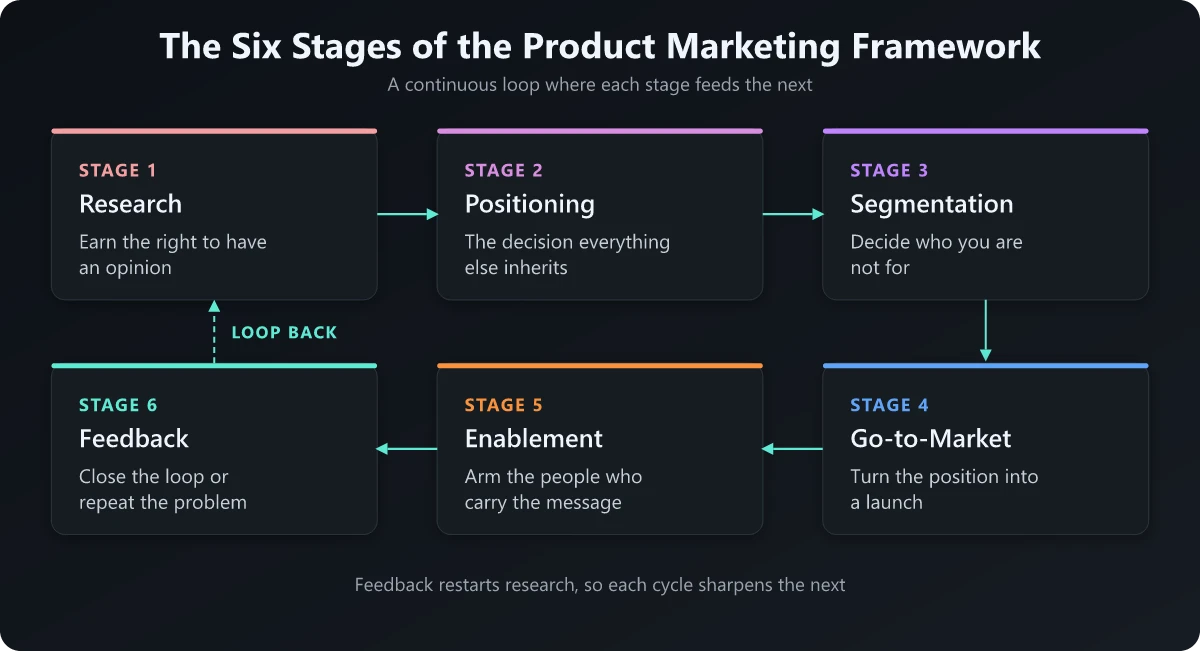
The stages are research, positioning, segmentation, go-to-market, enablement, and feedback. Let me take them in order, because the order matters - skip research and your positioning is a guess, skip positioning and your launches have no spine.
1. Research: Earn the Right to Have an Opinion
Every strong position I have ever shipped came from research I could point to, not instinct I had to defend. This stage is where you gather the raw material: customer interviews, win-loss conversations, support tickets, sales call recordings, and competitor teardowns.
The mistake I see most is treating research as a one-time project before a launch. It is not. It is a standing habit. I keep a running document of customer language - the exact words people use to describe their problem - because that language becomes my messaging later.
- Customers: interviews, surveys, and the unfiltered phrases buyers use
- Sales: call recordings, lost-deal reasons, recurring objections
- Market: competitor positioning, pricing pages, and category shifts
- Product usage: what people actually do versus what they say
If you want a deeper treatment of how this research connects to the broader discipline, my guide on what product marketing actually is lays out where this work sits in the function.
2. Positioning: The Decision Everything Else Inherits
Positioning is the single highest-leverage decision in the whole framework. Get it right and messaging, enablement, and launches all become easier because they inherit a clear answer. Get it wrong and you will paper over the gap with clever copy forever.
I define positioning as the choice of who you are for, what you are an alternative to, and why you are the better choice for that person. It is a strategic decision, not a tagline. I write it down as a short internal document that the rest of the team builds on.
If you have never formalized this, start with my walkthrough on product positioning, and pair it with the broader view in what market positioning means so you separate product-level and category-level decisions cleanly. Once positioning is set, the brand messaging framework is how you turn it into the pillars, matrix, and hierarchy the rest of the team writes from.
3. Segmentation: Decide Who You Are Not For
Strong positioning forces a hard follow-up: which segment is this actually for? A framework that tries to serve everyone produces messaging that moves no one. The discipline here is choosing your ideal customer profile and being honest about who you deprioritize.
I keep this stage tight. One primary ICP, maybe a secondary, and a clear note on who is out of scope this quarter. That single constraint sharpens every downstream message, because you stop hedging for audiences you were never going to win.
4. Go-to-Market: Turn the Position Into a Launch
This is the stage most people picture when they hear product marketing, and it is only one of six for a reason. A go-to-market plan is how you take a single release and bring it to the segment you chose, with the positioning you wrote.
I run launches in tiers. A tier-one launch gets the full motion - sales enablement, a campaign, executive air cover. A tier-three update might just need release notes and an in-app message. Forcing every release through the same heavy process is how teams burn out.
- Tier 1: new product or category-defining release, full cross-functional motion
- Tier 2: meaningful feature, targeted enablement plus a focused campaign
- Tier 3: minor update, lightweight notes and internal heads-up
For the operational detail of running these, I lean on a reusable go-to-market strategy template so I am not rebuilding the plan from memory each time. And for the content that fills those campaigns, I map every piece to a buyer-journey stage with a repeatable content marketing framework.
5. Enablement: Arm the People Who Carry the Message
A position nobody can repeat is worthless. Enablement is where the framework meets reality, because your sales team and your product are the ones saying your message out loud every day. If they cannot hold it, your beautiful positioning dies in the field.
The core artifacts I produce are battlecards, a one-pager, a pitch narrative, and an objection-handling guide. The test is simple: can a new rep tell the story correctly after one read? If not, the message is too complex, and that is my problem to fix, not theirs. That one-read test is also the argument for building the one-pager before the deck, because forcing the whole story onto a single sheet exposes every claim that only survived because a slide gave it room to breathe.
6. Feedback: Close the Loop or Repeat the Problem
This is the stage everyone skips, and skipping it is why the same confusion returns every quarter. Feedback is the disciplined practice of capturing what you learned - from launches, from win-loss, from sales - and routing it back into research, positioning, and the product roadmap.
Without this loop, your framework is just a straight line that ends at a launch. With it, every cycle makes the next one sharper. I treat win-loss insight and recurring objections as direct inputs to the next positioning review.
How the Stages Connect Into a Loop
The reason I call this a product marketing framework and not a list is that the stages feed each other on purpose. Research informs positioning. Positioning constrains segmentation. Segmentation shapes go-to-market. Go-to-market produces enablement needs. Enablement surfaces field feedback. Feedback restarts research.
When a stage breaks, the symptom usually shows up two stages later. Confusing sales decks are rarely an enablement problem - they are usually a positioning problem wearing an enablement costume. Knowing the loop lets you diagnose the real cause instead of patching the symptom.
This is also why I resist running stages in isolation. A team that treats enablement as a content factory, disconnected from positioning, will produce a lot of polished assets that quietly contradict each other.
Adapting the Framework to Your Stage and Team Size
The framework scales down without losing its shape. If you are the only product marketer, you still run all six stages - you just run them lighter. Pick the two stages where you are bleeding, usually positioning and enablement, and bring those to full depth first. Once you are three or four people the question flips from which stages to run to who owns each one, and the answer turns on whether you split the team by pillar, by product, or by buyer segment - a tradeoff I work through in the org models that fit each stage of growth.
For a SaaS context specifically, the rhythm of these stages changes because of free trials, product-led motions, and faster release cycles. I cover that adaptation in my SaaS product marketing strategy guide, which maps these same stages onto a product-led world.
Here is how I right-size the framework by team maturity:
| Team stage | Where to focus first | What to defer |
|---|---|---|
| Solo PMM | Positioning and enablement | Heavy launch tiering |
| Small team | Add go-to-market and research cadence | Formal win-loss program |
| Established team | Full loop with feedback discipline | Nothing - run all six |
The point is not to do everything at once. It is to know what the complete system looks like so your shortcuts are deliberate, not accidental.
Measuring Whether Your Product Marketing Framework Is Working
A framework you cannot measure is just a belief. I tie each stage to outcomes the business already cares about, so product marketing stops being a cost center people tolerate and becomes a function people fund.
Launch quality, win rate against named competitors, message consistency in the field, and sales confidence are the signals I watch. To make these concrete and accountable, I set objectives the way I describe in my piece on product marketing OKRs, which keeps the framework honest rather than busy.
If you are still defining the role itself, it helps to be precise about ownership, and my breakdown of what a product marketing manager actually does clarifies which of these stages a PMM owns versus influences.
The Takeaway
A product marketing framework is not bureaucracy. It is the difference between a function that reinvents itself every launch and one that compounds what it learns. The six stages - research, positioning, segmentation, go-to-market, enablement, and feedback - are not a checklist to complete once. They are a loop you run continuously, where each cycle sharpens the next.
Start small. Write down your positioning, choose one ICP, build one battlecard, and capture what you learn. That is a working product marketing framework, even if it fits on a single page. Depth comes later; the loop comes first.
The teams that win are not the ones with the fanciest launch. They are the ones that stopped solving the same problem twice. Build the system, run the loop, and let it compound.
Frequently Asked Questions
What is a product marketing framework?
A product marketing framework is a repeatable system that organizes the work of product marketing - research, positioning, messaging, go-to-market, enablement, and feedback - so launches and ongoing work are consistent instead of one-off. It is the operating manual for the function, not a single template.
What should a product marketing framework include?
At minimum it should cover customer and competitive research, positioning and messaging, segmentation and ICP, a go-to-market plan, sales enablement, and a loop that feeds insights back into product and marketing. Each stage should have clear owners and outputs.
How is a product marketing framework different from a go-to-market strategy?
A go-to-market strategy is how you bring one product or release to market. The framework is the larger system that produces GTM plans repeatedly, plus everything between launches - positioning upkeep, enablement, win-loss, and competitive monitoring.
How do I start using a product marketing framework if I am the only PMM?
Start with positioning and one tight ICP, then build a simple launch checklist and a battlecard. Do not try to run all stages at full depth on day one. Pick the two stages where you are losing deals or shipping confusing messaging and fix those first.
How often should you revisit your positioning and messaging?
Treat positioning as a living document. Revisit it whenever you enter a new segment, a competitor shifts strategy, or sales feedback shows the message is not landing. A light quarterly review plus event-driven updates works well in practice.