Product Marketing vs Growth Marketing: The Real Difference
Product marketing vs growth marketing, explained by a PMM: what each role actually owns, why teams keep confusing them, and how to run both so they compound.

Ask ten SaaS founders whether they need a product marketer or a growth marketer, and you will get ten different answers, usually followed by a single job description that mashes both roles into one impossible hire. The confusion is getting worse, not better, and there is a data point that explains why. In the 2025 State of Product Marketing report, 53.2% of product marketers now count generating revenue as a KPI - the exact scoreboard growth marketing was built on. When two disciplines start chasing the same number, the line between them blurs fast.
I have worked on both sides of this line, and I have watched teams waste a hiring cycle because they could not name which problem they were actually trying to solve. The product marketing vs growth marketing question is not a turf war. It is a diagnosis. This guide separates the two cleanly: what each one owns, why smart teams keep confusing them, and how to run both so they compound instead of colliding.
Product Marketing vs Growth Marketing: The Core Difference
Here is the cleanest way I know to tell them apart.
Product marketing owns how the market understands and chooses your product. It sets positioning, messaging, launches, sales enablement, and competitive intelligence. It answers the questions a buyer asks before they commit: why this, why now, why you and not the alternative. If you want the full remit, I broke it down in what is product marketing.
Growth marketing owns how usage and revenue compound once people arrive. It runs experiments across the whole customer lifecycle - acquisition, activation, retention, referral, revenue - and optimizes the numbers at each step. Its home turf is the AARRR “pirate metrics” funnel introduced by investor Dave McClure, and its instinct is to test, measure, and iterate. Growth marketing gets confused in the other direction just as often, with the paid ad account it usually runs, a mix-up I unpack in why buying traffic is only one slice of growth.
The one-line test I use: product marketing changes what people believe about your product. Growth marketing changes what people do, measured in a dashboard.
Narrative vs experiment
The deepest difference is not the funnel stage. It is the raw material each discipline works with.
Product marketing’s raw material is the story - the research, the customer language, the sharp claim that makes a buyer think “that is exactly my problem.” A product marketer spends their week in customer interviews, win-loss calls, competitor teardowns, and messaging docs. The output is meaning.
Growth marketing’s raw material is the experiment. A growth marketer spends their week forming hypotheses, shipping tests, and reading results: a new onboarding step, a pricing-page headline swap, a referral incentive, a re-engagement email. The output is a measured lift.
Neither is more sophisticated than the other. They are just different jobs wearing similar titles.
Product Marketing vs Growth Marketing: A Side-by-Side Comparison
When a founder asks me which role to hire, I put this table in front of them. It usually ends the debate in one meeting.
| Dimension | Product marketing | Growth marketing |
|---|---|---|
| Core question | Why should anyone choose this product? | How do we get more people to use it and pay more? |
| Primary goal | Clear, differentiated demand for the product | Compounding acquisition, activation, and retention |
| Owns | Positioning, messaging, launches, enablement, competitive intel | Funnel experiments across the AARRR lifecycle |
| Raw material | Customer research and narrative | Hypotheses and A/B tests |
| Time horizon | Weeks to quarters | Days to weeks per experiment |
| Core skill | Synthesis and storytelling | Analytics and rapid iteration |
| Key metrics | Adoption, launch impact, win rate, message resonance | CAC, activation rate, retention, LTV, conversion |
| Typical home | Product or marketing | Marketing or a dedicated growth org |
| Fails when | The work never connects to pipeline, so it gets cut | It optimizes a funnel nobody understands or wants |
Look at the middle of that table and you can already see the overlap. Both care about conversion. Both increasingly report on revenue. That shared ground is exactly where the confusion lives, so it is worth naming why.
Why the Two Get Confused
The mix-up is not ignorance. It comes from how modern teams are funded, staffed, and measured.
They increasingly chase the same number
For years, the neat story was that product marketing owned perception and growth owned revenue. That story is breaking down. With more than half of product marketers now carrying a revenue KPI, both disciplines answer to the same pipeline dashboard. When two roles are judged on the same outcome, leadership starts treating them as interchangeable, even though they move that number in completely different ways.
Small teams collapse both into one person
Most companies are not choosing between two departments. They are choosing what to prioritize inside one or two hires. In the 2025 report, 44.3% of product marketing teams are still just one or two people. When a single marketer runs launches, writes the messaging, and also owns the onboarding experiment backlog, the conceptual line between the two jobs stops mattering day to day - and the strategic work usually loses to the experiment that ships this week. The fix is rarely more headcount - it is deciding in advance which of those jobs the seat owns and which it declines, exactly the call you make when you scope a one-person product marketing function before adding a second hire.
The funnel overlaps in the middle
Acquisition and activation are contested territory. A landing page needs positioning (product marketing) and it needs conversion testing (growth). An onboarding flow needs a clear value narrative (product marketing) and needs friction removed step by step (growth). Because both disciplines legitimately touch these surfaces, each side can reasonably claim ownership, and that is where the org-chart arguments start.
How Product Marketing and Growth Marketing Work Together
This is the part most “versus” articles skip. Product marketing and growth marketing are not rivals competing for the same headcount. They are two halves of one loop, and each is weaker alone.
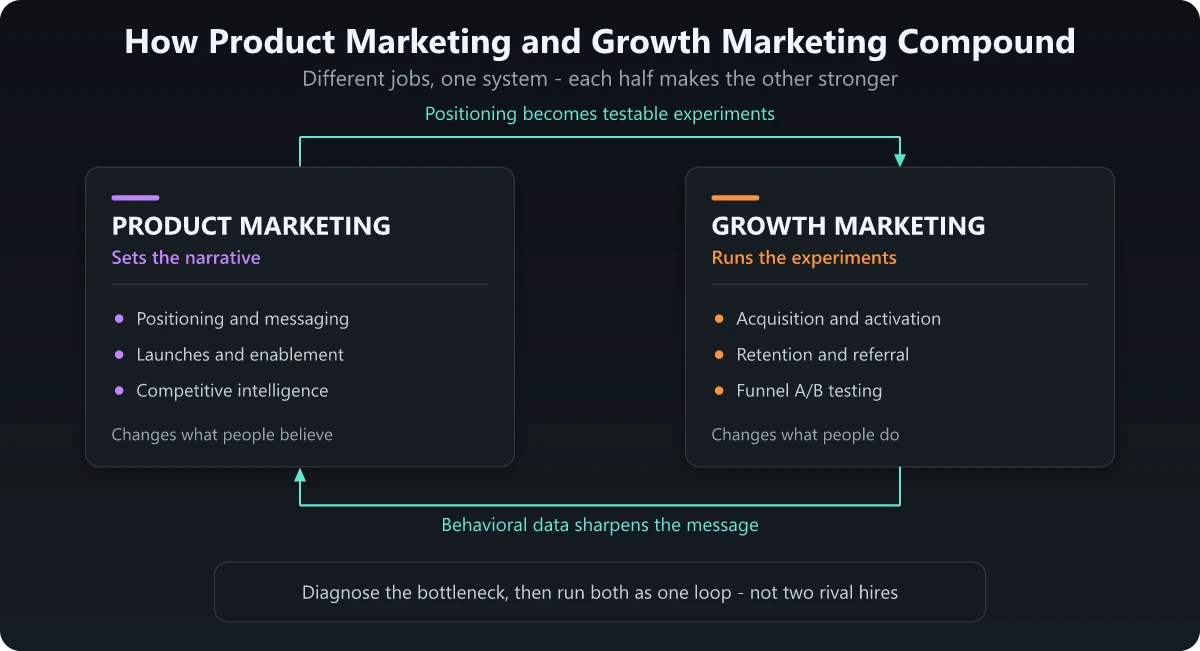
Growth marketing without product marketing optimizes a funnel built on a weak or generic message. You can A/B test a headline that never mattered and celebrate a 3% lift on a page that would convert far better with sharper positioning. You get local wins on a global loss, because nobody fixed the story the experiments are running on top of.
Product marketing without growth marketing produces beautiful positioning that never gets pressure-tested. You craft the message, ship the launch, and then have no systematic engine to turn that message into compounding adoption and retention. The narrative sits in a deck instead of moving metrics.
The healthy pattern looks like this:
- Product marketing sets the narrative. Positioning, messaging, and launch strategy define what the product means and who it is for. My product marketing framework walks through how that gets built.
- Growth marketing turns it into experiments. That positioning becomes testable hypotheses across the funnel: which value prop converts on the pricing page, which onboarding path activates fastest, which retention hook holds.
- Behavioral data flows back. The experiments reveal what customers actually respond to, which words convert and which promises retain. That evidence sharpens the next round of positioning.
- The loop compounds. Better positioning makes experiments more effective; better experiments make positioning more accurate. Run it for a year and the two disciplines stop competing and start multiplying each other.
If your growth engine is a self-serve product, this loop tightens even further, because the product itself is the primary acquisition channel. I covered that model in product-led growth examples and the broader SaaS growth strategy playbook.
Which One Does Your Business Need First
The honest answer depends on where your bottleneck sits today.
If your category is new or your positioning is unclear, hire product marketing first. You have a meaning problem, not a conversion problem. Running growth experiments on a product nobody can describe just buys you faster data about why the message is not landing. This is nearly always the right first move pre-product-market-fit, and it is reinforced by the market shift that 41% of companies now lead with product, up from 31% in 2024 - which only works when the product’s value is crisply articulated. If you are a founder sequencing this, I tied it into the bigger picture in go-to-market strategy for startups.
If your product and positioning are solid but the funnel leaks, hire growth first. The market understands you and signs up, but people stall at activation, churn after month two, or never refer. That is a conversion and retention problem, and it is exactly what a growth marketer is built to fix through disciplined experimentation.
If you are not sure, look at where prospects drop. If they bounce before they understand what you do, that is a product marketing gap. If they understand you, sign up, and then quietly disappear, that is a growth gap. The drop-off point names the discipline.
For a related sequencing question one layer up the funnel, the same logic applies to demand generation vs lead generation: diagnose the bottleneck before you fund the fix.
The Takeaway
The product marketing vs growth marketing debate dissolves the moment you stop treating it as a choice between two interchangeable hires. Product marketing changes what people believe about your product; growth marketing changes what they do about it. One works in narrative, the other in experiments, and they overlap in the exact middle of the funnel where most org-chart fights start.
So do not pick a side based on which title sounds more strategic. Diagnose the bottleneck. If the market cannot describe your product, you have a product marketing problem. If it can describe you but will not convert or stick, you have a growth problem. Then, once both roles exist, wire them into a single loop: positioning feeds experiments, experiment data feeds positioning, and the two compound instead of competing for the same headcount.
The teams that win the product marketing vs growth marketing question are the ones who stopped asking which one to hire and started running both as one system.
Frequently Asked Questions
What is the difference between product marketing and growth marketing?
Product marketing owns how the market understands and chooses your product: positioning, messaging, launches, sales enablement, and competitive intelligence. Growth marketing owns how usage and revenue compound after people arrive, running experiments across acquisition, activation, retention, referral, and revenue. Product marketing changes what people believe; growth marketing changes what people do, measured in a dashboard.
Is growth marketing the same as product marketing?
No. They overlap in the middle of the funnel and increasingly share revenue goals, but they are different disciplines with different raw materials. Product marketing works in narrative, research, and positioning. Growth marketing works in experiments, funnels, and metrics. One defines the story; the other optimizes the numbers that story produces.
Does a startup need product marketing or growth marketing first?
It depends on your bottleneck. If your category is new or your positioning is unclear, you have a meaning problem, so hire product marketing first. If your product and positioning are solid but the funnel leaks at signup, activation, or retention, you have a conversion problem, so hire growth first. Pre-product-market-fit, the answer is almost always product marketing.
Can one person do both product marketing and growth marketing?
In a small team, yes, and it happens constantly: 44.3% of product marketing teams are just one or two people. But the two jobs pull in different directions, and one usually gets starved. The narrative work quietly loses to the experiment backlog because experiments produce countable wins faster. If one person owns both, protect time for positioning on purpose.
Do product marketing and growth marketing report to the same team?
Often, but not always. Product marketing sometimes sits under product rather than marketing, while growth marketing usually sits under marketing or a dedicated growth org. What matters more than the org chart is a clean handoff: product marketing sets the positioning and message, growth turns it into experiments, and the resulting behavioral data flows back to sharpen the positioning.