Product Marketing Team Structure: 5 Models That Work (2026)
Product marketing team structure, explained by a PMM: the 5 org models, when each fits, who PMM should report to, and how to scale the team as you grow.

Most people picture a product marketing team as a department. In reality, in the 2025 State of Product Marketing report, 44.3% of product marketing teams are just one or two people. That single fact is why product marketing team structure matters more than almost any org-design question in a marketing org: when a handful of people are expected to own positioning, launches, sales enablement, and competitive intelligence for the entire company, how you structure them decides what actually gets done and what quietly gets dropped.
I have built and rebuilt product marketing teams through exactly this squeeze. This guide covers the five product marketing team structure models that hold up in practice, who PMM should report to, and how the structure should change as you scale from one generalist to a real function.
Who Is on a Product Marketing Team? Roles and Responsibilities
A product marketing team is built from a small set of repeating roles: a head of product marketing who owns the function, product marketing managers who own a product or a segment, and specialists for sales enablement, competitive intelligence, and market research. Most teams start with one generalist PMM and add specialists in that order.
That roster reads very differently at real headcount. At the 44.3% of teams that are one or two people, most of these are hats one person wears rather than seats one person fills. Read the list below as a hiring order rather than an org chart: the sequence in which each piece of the work finally gets its own owner as the team grows.
| Role | What they own | Usually the Nth hire |
|---|---|---|
| Product Marketing Manager | Positioning, launches, and enablement for one product or segment; the generalist first hire | 1st |
| Senior / Principal Product Marketing Manager | The hardest product or the flagship launch, plus mentoring; an individual contributor track rather than a management one | 2nd to 3rd |
| Sales Enablement Manager | Rep onboarding, pitch decks, objection handling, and certification; usually the first specialist split | 3rd to 5th |
| Competitive Intelligence Analyst | Battlecards, win-loss, and market monitoring; the pillar that vanishes when nobody owns it | 5th to 8th |
| Product Marketing / Market Research Analyst | Buyer research, message testing, and pricing and packaging input | only at 8+ |
| Technical Product Marketing Manager | Demos, technical proof points, and developer-facing content; only needed for technical or API-led products | only at 8+ |
| Customer Marketing Manager | Adoption, expansion, references, and case studies; often sits adjacent to PMM rather than inside it | adjacent function |
| Director of Product Marketing | The operating model, prioritization, and cross-functional negotiation; the first true manager hire | at 5 to 7 PMMs |
| VP / Head of Product Marketing | Function strategy, headcount, and the executive seat | at 12+ PMMs |
Four things about that order are worth pulling out.
The first hire is a generalist. The first product marketing manager does positioning, launches, and enablement across everything, which is why that job description usually reads like three jobs stapled together. I broke down what the scope looks like day to day in the PMM role itself.
Seniority is a separate axis from specialism. A Senior or Principal PMM manages nobody; they are the person you point at the hardest product or the launch that cannot slip. The full Associate to VP ladder, with US salary bands, sits in its own guide, and the seniority axis is worth planning independently of which pillars you split.
The first two specialist splits are enablement and competitive intelligence. Enablement goes first because reps feel the gap immediately and a structured enablement program is the most legible output PMM produces. Competitive intelligence goes second and matters more than its position in the queue suggests, because it is the pillar that quietly disappears when nobody has it in their title. Teams that take it seriously name an owner for win-loss and battlecards far earlier than headcount alone would justify.
Two of these roles do not belong in a strict sequence. Whether you need a technical product marketing manager depends on the product, not on the size of the team, and an API-led company often needs one long before it needs a market research analyst. Customer marketing is a boundary question, since it frequently reports into customer success or lifecycle marketing, so settle who owns adoption and references before you budget a seat for it. The fastest way to do that is to argue it at the artifact level, which is what the customer marketing and product marketing ownership matrix is for.
The roles list matters here because it is what the five models below are actually arranging. None of the models add or remove roles. They decide who wears which hats, and the model you pick determines whether one person wears four of these hats or four people each wear one.
Product Marketing Team Structure: The 5 Models
There is no universal org chart. But nearly every working product marketing team structure is a version of one of these five models. Product Marketing Alliance’s guide to team structures breaks them down along similar lines, and here is how I think about each.
1. By function
You split the team across the core pillars of the discipline: positioning and messaging, product launches, sales enablement, and competitive intelligence. Each person owns one pillar across all products.
This is the most common structure once a team passes three people. It produces real depth - a dedicated competitive intelligence lead builds sharper competitive intelligence than a generalist ever will. The risk is silos: the launch person and the enablement person have to coordinate tightly or the message drifts between them.
2. By product or feature
Each product marketer is paired with a product area and its product managers, owning everything PMM-related for that slice: its positioning, its launches, its enablement. A common starting ratio is one PMM for every four to six PMs.
This model shines when you have distinct products with different buyers. The marketer becomes a genuine expert in their product and its customers. The cost is duplicated effort and inconsistent messaging across products, because each PMM reinvents launch playbooks and competitive framing in isolation.
3. By segment or persona
Instead of organizing around products, you organize around customer segments - small business, mid-market, enterprise, or verticals like healthcare and finance. Each PMM owns the full experience for their segment and usually maps directly to how sales is structured.
If your product is sold very differently to different buyers, this alignment is powerful and makes the handoff to sales clean. It struggles when the product is essentially the same for everyone, because you end up with several people telling slightly different versions of one story.
4. By line of business
At large companies with multiple business units, product marketing is divided across those units, with each line of business running its own PMM group. Shared functions like brand and corporate communications stay centralized and support each unit.
This is really a scaled-up version of the product-aligned model, and it comes with the same tradeoff at a larger blast radius: deep unit expertise versus a fragmented company-level narrative. The same model also shows up as a regional or geographic split, applied to territories rather than business units, which is common at companies selling across regions where buying behavior genuinely differs, and it carries the identical tradeoff of local relevance bought at the cost of a coherent global story.
5. Hybrid
A central product marketing core owns standards, positioning frameworks, and shared functions, while individual PMMs are embedded inside specific product or business teams. The center keeps the story consistent; the embedded people keep it accurate to each product.
Most companies past a certain size land here, because it resolves the core tension in every other model: consistency versus depth. It is also the hardest to run, because embedded PMMs feel a constant pull between their product team and the central function.
Centralized vs Embedded: The Reporting-Line Question
Underneath the five models sits a more basic decision: does product marketing sit in one central team, or does it live embedded inside product and business units?
A centralized team reports into a single product marketing leader and serves the whole company. It keeps positioning and messaging consistent and makes the discipline easier to develop and defend. Its failure mode is distance from the product, where PMM becomes an order-taking service desk for decks and one-pagers.
An embedded team places marketers directly inside product teams. They gain deep product knowledge and ship faster with their PMs, but messaging fragments across the portfolio and the discipline gets harder to grow as a craft.
This is also where the eternal “who does PMM report to” argument lives - product or marketing. There is no clean answer, and the data shows why: in the 2025 report, 88.8% of product marketers work closely with product and 81% with marketing. PMM genuinely belongs to both. What decides the outcome is not the reporting box but whether the team has the authority to decline low-value requests and a real seat in roadmap and positioning decisions. I dug into the role itself in what does a product marketing manager do.
Product Marketing Team Structure Models Compared
When a leader asks me which model to adopt, I walk them through this table before anything else.
| Model | Best when | Main strength | Main risk |
|---|---|---|---|
| By function | You have 3+ PMMs and one product | Deep craft in each pillar | Silos between launch, enablement, and intel |
| By product | Distinct products with different buyers | Real product expertise | Duplicated work, inconsistent messaging |
| By segment | Product is sold differently by buyer type | Tight sales alignment | Fragmented story for one product |
| By line of business | Large firm with multiple business units | Autonomy per unit | Weak company-level narrative |
| Hybrid | You have scaled past ~15 people | Consistency plus depth | Hardest to coordinate |
The pattern to notice: every model trades consistency against depth. Functional and centralized structures protect the story; product, segment, and embedded structures protect the expertise. Your job is to pick the tradeoff that fits where your go-to-market actually breaks.
How to Structure a Product Marketing Team by Company Stage
The single biggest mistake I see is copying the structure of a company ten times your size. Structure should follow headcount and complexity, not ambition. Here is the progression that works.
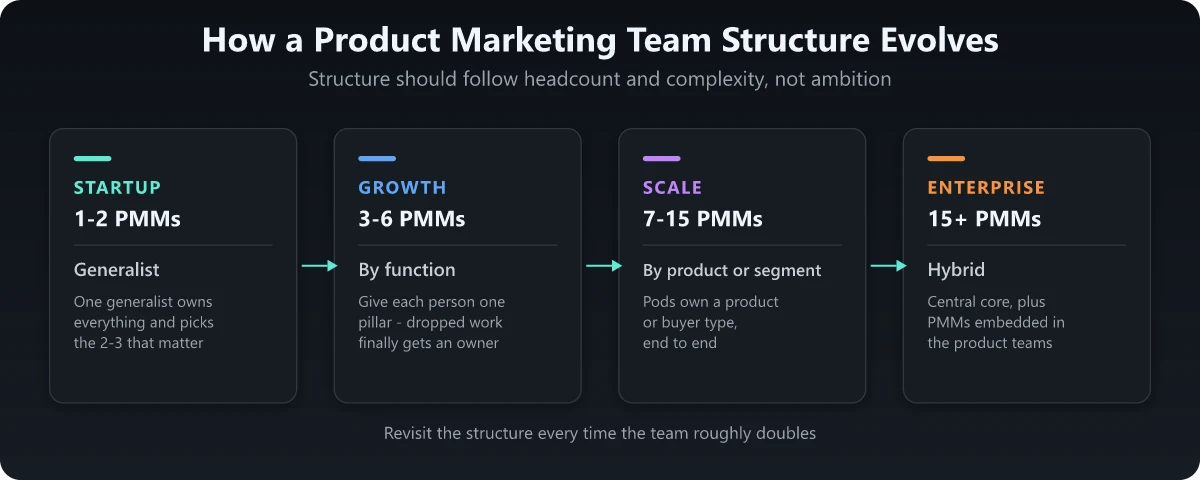
Startup, 1 to 2 PMMs: run a generalist. One strong generalist owns everything and ruthlessly prioritizes. Do not specialize yet. The whole game at this stage is picking the two or three things that matter - usually launches and core positioning - and ignoring the rest. If you are still deciding whether the role belongs on the team at all, I made the case in is product marketing a good career.
Growth, 3 to 6 PMMs: split by function. This is where the functional model earns its keep. Give each person a pillar - positioning, launches, enablement, competitive intel - so the work that a solo generalist kept dropping finally gets an owner. Anchor the team on a shared product marketing framework and shared product marketing OKRs so the pillars pull in one direction.
Scale, 7 to 15 PMMs: align to products or segments. Now the business has enough distinct products or buyer types that one central team cannot hold the context. Move to product- or segment-aligned pods, each owning its slice end to end.
Enterprise, 15+ PMMs: go hybrid. Keep a central core for positioning standards, competitive intelligence, and launch process, and embed specialists inside the product and business units. This is the only structure that holds a consistent story across a large portfolio without starving each product of dedicated attention.
The reason this progression works is that 41% of companies now lead with product, up from 31% in 2024 - which means PMM headcount is growing, and a structure that fit last year will not fit next year. Revisit it every time the team roughly doubles.
Common Product Marketing Team Structure Mistakes
- Specializing too early. Splitting two people by function just creates two overloaded specialists and a coordination tax. Stay generalist until the work visibly overflows.
- Structuring by deliverable instead of outcome. A “content team” and a “deck team” optimize for output volume, not for launches that land or deals that close.
- Leaving competitive intelligence unowned. In every model, competitive intel is the pillar that silently disappears because it is never urgent. Name an owner or it will not happen.
- Copying a hyperscaler’s org chart. The embedded, multi-pod structure that works at a 200-person marketing org will crush a team of four.
The Takeaway
Product marketing team structure is not about drawing the prettiest org chart. It is about deciding what your small, overloaded team will actually own when it cannot possibly do everything. With most teams sitting at one or two people, structure is really a forcing function for prioritization.
Pick the model that fits your size and where your go-to-market breaks: generalist while you are tiny, functional as you grow, product- or segment-aligned as you scale, and hybrid once you are large enough that consistency and depth are both at risk. Worry less about whether PMM reports to product or marketing, and more about whether the team has the authority to focus. Then revisit the whole structure every time you double, because the version that fits you today will quietly stop fitting the moment you grow.
Frequently Asked Questions
How should a product marketing team be structured?
There are five common models: by function (splitting people across positioning, launches, enablement, and competitive intelligence), by product or feature (each PMM paired with a product area), by segment or persona (aligned to how sales is organized), by line of business, and hybrid (a centralized core plus PMMs embedded in product teams). The right one depends on company size, product complexity, and where your go-to-market bottleneck sits, not on a fixed formula.
Who should product marketing report to?
Most commonly marketing, but reporting into product is increasingly common at product-led companies. There is no universally correct answer. Product marketers work closely with both: in the 2025 State of Product Marketing report, 88.8% collaborate closely with product and 81% with marketing. What matters more than the box on the org chart is that PMM has the authority to say no to low-value requests and the seat to influence roadmap and positioning.
How big should a product marketing team be?
Smaller than most people expect. In the 2025 State of Product Marketing report, 44.3% of product marketing teams are just one or two people. A common ratio is one product marketer for every four to six product managers, but it varies widely with product complexity and how much launch and enablement volume the business generates. Start with one strong generalist and specialize only when the work clearly exceeds what they can cover.
What is the difference between a centralized and embedded product marketing team?
A centralized team reports into one product marketing leader and serves the whole company from a single group, which keeps positioning and messaging consistent. An embedded (or decentralized) team places product marketers directly inside individual product or business units, which deepens product knowledge but risks inconsistent messaging across the portfolio. A hybrid keeps a central core for standards and shared functions while embedding specialists where deep product alignment matters.
When should you specialize a product marketing team by function?
Once you have roughly three or more product marketers and the generalist model starts breaking down, usually signaled by launches slipping, enablement going stale, or competitive intelligence never getting done. Splitting by function (positioning, launches, sales enablement, competitive intelligence) lets each person go deep on one pillar. Below three people, functional splits create more coordination overhead than they are worth.
What roles are on a product marketing team?
The core role is the product marketing manager, a generalist who owns positioning, launches, and enablement for a product or segment. As the team grows, specialists split off in a fairly consistent order: sales enablement, then competitive intelligence, then market research, with a technical product marketing manager added for developer-facing products. A director usually arrives at five to seven PMMs, and a VP or head of product marketing at twelve or more.