Growth Marketing vs Performance Marketing: The Difference
Growth marketing vs performance marketing, explained by a PMM: what each one actually does, why teams confuse them, and how they fit together across the funnel.
US digital advertising hit a record $258.6 billion in 2024, up 14.9% year over year, according to the IAB and PwC, and nearly all of it - search, social, display, video - is money that performance marketers optimize. That sheer scale is exactly why performance marketing gets mistaken for the whole of modern marketing. But performance marketing is one engine, not the whole machine, and confusing it with growth marketing is how companies end up pouring budget into ads while their funnel quietly leaks.
I have watched teams treat these two as synonyms and pay for it. The growth marketing vs performance marketing distinction is not academic - it decides whether you invest in buying traffic or in building a system that keeps that traffic paying you. This guide separates them cleanly: what each one owns, why they get confused, and how they actually fit together.
Growth Marketing vs Performance Marketing: The Core Difference
Here is the cleanest way I know to tell them apart.
Performance marketing is paid media optimized for a measurable action. You spend on channels like paid search and paid social, and you judge every dollar on a hard number: return on ad spend, cost per acquisition, conversion rate. It is fast, attributable, and mostly lives at the acquisition end of the funnel. Its instinct is to find a profitable channel and scale the spend.
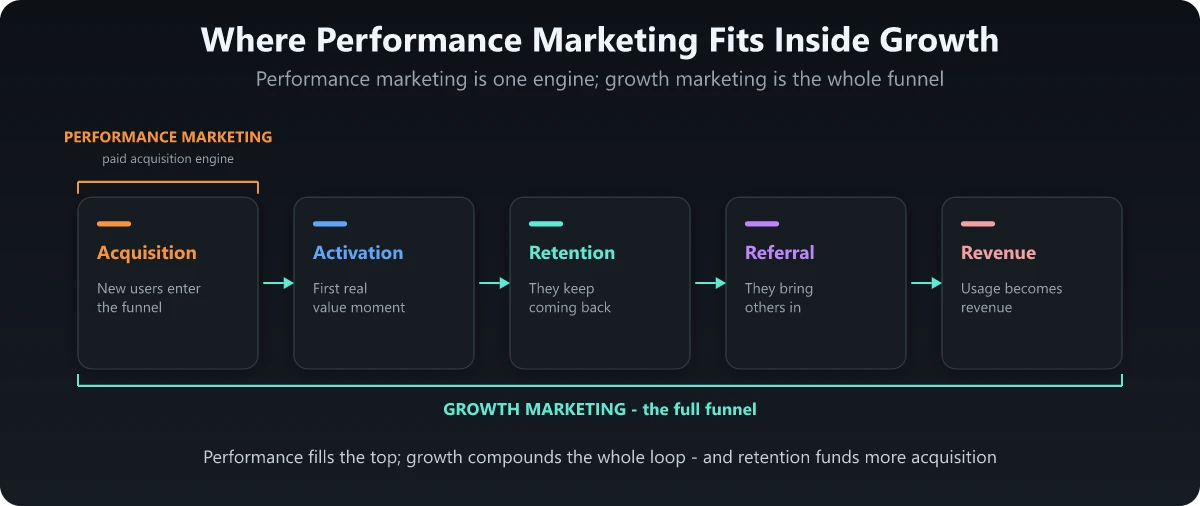
Growth marketing is a full-funnel system of experiments. It works across the entire customer lifecycle - the AARRR “pirate metrics” funnel of acquisition, activation, retention, referral, and revenue popularized by investor Dave McClure - and optimizes for compounding value over time, not just the next conversion. Its instinct is to test the whole loop and fix wherever the biggest leak is.
The one-line test I use: performance marketing asks “what did this ad spend return this month?” Growth marketing asks “what makes the entire funnel compound?”
Buying traffic vs engineering the loop
The deepest difference is where each one operates.
Performance marketing is an acquisition specialist. It is extremely good at one thing: turning budget into qualified traffic and conversions, measurably. If you have a channel that returns more than it costs, performance marketing is how you scale it.
Growth marketing owns the parts performance never touches, and almost none of that work runs through an ad account. That is precisely why a team that only buys ads is not doing growth.
What Is Growth Marketing?
Growth marketing is a full-funnel, experiment-driven approach to increasing revenue across the entire customer lifecycle, from first touch through activation, retention, referral and expansion. Rather than optimizing a single channel, it treats the funnel as one system and runs continuous tests wherever the largest leak sits.
The operating model is a loop, not a campaign calendar. Pick the stage with the worst drop-off, form a hypothesis about why, ship the smallest change that tests it, measure the result against a cohort, then move to the next constraint. The channel is whatever the constraint demands, which is why a growth team’s quarter can swing from a paid landing page test to an onboarding rewrite to a pricing experiment without ever changing its mandate.
What growth marketing owns across the funnel. Mapped to the AARRR stages, the work breaks down like this:
- Acquisition. Channel mix, content and SEO, organic distribution, and the paid campaigns that bring new people in.
- Activation. Onboarding, time-to-first-value, and the in-product prompts that turn a signup into someone who has actually used the thing.
- Retention. Lifecycle email, habit loops, churn saves, and the cohort analysis that shows whether week four holds.
- Referral. Invite loops, advocacy, and sharing mechanics built into the product itself, which is the pattern behind most product-led growth examples.
- Revenue. Pricing, packaging, upsell paths, and the expansion motions that raise revenue per account.
How growth marketing is measured. The scorecard is lifecycle and value metrics rather than campaign metrics: activation rate, week-4 or month-2 retention, churn, customer lifetime value, the LTV:CAC ratio, referral rate, and CAC payback period. Every one of those is read on a cohort over time rather than on a single campaign in a single month, which is exactly what makes growth results slower to see and harder to defend in a quarterly review.
Best for: teams whose bottleneck is what happens after the click.
What Is Performance Marketing?
Performance marketing is paid media bought and optimized against a measurable action such as a click, a lead, or a purchase, where spend is judged on the outcome it produced rather than on the audience it reached. Budget follows whatever the tracking says converts, and campaigns that stop clearing the bar get cut.
That accountability is the whole point. Brand advertising asks you to accept a lag between spend and effect; performance marketing collapses that lag into a dashboard you can read the same week, which makes it the easiest line in a marketing budget to defend and the first one scaled when a channel works.
The channels performance marketing buys. The mix is almost entirely paid, and in the US the largest lines look like this:
- Paid search. Intent-led auctions on Google Ads and Microsoft Advertising. US search advertising was worth $102.9 billion in 2024, up 15.9% year over year.
- Paid social. Interest, behavior and lookalike targeting on Meta, LinkedIn Ads, TikTok and Reddit. The US social category reached $88.8 billion in 2024, up 36.7%.
- Display. Programmatic banners and native placements across the open web, a US category worth $74.3 billion, up 12.4%.
- Digital video and CTV. Pre-roll, in-feed video and connected TV inventory, increasingly bought on the same performance terms as search and social.
- Retail media. Sponsored placements on retailer properties, bought against the retailer’s own purchase data.
- Affiliate and partner. Publishers and creators paid a commission per referred sale rather than per impression.
Those IAB format categories overlap, since a video ad sold on a social platform can sit in more than one line, so read them as individual channel sizes rather than slices of a single pie.
How performance marketing is bought and measured. Inventory is bought in real-time auctions on CPC, CPM or CPA terms, so the price of a conversion is set by whoever else wants the same audience. Conversions come back through pixels and, increasingly, server-side conversion APIs, then get credited to campaigns inside an attribution window the platform largely defines, with UTM parameters carrying the same campaign labels into your own analytics. Targeting runs on first-party audience lists, retargeting pools and lookalike expansion, and creative is treated as a variable to be tested continuously rather than a deliverable to be signed off. The four numbers that decide everything are ROAS, CPA, CTR and conversion rate. One caveat before you read those four numbers off a GA4 report: Google’s multi-network campaign types do not file under Paid Search at all, they get their own channel grouping called Cross Network, so a slice of your Google Ads spend sits outside the row you are judging it on.
Best for: teams whose funnel already converts and retains and who need volume fast, usually running alongside a broader SaaS demand generation motion.
Growth Marketing vs Performance Marketing: A Side-by-Side Comparison
When a founder asks me which one to invest in, I put this table in front of them first.
| Dimension | Growth marketing | Performance marketing |
|---|---|---|
| Core question | What makes the whole funnel compound? | What did this ad spend return? |
| Scope | Full funnel: acquisition to revenue | Mostly acquisition |
| Primary lever | Experiments across the lifecycle | Paid media optimization |
| Time horizon | Long-term compounding value | Immediate, in-campaign results |
| Key metrics | Activation, retention, LTV, LTV:CAC | ROAS, CPA, CTR, conversion rate |
| Channels | Product, lifecycle, content, paid, referral | Paid search, paid social, display |
| Strength | Durable, defensible growth | Fast, measurable acquisition |
| Fails when | Spread too thin with no focus metric | Scales spend on a funnel that leaks |
Look at the scope row and the relationship becomes obvious. Performance marketing is not the opposite of growth marketing. It sits inside it, as the paid acquisition engine. That overlap is exactly where the confusion comes from.
Why the Two Get Confused
The mix-up is not carelessness. It comes from how marketing is measured and staffed.
Both are data-driven, so they look alike
Performance and growth marketers both live in dashboards and both talk about experiments and optimization. From the outside, a growth marketer running an onboarding A/B test and a performance marketer running an ad creative test look like the same job. The difference is what they are optimizing: one is tuning a campaign, the other is tuning a customer’s entire journey.
Performance results are easier to see
A performance campaign produces a clean number this week: spend went in, conversions came out, here is the ROAS. Retention and activation improvements take longer to show up and are harder to attribute. So leadership tends to over-index on performance because it is legible, and the slower growth work gets underfunded - even when it is where the real leverage sits.
Small teams collapse both into one hire
In most companies, one or two people carry both mandates. When the same person buys the ads and owns the onboarding flow, the conceptual line between capturing demand and compounding it blurs day to day. The title says growth; the calendar says performance, because the ad account is on fire and the retention experiment can always wait.
This is the same trap I described in product marketing vs growth marketing: the countable work crowds out the compounding work.
How Growth Marketing and Performance Marketing Work Together
This is the part most “versus” articles miss. These two are not rivals fighting for budget. Performance marketing is a component of growth marketing, and each is weaker when you run it without the other.
Performance marketing without growth marketing scales a leaky funnel. You find a profitable channel, pour budget in, and acquire users who never activate, churn in a month, and never refer anyone. Your acquisition cost creeps up as you exhaust the cheap audiences, and because retention was never fixed, the whole thing gets less profitable the more you spend.
Growth marketing without performance marketing has no fast acquisition engine. You can build brilliant onboarding, retention, and referral loops, but if you have no reliable way to pour qualified traffic into the top, you are optimizing a funnel that too few people enter.
The healthy pattern looks like this:
- Performance marketing fills the top. Paid search and paid social buy qualified, measurable traffic into the funnel at a known cost.
- Growth marketing activates and retains it. Experiments across onboarding, retention, and referral turn that traffic into active, sticky, expanding customers.
- Retention lowers acquisition cost. As referral and retention improve, each customer is worth more and brings others, so the performance channels can profitably spend more to acquire them.
- The loop compounds. Better retention funds more aggressive acquisition, and more acquisition gives the growth experiments more data. Run it for a year and the two multiply each other.
If your product is self-serve, this loop tightens further, because the product itself becomes an acquisition channel. I covered that in product-led growth examples and the broader SaaS growth strategy playbook. For the upstream, non-paid side of demand, the SaaS demand generation guide pairs naturally with this.
Which One Does Your Business Need First
The honest answer depends on the state of your funnel.
If your funnel converts and retains, invest in performance marketing. You have product-market fit, activation works, and customers stick. Now you have a machine worth feeding, and performance marketing is the fastest way to pour fuel on it. Scaling paid acquisition on a healthy funnel is one of the highest-leverage moves in marketing.
If activation or retention leaks, fix growth first. Spending on performance ads to fill a bucket with holes just pays to lose customers faster and more expensively. Diagnose where people drop - onboarding, early retention, monetization - and fix that before you scale spend.
If you are not sure, look at your LTV-to-CAC ratio over time. If it is flat or falling while you keep increasing ad spend, you have a growth problem that no amount of performance marketing will solve. That gap is the tell. The same diagnose-before-you-fund logic applies one layer up in demand generation vs lead generation.
The Takeaway
The growth marketing vs performance marketing debate dissolves once you see that one contains the other. Performance marketing is the paid acquisition engine: fast, measurable, and focused on the top of the funnel. Growth marketing is the full system that turns acquired traffic into retained, expanding, referring customers. Performance marketing measures the campaign; growth marketing measures the customer over their whole life.
So do not frame it as a choice between the two. Use performance marketing to fill the funnel and growth marketing to make sure the funnel is worth filling. Fix activation and retention before you scale spend, then let performance marketing pour fuel on a machine that actually holds it. Run them as one system, and buying traffic finally starts to compound instead of just costing more every quarter.
Frequently Asked Questions
What is the difference between growth marketing and performance marketing?
Performance marketing is paid media bought and optimized for a measurable action, judged on metrics like ROAS and CPA. It mostly works the acquisition end of the funnel and delivers fast, attributable results. Growth marketing is a full-funnel system of experiments spanning acquisition, activation, retention, referral, and revenue, optimized for long-term compounding value. Performance marketing buys traffic; growth marketing engineers the whole loop that turns traffic into retained, expanding revenue.
Is performance marketing part of growth marketing?
Yes, in practice performance marketing is best understood as one channel inside growth marketing, specifically the paid acquisition engine. Growth marketing uses performance marketing to feed the top of the funnel, then keeps optimizing activation, retention, and referral that performance campaigns never touch. Treating performance marketing as the entire strategy is the most common and expensive mistake.
Is growth marketing just paid ads?
No. Paid ads are performance marketing, which is only the acquisition slice. Growth marketing runs experiments across the entire lifecycle: onboarding and activation, retention hooks, referral loops, and monetization, most of which have nothing to do with ad spend. A growth team that only buys ads is really a performance team wearing a growth title.
Does a startup need growth marketing or performance marketing first?
It depends on your funnel. If you have product-market fit and a funnel that converts and retains, performance marketing can pour fuel on it quickly. If activation or retention is leaky, spending on performance ads just pays to fill a bucket with holes, so fix the growth fundamentals first. Early on, most startups over-invest in paid acquisition and under-invest in retention, which is why acquisition costs keep rising while revenue does not.
What metrics does each one use?
Performance marketing tracks acquisition-efficiency metrics: ROAS (return on ad spend), CPA (cost per acquisition), CTR, and conversion rate. Growth marketing tracks lifecycle and value metrics: activation rate, retention and churn, customer lifetime value (LTV), referral rate, and the LTV-to-CAC ratio. The tell is that performance marketing measures the campaign, while growth marketing measures the customer over time.
What channels does performance marketing use?
Performance marketing runs almost entirely on paid channels: paid search on Google Ads and Microsoft Advertising, paid social on Meta, LinkedIn Ads and TikTok, programmatic display across the open web, digital video and connected TV, retail media placements on retailer sites, and affiliate or partner programs that pay a commission per referred sale. Each is bought in an auction and judged on cost per conversion.