Sales Kickoff Agenda: The Hour-by-Hour Run of Show (2026)
A real sales kickoff agenda with start times, durations and a named owner for every block, plus the T-8-week build calendar and the T+90 reinforcement plan.
The defect I look for first in any sales kickoff agenda is easy to spot: the blocks are named after departments rather than after outcomes. “Marketing Update.” “Product Session.” “Leadership Address.” Slots get sized by the seniority of whoever is presenting, the day fills up, and nobody ever wrote down what a rep is supposed to do differently on the Monday after.
Here is the claim I will defend for the rest of this post: a sales kickoff agenda is a behavior-change plan with timestamps. Every block on it has to name the rep behavior it installs and the single person accountable for proving that behavior stuck. A block that cannot answer both is entertainment, and it should be cut to make room for practice. Agendas built as a schedule of speakers are exactly why the new pitch quietly reverts to last year’s pitch by February.
I write this from the product marketing seat, which is the seat that has to actually produce about half of the agenda: the positioning session, the competitive block, the roadmap narrative and the customer-proof segment.
A sales kickoff agenda is the timed run of show for your annual SKO: every session with a start time, a duration, a named owner and the pre-work it requires. A two-day agenda that changes behavior runs in this order:
- Number reality and the year ahead - CRO, 45 min
- What changed in the market and the buyer - PMM, 45 min
- Positioning and messaging relaunch - PMM, 60 min
- Product and roadmap narrative - Product with PMM, 60 min
- Competitive teardown and battlecard drills - PMM, 75 min
- Customer proof and win teardown - top rep with a live customer, 60 min
- Certification and live practice - Enablement, 90 min
- Commitments, awards and the 90-day plan - CRO with Enablement, 60 min
What a sales kickoff agenda is, and what most of them actually are
A sales kickoff is the annual reset for a revenue team. A sales kickoff agenda is the document that turns that intent into a schedule someone can be held to.
The distinction matters because of arithmetic. Salesforce’s 2026 sales statistics roundup, drawn from its State of Sales research, reports that sales reps spend 60% of their time on non-selling tasks, and that 57% of sales professionals now say the sales cycle is getting longer (Salesforce). Two days off the road is an expensive purchase out of the 40% that is left. If those two days do not remove friction from the other 363, you bought a morale event at quota-carrying prices.
Most teams circulate a topic list. Reps need a run of show:
| A topic list says | A run of show says |
|---|---|
| ”Product Update” | 11:45 to 12:45, Product with PMM, three named launches, rep says the new value line back |
| ”Competitive” | 13:45 to 15:00, PMM, top 3 competitors, each rep runs one live trap objection |
| ”Enablement” | 09:20 to 10:50, Enablement, every rep certified against a published rubric |
| ”Team building” | 19:00, Ops, seating mixes segment and tenure so pods form before day 2 |
The two-day sales kickoff agenda: full hour-by-hour run of show
This is the working template. Times assume an in-person event for roughly 25 to 100 reps. Copy it, replace the owner names with real people, and delete any row you cannot staff.
Day 1: context, message and proof
| Time | Duration | Session | Owner | Pre-work required |
|---|---|---|---|---|
| 08:30 - 09:00 | 30 min | Arrival, coffee, seated by pod | Enablement | Pods pre-assigned by segment, not by manager |
| 09:00 - 09:45 | 45 min | Number reality and the year ahead | CRO | Final FY numbers signed off by Finance |
| 09:45 - 10:30 | 45 min | What changed in the market and the buyer | PMM | Win-loss synthesis and buyer research read-out |
| 10:30 - 10:45 | 15 min | Break | Ops | - |
| 10:45 - 11:45 | 60 min | Positioning and messaging relaunch | PMM | Messaging framework locked 3 weeks prior |
| 11:45 - 12:45 | 60 min | Product and roadmap narrative | Product with PMM | Roadmap approved, demo script rehearsed twice |
| 12:45 - 13:45 | 60 min | Lunch, seated by pod | Enablement | One discussion prompt per table |
| 13:45 - 15:00 | 75 min | Competitive teardown and battlecard drills | PMM | Refreshed battlecards for the top 3 competitors |
| 15:00 - 15:15 | 15 min | Break | Ops | - |
| 15:15 - 16:15 | 60 min | Customer proof and win teardown | Top rep with a live customer | Customer briefed, deal timeline written up |
| 16:15 - 17:00 | 45 min | Pricing, packaging and discount discipline | PMM with Finance | Approved price sheet and discount guardrails |
| 17:00 - 17:30 | 30 min | Debrief: one thing I will do differently | Enablement | Commitment card at every seat |
| 19:00 - late | - | Dinner and team event | Ops | Seating mixes segment and tenure |
Day 2: practice, certification and commitment
| Time | Duration | Session | Owner | Pre-work required |
|---|---|---|---|---|
| 09:00 - 09:20 | 20 min | Day 1 recap and the contract for today | Enablement | Commitment cards collected and themed overnight |
| 09:20 - 10:50 | 90 min | Certification: pitch the new narrative | Enablement with PMM | Scoring rubric published a week ahead |
| 10:50 - 11:05 | 15 min | Break | Ops | - |
| 11:05 - 12:05 | 60 min | Objection handling and competitive role-play | PMM with top reps | Top 8 objections pulled from the last two quarters |
| 12:05 - 13:00 | 55 min | Lunch | Ops | - |
| 13:00 - 14:00 | 60 min | Territory, account and pipeline working session | Sales managers | Every rep arrives with a named account list |
| 14:00 - 14:45 | 45 min | Tools and workflow: where the content lives | Enablement with RevOps | Content platform seeded, permissions checked |
| 14:45 - 15:00 | 15 min | Break | Ops | - |
| 15:00 - 15:45 | 45 min | Role breakouts: AE, SDR, SE, CSM | Function leads | A separate agenda and owner for each room |
| 15:45 - 16:30 | 45 min | Awards and top-performer teardown | CRO with top rep | Awards decided in advance, criteria published |
| 16:30 - 17:00 | 30 min | The 90-day plan and public commitments | CRO with Enablement | 30/60/90 template pre-filled per rep |
Three rules govern how this grid gets edited:
- Nothing over 90 minutes, and only certification earns 90. Everything else caps at 75.
- Day 2 is majority practice. In the grid above, 255 of Day 2’s 395 working minutes are reps talking rather than listening: certification, role-play, the pipeline session and the breakouts. If your Day 2 flips that ratio, you built a conference.
- Every row has exactly one owner. Two owners means no owner, and the block will show up half-built at the dry run.
Who owns each block of the sales kickoff agenda
The ownership question is the one that actually blocks SKO planning, and it is where a cross-functional agenda beats a sales-only one. In a Gartner survey of 227 chief sales officers run in August and September 2025, sales organizations that collaborate on enablement content with other functions such as marketing and service are 2.4 times more likely to achieve strong commercial growth than those that do not. The same survey found sales organizations completed an average of four transformations in the past 12 months, and Gartner predicts that by 2029, organizations with AI-driven enablement functions will achieve 40% faster sales stage velocity than those using traditional approaches (Gartner).
Four transformations a year is the real context for an SKO. It is not the moment you announce one change; it is the moment you reconcile four.
| Owner | Blocks they own | What they must deliver by T-1 week |
|---|---|---|
| CRO | Number and year ahead, awards, 90-day commitments | Signed-off numbers, territory decisions made public, award criteria |
| PMM | Market and buyer shift, positioning relaunch, competitive drills, pricing, roadmap narrative with Product | Messaging framework, refreshed battlecards, customer proof stories, price and discount sheet |
| Enablement | Certification, pods and logistics, debriefs, tools session | Scoring rubric, pre-read pack, breakout assignments, post-SKO curriculum |
| Product | Roadmap narrative, demo | Approved roadmap slide, a demo rehearsed twice with a PMM in the room |
| Top rep | Win teardown, role-play, breakout coaching | One documented deal timeline and the exact language that won it |
| RevOps | Pipeline working session support, tooling | Clean per-rep account lists and a working content platform |
Product marketing shows up in more rows than any other function on this list. That is not empire building. It is an accurate description of who writes the words reps are being asked to say.
What product marketing owes the SKO, working backwards from T-8 weeks
The single biggest reason SKO content is thin is that it gets commissioned four weeks out, when a positioning refresh needs eight. Work backwards.
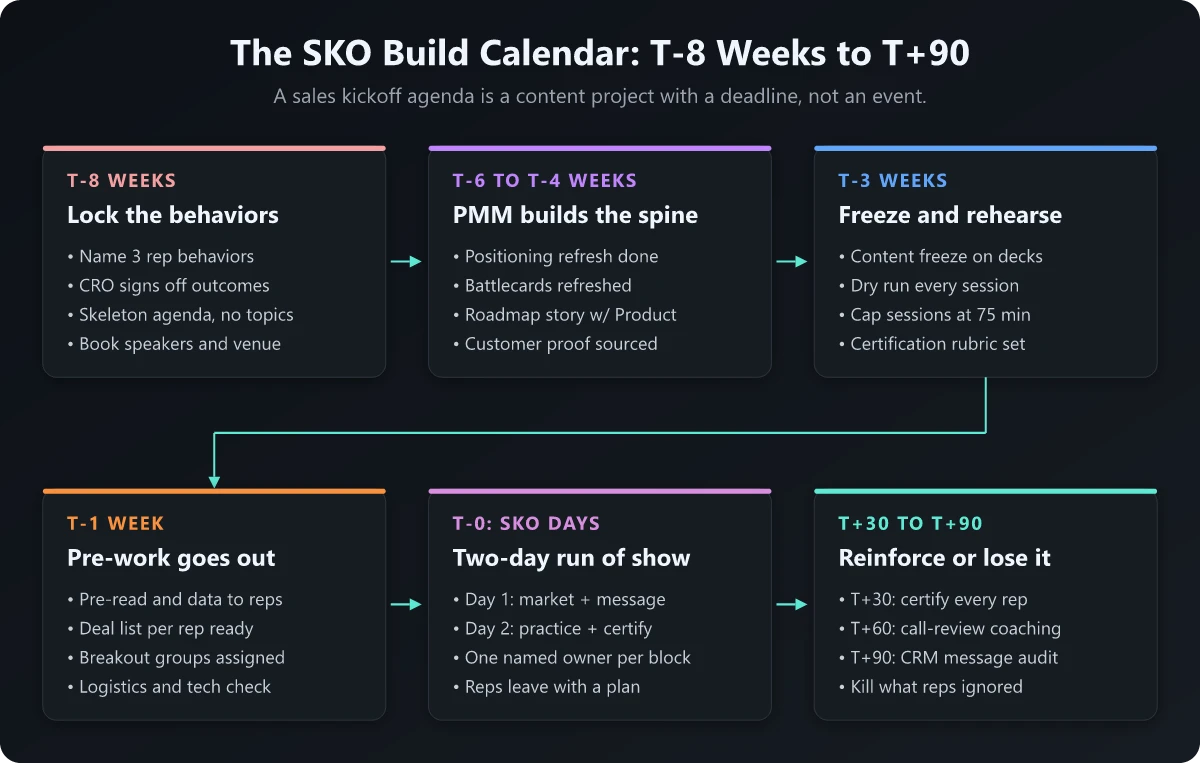
| Deadline | PMM deliverable | Why it gates the agenda |
|---|---|---|
| T-8 weeks | The three rep behaviors the SKO will install | Every session gets designed against these or gets cut |
| T-6 weeks | Positioning and messaging framework, final | Positioning, competitive and proof blocks all inherit it |
| T-6 weeks | Refreshed battlecards for the top 3 competitors | The drills block has no content without them |
| T-5 weeks | Customer sourced and briefed for the proof session | Customers need lead time and legal sign-off |
| T-4 weeks | Roadmap narrative agreed with Product | Stops the roadmap session becoming a feature list |
| T-3 weeks | Content freeze, dry run every session | The rehearsal is where you discover which deck is fiction |
| T-1 week | Pre-read pack to reps | Recovers 30 to 45 minutes of live time from setup |
The content freeze at T-3 weeks is the item most teams skip and most regret. A deck that changes the night before has not been rehearsed, and an unrehearsed session runs 20 minutes long and eats the practice block behind it.
If your SKO also carries a major launch, that workstream should already be feeding this calendar. The dependencies are laid out in the product launch checklist, and the drills block draws directly on the competitive battlecard template. Because the drills block pairs reps against one named rival at a time, that T-6 deliverable is three separate one-page cards rather than a single combined sheet, and a browser-based battlecard builder gets all three drafted and exported in an afternoon instead of a design ticket.
Sales kickoff agenda variants by team size
The same agenda does not scale from 12 reps to 400. What changes is not the content but the ratio of plenary to breakout, and who can credibly own a block.
| Under 25 reps | 25 to 100 reps | 100+ reps | |
|---|---|---|---|
| Length | 1 full day plus a half day | 2 full days | 2 plenary days plus 1 breakout day |
| Format | Single room, everyone in every session | Plenary mornings, breakouts afternoons | Tracked by role and segment from Day 2 |
| Certification | Live, everyone pitches to the room | Groups of 5 with a scorer per group | Manager-scored in parallel rooms, rubric enforced |
| Who owns PMM blocks | One PMM owns all of them | PMM lead plus a competitive owner | Segment PMMs own their own track |
| Customer proof | One customer, live | One live plus two recorded | One per segment track |
| Biggest failure mode | Turns into an all-hands | Middle of Day 2 sags | Breakouts run with no owner and no rubric |
| Skip entirely | Awards ceremony, tooling session | Nothing | Plenary role-play, it does not scale past 100 |
Under 25 reps, resist the pull toward an all-hands with a sales flavor. The whole value of a small-team SKO is that every rep can be certified live in one room, a luxury a 400-person org has to buy back with rubrics and parallel scoring.
Sales kickoff themes and ideas that survive the agenda
A theme is a filter, not a banner. Draft the agenda first, pick the theme second, then delete any session the theme does not justify. Themes chosen first tend to produce sessions that exist to fit the metaphor.
The strongest theme material in 2026 comes from what is actually happening to the buyer. A Gartner survey of 646 B2B buyers, run August through September 2025, found that 67% of B2B buyers prefer a rep-free experience and 45% used AI during a recent purchase, and that confident buyers are twice as likely to report a high-quality deal as buyers with low decision confidence (Gartner). That reframes the training block: the job is not pitch drilling, it is giving reps the language that creates value clarity fast when the buyer has already done most of the research alone.
Sales kickoff themes worth building an agenda around:
- “Earn the meeting.” Every session ends with what a rep must be able to say to justify the next 30 minutes of a buyer’s time.
- “Sell to the buyer who already read everything.” Sessions rebuilt for informed, self-directed buyers.
- “One number, one behavior.” Pick the single pipeline metric that is broken and make the entire agenda about the behavior that moves it.
- “Show, do not tell.” Every block includes a live demonstration by a rep, not a slide about it.
Sales kickoff ideas I would actively cut: motivational keynotes with no follow-on session, department update parades, awards that were not decided in advance, and any icebreaker longer than 10 minutes.
Sales kickoff presentation rules and meeting activities that work
Presentation quality is the difference between a session and an interruption. Four rules I hold to:
- No deck over 15 slides for a 45-minute block. The rest is discussion or practice.
- The last slide of every deck is “what you do differently on Monday.” Three bullets, rep-facing verbs.
- Nobody presents without a dry run. The dry run is for cutting, not polish.
- The PMM in the room owns language consistency. If two sessions describe the same product differently, reps will use neither.
Sales kickoff meeting activities that repay their time:
| Activity | Time | What it actually tests |
|---|---|---|
| Live pitch certification against a rubric | 90 min | Whether the new narrative is sayable under pressure |
| Competitive trap-objection drill in pairs | 45 min | Whether the battlecard survives contact with a real objection |
| Win teardown by the rep who closed it | 60 min | The language that worked, not the theory of why |
| Deal clinic on the rep’s own live pipeline | 60 min | Immediate application, which is the point |
| Silent deck review, reps mark unclear lines | 20 min | Where your messaging is confusing before it hits a customer |
Running a virtual or hybrid sales kickoff
A virtual SKO is not the in-person agenda on Zoom. Rebuild the run of show around attention, not travel.
- Split two days into three or four half days. Nobody absorbs a seven-hour video call.
- Cap sessions at 30 to 40 minutes and break every 60. Reformat the 90-minute certification into three 30-minute breakout rounds.
- Five reps and one scorer per breakout room. Certification in a 200-person webinar is theatre.
- Ship a physical kit before day one. Pre-read, commitment card, something on the desk.
- Record content sessions only. Leave practice unrecorded so reps take risks.
- In hybrid, give remote reps their own facilitator. A remote cohort with no in-room advocate becomes an audience within 20 minutes.
The T+30, T+60 and T+90 plan that decides whether the SKO mattered
The reinforcement plan is not an appendix to the SKO agenda. It is the part that determines whether the two days were an investment or a cost.
Highspot’s State of Sales Enablement Report 2025, based on a survey of 350 global go-to-market professionals, found that just 10% of large-scale B2B organizations are very effective at driving go-to-market initiatives, that one in two organizations (55%) struggles with either sales training or coaching, and that 84% of executives already recognize enablement as a driver of performance (Highspot). Recognition is not the constraint. Follow-through is.
| Milestone | Owner | What happens | Pass condition |
|---|---|---|---|
| T+7 days | Enablement | Recordings, decks and battlecards posted in one place, one link | Every rep has opened the link |
| T+30 | Enablement with PMM | Async re-certification for anyone who did not pass live | 100% of reps certified on the new narrative |
| T+30 | Sales managers | 1:1 review of each rep’s 30/60/90 commitment card | Every card has a manager comment |
| T+60 | PMM with managers | Call-review coaching: three recorded calls per rep scored against the new messaging | Managers can name each rep’s weakest block |
| T+60 | PMM | Battlecard refresh based on objections heard since SKO | At least one card materially changed |
| T+90 | PMM with RevOps | Audit CRM notes and call transcripts for the new value language | New language present in a majority of active deals |
| T+90 | Enablement | Kill list: SKO content with near-zero usage gets retired | Library is smaller than it was at T+7 |
That last row matters more than it looks. An enablement library that only grows teaches reps to stop searching it. The ongoing version of this discipline is what the sales enablement checklist is for. The SKO is the spike; the checklist is the baseline.
How to measure a sales kickoff
Attendance and satisfaction scores are the metrics you report when you did not instrument anything. Highspot’s GTM Performance Gap Report found that five in six (83%) B2B sales, enablement and marketing leaders said their teams are executing without clear proof of what is working from a go-to-market perspective (Highspot). An SKO is a controlled event with a clean before-and-after boundary, which makes it one of the easier things in enablement to actually measure.
Pick three of these five, baseline them the week before, and read them at T+90:
- Certification pass rate at T+2 days and again at T+30. A drop between the two is retention failure, not training failure.
- Content usage on the specific assets launched at SKO, measured in your content platform, not in Drive.
- New-message adoption, sampled from call recordings or CRM notes: percentage of active deals where the new value language appears.
- Stage-conversion change on the one stage the SKO was designed to unblock. Only one, chosen at T-8 weeks.
- Ramp for reps hired within 60 days of SKO, against the prior cohort.
Metric selection belongs at T-8 weeks with the behavior list, not at T+90 when someone asks for a readout. More on choosing the right numbers in the sales enablement KPIs breakdown.
Build the sales kickoff agenda backwards from behavior
Every generic SKO agenda template you can download is a list of sessions someone else found useful. That is why they are interchangeable, and why teams that use them end up with an event that felt good and changed nothing.
The version worth building starts from three behaviors, gives each block one owner and a duration, freezes content three weeks out, spends most of Day 2 on practice rather than presentation, and treats T+30, T+60 and T+90 as part of the same agenda. That is the whole claim: a sales kickoff agenda is a behavior-change plan with timestamps, and any block that cannot name the behavior it installs and the person accountable for it does not deserve a row on the grid.
Print the run of show above, put a real name in every owner cell, and delete the rows you cannot staff. What survives that edit is your actual sales kickoff agenda.
Frequently Asked Questions
What is a sales kickoff?
A sales kickoff (SKO) is the annual meeting where a revenue team resets on the number, the market, the product and the pitch for the year ahead. It usually runs one to three days and mixes leadership context, positioning and product updates, competitive training and live practice. The useful version ends with every rep certified on a new behavior, not just motivated.
How long should a sales kickoff be?
Two days is the default for teams of 25 to 100 reps. Under 25 reps, one full day plus a half day of practice is enough. Over 100 reps, run two plenary days plus a third day of role breakouts. Set the length by how many behaviors you are installing, not by the travel budget. Budget roughly 90 minutes of live practice per behavior.
What should be on a sales kickoff meeting agenda?
Eight core blocks: the number and the year ahead (CRO), the market and buyer shift (PMM), positioning and messaging relaunch (PMM), product and roadmap narrative (Product), competitive and battlecard drills (PMM), customer proof and win teardown (a top rep with a live customer), certification and live practice (Enablement), and commitments plus the 90-day plan. Every block needs a start time, a duration and one named owner.
What are the best sales kickoff themes?
The best sales kickoff themes name the change you are asking reps to make rather than a sports metaphor. Draft the agenda first, pick the theme second, then use the theme as a filter: any session that does not advance it gets cut. A theme tied to a real buyer shift ages far better than a generic Level Up or Unstoppable banner.
What are good virtual sales kickoff ideas?
Cut every session to 30 to 40 minutes, break every 60 minutes, and spread the same two-day agenda across three or four half days. Replace plenary certification with breakout rooms of five reps and one scorer, ship a physical kit to every rep before day one, and record only the content sessions so practice stays unrecorded and low stakes.