12 Win-Loss Analysis Questions to Ask (2026)
12 win-loss analysis questions a PMM actually uses, grouped by deal stage, plus how to ask them so buyers give you the truth instead of a polite non-answer.
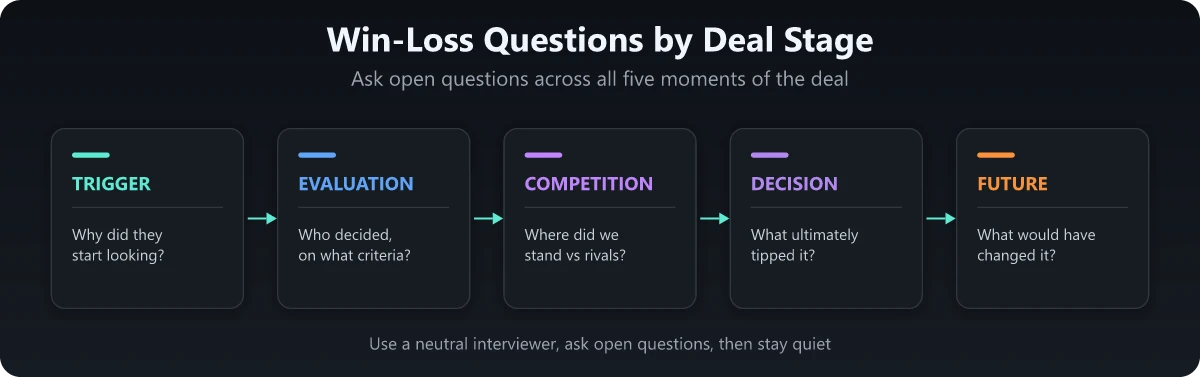
The win-loss questions that matter most cover five moments of the deal:
- Trigger - what made them start looking
- Evaluation - who decided, and on what criteria
- Competition - where you stood out or fell short
- Decision - what actually tipped it
- Future - what would have changed the outcome
Ask open “what” and “why” questions in each, and let the buyer’s answers lead.
The best win-loss interview I ever watched went sideways in the first two minutes. The rep opened with “so, why didn’t you pick us?” The buyer got defensive, gave a tidy non-answer about budget, and we walked away having learned nothing we could use. Budget is almost never the real reason; it is the polite one. The quality of your win-loss analysis is decided entirely by the questions you ask and how you ask them. These are the 12 win-loss analysis questions I actually use, grouped by the stage of the deal they unlock. For the why behind the practice, start with what a win-loss analysis is.
Trigger: Why They Started Looking
You cannot understand a decision without understanding what set it in motion.
1. What prompted you to start looking for a solution when you did? This surfaces the real pain and the timing. A buyer who was solving an urgent problem evaluates completely differently from one who was casually comparing.
2. What would have happened if you had done nothing? The honest answer tells you whether “do nothing” was your real competitor, which it often is.
Evaluation: How the Decision Got Made
Deals are lost in the process as often as on the product.
3. Who was involved in the decision, and who had the final say? Maps the buying committee. If you were selling to the wrong person the whole time, this is where you find out.
4. What were your top three criteria, and how did you weight them? Reveals what actually mattered versus what your deck assumed mattered.
5. Which vendors made your shortlist? Confirms who you are really competing against, which is frequently not who your battlecards assume. Feed this back into your competitive intelligence.
Competition: Where You Stood
This is the group that most directly sharpens your positioning.
6. Where did we stand out, and where did we fall short? Ask for both in the same breath so the buyer feels balanced enough to be candid about the weakness.
7. What was your impression of our team through the process? Sales experience is part of the product. A great tool with a clumsy process still loses.
Decision: What Tipped It
The heart of the interview, and where you must resist the urge to defend.
8. What ultimately tipped the decision one way or the other? The single most important question. Stay silent after asking it.
9. (Loss) What did the vendor you chose do better than us? Specifics here are gold for your competitive battlecards. Push past “they were just a better fit.”
10. Was price a deciding factor, or a tiebreaker? Separates a genuine pricing problem from a value-communication problem. They are fixed very differently.
Future: What Would Have Changed It
End forward-looking, not backward.
11. What, if anything, would have changed your decision? Tells you whether the deal was ever winnable, and what the one missing thing was.
12. Would you recommend us to a peer, and why or why not? Even in a loss, this measures whether you left a good impression, which shapes the next deal in that network.
How to Ask Them So You Get the Truth
The questions only work with the right technique. A few rules I hold to:
- Use a neutral interviewer. Buyers soften the truth when the rep who lost the deal is on the call. Product marketing or an outside party gets the real answers.
- Stay open and stay quiet. Ask the “what” or “why”, then let the silence do the work. The best insight usually comes after the buyer’s first, rehearsed answer.
- Never argue with a reason. The moment you defend, the buyer stops being honest. You are collecting intelligence, not relitigating the deal.
- Adapt, do not read. These 12 are a spine, not a script. Follow the buyer’s story where it goes.
Once you have run enough interviews, the patterns are what matter. Roll the answers into a running view of why you win and lose, like the one in my win-loss analysis dashboard guide.
Interviews also surface the losses your CRM files wrongly. Deals that ended because the buying group never reached a decision are not competitive losses, and how you count them decides whether your number can be compared to any SaaS win rate benchmark at all.
The Takeaway
Win-loss analysis lives or dies on the questions. Ask closed, defensive, or leading questions and you get the polite non-answers that make everyone feel fine and change nothing. Ask open questions across the trigger, evaluation, competition, decision, and future - with a neutral interviewer who knows when to stay quiet - and buyers will tell you exactly why you win and lose.
Start with these 12 win-loss analysis questions as your spine, adapt them to each buyer’s story, and the program stops producing anecdotes and starts producing the competitive truth your positioning has been missing.
Frequently Asked Questions
What questions should you ask in a win-loss analysis?
Ask open questions across five moments of the deal: what triggered the search, who evaluated and on what criteria, where you stood out or fell short against competitors, what ultimately tipped the decision, and what would have changed the outcome. Favor 'what' and 'why' over yes/no questions, and let the buyer's answers steer follow-ups rather than reading a fixed script.
How do you run a win-loss interview?
Keep it to a 20-30 minute conversation, ideally run by someone who was not on the deal so the buyer speaks freely. Start with the trigger, move through evaluation and competition, and end on what would have changed their mind. Ask open questions, stay quiet after each one, and never argue with a reason you do not like - you are collecting truth, not defending the loss.
Who should conduct win-loss interviews?
Ideally a neutral third party or someone outside the deal team - product marketing, a dedicated analyst, or an external firm. Buyers soften their real reasons when the rep who lost the deal is on the call. Neutrality is what turns a defensive debrief into usable competitive intelligence.
What is the difference between win and loss interview questions?
The structure is the same; the emphasis shifts. In a loss interview you probe harder on what the chosen vendor did better and whether the decision was reversible. In a win interview you dig into what nearly lost you the deal and which of your strengths actually drove the choice, so you can repeat it. Both need the same open, non-defensive style.