ChatGPT Go vs Plus vs Pro: Which Plan to Buy (Oct 2026)
I checked ChatGPT Go vs Plus vs Pro on OpenAI's own pages on 16 October 2026: what $20 Plus adds over $8 Go, where the pages disagree and which Pro tier fits.
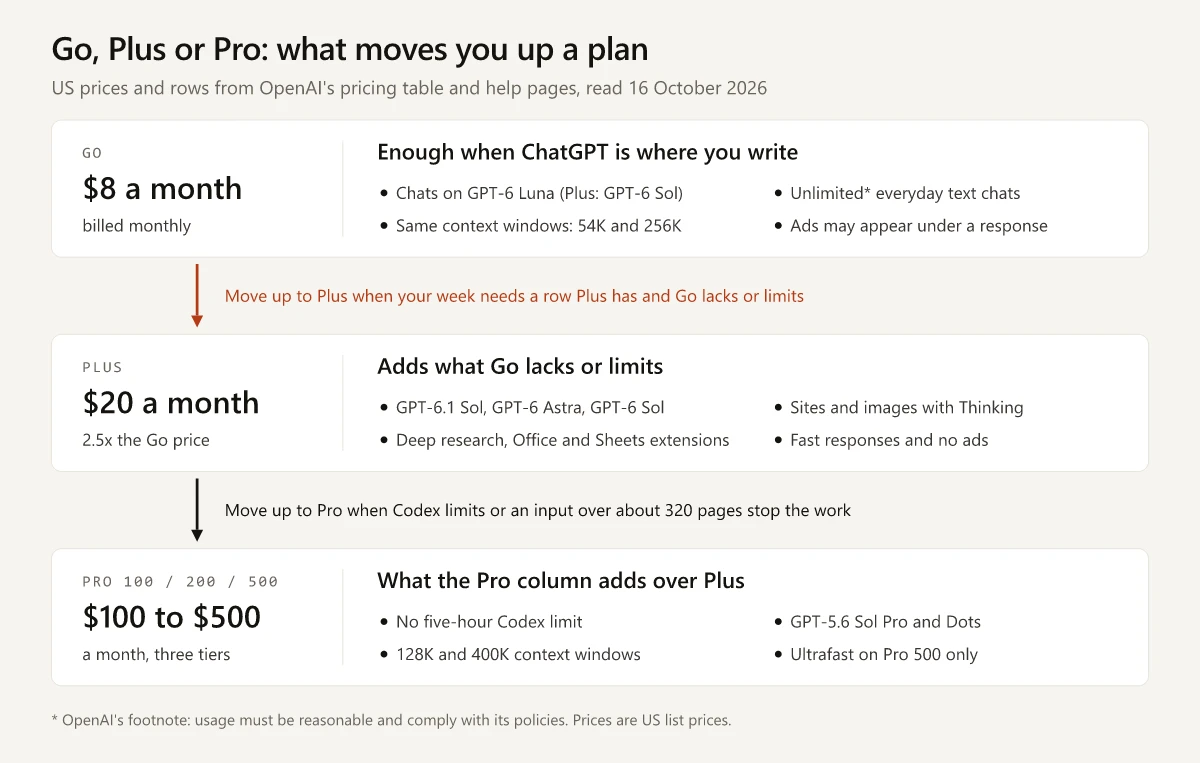
ChatGPT Plus costs 2.5 times as much as ChatGPT Go in the US, $20 a month against $8, on OpenAI’s own pages on 16 October 2026. The extra $12 buys the rows of OpenAI’s pricing table where Go says No or Limited and Plus says Yes, such as GPT-6 Sol, deep research and Sites, plus an account with no ads. Compared row by row, ChatGPT Go vs Plus comes down to 23 of that table’s 86 rows.
I would choose between the two by the rows a normal marketing week hits, not by the $12. Briefs, emails, posts and rewrites run on GPT-6 Luna in Go and on GPT-6 Sol in Plus, per OpenAI’s 7 October 2026 release note, with the same context windows on both, so Go covers them when Luna’s drafts need only light edits. Plus earns the extra money in a week that needs a sourced brief from deep research, a deck or spreadsheet built through the Office and Sheets extensions, a page published on Sites or an ad visual from image generation with Thinking.
OpenAI’s pages also contradict each other on the questions a Go buyer asks, including ads and voice limits, so I set out both sides of each below and say which one to go with. Seven of the ten OpenAI help articles I cite had been edited in the four days before I read them.
What Is the Difference Between ChatGPT Go and Plus?
On 16 October 2026, ChatGPT Go costs $8 a month in the US and Plus $20. Both list unlimited text chats and identical context windows. Plus adds GPT-6 Sol in chat (Go: GPT-6 Luna), GPT-6.1 Sol, GPT-6 Astra, Sites, image generation with Thinking, fast responses and no ads, and lifts Go’s Limited Codex, deep research and Office and Sheets extensions.
The prices come from three OpenAI pages: the Go launch post (“In the US, Go is available for $8 per month”), the Plus help article (“Price: $20/month (billed monthly)”) and OpenAI’s ChatGPT Work and Codex pricing page, which lists Go at $8, Plus at $20 and Pro “Plans at $100, $200, or $500 USD per month”. Every row below is from OpenAI’s pricing page as it was served on 16 October 2026, with Free shown for reference.
The 23 Rows Where Go and Plus Differ
| Row on OpenAI’s pricing table | Free | Go | Plus | Pro (one column for three tiers) |
|---|---|---|---|---|
| GPT-6.1 Sol | No | No | Yes | Expanded |
| GPT-6 Astra | No | No | Yes | Expanded |
| GPT-6 Sol | No | No | Yes | Expanded |
| GPT-5.6 Sol | No | No | Yes | Unlimited* |
| GPT-5.6 Luna | No | No | Yes | Unlimited* |
| GPT-5.6 Terra | Limited access in Work and Codex on desktop | Limited access in Work and Codex on desktop | Yes | Unlimited* |
| GPT-5 Thinking Mini | Yes | Yes | Expanded | Unlimited* |
| Legacy models | No | No | Yes | Yes |
| Response times | Limited on bandwidth & availability | Limited on bandwidth & availability | Fast | Ultrafast (on eligible tiers) |
| ChatGPT Work | Limited (desktop app) | Limited (desktop app) | Desktop, web, and mobile | Desktop, web, and mobile |
| Codex | Limited | Limited | Yes | Expanded |
| Excel, Word, PowerPoint, and Google Sheets extensions | Limited | Limited | Yes | Expanded |
| Deep research | Limited | Limited | Yes | Yes |
| Apps for deep research | Limited | Limited | Yes | Yes |
| Interactive tables and charts | No | No | Yes | Yes |
| Image generation with Thinking | No | No | Yes | Yes |
| Sites | No | No | Yes | Yes |
| Apps connecting to internal tools | No | No | Yes | Yes |
| Developer mode (beta) | No | No | Yes | Yes |
| ChatGPT record mode | No | No | Yes | Yes |
| Memory | Limited | Yes | Expanded | Expanded |
| Memory with past chats | Limited | Yes | Expanded | Expanded |
| Opportunities to test new features | No | No | Yes | Yes |
* OpenAI’s footnote on the pricing page: “Usage must be reasonable and comply with our policies.”
Same on Go and Plus
The other 63 rows match, and 32 of those read No on both plans, 27 of them under the table’s “Security & Administration” and “Customer Service” headings. The ones a marketer is likely to care about:
- Everyday text chats, marked “Unlimited*” on all four plans, and the GPT-6 Luna row, though Plus chats run on GPT-6 Sol
- Context windows: GPT Instant 54K, about 40 pages of input, and GPT Reasoning 256K, about 320 pages
- Image generation, file uploads, data analysis and vision
- Voice (“Expanded” on both, though Go gets the mini Quip model, as the next section shows) and voice with video
- Projects, shared projects and scheduled tasks
- Search, the built-in browser, and creating and sharing plugins
- Model training on your chats, with “Opt-out available” on every plan
OpenAI’s Own Pages Disagree on Six Go Questions (Checked 16 October 2026)
Each row quotes the two OpenAI pages that answer the same question differently. I read them logged out from an Indian connection in the early hours of 16 October 2026, India time. The update dates are each help article’s last edit as of that read, in UTC; the pricing page carries no date.
| Question | One OpenAI page says | Another OpenAI page says | Which page to go with, and what to check |
|---|---|---|---|
| Does Go show ads? | Go article, updated 12 October 2026: “We may start testing ads in ChatGPT Go in the future.” | Ads FAQ, updated 14 October 2026: “Ad testing started in the United States on February 9, 2026” and “Ads may appear for users on the Free and Go plans.” | The ads FAQ, the newer page; the release notes add rollouts for Australia, New Zealand and Canada on 16 April and the UK on 4 June 2026. Settings > Ad Controls, which the FAQ gives Free and Go users where ads run or soon will, changes personalization, not whether ads show. “Ads-Free is a Free-plan option”, so a Go user who wants no ads has to upgrade to a plan “like Plus or Pro” or switch back to Free, whose Ads-Free mode brings “lower usage limits and reduced feature access”. |
| What are Go’s voice limits? | Go article: “Voice mode is included with the same usage limits as the Free tier.” | Voice article, updated 15 October 2026: Free gets “Limited access to GPT-Live-1.1 Quip”, Go “3 hours with GPT-Live-1.1 Quip” and Plus “3 hours with GPT-Live-1.1”, measured over a rolling 24 hours. The pricing table marks Voice “Yes” on Free and “Expanded” on Go. | The Voice article, which matches the 9 September 2026 release note giving Go “Up to 3 hours”. The 15 October entry in OpenAI’s release notes calls Quip “a mini version of the model”. ChatGPT notifies you when you reach a Voice limit. |
| Which model does Go use? | Go article: “Think uses GPT-5.6 Luna.” | Pricing table: GPT-5.6 Luna “No” on Go, GPT-6 Luna “Yes”. The 7 October release note: “Plus, Pro, Business, and Enterprise use GPT-6 Sol; Free and Go use GPT-6 Luna”. | The Go article, edited on 12 October, is newer than the 7 October release note entry but still names GPT-5.6 Luna; the pricing table, that release note and OpenAI’s GPT-6 announcement each say GPT-6 Luna, so go with them. Open the model picker, which the Plus article tells subscribers to check “for the options on your account”. |
| Does Go get image generation with Thinking? | 21 April 2026 release note: “Images with thinking is available on all paid ChatGPT plans.” | Pricing table: “No” on Go and “Yes” on Plus. | The live table; the release note dates from April. Count it as a Plus feature unless your Go account offers it. |
| Does Go have projects, scheduled tasks and custom GPTs? | Pricing page, Plus card: “Projects, scheduled tasks, and custom GPTs” listed under “Everything in Go and:“ | The same page’s table marks Projects and Scheduled tasks “Yes” on Go, and the Go article lists “Access to projects, tasks, custom GPTs, and Library”. | The table and the Go article agree. Custom GPTs are “scheduled to retire on Dec 11, 2026” on every plan, per OpenAI’s retirement FAQ, so they are no reason to buy Plus. |
| Are text chats unlimited? | Free and Go cards: “Unlimited text chats subject to abuse guardrails”. Plus card: “Limits apply”. | The table marks everyday text chats “Unlimited*” on all four plans. The Plus article says Plus “may include usage limits such as message caps, especially during high demand”, and the Go article says usage “is subject to plan limits, abuse guardrails, and temporary restrictions during high demand”. | Neither plan has a published chat message count, and neither article limits caps to busy periods, so plan for caps on either plan, most of all at peak times. |
ChatGPT Go vs Plus for Marketing Work, Job by Job
Each row below takes a common marketing job and names the pricing-table row that decides the plan, as of 16 October 2026.
| Marketing job | Row that decides it | Go | Plus | Plan I would pick |
|---|---|---|---|---|
| Briefs, emails, posts and rewrites | Everyday text chats and the chat model | Unlimited*, GPT-6 Luna | Unlimited*, GPT-6 Sol | Go if GPT-6 Luna’s drafts pass your edit; Plus to draft on GPT-6 Sol |
| Summarizing a long report or transcript | Input maximum | About 40 pages (Instant), 320 (reasoning) | Same | Go; past about 320 pages, Pro (about 680) |
| Research brief with sources | Deep research, apps for deep research | Limited | Yes | Plus |
| Reports, decks and spreadsheets | Excel, Word, PowerPoint and Google Sheets extensions; interactive tables and charts | Limited; No | Yes; Yes | Plus |
| Landing page or prototype | Sites; Codex | No; Limited | Yes; Yes | Plus |
| Ad visuals and social creative | Image generation; image generation with Thinking | Yes; No | Yes; Yes | Go for rough drafts, Plus when the image needs planning |
| Live meeting capture | ChatGPT record mode | No | Yes, in the macOS desktop app | Plus, on a Mac |
| Working on a shared screen with a client | Ads | May appear below a response | None | Plus |
What the deciding rows do, in OpenAI’s words:
- Images with thinking “can plan and refine image outputs before generating them”, per the 21 April 2026 release note. Go’s pricing card promises “More image creation”; the Plus card promises “More complex and accurate image creation”.
- Sites “lets you build, host, and share a website by describing it in ChatGPT or Codex” and can also “host web apps, games, or a compatible project you’ve already built”, per OpenAI’s Sites documentation. OpenAI’s Sites help article says it “is available in public beta for ChatGPT workspaces, Plus, and Pro accounts”.
- Codex on Go is “GPT-6 Luna at Standard speed in the desktop app, subject to rollout”, per the Work and Codex pricing page, while Plus gets “Codex on the web, in the CLI, in the IDE extension, and on iOS” with GPT-6.1 Sol and GPT-6 Luna.
- Record mode “can transcribe and summarize audio recordings like meetings, brainstorms, or voice notes”, and OpenAI’s ChatGPT record article says it runs only in the macOS desktop app.
- On ads, the ads FAQ says the system weighs “the context and intent of your current conversation” when it picks an ad, and that OpenAI does “not share your conversations with ChatGPT with advertisers”. For client work on Go, the practical issue is a sponsored unit matched to the chat’s topic showing under a response on a shared screen. Temporary Chats show no ads.
The text-only jobs are where Go holds up. The ten workflows in my guide to using ChatGPT for sales and marketing, such as cold-email personalization and battlecard drafts, are chats with pasted or uploaded context, and Go marks both everyday text chats and file uploads as included.
If the landing page is headed for a real codebase rather than Sites, the coding agent matters more than the plan tier. I build this site with Claude Code, and my Claude vs ChatGPT comparison sets Claude Code against Codex and Claude Pro against ChatGPT Plus.
ChatGPT Plus vs Pro: Pro 100, Pro 200 and Pro 500 (Checked 16 October 2026)
ChatGPT Pro is three monthly plans, Pro 100 at $100, Pro 200 at $200 and Pro 500 at $500, per OpenAI’s Pro tiers article, against $20 for Plus. The pricing table differs between Plus and Pro on 19 of its 86 rows, but it shows Pro as one column, so this table splits the tiers using OpenAI’s other pages and one news report.
| Plus | Pro 100 | Pro 200 | Pro 500 | Who says so | |
|---|---|---|---|---|---|
| Monthly price, US | $20 | $100 | $200 | $500 | OpenAI’s Plus and Pro tiers articles |
| Price as a multiple of Plus | 1x | 5x | 10x | 25x | My arithmetic |
| Ultrafast | No (“Fast” response times) | Not included | Not included | Included | Pro tiers article; pricing table for Plus |
| Live voice per rolling 24 hours | 3 hours, GPT-Live-1.1 | 15 hours | Unlimited, subject to abuse guardrails | Not listed | Voice article |
| Included usage against Plus | 1x | ”5X standard usage allowance” for Codex, raised to “up to 10x” for a limited time in April | 10x for Work and Codex on a new subscription; grandfathered subscribers keep 20x through 29 October 2026, then 10x | 25x | Pro 100: OpenAI’s 9 April 2026 release note. Pro 200 and Pro 500: The New Stack, 29 September 2026, a news report; the Pro tiers article says only that new Pro 200 subscriptions get “a lower usage allowance” |
The Pro tiers article ranks the tiers without numbers: “Pro 200 includes more usage than Pro 100. Pro 500 offers the highest included usage of the three plans.” Neither it nor the pricing page states a multiple of Plus as of 16 October 2026, and The New Stack’s own report adds that “it’s unclear what exactly the included allowance in the $500 plan will be”.
One line of arithmetic per tier:
- Pro 100 costs $80 a month more than Plus, for a standard 5x of Plus’s Codex allowance.
- Pro 200 costs $180 more, for a reported 10x of Plus on a new subscription.
- Pro 500 costs $480 more. Ultrafast draws the included allowance at 8 times the Standard rate, so a reported 25x spent entirely in Ultrafast covers about 3.1 Plus allowances of Standard-speed work (25 / 8).
The 9 April release note gives no end date for Pro 100’s “limited time” 10x, and no later entry says it has ended. If it has, and the press figures hold, a new subscriber’s usage rises in step with price: 5x, 10x and 25x of Plus for 5, 10 and 25 times the money. On those numbers Pro buys headroom, plus Ultrafast on Pro 500, rather than a lower price per unit of work.
One dated rule, from the Pro tiers article: if you had an active Pro 200 subscription at any point from 22 September through 10 a.m. Pacific Time on 29 September 2026, you keep the previous allowance through 29 October 2026, and every other Pro 200 subscription gets “a lower usage allowance” at the same $200.
Rows the Pricing Table’s Pro Column Adds Over Plus
Read on 16 October 2026, alongside the Pro column in the first table:
- GPT-5.6 Sol Pro, marked No on Free, Go and Plus, and on the Pro card “Pro reasoning powered by GPT-6 Astra”; the 7 October release note says the Pro reasoning option “continues to use GPT-6 Astra”.
- GPT Instant context of 128K, about 250 pages of input, and GPT Reasoning context of 400K, about 680 pages, against 54K and 256K on Plus.
- Codex marked “Expanded”. The Work and Codex pricing page says “Pro plans currently have no five-hour limit”, while Plus works to OpenAI’s estimates of 15 to 160 local messages per five hours on GPT-6.1 Sol and 5 to 45 on GPT-6 Astra, which it says “are not fixed message limits”.
- Dots, OpenAI’s “always-on agents”, rolling out to eligible Pro users aged 18 and older; the 29 September 2026 release note excludes the European Economic Area, Switzerland and the UK at launch.
- Voice marked “Unlimited*” (split by tier in the table above), GPT-6 Luna marked “Expanded” and “Share Plugins with your workspace” marked “Yes”, against “Expanded”, “Yes” and “No” on Plus.
For a marketer, the Pro trigger is a Codex or Work session that keeps stopping at the Plus five-hour estimates, or a source pack over about 320 pages. Drafting copy hits neither.
ChatGPT Go vs Plus Price, Billing and Switching
As of 16 October 2026:
| Go | Plus | Pro | |
|---|---|---|---|
| US price | $8 a month | $20 a month | $100, $200 or $500 a month |
| Billing | Monthly | Monthly | Monthly |
| Annual plan (per OpenAI’s help articles) | Not offered | Not offered | Not offered |
- Annual billing: the Go article says OpenAI does “not support annual billing or the option to pay for multiple months in advance for ChatGPT Go, Plus, or Pro subscriptions”, and the pricing page’s FAQ offers “annual plans for Business and Enterprise” only.
- Upgrading: OpenAI’s 9 April 2026 release note says “You can upgrade, switch, or cancel your plan from Settings > My Plan or from the Pricing page.”
- Downgrading to Go: no refund. The Go article says “Your current plan will remain active until the end of your billing cycle”, after which the account moves to Go’s rate.
- App store subscriptions: per the Pro tiers article, cancel “through the platform where you purchased your subscription: ChatGPT, Apple or Google Play”.
- Credits past a limit: OpenAI’s credits article says Plus and Pro users who hit a Codex limit see an option to add credits, while buying credits is open to “a limited group of Free and Go users”.
- India: the ratio doubles. On 16 October 2026 the per-country price file that the pricing page’s script requests,
chatgpt.com/backend-api/checkout_pricing_config/configs/IN(undocumented, and it can change), returned ₹399 for Go and ₹1,999 for Plus with GST included, so Plus costs five times Go there. My Claude Pro price in India breakdown has the rupee prices by checkout and sets Go against Claude Pro. If your Go plan came from OpenAI’s free year in India, what renews when those 12 months end depends on where you signed up. Beyond Go and Plus, I set out the India prices of the three Pro tiers and Business, with GST and UPI noted for each plan, in a plan-by-plan guide to ChatGPT in rupees.
If you are still deciding whether to pay at all, my roundup of free AI tools for marketing covers what ChatGPT’s Free plan and its rivals give you before a subscription.
ChatGPT Go vs Plus: Pay for the Rows Your Week Hits
Go at $8 is enough when ChatGPT is where you write and GPT-6 Luna’s drafts pass your edit. It has Plus’s context windows, with response times OpenAI labels “Limited on bandwidth & availability” and possible ads.
Plus at $20 is worth it once your week needs chats on GPT-6 Sol, a screen with no ads, or one of the rows Go marks No or Limited and Plus marks Yes: deep research, the Office and Sheets extensions, Sites, image generation with Thinking or record mode. Pro makes sense only when Codex’s five-hour estimates or an input of more than about 320 pages stop the work.
Re-read the pricing table and the Go, Plus and ads articles on the day you buy, then pay for the cheapest column that clears this week’s jobs.
Frequently Asked Questions
Is ChatGPT Go worth it?
For text-first work, yes, as long as GPT-6 Luna's drafts pass your edit. As of 16 October 2026, Go costs $8 a month in the US against $20 for Plus and lists the same unlimited everyday text chats and context windows, but Go chats run on GPT-6 Luna and Plus chats on GPT-6 Sol. Pay for Plus if your week needs deep research, the Office and Sheets extensions, Sites, image generation with Thinking or an account with no ads.
Does ChatGPT Go have ads?
It can. OpenAI's ads FAQ says ads may appear on the Free and Go plans and that testing started in the US on 9 February 2026, and its release notes add Australia, New Zealand and Canada in April and the UK in June. Go has no Ads-Free option: the FAQ says to switch back to Free for its Ads-Free mode or upgrade to Plus or Pro, which have no ads.
What is the difference between ChatGPT Plus and Pro?
Pro is three monthly plans at $100, $200 and $500. The Pro column of OpenAI's pricing table adds GPT-5.6 Sol Pro, Dots, expanded Codex and 128K and 400K context windows against Plus's 54K and 256K. OpenAI's Work and Codex pricing page says Pro plans currently have no five-hour limit, and Ultrafast comes with Pro 500 alone.
Can I switch from ChatGPT Go to Plus?
Yes. OpenAI's release notes say you can upgrade, switch or cancel from Settings > My Plan or from the pricing page. Moving down from Plus or Pro to Go brings no refund: the Go article says your current plan stays active until the end of the billing cycle, then switches to Go.
Does ChatGPT have annual billing?
OpenAI says not on individual plans. As of 16 October 2026, its Go, Plus and Pro help articles say it does not support annual billing or paying for several months in advance, and its pricing page lists annual plans only for Business and Enterprise.