What Is the Difference Between Claude and ChatGPT? (2026)
The difference between Claude and ChatGPT is mostly images, free-plan limits and billing. This dated guide maps each tool to marketing jobs and compares Pro vs Plus.
Pick ChatGPT when a marketing job ends in an image or needs unlimited free text chat, and pick Claude when a draft needs rethinking rather than rewording. For research, files, connectors and coding, both $20 plans ship comparable features, so the difference between Claude and ChatGPT there comes down to the tools you already use.
Every vendor fact below comes from Anthropic’s or OpenAI’s own pages as checked on 26 September 2026, after Anthropic released Claude Opus 5.5 on 22 September and OpenAI temporarily paused new sign-ups and upgrades to its $200 Pro plan on 10 September.
What Is the Difference Between Claude and ChatGPT?
Claude is Anthropic’s AI assistant and ChatGPT is OpenAI’s. Both offer a free plan and a $20-a-month plan with cited web research, file analysis, memory, projects, connectors and a coding agent. The practical differences: ChatGPT generates images and gives free users unlimited text chats on GPT-5.6 Luna, while Claude does not generate photos or illustrations and offers annual billing.
Claude vs ChatGPT Comparison Table (September 2026)
Checked on 26 September 2026 against each vendor’s own pages. Prices are US list prices for individual plans, and cells without their own link come from the Claude pricing page or the ChatGPT pricing page.
| Claude (Anthropic) | ChatGPT (OpenAI) | |
|---|---|---|
| Individual plans | Free, Pro ($20), Max 5x ($100), Max 20x ($200) (Max plan help) | Free, Go, Plus ($20), Pro ($100 and $200) (Plus help) |
| Models by plan | Sonnet and Haiku on Free, Opus from Pro up, Fable access varies by plan; the lineup is compared in Claude Sonnet vs Opus | GPT-5.6 Luna on every plan; GPT-6 Astra, Sol and Luna from Plus up |
| Free plan | Chat, web search, file creation, code execution, memory, connectors, Artifacts | Unlimited text chats with GPT-5.6 Luna, “subject to abuse guardrails”, plus limited uploads, image generation, voice, deep research and Codex |
| Image generation | ”Doesn’t generate photos or illustrations”; builds diagrams, charts and interactive visuals in HTML and SVG (Claude help) | Generates and edits images, including from a reference image (OpenAI docs) |
| Research with citations | Research on paid plans searches the web plus connected Gmail, Calendar and Docs, with citations (Claude help) | Web search shows citations in the chat; deep research returns a report with its sources (OpenAI docs) |
| Files and data | Creates files and runs code from the Free plan up | File uploads and data analysis, limited on Free; creates documents, spreadsheets, presentations and PDFs (OpenAI docs) |
| Memory | ”Memory across conversations” from the Free plan up | Limited on Free, “Expanded memory and context” on Plus |
| Projects | Up to 5 on Free, listed without that cap from Pro up | On every plan; a project keeps “related chats, files, instructions, and sources together” (OpenAI docs) |
| Connectors and MCP | Custom connectors over remote MCP on every plan, one on Free (Claude help) | Plugins supply remote MCP tools on the web; the desktop app and Codex connect to MCP servers directly (OpenAI docs) |
| Coding agent | Claude Code, listed from Pro up, in terminal, IDE, desktop app and browser (Claude Code docs) | Codex, limited on Free and expanded on Plus, in CLI, IDE extension, cloud and desktop app (OpenAI docs) |
| Training on your chats | Opt-out on every individual plan, per the “Model training” row | ”Content is used to train our models”, with “Opt-out available” on every individual plan |
The Difference Between Claude and ChatGPT for Marketing Work
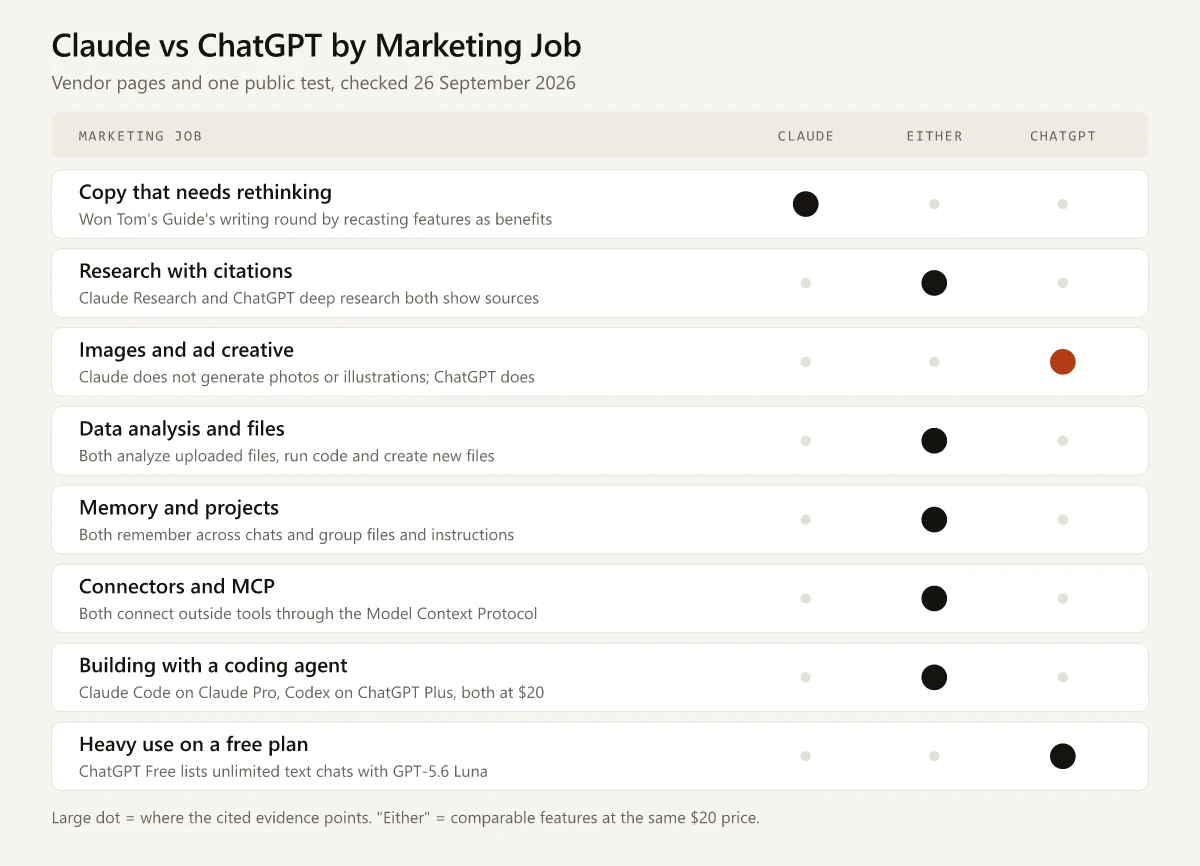
Claude vs ChatGPT for Writing and Editing Copy
For writing, the evidence I can point to is one same-prompt test. Amanda Caswell at Tom’s Guide ran the same five prompts through ChatGPT-6 and Claude Opus 5.5 on 24 September 2026, and Claude came out ahead in four.
- The writing round asked for a rewrite of a dull two-sentence product announcement that kept every fact and used no em dashes, no cliches and none of “exciting,” “revolutionary,” “game-changing” or “seamless”. Claude won it.
- ChatGPT’s rewrite met the brief too: the reviewer says it “avoided AI styles and retained every factual detail.” Claude won because it “understood that a ‘human’ rewrite requires rethinking how to explain the value of the features, rather than just shifting a few verbs in the original text.”
- ChatGPT won the fifth prompt, an open-ended request for a personal system. Across the test, the reviewer found ChatGPT “the less ‘fluffy’ of the two models, with a response that gets to the point faster,” and said that became an advantage in the final round.
- Anthropic’s Opus 5.5 announcement says the model “follows the writing rules you give it.” That is the vendor’s claim about its own model, and the Tom’s Guide round did not test it.
For marketing copy, that points to Claude when a draft needs rethinking, such as turning a feature list into benefits, and to ChatGPT when you want a short, direct first pass. It matches what I wrote in my free AI tools for marketing roundup: ChatGPT for speed, Claude for quality. Five prompts from one reviewer will not settle it for your own briefs.
Research With Citations
Both tools run multi-step web research and show their sources, so this job is close to a tie.
- Claude’s Research is on paid plans only, and Anthropic warns that “research sessions can use up your limits faster due to Claude retrieving multiple sources” (Research help).
- OpenAI’s web search docs place deep research in ChatGPT Work, the mode you switch to from Chat with a toggle above the message box (desktop app docs). Free gets “Limited ChatGPT Work access on desktop”, and Plus gets “Expanded access to ChatGPT Work on desktop, web, and mobile”.
- For a long analyst report or a set of interview transcripts, Claude’s paid plans support up to a 1M-token context window on the newest models, per Anthropic’s usage and length limits article. OpenAI’s pricing table lists a 256K total context window for its reasoning models on Plus and 54K for Instant.
Whichever you pick, open every cited link before a number goes into a deck. On this site every statistic is re-fetched on its cited page before it ships, and a Claude Research or ChatGPT deep research answer deserves the same check.
Images and Ad Creative
This is the cleanest split. Claude answers a visual brief with a diagram, chart or interactive visual built in HTML and SVG, or with Claude Design, which launched on 17 April 2026 as a research preview and makes designs, prototypes, slides, one-pagers and marketing collateral. As of September 2026, Anthropic’s Claude Design help article says it “is available in beta on Pro, Max, Team, and Enterprise plans.”
ChatGPT’s pricing page lists “Limited and slower image generation” on Free and “More complex and accurate image creation” on Plus. For ad variants, social visuals and product mockups, start in ChatGPT.
Data Analysis and Files
Claude’s pricing table marks “Create and edit files with code execution” as available on Free, while ChatGPT’s marks file uploads and data analysis as “Limited” on Free. On the $20 plans, both will read a campaign export or a survey CSV, run the analysis and hand back a file. Test with a file you already understand, so you can spot a wrong total.
Memory and Projects
Both remember context across chats and both group work into projects, even on Free, where ChatGPT’s memory is marked “Limited” and Claude caps you at 5 projects. The marketing use is the same in both: put your positioning doc, ICP, messaging house and brand voice rules in one project, so every chat starts from them. If you use ChatGPT this way, my guide to using ChatGPT for sales and marketing has workflows that plug straight into a project.
Connectors and MCP
Both connect to outside tools through the Model Context Protocol (MCP), an open standard for linking AI tools to data sources. My own keyword research runs through the Ahrefs and Semrush MCP servers inside Claude Code, so I can confirm MCP works in Claude Code for SEO data. Pick the tool whose connectors match the stack you already run.
Where Claude Is Better, and Where ChatGPT Is
Claude is better at a short list of things, and ChatGPT has a list of its own.
Claude is ahead when:
- The copy has to explain its value differently for readers. That was the reviewer’s reason for Claude’s writing win at Tom’s Guide, and Anthropic separately says Opus 5.5 follows the writing rules you give it (a vendor claim).
- You want thorough answers to multi-factor questions. Claude won the party-planning, vacation-rental and city-budget rounds, and the reviewer summed it up as “Claude tends to keep digging.”
- You will commit for a year. Claude Pro has an annual price; ChatGPT Plus has none.
ChatGPT is ahead when:
- The deliverable is an image, a mockup or an ad visual.
- You want a short, direct answer. ChatGPT won the open-ended round, and the reviewer found it “the less ‘fluffy’ of the two models.”
- You want a cheaper paid tier than Plus. ChatGPT Go, which OpenAI calls “a low-cost subscription plan” (Go help), sits between Free and Plus, and the pricing page says it “may include ads”. Claude lists no plan between Free and Pro.
- You live on a free plan. ChatGPT Free lists unlimited text chats with GPT-5.6 Luna, subject to abuse guardrails.
So is Claude better than ChatGPT? For a content marketer rewriting launch copy, the Tom’s Guide result points that way. For a performance marketer shipping ad creative every day, no.
Claude Pro vs ChatGPT Plus: Price and Limits
At $20 a month both plans cost the same, but they bill and meter differently. As of September 2026, with unlinked cells taken from each vendor’s pricing page:
| Claude Pro | ChatGPT Plus | |
|---|---|---|
| Monthly price | $20 (Pro plan help) | $20 (Plus help) |
| Annual option | $17 a month, $200 billed annually | None: “we do not support annual billing” |
| How limits work | Session limit that resets every five hours, plus a weekly limit (Pro plan help), in one pool across claude.ai, Claude Code and Claude Desktop (usage limits) | “May include usage limits such as message caps”, which “may vary based on system conditions” (Plus help) |
| Coding agent | Claude Code | ”Expanded Codex usage” |
| Research | Research, which Free lacks | ”Expanded deep research” |
| Images and documents | No image generation; Claude Design, Slides and Docs from Pro up, with Claude Design in beta per Anthropic’s help center | ”More complex and accurate image creation”; documents, spreadsheets, presentations and PDFs in ChatGPT Work |
| Organising work | Projects without the Free plan’s cap of 5 | ”Projects, scheduled tasks, and custom GPTs” |
| Handing off tasks | ”Hand off and schedule tasks”; since 16 September 2026 Anthropic has been merging Cowork into the Claude app, rolling out to Pro and Max first (Cowork announcement) | “Expanded access to ChatGPT Work on desktop, web, and mobile” |
| Office and browser | ”Claude in Chrome and Microsoft 365” | Excel, Word, PowerPoint and Google Sheets extensions, plus a built-in browser |
| Next tier up | Max 5x at $100 for five times Pro’s per-session usage, Max 20x at $200 | Pro at $100 (“5x more usage”); new sign-ups and upgrades to Pro $200 temporarily paused since 10 September 2026 |
The annual math: twelve months of Plus is 12 x $20 = $240, and a year of Claude Pro billed annually is $200, so Claude costs $40 less if you commit. Paid monthly, both come to $240 a year.
On Claude, the shared pool means a long Claude Code session eats into your chat allowance. On ChatGPT’s desktop app, Codex CLI and IDE extension, built-in image generation “counts toward your general Codex usage limits”, per OpenAI’s image generation docs.
Is Claude Pro worth it over ChatGPT Plus? Pay for Pro if you want Claude Code in the same subscription, rewrite a lot of launch copy, or will commit for a year. Pay for Plus if images are part of your weekly output or you want expanded Codex and deep research.
Claude Code vs OpenAI Codex for Marketers Who Build
This is the part of the comparison I can speak to first-hand, on the Claude side. I build with Claude Code inside VS Code on Windows 11. This Astro site, its nine free marketing tools and the scripts that pull Search Console and Semrush data were all built with it, and I wrote up the WordPress to Astro migration that started it. That also means my bias runs toward Claude: the Codex column below comes from OpenAI’s documentation, and no side-by-side prompt test of mine appears on this page.
| Claude Code | OpenAI Codex | |
|---|---|---|
| Included with | Claude Pro and up | ChatGPT Free and Go (limited), Plus (expanded) |
| Where it runs | Terminal, IDE, desktop app, browser (Claude Code docs) | CLI, IDE extension, cloud, ChatGPT desktop app (OpenAI docs) |
| Project instructions | CLAUDE.md, and it can read an AGENTS.md (Claude Code docs) | AGENTS.md (OpenAI docs) |
| MCP | Yes, per the Claude Code docs | Yes, in the CLI and IDE extension (OpenAI docs) |
| Local repository work | Reads the codebase, edits files, runs commands | ”Let Codex inspect files, make edits, and run the tools already installed on your machine” (Codex CLI docs) |
On paper they cover the same ground. The Claude Code features I lean on go well past a chat window: custom slash commands that run a whole routine from one line and a memory system that works without a CLAUDE.md file. It also supports installable skills that package a workflow for reuse. If you are deciding between the Claude chat app and Claude Code, that is a separate comparison: Claude vs Claude Code.
How to Test Claude and ChatGPT Before You Pay
Both free plans are enough to run a fair test in an afternoon, before any money changes hands.
- Pick three briefs you will ship this month, for example a launch email, a positioning statement and a 1,200-word blog section.
- Write one prompt per brief with hard constraints: word count, audience, banned words and one source file both tools get.
- Run each prompt on the same day in a Claude incognito chat, which Anthropic says “won’t use Claude’s existing memory” (incognito help), and in ChatGPT with memory turned off under Settings > Personalization (OpenAI docs), so neither draws on stored context.
- Score the outputs blind. Count broken constraints, check every number against the source file, and time the edits before each draft is shippable.
- Pay for the tool that needed fewer edits, then spend the first month on the features you bought it for, such as Claude Code or the fuller image creation on ChatGPT Plus.
For the prompts themselves, my ChatGPT prompts for marketing work in both tools with light edits. If you want a checklist for spotting machine-sounding copy while you score, the AI-writing tells catalogued at tropes.fyi are a good start.
Claude vs ChatGPT for Marketing: Which to Pay For
- No budget: use ChatGPT Free for unlimited text chat on GPT-5.6 Luna, and keep Claude Free alongside it for file creation, code execution and one custom connector.
- PMM doing competitive research: pick the tool that connects to your sources. Claude Research can read connected Gmail, Calendar and Docs on paid plans, and OpenAI’s deep research steps tell you to “include relevant files or connected app context” (OpenAI docs).
- Builder of tools and automations: either, since both $20 plans include a coding agent. I use Claude Code.
- Images and copy every week: both $20 plans, which together cost less than one $100 tier.
If Gemini or Grok is also on your list, my comparison of ChatGPT with other AI models covers them, and my AI tools for affiliate marketing roundup puts Claude and ChatGPT side by side for affiliate content.
Before you buy, recheck the difference between Claude and ChatGPT on both pricing pages, since every row here is dated. Then run the three-brief test on both free plans this week.
Frequently Asked Questions
Is Claude better than ChatGPT?
It depends on the job. Claude won the writing round in a Tom's Guide same-prompt test published on 24 September 2026, and it offers annual billing on its $20 plan. As of September 2026, ChatGPT generates images, has a low-cost Go plan below Plus and gives free users unlimited text chats on GPT-5.6 Luna.
What is the difference between Claude Pro and ChatGPT Plus?
Both cost $20 a month. Claude Pro can also be billed at $200 a year and includes Claude Code, with one usage pool shared across chat and coding. ChatGPT Plus is billed monthly only, and OpenAI's pricing page lists more complex image creation, expanded deep research, custom GPTs and expanded Codex usage on it.
Can Claude generate images like ChatGPT?
No. Anthropic's help center says Claude doesn't generate photos or illustrations the way image-generation tools do. It can build diagrams, charts and interactive visuals with HTML and SVG, and Claude Design, in beta on Pro, Max, Team and Enterprise as of September 2026, makes designs, prototypes, slides and one-pagers. ChatGPT generates and edits images.
Which is better for writing, Claude or ChatGPT?
Claude Opus 5.5 won the writing round of a Tom's Guide test published on 24 September 2026, a rewrite with no em dashes and no cliches. The reviewer noted that ChatGPT-6 also avoided AI styles and kept every fact; Claude won for rethinking how to explain the features. Run three of your own briefs through both free plans before paying.
Is Claude or ChatGPT better for marketing?
Pick by the job. ChatGPT fits image-led creative and heavy free-plan text chat. Going by one public test, Claude fits copy that needs rethinking rather than light rewording. For research with citations, data files, connectors and coding agents, both $20 plans ship comparable features, so the tools you already use should decide.