Customer Onboarding Template: The Free 7-Stage Framework
A free customer onboarding template with stages, owners, milestones, and timelines. Copy, paste, and adapt this SaaS framework in one afternoon today.

Most new users never reach the moment your product becomes useful. Userpilot’s 2024 benchmark of 62 B2B SaaS companies put the average user activation rate at just 37.5%, meaning roughly two out of three signups never complete the core action that makes a product stick. A repeatable customer onboarding template is the cheapest fix for that gap, because it forces every stage, owner, and milestone into one view your whole team can run.
This guide hands you a copy-paste customer onboarding template you can adapt in an afternoon. You get the fillable stage table first, then the logic behind each column, owner assignments, timelines, and the metrics that tell you it is working. If you only need the definition and theory, start with what customer onboarding is and come back here for the build.
The Customer Onboarding Template (Copy and Paste)
Here is the core framework. Each row is a stage; each column forces a decision your team would otherwise leave implicit. Replace the example owners and timelines with your own.
| Stage | Goal | Owner | Key milestone / exit criteria | Target timeline | Customer action |
|---|---|---|---|---|---|
| 1. Welcome and kickoff | Set expectations, confirm goals | CS / Onboarding | Kickoff call booked and held | Day 0 to 2 | Attend kickoff, name a champion |
| 2. Account setup | Provision access, configure basics | Implementation | Account live, users invited | Day 1 to 5 | Approve config, add seats |
| 3. Data and integrations | Connect existing tools and data | Implementation + Eng | Core integration verified | Day 3 to 10 | Grant access, validate data |
| 4. First value (activation) | Customer hits the “aha” action | CS / Product | First key outcome achieved | Day 5 to 14 | Complete core workflow once |
| 5. Training and enablement | Team can self-serve | CS / Enablement | Admin and end users trained | Day 7 to 21 | Attend training, invite team |
| 6. Adoption and expansion | Usage becomes habitual | CS / AM | Weekly active usage target hit | Day 21 to 45 | Use product in real workflow |
| 7. Handoff to ongoing success | Move from launch to lifecycle | AM / CS | First QBR or check-in scheduled | Day 45 to 60 | Confirm renewal owner, KPIs |
Copy this into a sheet, a project tool, or your onboarding software and treat it as the single source of truth. The columns matter more than the exact stages, so adjust the rows to match your product while keeping every row accountable.
How to Read the Columns
The owner column is the most important and the most often skipped. Onboarding stalls in the gaps between teams, so every stage needs one name, not a department.
The exit criteria column turns vague stages into binary checkpoints. A stage is either done or it is not, which keeps a customer from drifting for three weeks while everyone assumes someone else owns the next step.
The timeline column sets internal urgency. These are targets, not guarantees, but a stage with no deadline is a stage that slips.
Stage-by-Stage: What Each Step Actually Does
The customer onboarding template only works if each stage has a clear job. Here is what each row is built to accomplish.
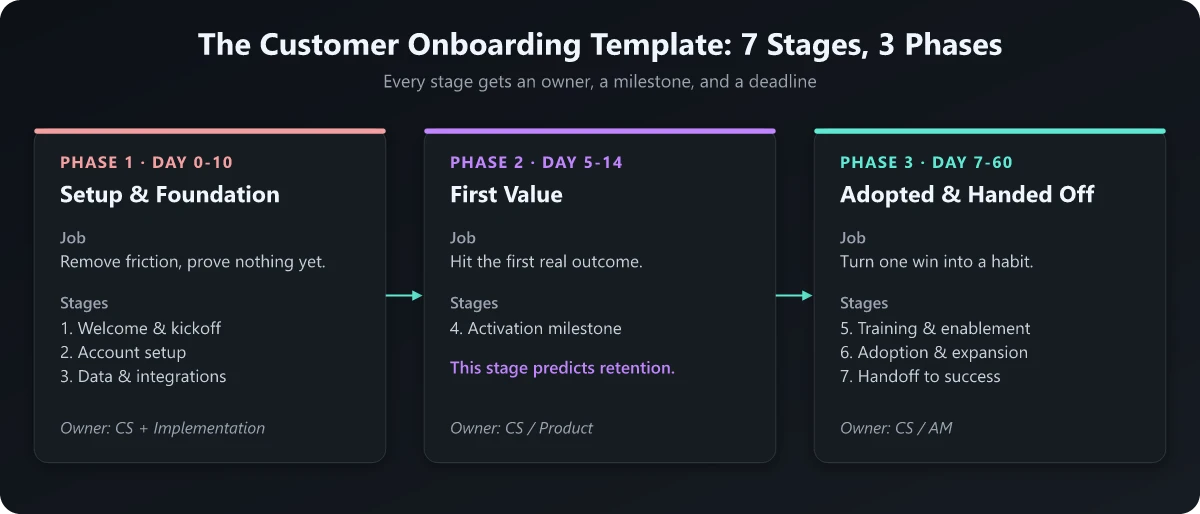
Stage 1 to 3: Setup and Foundation
The first three stages exist to remove friction, not to impress. Kickoff aligns on the goal the customer bought your product to hit, so write that goal down and reference it at every later stage.
Account setup and integrations are where technical onboarding lives. Keep this phase short and owned by an implementation specialist, because dependency on engineering is a common place onboarding stalls.
Stage 4: First Value Is the Whole Game
Activation is the stage that predicts retention, which is why it gets its own milestone. The faster a customer reaches a real outcome, the more likely they stay.
Userpilot’s 2025 benchmark across 547 SaaS companies found a median time to value of about 1 day and 12 hours. Your number will differ by product complexity, but the principle holds: design stage 4 to deliver one concrete win as early as possible, then build everything else around protecting that moment.
Stage 5 to 7: From Activated to Adopted
Training, adoption, and handoff convert a single win into a habit. This is where onboarding overlaps with lifecycle marketing, because the same triggers, nudges, and check-ins that drive adoption also feed expansion and renewal.
The final handoff stage is easy to forget and expensive to skip. A clean transition to an account manager or ongoing success owner is what keeps the relationship from going quiet after launch.
Assigning Owners Without Creating Chaos
A template is only as good as the accountability behind it. The owner column should follow a simple rule: one accountable owner per stage, with named supporters.
Onboarding ownership is also increasingly shared with outside teams. Rocketlane’s 2025 report, built on responses from over 950 onboarding professionals, found that 49.4% of organizations involve external partners in their customer onboarding journey. If partners or resellers touch your process, give them their own rows and owners rather than leaving the work ambiguous.
A Simple RACI for Each Stage
You do not need a heavy RACI matrix, but you do need clarity. For each stage, answer three questions:
- Who is accountable? The single name in the owner column.
- Who supports? Engineering, product, or partners who execute parts of the stage.
- Who is informed? Sales, leadership, or the account team who need visibility but do not act.
Bake those answers into the template once and you stop relitigating ownership on every new account.
Setting Timelines That Reflect Reality
Timelines in the template are commitments to internal momentum, not promises to the customer. Set them from your own data, then tighten them.
Userpilot’s activation benchmark, with its low average activation rate, is a reminder that most onboarding leaks value early. If two-thirds of users never activate, the fix is rarely more steps; it is fewer steps reaching value faster. Audit your template for any stage that delays the first win and ask whether it can move after activation instead of before it.
Compress, Then Sequence
Two rules keep timelines honest. First, compress everything before stage 4 so nothing blocks the first value. Second, sequence everything after stage 4 so training and expansion happen once the customer already cares.
This ordering is the difference between an onboarding flow that feels like setup work and one that feels like progress.
Metrics: Proving Your Customer Onboarding Template Works
A customer onboarding template should be measured, not just filled in. Track a small set of metrics so you can see where customers stall.
| Metric | What it tells you | Healthy direction |
|---|---|---|
| Activation rate | Share of users hitting first value | Higher |
| Time to value | Days to first key outcome | Lower |
| Stage completion rate | Where customers drop in the flow | Higher per stage |
| Onboarding cycle time | Total days from kickoff to handoff | Lower |
| Onboarding-stage churn | Customers lost before adoption | Lower |
Start with activation rate and time to value, since those two predict the rest. As your template matures, add stage-level completion so you can pinpoint the exact row where customers stall, the same way customer journey analytics surfaces drop-off points across the wider journey.
For SaaS teams, onboarding metrics feed directly into broader growth. The way you activate and retain new accounts shapes your entire SaaS growth strategy, and B2B teams will find a deeper operational playbook in these B2B customer onboarding best practices.
How to Adapt the Template in an Afternoon
You do not need a six-week project to ship this. Here is the fast path.
- Copy the stage table into your tool of choice and rename stages to match your product.
- Assign one owner per stage using the names on your team, not departments.
- Set timelines from your own data, then shave a day off anything before stage 4.
- Pick two metrics (activation rate and time to value) and find where you measure them today.
- Run it on the next three new accounts and note exactly where customers stall.
After three accounts you will see your real bottleneck, and the template becomes a living document you tune instead of a static checklist you abandon.
Where Onboarding Is Heading
Onboarding is also becoming a paid, strategic function rather than a free afterthought. Rocketlane’s 2025 report found that 54.5% of companies plan to price onboarding as a premium service offering. If you are investing the effort to build a real template, treat it as a revenue lever, not a cost center.
Conclusion: Ship the Template, Then Improve It
A good customer onboarding template does one thing exceptionally well. It makes every stage, owner, milestone, and timeline visible so nothing slips between teams. With average activation rates sitting near 37.5%, the teams that win are not the ones with the most onboarding steps, but the ones with the clearest, fastest path to first value.
Copy the table above, assign real owners, set honest timelines, and run it on your next three accounts. Then keep tightening the stages before activation until your time to value is the shortest in your category. Start with the template today, measure activation and time to value, and let the data tell you which row to fix next.
Frequently Asked Questions
What is a customer onboarding template?
A customer onboarding template is a reusable framework that maps every stage a new customer moves through, from contract signed to first value and full adoption. It assigns an owner, a milestone, and a target timeline to each step so nothing gets dropped between sales and success.
What should a customer onboarding template include?
A strong template includes the onboarding stage, the goal of that stage, the owner responsible, the key milestone or exit criteria, the target timeline, and the customer-facing action required. Optional columns cover risk flags, internal notes, and the success metric you measure.
How long should customer onboarding take?
It depends on product complexity, but the goal is to shorten time-to-value as much as possible. Userpilot's 2025 benchmark across 547 SaaS companies found a median time to value of about 1 day and 12 hours, so even complex B2B products should aim to deliver a first win within the first week or two.
Who owns the customer onboarding process?
Onboarding is usually owned by Customer Success or an implementation team, with support from product, sales, and sometimes external partners. The template should name a single accountable owner per stage so handoffs between teams are explicit.
How is customer onboarding different from a free trial?
A free trial is a self-serve evaluation window, while customer onboarding is the structured process of turning a paying customer into an activated, adopted user. Onboarding can include trial activation, but it extends through implementation, training, and the first measurable outcome.