Groq API Key: Free Limits and the Model IDs Groq Still Lists
Get a Groq API key at console.groq.com, see the free plan limits per model as of November 2026, and skip the Llama model IDs Groq shut down for free accounts.
Groq, spelled with a q, is an inference provider: it serves hosted models through an OpenAI-compatible API, and a Groq API key is created at console.groq.com. Grok, spelled with a k, is xAI’s model, with its own API docs at docs.x.ai and its own keys, which the Grok API key guide covers. This page covers the one with a q.
Creating the key is the easy part. My reading of those docs is that the model ID you paste next needs more care than the key does, because Groq’s own quickstart sample still calls llama-3.3-70b-versatile, a model its deprecations page lists as shut down for free and developer-tier usage on 16 August 2026.
Unless a line names another source, every Groq fact below comes from Groq’s own documentation as it stood on 24 November 2026. Groq retired models in July, August and September 2026, so recheck the linked page before you build on a model ID, a limit or a price.
How to get a key and send a working request (November 2026):
- Open console.groq.com/keys and sign in or create an account with Google, GitHub, SSO or email.
- Choose the project in the Console’s project selector. Groq says keys are “specific to the project you have selected”.
- Create the key on the API Keys page and save it in a password or secrets manager straight away.
- Set it as the
GROQ_API_KEYenvironment variable. - Call a model ID that is on the free plan table today, such as
openai/gpt-oss-20b, and leavellama-3.3-70b-versatileout.
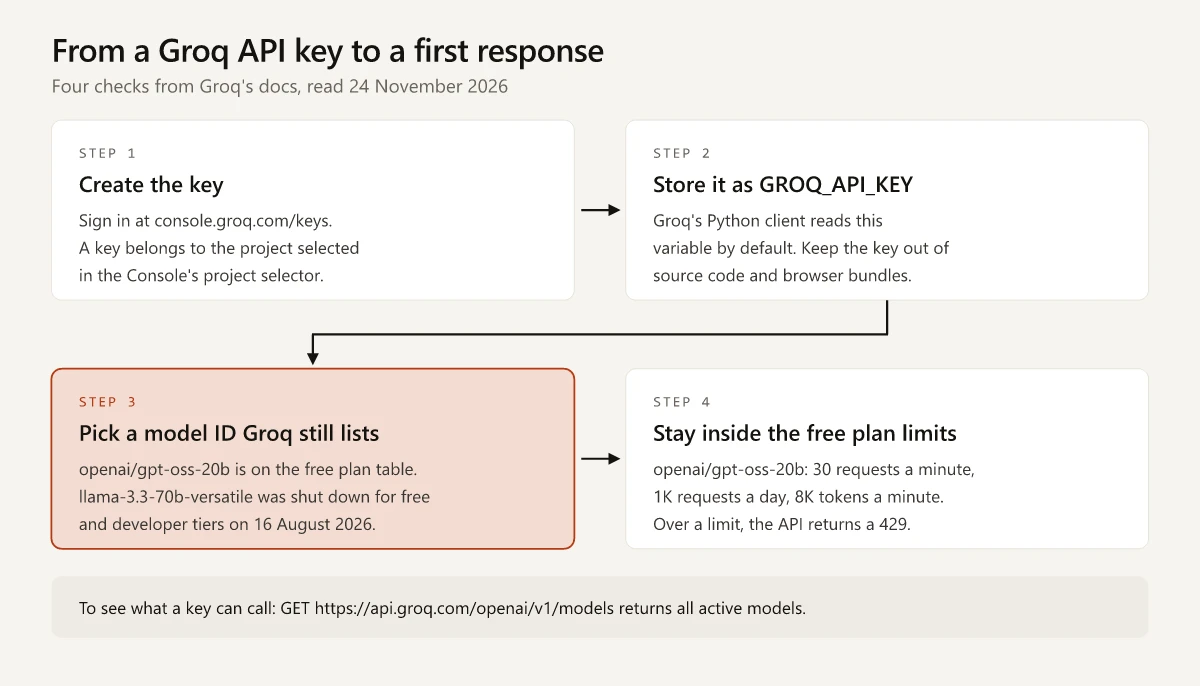
How to Get a Groq API Key
Groq’s quickstart covers key creation in one sentence: “Please visit here to create an API Key”, linked to console.groq.com/keys. That page sits behind a login, so the steps here use what Groq’s public docs say about it and nothing else.
Sign In and Choose a Project
- A logged-out load of
console.groq.com/keyson 24 November 2026 showed “Create an account or login to access this page” with four options: Continue with Google, Continue with GitHub, Continue with SSO and Continue with email. Continuing accepts Groq’s Services Agreement. - Groq’s Projects docs place a project selector in the top navigation and say “Any API keys generated will be specific to the project you have selected.” Logs are project-specific too.
- The same page suggests separate projects for development, staging and production, with names such as “myapp-dev”, “myapp-staging” and “myapp-prod”.
If you were invited to someone else’s organization, your role decides whether you can manage keys:
| Organization role | Access inside a project, in Groq’s words |
|---|---|
| Owner | Full access, including “managing API keys” |
| Developer | ”Currently same as Owner.” |
| Reader | ”Read-only access to projects and usage metrics, logs, and spending data.” |
Create the Key and Store It
Groq’s docs name the place, the API Keys page, and stop there. None of the Groq docs pages I read describes the create dialog or says whether the Console shows a key again later. Apideck’s guide, now hosted on API Tracker, first published on 6 October 2025, tells readers to copy the key at once because “Groq only shows it once”, and that is the safe assumption to work from.
Groq’s security onboarding page writes its sample keys with a gsk_ prefix (gsk_your_secret_key_here).
The quickstart then sets the key as an environment variable:
export GROQ_API_KEY=<your-api-key-here>That is the one form the quickstart gives. On Windows, PowerShell needs a different form; I build this site on Windows 11 with Git Bash and PowerShell, and the syntax comes from Microsoft’s environment variable docs:
$Env:GROQ_API_KEY = "gsk_..."Microsoft says a change made this way “affects only the current session”. For a Python project, Groq’s client libraries page recommends python-dotenv with GROQ_API_KEY in a .env file “so that your API Key is not stored in source control”.
Send a Request With a Current Model ID
Groq’s docs overview carries a sample that uses a model on the free plan table:
curl -X POST https://api.groq.com/openai/v1/responses \
-H "Authorization: Bearer $GROQ_API_KEY" \
-H "Content-Type: application/json" \
-d '{
    "model": "openai/gpt-oss-20b",
    "input": "Explain the importance of fast language models"
}'
In Python, the GPT OSS 20B model page installs the SDK with pip install groq and calls it like this. Groq() with no arguments reads GROQ_API_KEY, which the client libraries page calls the default:
from groq import Groq
client = Groq()
completion = client.chat.completions.create(
    model="openai/gpt-oss-20b",
    messages=[
        {
            "role": "user",
            "content": "Explain why fast inference is critical for reasoning models"
        }
    ]
)
print(completion.choices[0].message.content)
Two more places the key goes:
- Code written for OpenAI’s client libraries: Groq’s OpenAI compatibility page says to pass the Groq key as
api_keyand changebase_urltohttps://api.groq.com/openai/v1. If you need an OpenAI key itself, the OpenAI API key guide explains its prepaid credit billing. - Coding agents: Groq’s Coding with Groq page lists OpenCode “with native Groq support”, and which providers OpenCode and Claude Code each accept covers the wider choice between those two tools.
Is a Groq API Key Free?
Yes: Groq has a Free tier with its own rate limits, and usage-based billing belongs to the Developer tier, which the billing FAQ says needs “a valid payment method (credit card, US bank account, or SEPA debit account)”.
| Free tier | Developer tier | |
|---|---|---|
| Payment method | None named for the Free tier in the billing FAQ | Credit card, US bank account or SEPA debit account |
| Charges | After a downgrade to Free, “Any usage-based charges stop immediately” | Tokens billed monthly in arrears and at progressive thresholds |
Limits on openai/gpt-oss-120b | 30 RPM, 1K RPD, 8K TPM, 200K TPD | 1K RPM, 500K RPD, 250K TPM |
| Batch and Flex processing | Not listed for the Free tier | Yes (Developer tier features); Flex is “to paid customers only” |
| Spend limits | ”only available on paid plans, not free tier accounts” | Yes, managed by an organization owner |
| Speech-to-text file size | 25 MB | 100 MB |
Sources: the billing FAQ, the two tabs of the rate-limits page, and Groq’s Flex, Spend Limits and speech-to-text docs.
One thing I could not confirm on a Groq page is the line that the Free tier needs “no credit card”. Search results still list a Groq community thread titled “Is there a free tier and what are its limits?”, but on 24 November 2026 community.groq.com redirected to Groq’s homepage, so I could not read it and I am not repeating the line from it. What Groq’s live pages support is narrower: the sign-in screen asked for a Google, GitHub, SSO or email login, and the billing FAQ ties the payment method to the Developer upgrade.
Going over a free limit is documented on the rate-limits page: “When you exceed rate limits, our API returns a 429 Too Many Requests HTTP status code.”
Groq API Key Free Limits by Model
This is the Free Plan Limits tab of Groq’s rate-limits page as it stood on 24 November 2026. RPM and RPD are requests per minute and per day, TPM and TPD are tokens per minute and per day, and ASH and ASD are audio seconds per hour and per day.
| Model ID | RPM | RPD | TPM | TPD | ASH | ASD |
|---|---|---|---|---|---|---|
openai/gpt-oss-120b | 30 | 1K | 8K | 200K | - | - |
openai/gpt-oss-20b | 30 | 1K | 8K | 200K | - | - |
qwen/qwen3.8-27b | 30 | 1K | 8K | 200K | - | - |
openai/gpt-oss-safeguard-20b | 3 | 1K | 2K | 200K | - | - |
meta-llama/llama-prompt-guard-2-22m | 30 | 14.4K | 15K | 500K | - | - |
meta-llama/llama-prompt-guard-2-86m | 30 | 14.4K | 15K | 500K | - | - |
whisper-large-v3 | 20 | 2K | - | - | 7.2K | 28.8K |
whisper-large-v3-turbo | 20 | 2K | - | - | 7.2K | 28.8K |
canopylabs/orpheus-v1-english | 10 | 100 | 1.2K | 3.6K | - | - |
canopylabs/orpheus-arabic-saudi | 10 | 100 | 1.2K | 3.6K | - | - |
How to read it, with my arithmetic where I add any:
openai/gpt-oss-120b,openai/gpt-oss-20bandqwen/qwen3.8-27bshare one row of numbers. At 200K tokens and 1K requests a day, using every request leaves an average of 200 tokens per request (200,000 / 1,000).- At full speed the daily token cap runs out fast: 200K tokens a day at 8K tokens a minute is 25 minutes of full-rate use (200,000 / 8,000).
- Whisper’s 7.2K audio seconds an hour is 2 hours of audio per hour, and 28.8K a day is 8 hours of audio.
- If you have seen 14,400 requests a day quoted for Groq’s free tier, that figure sits on the two Prompt Guard rows of this table and on no chat model. Groq’s rate-limit header example on the same page also uses 14400, labelled as an illustrative value.
- A second key does not add quota. Limits “apply at the organization level, not individual users”, and the Projects docs say custom project limits “can only be set to values equal to or lower than your organization’s limits”.
- Cached tokens “do not count towards your rate limits”.
Groq calls the table “a high level summary and there may be exceptions” and sends you to the Limits page in your account settings, console.groq.com/settings/limits, for your exact figures. Groq’s page has a second tab, Developer Plan Limits, with the higher figures; the table above is the Free Plan Limits tab.
If you are weighing Google’s free tier instead, the free Gemini API key guide covers how its limits work.
The Retired Model IDs Older Guides Still Use
Groq’s deprecations page says that after a shutdown date, “Requests to deprecated model IDs will return errors.” These are the deprecation entries for the model IDs that still turn up in Groq’s quickstart, in third-party guides such as the one below, and in Groq’s own replacement advice, newest shutdown first:
| Model ID | Shutdown date | Replacement Groq names |
|---|---|---|
groq/compound and groq/compound-mini | 21 September 2026 | None listed |
qwen/qwen3.6-27b | 14 September 2026 | qwen/qwen3.8-27b |
llama-3.3-70b-versatile | 16 August 2026 | openai/gpt-oss-120b or qwen/qwen3.6-27b (itself retired on 14 September 2026; Groq names qwen/qwen3.8-27b) |
llama-3.1-8b-instant | 16 August 2026 | openai/gpt-oss-20b |
qwen/qwen3-32b | 17 July 2026 | openai/gpt-oss-120b |
meta-llama/llama-4-scout-17b-16e-instruct | 17 July 2026 | openai/gpt-oss-120b or qwen/qwen3.6-27b (itself retired on 14 September 2026; Groq names qwen/qwen3.8-27b) |
gemma2-9b-it | 8 October 2025 | llama-3.1-8b-instant, itself retired since |
mixtral-8x7b-32768 | 20 March 2025 | mistral-saba-24b or llama-3.3-70b-versatile, both retired since |
For the two Llama IDs, Groq says it emailed users on 17 June 2026 and adds: “This deprecation applies to free and developer-tier usage; enterprise customers with a committed-spend contract are not affected.” That is consistent with a models page that still lists both under an Enterprise tag.
As read on 24 November 2026, Groq’s own pages do not agree with each other about llama-3.3-70b-versatile:
| Groq page | What it shows |
|---|---|
| Quickstart | The curl, Python and AI SDK samples all call llama-3.3-70b-versatile |
| Client libraries page | The Python sample calls llama-3.3-70b-versatile |
| Models page | Llama 3.3 70B and Llama 3.1 8B carry an “Enterprise” tag, with Contact Sales in place of a price and rate limits |
| Free plan limits table | No Llama chat model; the Llama entries are the two Prompt Guard models |
| Deprecations page | Both IDs shut down on 08/16/26 for free and developer-tier usage |
Guides outside Groq’s docs can be further behind. The Maxim Bifrost guide to Groq keys, as read on 24 November 2026, lists both Llama IDs, both Compound IDs, qwen/qwen3-32b and Llama 4 Scout under “Available Groq Models”, and its sample request calls mixtral-8x7b-32768.
So copy the model ID from Groq’s own list instead of from a tutorial, and that includes this page. The models page documents a request that returns “a JSON list of all active models”:
curl -X GET "https://api.groq.com/openai/v1/models" \
     -H "Authorization: Bearer $GROQ_API_KEY" \
     -H "Content-Type: application/json"
My rule for a new key: start on a model Groq lists under Production Models (openai/gpt-oss-120b or openai/gpt-oss-20b for text). qwen/qwen3.8-27b sits under Preview Models, and Groq says preview models “may be discontinued at short notice”.
Groq Key Errors: 401, 403, 429 and 498
Groq’s error codes page and the docs for the features behind each code give these meanings:
| Status | What Groq says | What to check |
|---|---|---|
| 401 Unauthorized | The request “lacks valid authentication credentials”; make sure “the api key is valid” | That GROQ_API_KEY is set in the shell running your code, and that the key has not been revoked |
| 403 Forbidden | ”The request is not allowed due to permission restrictions.” Blocked models return 403 with model_permission_blocked_org or model_permission_blocked_project | Model permissions: an Owner sets them for the organization, a Developer or Owner for a project |
400 with blocked_api_access | The organization reached its spend limit, a Developer tier feature | Raise the limit, or wait for the reset on the 1st of the month |
| 413 Request Entity Too Large | ”The request body is too large.” | Request size, including audio file size (see the tier table above) |
| 429 Too Many Requests | ”Too many requests were sent in a given timeframe.” | Wait for the retry-after value |
| 498 | ”Flex Tier Capacity Exceeded”, with error capacity_exceeded | Applies to the paid Flex tier; retry with backoff |
| 500, 502, 503 | Server errors; “You will not be charged for requests that return server error codes.” | Retry later |
The error codes page does not say which status a retired model ID returns. The deprecations page says only that such requests “will return errors”, so read the error message and compare the model ID with the models endpoint.
When a 429 arrives, the response headers show what ran out, and each header family has a fixed scope:
| Header | Scope, per the rate-limits page |
|---|---|
retry-after | Seconds to wait; “only set if you hit the rate limit and status code 429 is returned” |
x-ratelimit-limit-requests, x-ratelimit-remaining-requests, x-ratelimit-reset-requests | ”Always refers to Requests Per Day (RPD)“ |
x-ratelimit-limit-tokens, x-ratelimit-remaining-tokens, x-ratelimit-reset-tokens | ”Always refers to Tokens Per Minute (TPM)” |
No header in that table reports requests left in the current minute or tokens left in the day, so a 429 can arrive while both remaining values still look healthy. Groq’s security onboarding page recommends “client-side rate limiting and exponential backoff for 429 / 5xx responses”.
What Groq Bills After You Add a Payment Method
Upgrading to the Developer tier changes the limits at once and the bill later. From the billing FAQ:
- “there’s no immediate charge” at the upgrade. Tokens are billed at month-end, or sooner when cumulative usage crosses a progressive threshold: $1, $10, $100, $500 and $1,000.
- India has its own rule: “Customers with a billing address in India have different progressive billing thresholds.” For them the thresholds are “only $1, $10, and then $100 recurring”, so an invoice triggers at every further $100 of usage.
- Groq bills only once usage has reached at least $0.50.
- Accepted payment methods are credit cards (Visa, MasterCard, American Express, Discover), United States bank accounts and SEPA debit accounts. That list has no UPI entry, and every amount on the Groq docs pages I read from India was in US dollars, with no rupee price and no GST line.
- A failed payment can be retried “up to two times”, and “Failed payments may result in service suspension.”
- You can downgrade to Free at any time from Settings > Billing, after paying a final invoice for unbilled usage.
Prices for six of the models on the free table, per 1M tokens in US dollars unless marked per hour, from the models page on 24 November 2026:
| Model ID | Listed under | Input | Output |
|---|---|---|---|
openai/gpt-oss-120b | Production Models | $0.15 | $0.60 |
openai/gpt-oss-20b | Production Models | $0.075 | $0.30 |
openai/gpt-oss-safeguard-20b | Preview Models | $0.075 | $0.30 |
qwen/qwen3.8-27b | Preview Models | $0.80 | $4.00 |
whisper-large-v3 | Production Models | $0.111 per hour | n/a |
whisper-large-v3-turbo | Production Models | $0.04 per hour | n/a |
A worked example on openai/gpt-oss-20b: 10M input tokens cost $0.75 (10 x $0.075) and 1M output tokens cost $0.30, a total of $1.05. That crosses the $1 threshold, which the FAQ says is charged immediately. For scale, the same 11M tokens equal 55 days of the free plan’s 200K tokens per day (11,000,000 / 200,000).
Two controls are worth setting on the day you upgrade:
- A spend limit under Settings > Billing > Limits, in US dollars per month. When it is reached, calls from every key in the organization return a 400 with
blocked_api_access. Groq warns of “a 10-15 minute delay in spend tracking”, so a busy workload can overshoot slightly. - Alert thresholds on the same page, which the Spend Limits docs suggest at 50%, 75% and 90% of the limit.
Anthropic’s API is funded the other way round, from prepaid Console credits, and my guide to getting a Claude API key covers that setup. If a coding tool is why you want a key at all, API key billing versus a flat subscription in Claude Code is the trade to read first.
Keeping the Key Safe
Groq’s security onboarding page is short and specific:
- “Never expose or hardcode API keys directly into your source code.” Use environment variables or a secret management system.
- “Never embed keys in frontend code or expose them in browser bundles.” Browser apps should “route through a trusted backend proxy”.
- “Rotate API keys periodically (e.g., quarterly)” and “Use per-environment keys (dev / staging / prod)”, which pairs with one project per environment.
- If a key may be compromised: “Revoke the key immediately from the Groq Console”, rotate to a new key, redeploy your secrets and review the logs. Groq adds: “Never reuse compromised keys, even temporarily.”
Know where each copy of the key lives before you rotate it. Groq’s OpenCode setup page, for example, says the key you enter there “will be stored securely in ~/.local/share/opencode/auth.json”.
A key copied from a public repo or a shared list belongs to someone else’s organization. It draws on their limits and their invoice, and it stops working when they follow Groq’s advice to revoke it. Do not use one.
A Groq API Key Is Only as Current as Its Model ID
The key itself is four short steps: sign in, pick the project, create it, export GROQ_API_KEY. What changes underneath it is the model list, with shutdowns in July, August and September 2026, and Groq’s quickstart sample has not caught up with its own deprecations page. Before you write any code against a new Groq API key, run the models list request, then pick an ID from the response that Groq’s models page lists under Production Models.
Frequently Asked Questions
Is the Groq API key free?
Yes. Groq has a Free tier with its own rate limits, and its billing FAQ asks for a payment method when you upgrade to the Developer tier. On 24 November 2026 the free plan table listed openai/gpt-oss-120b at 30 requests per minute and 1,000 requests per day.
What is the Groq API key free limit?
It depends on the model. Groq's rate-limits page, read on 24 November 2026, listed 30 requests per minute, 1,000 requests per day, 8,000 tokens per minute and 200,000 tokens per day on the free plan for openai/gpt-oss-120b, openai/gpt-oss-20b and qwen/qwen3.8-27b. Limits apply to the whole organization, so a second key does not add quota.
How do I get a Groq API key?
Sign in at console.groq.com/keys with Google, GitHub, SSO or email, select the project the key should belong to, and create the key on the API Keys page. Then store it in the GROQ_API_KEY environment variable, which Groq's Python client and the AI SDK's Groq provider read by default.
Why is my Groq API key not working?
Groq's error page says a 401 means the request lacks valid credentials, a 403 means a permission restriction such as a blocked model, and a 429 means a rate limit was hit. If the key is fine, check the model ID: Groq shut down llama-3.3-70b-versatile and llama-3.1-8b-instant for free and developer-tier usage on 16 August 2026.
How much does the Groq API cost after the free tier?
On the Developer tier, which Groq's billing FAQ describes as pay-as-you-go pricing, Groq bills per token in US dollars: on 24 November 2026 its models page listed openai/gpt-oss-20b at $0.075 per 1M input tokens and $0.30 per 1M output tokens. Billing is monthly in arrears, with progressive thresholds starting at $1.