Differentiate Your Product When Competitors Copy Features
How to differentiate your product when competitors copy your features: score every claim by time to copy, drop the ones under two quarters, attach real proof.
Here is one row of the scorecard I use to work out how to differentiate your product when competitors copy your features. I filled it in for coverage breadth, the claim every vendor in my own category reaches for:
| Scorecard field | Entry |
|---|---|
| Claim | Coverage breadth, published as a device and browser count |
| Type | Integration or device count |
| Time to copy | One to two quarters, because coverage is bought rather than invented |
| Who else says it | BrowserStack’s homepage advertises 35,000+ real devices and 7 million developers. TestMu AI, formerly LambdaTest, advertises 3,000+ browser combinations and 10,000+ real devices. A Walmart engineering manager quoted on the Sauce Labs cross-browser page cites 700+ browser and OS combinations plus 300+ real devices |
| Proof attached | A self-published count, on each vendor’s own marketing site |
| Verdict | Fails the two-quarter line, no evidence a buyer can check |
That row is a talking point. It belongs in the battlecard and it does not belong in the positioning, because every serious vendor in the category can publish a bigger number next quarter by signing one more device supplier.
I market a software-testing cloud, so feature parity is the starting condition of most weeks. The question of how to differentiate your product when competitors copy your features is a scoring problem, and the scoring has to happen before the messaging, not after sales complains that the deck sounds like everyone else’s.
How to differentiate your product when competitors copy your features:
- Re-score the claim rather than defending the feature. A copied feature has already lost that argument, so score which of your remaining claims is still yours two quarters from now.
- Rank every candidate by time to copy. Features and price moves die in a quarter or two. Data assets, business model changes and workflow depth do not.
- Cut anything under the two-quarter line. It stays in the competitive battlecard as a talking point and comes out of the positioning.
- Attach a proof asset to each survivor. A dated changelog, a named customer outcome, a third-party evaluation, or a number computed from data only you hold.
- Re-run the scoring every quarter against what competitors actually shipped, taken from their changelog rather than their roadmap slide.
What Counts as a Durable Differentiator?
A durable differentiator is a claim that stays true after a funded competitor decides to attack it. It has to clear three tests:
- Copy cost. What a competitor gives up, spends or waits for in order to match it.
- Buyer relevance. Whether it shows up in real deals as a reason to choose, which comes out of win-loss interviews rather than an internal workshop.
- Provability. Whether a buyer can confirm it without taking your word for it.
A claim that clears relevance and provability but not copy cost is a feature announcement with a short shelf life. A claim that clears copy cost but not provability is an assertion, and buyers discount assertions. Only claims that clear all three earn a place in product positioning.
The Differentiation Durability Scorecard
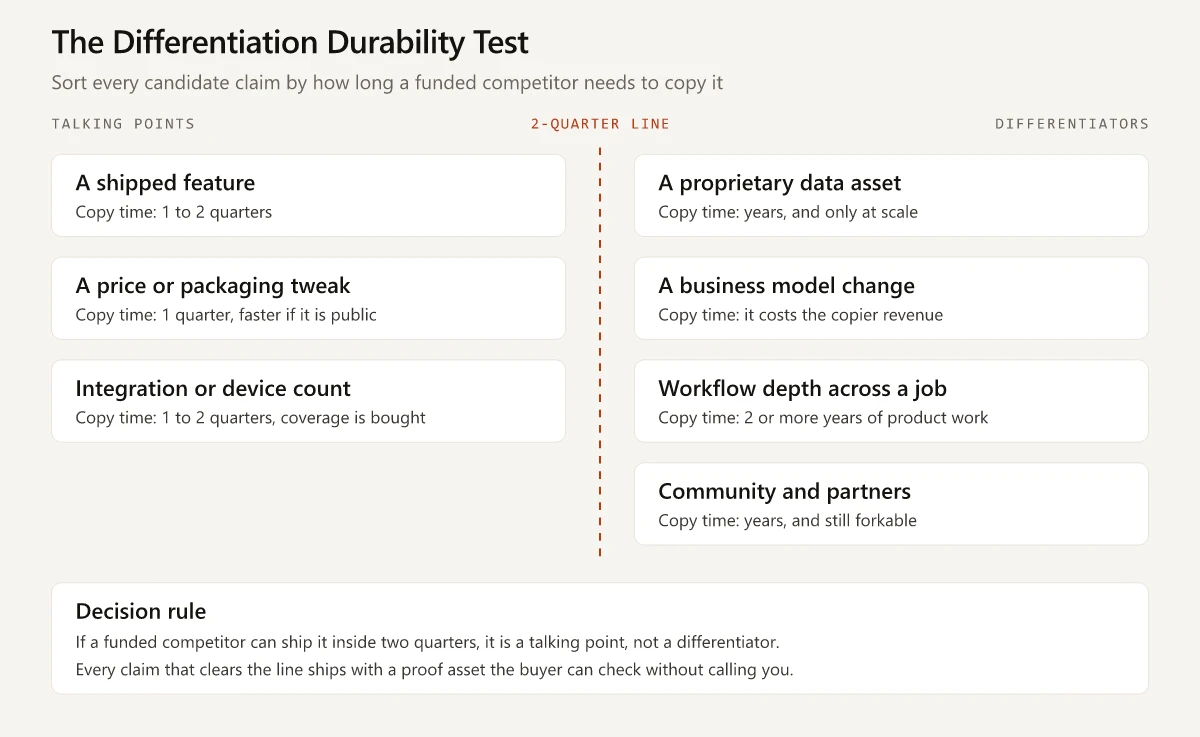
Estimates below are my working numbers for B2B software, calibrated against the dated examples further down. Adjust the quarters for your category and keep the ordering.
| Differentiator type | Time to copy | What the copier gives up |
|---|---|---|
| Shipped feature | 1 to 2 quarters | Engineering time |
| Integration or device coverage | 1 to 2 quarters | Partner and procurement work |
| Price or packaging move | 1 quarter | Margin on the pricing page, briefly |
| Performance or scale claim | 2 to 6 quarters when it comes from architecture | An architecture rewrite |
| Proprietary data asset | Years | Volume they never collected |
| Business model change | Indefinite while copying costs them revenue | A revenue line already on their books |
| Workflow depth across a whole job | 2 or more years | Sequenced product work, not one release |
| Community and partner network | Years, and still forkable | Trust earned in public over time |
The diagram below sorts seven of these eight either side of the two-quarter line. Performance and scale claims are the one type that genuinely straddles it: bolted onto an existing architecture they fall inside a quarter, and only when the speed comes from the architecture itself do they hold for six.
The decision rule is one line: if a funded competitor can ship it inside two quarters, it is a talking point, not a differentiator.
Six Numbers That Say Whether a Differentiator Survives
Score each candidate claim from 0 to 3 on all six, for a maximum of 18. A claim needs 12 or better to go into positioning, and it cannot score below 2 on time to copy no matter how well it does elsewhere.
| Metric | What it measures | Score 3 when |
|---|---|---|
| Time to copy | Quarters a funded competitor needs to match it | It needs more than four quarters |
| Copy cost | What matching it costs the competitor | Copying costs them revenue or an architecture rewrite |
| Proof strength | Who vouches for the claim | A third party you did not control published it |
| Deal presence | Share of competitive deals where the buyer raises it unprompted | It comes up in most competitive deals |
| Win-rate delta | Win rate in deals where the claim was made against deals where it was absent | The gap holds across two quarters |
| Evidence age | Days since the newest supporting proof asset was refreshed | Under 90 days |
Deal presence and win-rate delta are the two metrics most teams skip, and they are the two that stop a favorite claim from surviving on internal enthusiasm alone. Both come out of the same win-loss notes, so the marginal cost of scoring them is an afternoon of reading.
How Do You Differentiate a Product When Competitors Copy Your Features?
By changing which claim you lead with, and by making the new lead claim expensive to copy. Shipping a bigger version of the copied feature invites the same response from a competitor who has just demonstrated they can ship it.
Three moves change the copy cost rather than the feature list:
- Move the claim onto your data. From what the product does to what only your data can say. A claim supported by a model trained on volume a competitor never collected is one they cannot make at any engineering budget.
- Move the claim into the business model. Bundling, a support commitment or a pricing guarantee is copyable in a week technically and painful commercially, because the copy costs the competitor money they already book.
- Move the claim onto the whole job. One feature is copyable. A sequence of steps that hand off cleanly across a whole job is a roadmap, and roadmaps take years.
Time to Copy, With Dates
- AI research agents: 53 days apart. Google shipped Deep Research in Gemini on December 11, 2024. OpenAI shipped deep research in ChatGPT on February 2, 2025. Two of the best-resourced product teams in the world put the same named capability in market 53 days apart. Neither company says it copied the other, and an agent of that class is not built in seven weeks, so read this as parallel development rather than a copy interval. What it sets is the gap a buyer sees: seven weeks after the category-defining launch, the capability was no longer distinctive.
- Bundling is answered with revenue, not engineering. Zoom announced AI Companion on September 5, 2023, included at no additional cost for paid accounts. Matching that is a pricing decision rather than an engineering one, and it costs any competitor selling a per-seat AI add-on the revenue that add-on books.
- Data compounds where features do not. Stripe’s Radar page states a 92% likelihood that a charge comes from a card Stripe has already seen, on AI trained across more than 70 trillion data points on its network. A competitor can ship a fraud model in a quarter and still not have seen the card.
- Workflow depth shows up on the financials. Figma reported a net dollar retention rate of 136% as of December 31, 2025 in its fourth quarter and fiscal year 2025 results, filed February 18, 2026. The filing does not attribute that to any one cause, and net dollar retention also moves on seats, price and cross-sell. It is the number I would want to move, not proof on its own.
Third-party proof is getting scarcer, which raises its value. MITRE ran its 2025 ATT&CK Enterprise Evaluations with 11 participating vendors, and Microsoft, Palo Alto Networks and SentinelOne sat the round out, according to SecurityWeek’s December 11, 2025 report. When rivals stop entering the evaluation, entering it becomes the claim.
Proof Assets: Pair Every Claim With Its Evidence
Buyers check. TrustRadius published its ninth annual buyer research report on April 8, 2025, drawn from 2,058 technology buyers and 490 technology vendors: 77% of buyers looked at user reviews while making a software purchase, and 72% ran into Google’s AI Overviews during research, 90% of whom clicked through to a cited source. A claim with no checkable evidence behind it gets resolved somewhere you do not control.
| Claim shape | Proof asset it needs | Where the buyer finds it | Refresh cadence |
|---|---|---|---|
| We ship faster than they do | A dated public changelog, in the style of Linear’s | Your own product site | Weekly |
| We are the only one that does this end to end | A named customer story with a before and after | Your site, plus the customer’s own channels | Quarterly |
| We are more accurate or faster | A third-party evaluation with a published method | The evaluator’s site | Every evaluation cycle |
| Our data is better | A number computed from your own data, stated with its denominator | A product page | Quarterly |
| Buyers prefer us | A review corpus on a property you do not own | G2, TrustRadius, Gartner Peer Insights | Continuous |
| Cheaper at your volume | Published pricing plus the arithmetic for their volume | Your pricing page | On every price change |
The pairing matters more than the wording. A durable claim with no proof asset performs like a weak one, because the buyer cannot separate it from the identical sentence on four other sites.
What to Do the Week a Competitor Ships Your Feature
- Read their changelog entry and their pricing page, then write down what the feature costs their buyer. Bundled and paid add-on are different answers.
- Pull every competitive deal from the last two quarters where your version of that feature was raised, and count how many were won on it.
- Re-score the affected claim on the six metrics. Most claims lose points on proof strength and deal presence before they lose points on time to copy.
- Move the claim to the battlecard if it drops below 12, and promote the highest-scoring survivor to lead claim.
- Brief sales with the survivor and its proof asset in the same document. A new claim without its evidence lasts one call.
Feature parity is the normal state of a healthy category, and it says the buyer’s problem was worth solving. What decides the deal after parity is which vendor can hand over a claim the buyer can verify in ten minutes without a sales call.
So take the differentiation slide you are using now and write a time-to-copy estimate next to every claim on it. Delete the rows that cannot survive two quarters, and hand what is left to sales with its proof attached.
Frequently Asked Questions
How do you differentiate when competitors copy your features?
Re-score the claim instead of defending the feature. Rank every candidate differentiator by how long a funded competitor needs to copy it, remove anything copyable inside two quarters, and keep the ones that require accumulated data, a business model change or years of workflow depth. Then attach a proof asset to each survivor.
What makes a differentiator hard to copy?
Copy cost. A shipped feature costs a competitor engineering time. A data asset costs them years of volume they never collected. A business model change costs them revenue they already book, which is why Zoom including AI Companion with paid accounts in September 2023 was harder to answer than any single feature.
How long does it take a competitor to copy a feature?
Faster than most differentiation slides assume. Google shipped Deep Research in Gemini on December 11, 2024 and OpenAI shipped deep research in ChatGPT on February 2, 2025, 53 days apart, though neither company describes that as copying. Plan for one to two quarters on anything a competitor can see in your product, your pricing page or your changelog.
What proof do buyers accept for a differentiation claim?
Evidence they can check without you. TrustRadius published its ninth annual buyer research report on April 8, 2025 from 2,058 technology buyers and 490 vendors, and 77% of those buyers looked at user reviews during a purchase. Pair each claim with a dated changelog, a named customer outcome, a third-party evaluation or a number computed from data only you hold.
Does feature parity mean I should change my positioning?
Not by itself. Parity changes which claim you lead with, not who you are for. Positioning changes when the buyer, the competitive alternative or the job changes; claim selection changes every time a competitor closes a gap.