Customer Success Story Template: Copy It, Get It Approved
A copy-paste customer success story template for B2B SaaS, plus the approval ladder, metric fallbacks and interview script that get the story published.
The customer success story template was never the bottleneck. Customer success stories die after the draft, not before it: the champion goes quiet three days before the interview, the customer’s legal team strikes the one number that made the story worth telling, and the finished PDF lands in a folder no rep ever opens. None of that is a template problem.
So here is the claim I will defend for the rest of this post: a customer success story template is the easy 20% of the job, and almost every page currently ranking for that phrase hands you the 20% and stops. The other 80% is a production system. Permission negotiated before you need it. A metric you can source when the customer refuses to hand one over. One interview cut into four assets. And an honest read on whether sales ever used the thing.
Take the template first. It is below, complete, in a block you can copy. Then keep reading for the parts that decide whether it ever gets published.
What to include in a customer success story template
A customer success story template needs seven blocks, in this order:
- Headline - the outcome and the customer, not your product name.
- Customer snapshot - industry, size, region and stack, so a reader can self-identify in four seconds.
- The trigger - the specific event that made the status quo unacceptable.
- What they tried first - the alternative that failed, including building it internally and doing nothing.
- What they did - the rollout in the customer’s words, with named features and real timelines.
- Results with a baseline - the before number, the after number, the time window, and where the number came from.
- Quote and next step - one attributed quote a competitor could not have written, plus what the customer is doing next.
The trigger and the failed alternative are the ones most templates skip. They are also the difference between a story and a brochure, because they are the only parts a buyer cannot get from your pricing page.
The copy-paste customer success story template
Lift this whole block. The word counts are guardrails, not suggestions: every block that runs long is a block that got written by marketing instead of by the customer.
================================================================
CUSTOMER SUCCESS STORY TEMPLATE
================================================================

HEADLINE  (max 12 words)
[Customer] [cut / grew / shipped] [metric + number] in [window]
with [Product]

SUBHEAD  (25-35 words)
One sentence naming the buyer role, the industry and the single
outcome. Written so a reader who skips everything else still
knows whether this story is about them.

----------------------------------------------------------------
BLOCK 1 - CUSTOMER SNAPSHOT  (40-60 words)
Company:     [name or descriptor]
Industry:    [ ]     Employees: [ ]     Region: [ ]
Replaced / sits beside: [ ]
Interviewed: [name], [title]
Who this is for: [one line matching a segment of your ICP]

----------------------------------------------------------------
BLOCK 2 - THE TRIGGER  (60-90 words)
What changed at [Customer] that made the old way unacceptable?
Name the event, not the feeling: a funding round, an audit
finding, a new regulation, a hiring freeze, a failed launch,
a churned client, a compliance deadline.
Then quantify the cost of standing still, per week or per
release or per ticket.

----------------------------------------------------------------
BLOCK 3 - WHAT THEY TRIED FIRST  (50-80 words)
The alternative they attempted before you. Include "we built it
ourselves" and "we did nothing" as valid answers.
Why it did not hold: [ ]
This block is the credibility block. Do not delete it because
it makes the story longer.

----------------------------------------------------------------
BLOCK 4 - WHAT THEY DID  (100-140 words)
The rollout in the customer's words. Who was involved, how long
it took, what the first 30 days looked like, what they switched
on first and what they deliberately left off.
Name specific features. Delete every adjective you wrote.

----------------------------------------------------------------
BLOCK 5 - RESULTS  (60-90 words plus the table)

| Metric | Before | After | Window | Source of number |
|--------|--------|-------|--------|------------------|
| [    ] | [    ] | [   ] | [    ] | [               ]|
| [    ] | [    ] | [   ] | [    ] | [               ]|

Rule: no "after" number ships without a "before" number, a time
window and a named source sitting next to it. If there is no
baseline, say so in the story instead of implying one.

----------------------------------------------------------------
BLOCK 6 - QUOTE AND NEXT STEP  (40-60 words)
"[One quote, 25-40 words, that a competitor could not truthfully
have said about their own product.]"
   - [Name], [Title], [Company]

Next: what [Customer] is expanding, adding or measuring now.

----------------------------------------------------------------
APPROVAL FOOTER  (internal only, strip before publishing)
Story approved by:   [name] on [date]
Approval scope:      [logo / name / figures / quote]
Numbers verified by: [system or report]
Champion still employed check + re-review: [date + 12 months]
================================================================
That footer is not decoration. A story whose champion left eighteen months ago and whose numbers nobody can trace is a liability the first time a prospect asks a follow-up question.
Why the published story now does the selling
The reason to run a production system rather than a template is that the story is no longer supporting material for a sales call. In a lot of deals it happens instead of one.
6sense’s 2025 B2B Buyer Experience Report, built on nearly 4,000 buyer responses, found that 94% of buyers could put their shortlist in order of preference before engaging with sellers or SDRs, and that 77.0% (n=3,744) said their first vendor conversation was with the ultimate winner. The same study puts the point of first seller contact at 61% of the buying journey in 2025, shifted from about 69% in 2024 - roughly six to seven weeks earlier in the process.
Read those together: the ranking is done before you get a meeting, and the vendor already leading usually wins. Published customer stories are among the few assets working inside that unattended stretch.
Marketers already know this, which is the odd part. In the Content Marketing Institute’s 2025 B2B Content Marketing Benchmarks (n=980 B2B respondents, fielded June 25 to August 16, 2024), 75% of B2B marketers had used case studies or customer stories in the last 12 months and 53% said they produced the best results. That 53% is second place. Video took the top spot at 58%, pushing customer stories down from where they sat the year before.
My read on that slip: stories still work, they are just hard to produce well while video is easy to produce badly, so volume moved. Which is exactly why the production system is the differentiator, and the template is not.
The 12-question customer story interview script
Forty-five minutes, recorded with permission, twelve fixed questions. Fixed matters: a consistent script is what lets you compare stories across accounts later, the same discipline that makes a set of win-loss analysis questions useful instead of anecdotal.
CUSTOMER STORY INTERVIEW - 45 MINUTES, 12 QUESTIONS

WARM-UP (5 min)
 1. Walk me through your role and what your team is accountable
    for this quarter.
 2. Before you had a solution for this, what did a bad week
    look like?

THE TRIGGER (10 min)
 3. What specifically happened that made you start looking?
    A date or an event, not a feeling.
 4. Who else got pulled into the decision, and what did each of
    them need to see before they would sign off?
 5. What did you try before us, and why did you stop?

THE ROLLOUT (10 min)
 6. What did the first 30 days actually look like?
 7. What went wrong, or took longer than you expected?
 8. Which feature did your team adopt without being told to?

THE RESULTS (12 min)
 9. What number moved, and what was it before?
10. How are you measuring that, and could you forward me the
    report the number comes from?
11. If you had to defend this renewal to your CFO in one
    sentence, what would you say?

THE CLOSE (8 min)
12. What would you tell a peer who is exactly where you were
    twelve months ago?
Question 7 is the one nobody asks and the one that makes the story believable. A story with no friction in it reads as marketing copy, and buyers who have run an implementation know it.
Question 10 is the one that saves you weeks. Asking for the report in the room, while the champion is engaged, is far easier than chasing a number through email after legal has already gone quiet.
The approval gauntlet: who signs off, and when to ask
Every template you will find assumes the customer says yes, hands over numbers and lets you use the logo. In B2B SaaS that assumption is where story production actually breaks.
The cheapest way to shorten the gauntlet is to source candidates from accounts that already have an executive relationship with you, which is one of the quieter returns on running a customer advisory board.
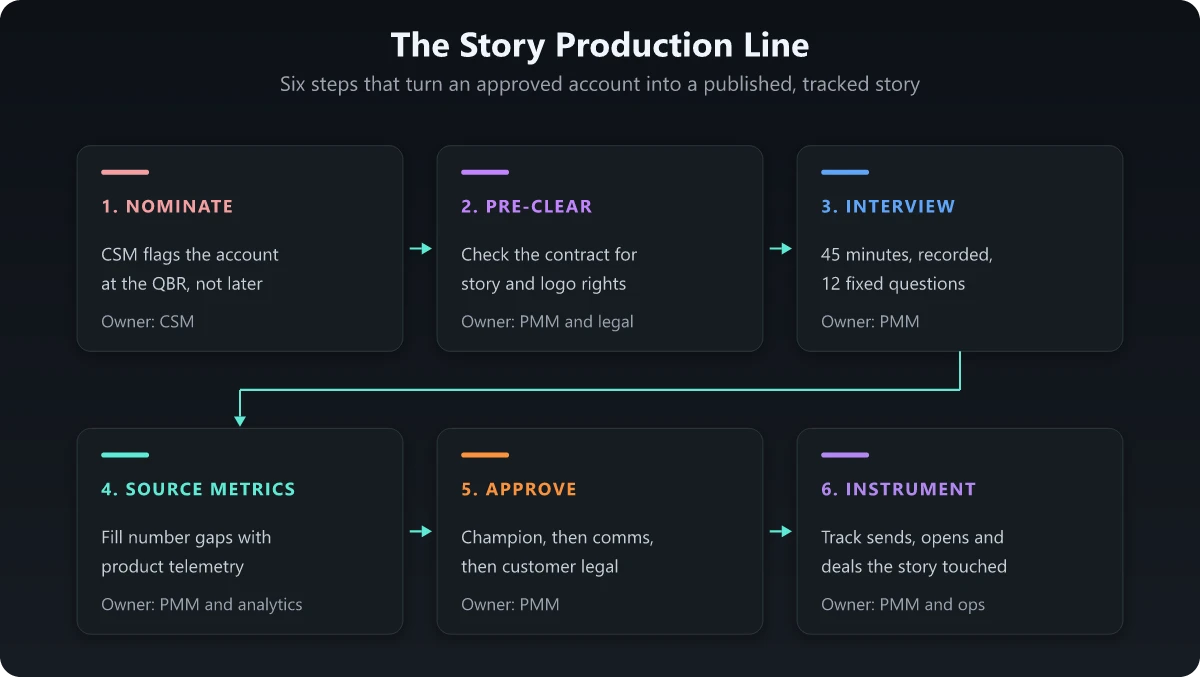
There are up to five approvers, and asking them in the wrong order is what turns a two-week story into a two-quarter story.
| Approver | What they are protecting | When to ask | Most common redline |
|---|---|---|---|
| Your champion | Their own internal credibility | At the QBR, before you draft anything | ”That quote makes me sound like I did not know what I was doing” |
| Customer comms or PR | Brand voice, timing, competitor optics | With the first full draft | Rewrites your headline into their corporate boilerplate |
| Customer legal | Contract terms, logo use, forward-looking claims | Only after comms is satisfied | Strikes absolute figures and anything predictive |
| Customer security or procurement | Disclosure of what you are deployed on | Regulated and enterprise buyers only | Blocks naming the environment, region or integration |
| Your own legal | Claims substantiation | Before publish, never after | Requires a traceable source for every number |
Three rules that shorten this materially:
- Pre-negotiate story rights at contract or renewal, not at draft time. A one-line reference clause in the MSA, or an explicit “yes in principle” logged at the QBR, converts a cold ask into a scheduling problem.
- Never send legal a draft that comms has not blessed. Legal edits are additive to comms edits, and doing them in parallel means you resolve the same sentence twice with two counterparties.
- Give every approver a deadline and a default. “If we do not hear back by the 14th we will publish the version attached with the revenue figure removed” moves reviews that silence never will.
Then plan for the failure modes: the champion leaves mid-review, comms sits on it through a quiet period, or the number is so good legal will not print it without a methodology note.
The anonymization ladder: what to publish when the logo is refused
When the logo is refused, most teams shelve the story. That is the wrong instinct, because logo recognition is not the only currency in a customer story. Specificity is.
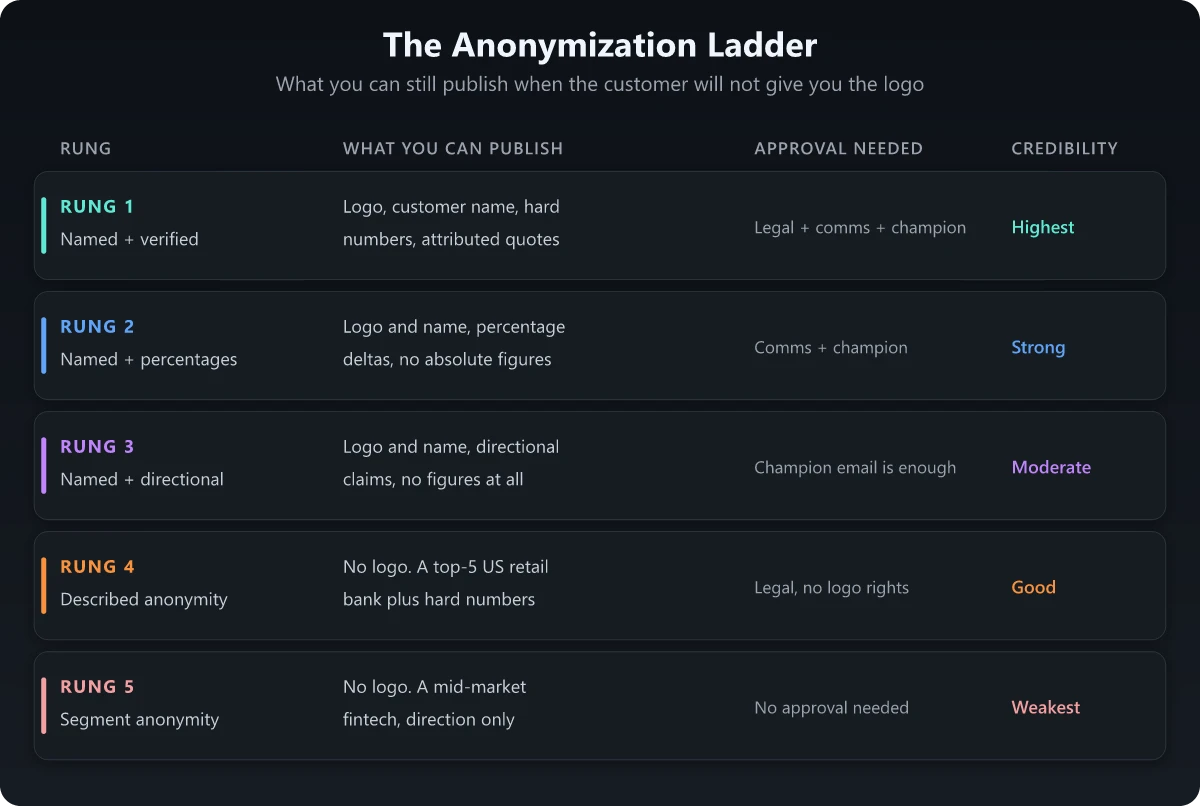
| Rung | What you can publish | Approval needed | Credibility |
|---|---|---|---|
| 1. Named plus verified | Logo, customer name, hard numbers, attributed quotes | Legal, comms and champion | Highest |
| 2. Named plus percentages | Logo and name, percentage deltas only, no absolute figures | Comms and champion | Strong |
| 3. Named plus directional | Logo and name, directional claims, no figures at all | Champion email is enough | Moderate |
| 4. Described anonymity | No logo. “A top-5 US retail bank” plus hard verified numbers | Legal, no logo rights needed | Good |
| 5. Segment anonymity | No logo. “A mid-market fintech” plus directional claims | None required | Weakest |
The non-obvious part is the ordering. Rung 4 beats rung 3. A specific, sourced number attached to a described company persuades a technical buyer more than a recognizable logo attached to “significantly improved efficiency”. If you have to choose between the name and the number, keep the number.
Rung 5 still earns its place: it is where most product pages should operate all the time, feeding a specific outcome into each messaging pillar rather than leaving pillars unproven.
Metric sourcing when the customer will not give you a number
This is the blocker that kills the most stories and the one almost no template accounts for. The customer is happy to be featured, and simply cannot or will not produce a figure.
Every row below is a legitimate substitute, not a workaround, provided you disclose what you did.
| Blocker you will actually hit | Legitimate substitute | What you must disclose |
|---|---|---|
| Customer will not share revenue impact | Seat expansion, contract value growth or renewal length from your own CRM | Label it as your data, not theirs |
| No before-baseline was ever captured | First 30 days of product telemetry as the baseline, measured against month six | State the baseline window in the story |
| Legal blocks absolute figures | Indexed or percentage deltas: 100 to 162, or plus 62% | Say that absolute figures were withheld |
| Customer has no analyst to pull the number | Your own product usage data, sent to the champion for written sign-off | Name the system the number came from |
| The impact is genuinely qualitative | Time to value, tickets deflected, steps removed from a named workflow | Do not dress a process win as a revenue win |
| The number is real but sounds implausible | Publish the conservative bound of the range | Show the calculation in a footnote |
The disclosure column is the whole point. “Measured in our platform across the customer’s first six months, verified by their operations lead” beats a bigger unattributed number, because it survives a prospect asking how you got it.
Cut one interview into four formats
Most guidance treats repurposing as a distribution list: LinkedIn, newsletter, video. That is channel work. The higher-leverage cut turns one 45-minute interview into four assets shaped for four different moments.
| Format | Length | Blocks used | Where it lives | Signal it is working |
|---|---|---|---|---|
| Web story page | 700-900 words | All seven | /customers/[slug] | Organic entrances and demo requests from the page |
| Sales one-pager | One page | Snapshot, trigger, results, quote | CRM and enablement hub | Attach rate on open opportunities |
| Battlecard proof point | 60 words | Results plus one quote | Competitive battlecard | Rep usage in the losing-to-X play |
| Deck slide | One slide | Headline, before-and-after table, logo | Standard pitch deck | Adoption of the current deck version |
The 60-word cut is the one most teams never make, and it is the highest-value output of the whole exercise. A rep in a competitive deal does not forward a 900-word page. They paste two sentences and a number into an email. Build that version deliberately and drop it straight into the relevant competitive battlecard rather than hoping someone extracts it later. The one-pager is the cut teams postpone because the layout is fiddly rather than because the content is missing, so build it in a one-page case study builder and attach the export to the CRM record the day approval lands. If the same interview also has to prove a point inside a white paper, cut a 50-word version from the web story page once the customer has approved it and follow Gordon Graham’s method for fitting a case study into a white paper: one sentence each for the problem, the solution and the result.
Make the story legible to AI assistants, not just skimmers
Buyer research now starts in a place where your page has to be machine-readable to survive. G2’s March 2026 research with 1,076 B2B software decision-makers found 51% now begin software research with an AI chatbot more often than with Google, up from 29% in April 2025, and that 85% think more highly of a vendor when an AI chatbot mentions them in a recommendation.
Two more numbers change how you should format the story. G2 found 45% of buyers say citations from software review sites are the most confidence-inspiring signal in an AI-generated response. And the TrustRadius 2026 B2B Buying Disconnect report, covering 1,862 technology buyers surveyed in January 2026, found 63% used AI during the purchase journey while 94% of those AI users fact-check its responses at least some of the time.
So the assistant surfaces you, and then the buyer goes looking for corroboration. Formatting rules that follow directly:
- Put the outcome, the customer descriptor and the number in one sentence in the first 40 words. That sentence is what gets extracted.
- Use a real HTML table for before-and-after figures. Tables extract cleanly; the same numbers inside a hero graphic do not extract at all.
- Never let a PDF hold the only copy of a number. If the story exists only as a gated PDF, it is invisible to the research step that now happens first.
- Keep the figures identical across your site, your review profiles and your sales deck. Given how many buyers fact-check, an inconsistency between your story page and your G2 profile costs you more than a weaker number would have.
- Give every story a stable URL with the customer or segment in the slug, and keep it there. Moved URLs lose the citation history that got you surfaced.
Did sales ever use it? The step nobody instruments
Most customer stories are published and never touched again. Closing that loop is the cheapest way to find out whether the last six stories were worth producing.
Four things to track, all available in a normal enablement stack:
- Time to first send. Days between publish and the first time a rep shares it with a prospect. If it exceeds 30, the launch failed, not the story.
- Rep coverage. Percentage of reps who have sent it at least once. A story used heavily by two reps is a story nobody found.
- Attach rate. Percentage of open opportunities in the matching segment where the story was shared. This is the number to report upward.
- Stage at send. If stories only go out late as objection-handling, your discovery decks are missing proof they should be carrying.
Then set a retirement rule: any story with zero sends in 90 days gets re-cut or pulled from the hub, and the champion re-verification date in the approval footer becomes the annual audit trigger. Wiring this into your existing sales enablement strategy means story production competes for budget on measured usage rather than volume shipped.
The customer success story template is the first 20%
If you came here for the asset, the copy-paste block above is a complete customer success story template and you can ship with it today. But the reason your last three stories stalled was not the structure of the document.
It was that nobody had pre-cleared permission at the QBR, nobody had a fallback when the customer would not release a number, nobody built the 60-word cut the reps would actually send, and nobody checked afterwards whether a single deal touched it.
With 94% of buyers ranking their shortlist before they will speak to you, the published story is doing work a first call used to do. The template makes that story easy to write. The production system around it - pre-negotiated rights, the anonymization ladder, metric substitution, the four-format cut and usage instrumentation - is what makes it exist at all.
Start with one account. Pre-clear it at the next QBR before you write a word.
Frequently Asked Questions
What should a customer success story template include?
Seven blocks: a headline carrying the outcome, a customer snapshot, the trigger event, what the customer tried first, what they actually did, results with a before number and a time window, and one attributed quote plus a next step. The trigger and the failed alternative are the two blocks most templates skip, and they are what make the story believable.
What questions should I ask in a customer story interview?
Twelve questions across five blocks: warm-up, trigger, rollout, results and close. The two that matter most are 'what specifically happened that made you start looking' and 'what went wrong or took longer than you expected'. The second one produces the detail that makes the rest of the story credible.
Can I publish a customer success story without naming the customer?
Yes. Descriptive anonymity such as 'a top-5 US retail bank' paired with hard verified numbers is more persuasive than a named logo attached to a vague directional claim. You trade logo recognition for specificity, so keep the numbers if you have to lose the name.
How long should a customer success story be?
The web version runs 700 to 900 words. Anything longer is being read by nobody, and anything shorter cannot carry a trigger, a failed alternative and a sourced result. Cut the same interview down to a one-page PDF, a single slide and a 60-word battlecard proof point.
What is the difference between a customer success story and a B2B SaaS case study?
Nothing structural. A B2B SaaS case study template and a customer success story template use the same seven blocks. The label usually signals the owner: case studies tend to sit with demand gen and lead with the metric, customer stories tend to sit with product marketing or customer success and lead with the customer's situation.