Land and Expand Strategy: What to Withhold and Why
Land and expand is a packaging decision, not a sales tactic. What to withhold from the entry tier, which usage signal fires the expansion play, and who owns it.
“We landed that account nine months ago. Why has it not expanded?”
The question usually arrives in a quarterly business review, pointed at sales, and the honest answer is almost never about sales. Land and expand had already failed by the time that contract was signed. Somebody packaged an entry tier that did everything the buyer needed, discounted it to close the quarter, and handed the expansion team an account it had no way to grow.
Search results for land and expand describe a sales sequence: sell small, prove value, upsell later. Run that way it produces a book of accounts that renew at the number they were sold for. The decisions that determine whether an account can expand at all are packaging and positioning decisions made before a rep opens the opportunity - what the entry tier deliberately does not include, which usage signal you instrument as the expansion trigger, and who owns the motion when expansion sits outside everyone’s quota.
A land and expand strategy is working when four things are true before the first contract is signed:
- The entry tier is capped on the value metric, so growth in customer usage produces a bill increase instead of a free ride
- There is a named second job the same buyer will hit within 6 to 12 months that the entry tier does not do
- The behaviour that says “they have hit it” is instrumented, has a threshold, and lands in a named person’s queue
- One team carries a net revenue retention number and has the authority to change packaging when the data says the boundary is wrong
Expansion revenue is one of the engines in any SaaS growth strategy, and it is the engine most often assigned to nobody in particular.
What Is Land and Expand?
Land and expand is a go-to-market model where the first sale is intentionally small - one team, one use case, one product - and the majority of account revenue arrives later through usage growth, seat growth and cross-sell into adjacent products. The entry contract is priced and packaged to clear approval quickly. The account plan assumes several expansion events after it.
Datadog states the model in its own filings. From its Form 10-Q for the quarter ended June 30, 2026: “We employ a land-and-expand business model centered around offering products that are easy to adopt and have a very short time to value” (Datadog Form 10-Q).
Both commitments buried in that sentence are packaging decisions rather than sales behaviours. Easy to adopt means the entry product has to produce a result without a services engagement attached. Short time to value means the buyer gets that result well before the first renewal conversation.
How Public Companies Measure Land and Expand
Most public companies running this model publish a retention figure, and no two of them mean the same thing.
| Company | Metric name used in filings | Latest published figure | As of |
|---|---|---|---|
| Datadog | Dollar-based net retention rate | In the low-120%‘s | June 30, 2026 |
| Figma | Net dollar retention rate | 136% | June 30, 2026 |
| Snowflake | Net revenue retention rate | 126% | April 30, 2026 |
| Twilio | Dollar-based net expansion rate | 116% | Q2 2026 |
The definitions diverge in which customers get counted at all. Figma calculates net dollar retention using only paid customers above $10,000 in ARR, and says why in the filing: “we believe that $10,000 in ARR is an important threshold, as it is a strong indicator of significant paid usage of our products” (Figma Form 10-Q). Twilio sets its bar at accounts with at least $5 of revenue in the last month of the quarter, and the same filing reports a dollar-based net expansion rate of 116% for Q2 2026 against 108% a year earlier (Twilio Q2 2026 results). Datadog’s version excludes ARR from new customers entirely, so its figure measures only what happened inside the existing base.
Twilio states the incomparability in its own disclosure: the metric “is not based on any standardized industry methodology and is not necessarily calculated in the same manner” as other companies use. Copying a competitor’s headline retention number into a board deck compares two different populations.
Snowflake reported a net revenue retention rate of 126% alongside 779 customers with trailing 12-month product revenue above $1 million, up 29% year over year (Snowflake Q1 fiscal 2027 results). Private companies sit a long way below that. SaaS Capital’s survey of more than 1,000 private B2B SaaS companies, published on April 24, 2026, put the median net revenue retention for bootstrapped companies between $3M and $20M in ARR at 103%, with the 90th percentile at 117.9% (SaaS Capital benchmarking metrics).
Those two figures are built differently. Snowflake’s is trailing two-year product revenue from customers under capacity contracts. SaaS Capital’s is self-reported annual retention across a mixed population of private companies a fraction of the size. Read the distance as a directional contrast, and set your own target against companies with your pricing structure and your customer count.
Why the Land and Expand Sales Strategy Stalls
The sales-strategy version reads: sell a pilot, deliver value, come back for more. Each clause depends on a packaging decision made by someone who was not in the deal.
A pilot has to exist as a real SKU with a scope and a price. Where the only thing on the price list is the platform, the rep discounts the platform and calls it a pilot, and that discount becomes the reference price for every renewal and expansion after it.
Value has to arrive without the modules you held back, or the pilot fails on its own terms and nobody gets an expansion conversation.
Then there has to be a more. An entry tier that already covers the buyer’s next two jobs turns the expansion call into a request that a satisfied customer pay extra for capability they already have.
Compensation compounds it. Check your own plan: if $60,000 of expansion ARR pays a rep considerably less than $60,000 of new ARR, expansion becomes the last call of every day. That is a comp design decision, and no amount of enablement content overrides it.
Failure Mode One: The Entry Tier With Nothing Left to Buy
The most expensive mistake in this model is landing too well. The pilot works, the customer is happy, the champion becomes a reference, and the account renews flat forever, because the package they bought does everything they need.
Look at what Atlassian withholds from the Jira free plan. The free plan already carries “Unlimited goals, projects, tasks, and forms”, the backlog, list, board, timeline, calendar and summary views, plus reports and dashboards. Standard does gate real capability behind it, including user roles and permissions, external collaboration and the Rovo AI features. The constraint a growing team hits first is the value metric and the operating envelope around it: up to 10 users, 100 automation rule runs per month, 2 GB of storage, and support from the Atlassian Community (Jira pricing). Standard, at $7.91 per user per month, lifts those to 100,000 users per site, 1,700 automation rule runs, 250 GB of storage and 9/5 regional support.
Slack uses a different axis. Its free plan keeps 90 days of message history, up to ten apps, and huddles limited to 1:1 (Slack pricing). Each of those caps gets more painful the longer and wider the product is used, which is the design. The constraint tightens exactly as the customer succeeds.
The Four Axes You Can Withhold On
| Axis | What the entry tier caps | Why it creates expansion | Live example |
|---|---|---|---|
| Volume of the value metric | Seats, workspaces, monitored hosts, events, storage | Success raises usage and usage raises the bill | Jira free stops at 10 users |
| The adjacent job | The second workflow the same buyer will need | The customer expands into a new job rather than more of the same | Slack free allows only 1:1 huddles |
| Governance and scale | SSO, audit logs, data residency, admin roles, uptime SLA | The buying committee grows to include IT and security | Jira Standard adds user roles and multi-region data residency |
| Time depth | History windows, retention, historical reporting | The cap hurts more the longer they stay | Slack free retains 90 days of message history |
The one thing that never goes on the withhold list is time to first value. If the entry tier cannot produce a result the buyer can show a manager inside the first month, there is no expansion path to design, only a churned pilot and a bad reference. Cap volume, adjacency, governance and depth as hard as the market allows, and leave the first win alone.
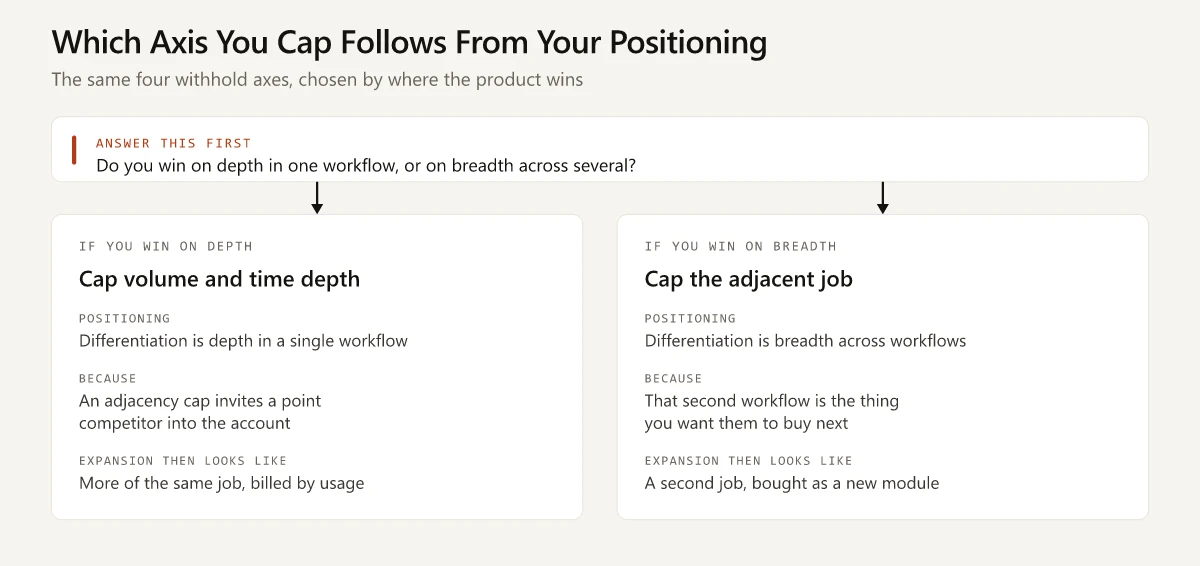
Which axis to use is a positioning question before it is a pricing one. If your differentiation is depth in a single workflow, cap volume and time depth, because an adjacency cap invites a point competitor into the account. If your differentiation is breadth across workflows, cap the adjacent job, because that is the thing you want them to buy next. The tier-boundary arithmetic that follows from either choice is worked through in the good better best pricing guide.
The Test to Run on Your Own Entry Tier
This takes an afternoon:
- Write down, in one sentence, the job your entry tier does.
- Write down the next job the same buyer hits within 12 months.
- Open your public pricing page and check whether the entry tier already does job two.
- If it does, you have a packaging problem, and the fix is a tier boundary rather than a sales play.
Expect step 3 to be the one that fails, because entry tiers accumulate. Every quarter a rep loses a deal on a missing capability, the capability gets added to the tier that lost it, and three years later the entry tier is the platform at a third of the price.
Failure Mode Two: The Expansion Trigger Nobody Instrumented
The second failure survives good packaging. There is a real next tier, the boundary is well drawn, and nothing ever fires. The expansion path exists on a slide and nowhere in the telemetry.
Atlassian’s Q4 FY26 shareholder letter shows the instrumented version: “Customers that adopt Rovo are completing 20% more Jira work items and creating/editing 25% more Confluence pages versus non-adopters”, and “Rovo adopters continue to grow their ARR more than 2x faster than non-adopters” (Atlassian Q4 FY26 letter to shareholders). The same letter reports that its $3M+ ARR customers grew more than 50% year over year and its $5M+ ARR customers grew more than 70%.
Publishing the second of those sentences requires joining product adoption data to ARR movement at the account level. A company that cannot write that sentence about its own product also cannot fire an expansion play at the right moment, because it has no way to know when the moment arrived.
Datadog publishes the same idea as a distribution across product counts. As of June 30, 2026, approximately 85% of its customers used two or more products, 58% used four or more, 37% used six or more, 22% used eight or more, and 13% used ten or more, each of those up from a year earlier (Datadog Form 10-Q). Its $100,000+ ARR customer count reached about 4,720, up 23% from about 3,850 (Datadog Q2 2026 results). Each of those bands is a countable population, so each one carries a specific expansion play attached to a specific list of accounts.
What an Expansion Trigger Needs to Fire
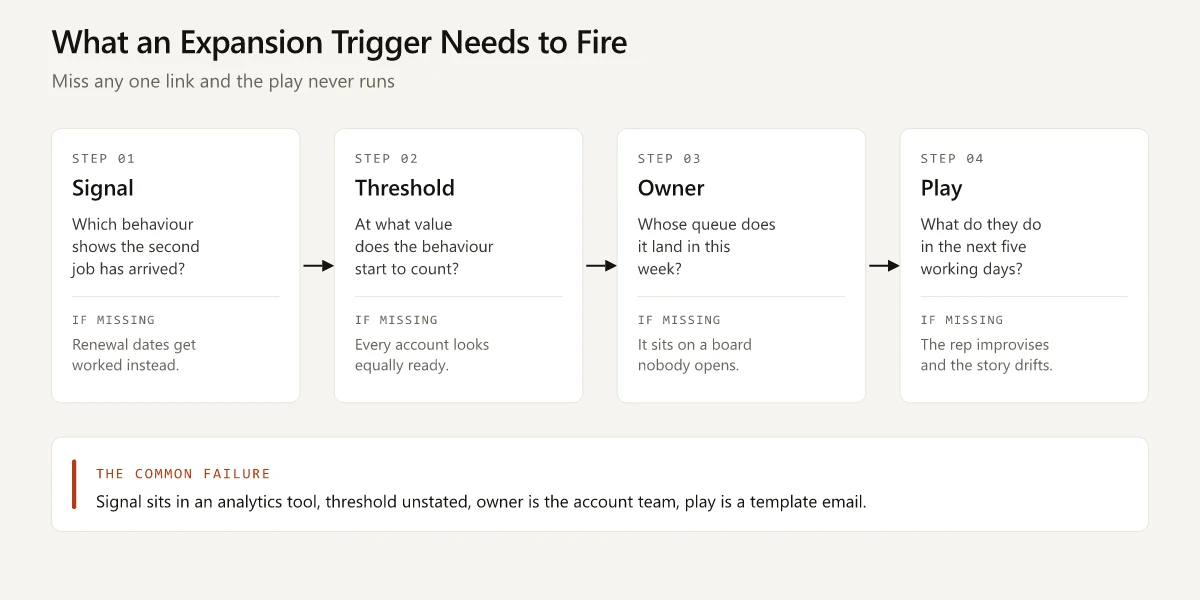
The four parts have to be written down together, one row per signal, with the threshold as a number and the owner as a named person. A trigger map that leaves the owner column at team level has three parts, not four, and the first message never gets sent by anyone.
Signals Worth Instrumenting First
| Signal | Threshold shape | What it points at |
|---|---|---|
| Active seats against licensed seats | Above 85% of purchased seats active in 30 days | Seat expansion ahead of the renewal date |
| A second department appearing in the user list | Users from a second business unit or email pattern | Cross-team land inside the same logo |
| Value metric approaching the tier ceiling | 70% of included volume consumed by mid-quarter | Tier upgrade before overage becomes a support ticket |
| Support tickets requesting a higher-tier capability | Two tickets from the same account in a quarter | Governance or scale upgrade |
| An IT or security reviewer added to the workspace | Any occurrence | Enterprise tier conversation, longer cycle |
| Usage flat after a sustained growth run | 60 flat days following three growing months | Contraction risk, which needs a different play |
The threshold values in that middle column are starting points to calibrate against your own usage curve, not published benchmarks.
That last row matters as much as the five above it. The same instrumentation that catches expansion catches contraction, and the two move on separate levers: SaaS Capital puts median gross revenue retention at 91% against 100% at the 90th percentile (SaaS Capital benchmarking metrics), and no upsell play closes that nine-point gap, because gross revenue retention excludes expansion by definition.
Pick two signals to start. A trigger system with six inputs and no owner produces less revenue than one signal a named person acts on every Monday.
How to Design the Land So There Is Room to Expand
Take these in order. Reversing the order is how teams end up with three arbitrary bundles.
- Pick the value metric before anything else. One unit that grows as the customer gets more value: seats, monitored hosts, tracked contacts, API calls, gigabytes ingested. Consumption metrics expand without a purchase order; seat metrics need a human to authorise every step. The trade-offs between per-seat, usage-based and tiered structures are covered in the B2B SaaS pricing models breakdown.
- Name the second job explicitly, as the actual next problem the same buyer owns. For Jira that job is coordinating work across several teams, which is why cross-team planning and cross-project dependency management sit in Premium at $14.54 per user per month rather than in Standard. If nobody on your team can name the second job in a sentence, the trigger work above has nothing to fire on.
- Draw the boundary where the pain starts rather than where the feature list ends. A tier boundary works when crossing it is triggered by the customer succeeding. Ten users is a boundary a growing team crosses on its own. An arbitrary feature fence is a boundary the customer negotiates around or resents.
- Price the step so upgrading is a smaller decision than switching. At the boundary the buyer compares your next tier against a competitor’s entry tier plus the cost of migrating to it, rather than against the tier they are already on. If the step is large enough that migration looks cheap, you drew the boundary at the point where the account leaves.
Then write the boundaries down with reasons. A tier boundary rationale document, one line per capability explaining which tier it sits in and why, is the artefact that stops the entry tier accumulating capability every time a deal is lost.
Who Owns the Land and Expand Motion
Expansion falls between functions by default. Sales carries new logo quota, customer success carries renewal and churn, product carries the roadmap, and the space in between belongs to nobody.
| Function | What it can move | What it cannot do | The right assignment |
|---|---|---|---|
| Account executive | Timing, commercial terms, multi-year structure | Change what the tiers contain | Runs the play on triggered accounts |
| Customer success | Adoption depth, health, executive relationships | Carry a revenue target without a comp change | Surfaces the signal, closes small expansions or hands off |
| Product marketing | Tier boundaries, upgrade narrative, trigger-to-play map, enablement | Close the deal | Owns the design of the motion end to end |
| Growth or PLG | In-product upgrade prompts, self-serve checkout | Reach committee-approved enterprise tiers | Owns the automated portion of the ladder |
Product marketing’s deliverables for expansion are narrower and more concrete than a general enablement brief:
- The tier boundary rationale document, with the second job named per tier
- An upgrade narrative written about the customer’s next problem rather than your next feature
- A trigger-to-play map: signal, threshold, owner, first message, in one table
- Expansion battlecards against the two real alternatives, which are staying on the current tier and building it internally
- Migration and price-change communications for customers already sitting on legacy packaging
Which accounts get worked first is a scoring problem, and it is the same scoring problem as target selection in account-based marketing prioritisation. Score the installed base on fit, signal strength and reachable budget, the same way you would score a prospect list.
Where this sits against adjacent functions is an argument worth settling in writing. The practical split I would defend: expansion demand generation into the installed base belongs to customer marketing, and the packaging and narrative that make expansion possible belong to product marketing. The boundary between the two roles is worked through in customer marketing versus product marketing.
The Metrics That Show the Packaging Works
Net revenue retention is the headline, and on its own it hides more than it shows.
| Metric | What it tells you | The decision it drives |
|---|---|---|
| Net revenue retention | Whether the base grows without new logos | Whether to fund expansion or acquisition next |
| Gross revenue retention | Whether the product holds without expansion masking churn | Whether the entry tier delivers its promised job |
| Expansion ARR as a share of new ARR | How much of growth comes from the installed base | Where the next headcount goes |
| Median days from close to first expansion | Whether the boundary is reachable in a normal usage curve | Whether the entry tier is sized correctly |
| Share of customers on two or more products | Whether cross-sell packaging works at all | Which adjacent product to prioritise |
| Revenue mix by tier | Whether the middle tier is doing its job | Whether to restructure the ladder |
Read the headline number with these distortions in mind:
- A price increase inflates net revenue retention without a single customer expanding usage, so track the metric with and without price effects.
- A minimum-size threshold changes which customers are in the calculation at all, which is why Figma’s 136% is computed over paid customers above $10,000 in ARR rather than across its whole paid base.
- A small denominator makes early-stage retention swing violently, so a company with 40 customers should read the trend rather than the level.
Gross revenue retention deserves a place next to the headline for a specific reason. Strong expansion inside a shrinking base produces a healthy-looking net figure while the product loses footprint underneath it. Watching the pair together is the only way to tell whether the entry tier is delivering the job it promised.
Is Land and Expand Better Than Selling the Full Platform Up Front?
It depends on whether your buyer can approve the full platform inside one budget cycle. Where they cannot, land and expand converts one large approval problem into a small one plus a series of easier ones, at the cost of a longer path to full account value.
| Dimension | Land and expand | Full platform up front |
|---|---|---|
| First deal cycle | Shorter, often single-threaded | Longer, committee and procurement |
| Discount pressure | Lower on the first deal, higher at each step | Concentrated in one negotiation |
| Time to full account value | Deferred, arriving across several expansion events | Immediate on signature |
| Failure mode | Account renews flat, nothing left to sell into | Deal never closes, or closes and never deploys |
| Best fit | Self-serve entry, consumption metric, team-level buyer | Consolidation deals, displacement of an incumbent suite |
The two are not exclusive in practice. A platform company can run the entry-tier motion for the mid-market and a full-suite motion against a named enterprise list, with different packaging, different comp and different content for each. The mistake is running one packaging structure and expecting both motions to work off it.
When a Land and Expand Strategy Is the Wrong Choice
The model has real preconditions. It fails predictably here:
- A hard buyer ceiling. If the product is used by one person per company, there is no seat expansion and no second team. Growth has to come from adjacent products or not at all.
- One-time or project purchases. Implementation, migration and audit-shaped work does not recur, so the expansion motion is really a new-logo motion with a warm introduction.
- Value only at full deployment. A data platform that needs every source connected before it produces an answer cannot land small honestly. A small land produces a failed pilot and a reference you cannot use.
- Annual vendor consolidation. If procurement processes purchase orders once a year and refuses mid-term additions, expansion events pile up against a single date and the trigger system stops mattering.
- A competitor who lands the whole account. Where switching costs are high and an incumbent takes the full footprint first, the small land arrives after the door has closed.
In each of those, the honest answer is to price and package for a single larger commitment, then put the effort into shortening the evaluation instead of shortening the first contract.
Land and expand is not a phase that follows the sale. It is a set of constraints designed into the entry tier months earlier and wired to a signal somebody watches. Open your own pricing page and name the exact line where the entry tier stops. That line is your expansion plan.
Frequently Asked Questions
What is a land and expand strategy?
A land and expand strategy sells a deliberately small first contract to one team or one use case, then grows account revenue through usage, seats and cross-sell. The entry package is designed to be easy to approve and easy to outgrow, so most of the account's lifetime revenue arrives after the first signature rather than in it.
How is a land and expand sales strategy different from upselling?
Upselling is a conversation you have with an account you already sold. A land and expand sales strategy is a packaging decision made before the first deal, setting what the entry tier caps and which behaviour signals the customer is ready for the next tier. Without those two decisions the upsell has nothing to sell into.
What is a good net revenue retention rate for land and expand?
It depends on segment and on how the number is defined. SaaS Capital's April 2026 survey of more than 1,000 private B2B SaaS companies put the median net revenue retention for bootstrapped companies between $3M and $20M ARR at 103%, with the 90th percentile at 117.9%. Public companies publish higher figures, and each of them defines its own cohort: Figma counts only paid customers above $10,000 in ARR, Twilio counts any account with $5 of revenue in the quarter's last month, and Datadog counts every customer it had 12 months earlier. Those figures are not comparable to each other, or to a private-company median.
Who owns expansion revenue in a SaaS company?
Usually nobody, which is the problem. Sales owns new logos, customer success owns renewal and churn, and expansion falls between them. The workable split is that one revenue team carries a net revenue retention number and product marketing owns the packaging boundaries, the upgrade narrative and the trigger-to-play map that team runs.
When does land and expand not work?
When the product has a hard ceiling of one buyer per company, when the purchase is a one-time project rather than a subscription, when value only appears after full deployment, or when procurement consolidates vendors once a year and will not process a second purchase order mid-term.