Customer Marketing vs Product Marketing: Who Owns What
Customer marketing vs product marketing settled at the deliverable level: a 12-artifact ownership matrix with default owners, co-owners and handoff triggers.

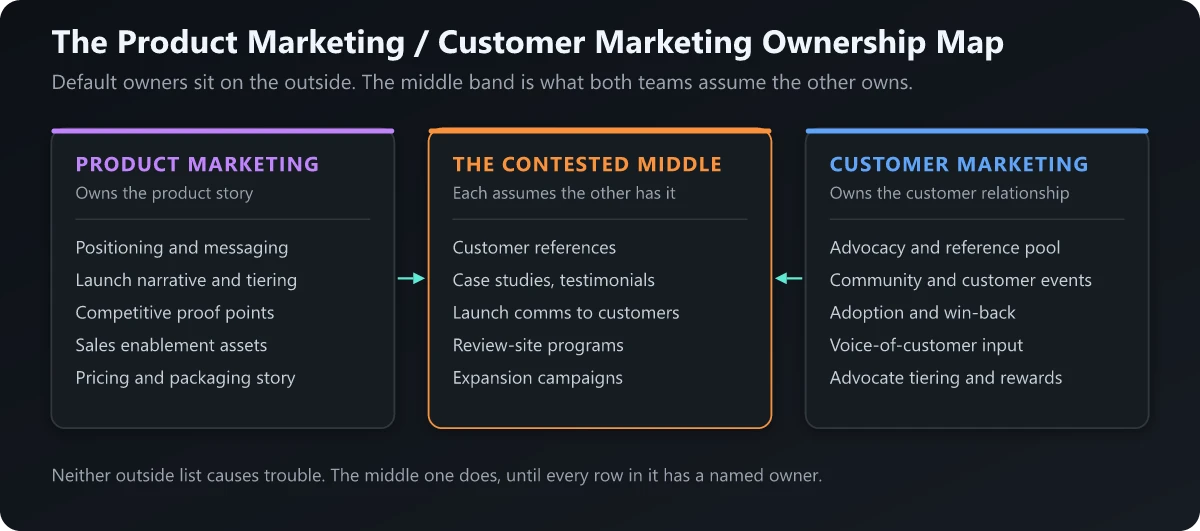
A launch ships. The press release goes out, paid campaigns light up, sales gets a battlecard, and the several thousand companies already paying for the product find out about the new tier from a competitor’s newsletter. Two weeks later the reference program stalls, because the one customer who agreed to be quoted was never chased through legal. Nobody dropped anything. Two teams each assumed the other was holding it. That is what customer marketing vs product marketing looks like when the line between them was never drawn.
Is customer marketing part of product marketing? No. Customer marketing is a separate function that markets to people who have already bought. Product marketing takes the product to the market. They share tools, a database and often a floor, and in a small team the same person does both, which is why the question keeps getting asked. But they answer to different audiences, different triggers and different numbers.
Definitions are not the problem here, and treating them as the problem is why the boundary never gets drawn. The standard advice on customer marketing vs product marketing defines both functions, lists their tactics, recites their metrics, and stops. None of it says who owns the customer reference program on a Tuesday when a launch needs an approved quote by Friday. That gap is measurable. In Customer Marketing Alliance’s State of Customer Marketing Report, customer marketers rated how well other teams understand their role at an average of 5.3, and only 47.6% rated it 6 or above. So this guide divides the work instead of defining it: five axes that actually differ, then a twelve-row matrix assigning every artifact both teams fight over or quietly drop.
Customer Marketing vs Product Marketing: The Five Axes That Actually Differ
Ignore the tactic lists. The two functions separate cleanly on five things, and if you can answer these five for a piece of work you already know who owns it.
| Axis | Product marketing | Customer marketing |
|---|---|---|
| Audience | The market: prospects, analysts, press, sales | The installed base: current customers and their end users |
| What triggers the work | The roadmap: a launch, a pricing change, a competitor move | The customer: a renewal date, a usage drop, an upgrade signal |
| The deliverable | Positioning, launch narrative, battlecards, enablement | Advocacy programs, adoption campaigns, references, community |
| Metric it rolls up to | Pipeline influenced, win rate, launch adoption | Net revenue retention, expansion ARR, advocate supply |
| Cadence | Release-driven and bursty | Always-on and lifecycle-driven |
The trigger row does the most work. Product marketing reacts to the roadmap; customer marketing reacts to the customer. When a piece of work has two triggers, a launch date and a renewal date, you have found a contested artifact and it needs an owner written down.
The metric row explains why the argument is worth having. Benchmarkit’s 2025 B2B SaaS Performance Metrics benchmarks put median expansion ARR at 40% of total new ARR, rising to over 50% at companies above $50M. Close to half of new revenue now comes from customers you already have, which is exactly the audience with no clear marketing owner in most orgs.
What Is Customer Marketing?
Customer marketing is the practice of marketing to your existing customer base rather than to net-new prospects. Product Marketing Alliance’s guide to customer marketing frames it as promoting your products or services to existing customers with the goal of loyalty, repeat purchase and word of mouth. In practice it resolves into four program families:
- Adoption and expansion. Getting customers onto more of what they bought, then onto more products. Usage-triggered campaigns, upgrade nudges, in-product prompts.
- Advocacy and references. Building a supply of customers willing to be quoted, filmed, called by a prospect, or listed as a logo.
- Community and events. Peer-to-peer surface area. Atlassian Community and Salesforce’s Trailblazer Community are two long-running public examples.
- Retention and win-back. Renewal support, at-risk campaigns, and structured attempts to bring back churned accounts.
Advocacy is where the function is most visible and most under-resourced. In the same Customer Marketing Alliance survey, 62.2% of participants had a customer advocacy program, but advocates made up less than 5% to 10% of the customer base. The reference pool is small, slow to build and easy to burn, which is precisely why fighting over who owns it matters.
Customer marketing sits downstream of product marketing in the sense that it markets a product someone else positioned. It is not a subset of it.
What a Customer Marketing Manager Actually Owns
A customer marketing manager’s job description varies more than a PMM’s, because the role gets built around whatever the company is currently bad at. Strip that away and the customer marketing responsibilities that recur are these.
| Responsibility | What it looks like in a week |
|---|---|
| Reference pool management | Keeping a live list of who can be called, for what, and when consent expires |
| Case study pipeline | Sourcing, interviewing, writing, chasing approval, republishing |
| Review-site programs | Campaigns to generate reviews on G2, TrustRadius and Gartner Peer Insights |
| Adoption campaigns | Segmented sends and in-product messages tied to usage thresholds |
| Expansion campaigns | Cross-sell and upsell plays to accounts crossing an entitlement limit |
| Community management | Moderation, programming, contributor recognition |
| Advocacy tiering | Ranking advocates by what they have done and what they will do next |
| Customer events | User groups, roadshows, the customer track at the annual conference |
| Voice of the customer input | Feeding verbatims back into product and marketing |
Two things are worth noticing. First, roughly half of that list produces assets product marketing consumes. Second, none of it produces the positioning those assets sit inside. That asymmetry is the whole boundary problem in one sentence.
Case studies deserve their own note, because they are the single most contested artifact on the list. Content Marketing Institute’s 2025 B2B content marketing benchmarks found 43% of B2B marketers naming aligning content across sales and marketing as a challenge, and 40% naming communicating across organizational silos. Those are the exact two conditions a case study gets produced under. An artifact this widely used and this ambiguously owned is a predictable point of failure. For the mechanics rather than the ownership argument, the customer success story template covers the interview script and the approval chase. Ownership arguments get shorter when the artifact is already half-built, so hand both teams the same fill-in-the-blanks case study one-pager and the only thing left to negotiate is the claim it has to prove. To settle that claim, agree which buyer question the next story has to answer, since a situation-led case study and a metric-led one do different jobs in a deal: the first lets a prospect recognize their own company, and the second gives a champion a number to paste into a business case.
Customer Marketing Strategy: The Three Programs That Have to Exist
A customer marketing strategy is not a channel plan. At minimum it commits to three standing programs with named owners and a refresh cadence.
- A reference supply program. A target number of net-new referenceable accounts per quarter, sourced from a defined trigger such as a completed onboarding milestone or a high NPS response.
- An adoption program tied to a product metric. Not “customer newsletter” but “move accounts using feature X from 30% to 45%”, which is where customer enablement content and lifecycle sends do the actual work.
- An expansion program tied to an entitlement signal. Seat limits, usage caps, contract anniversaries. Anything else is a broadcast.
Everything else - community, events, awards programs, advocate tiering - is a multiplier on those three. Start them in that order.
Customer Marketing vs Lifecycle Marketing
These two overlap enough that some companies just pick a title and move on. The useful distinction: lifecycle marketing is defined by stages and owns the full journey including pre-purchase, while customer marketing is defined by audience and starts at the point of sale. Lifecycle owns the mechanism, customer marketing owns the constituency, and at small headcount they are the same three people.
If you need the stage framework itself, lifecycle marketing covers it end to end and I am not going to restate it here. What matters for this article is that lifecycle marketing is a delivery system, not an owner. Deciding that “lifecycle owns it” does not tell you who writes the story angle.
The Contested Deliverables Ownership Matrix
This is the part that almost always gets skipped. Twelve artifacts both functions routinely claim or both quietly drop, each with a default owner, a co-owner, the event that triggers the handoff, and the metric it rolls up to.
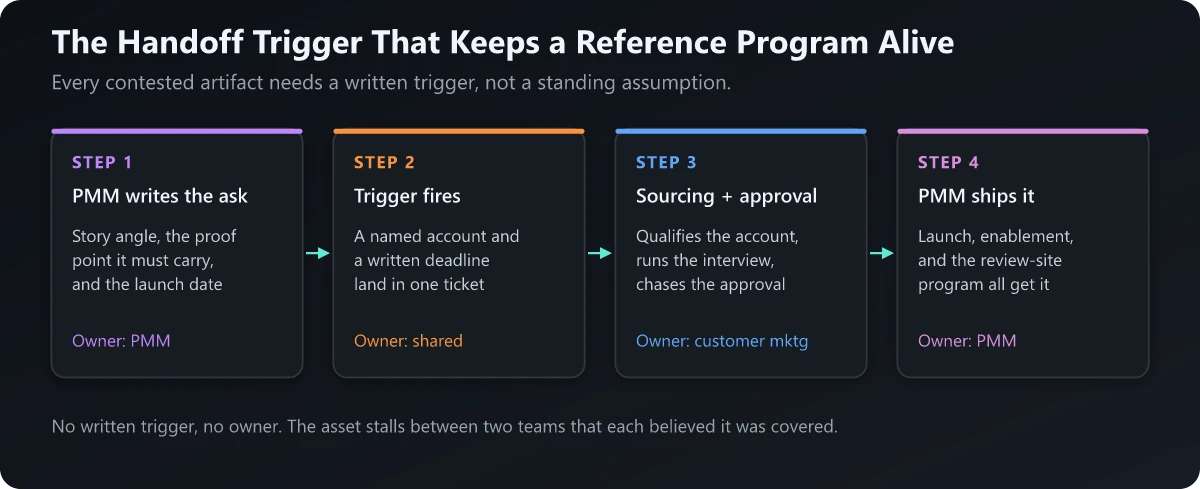
The default owner is accountable for the artifact existing. The co-owner is accountable for one specific input the default owner cannot produce alone. The handoff trigger is the written event that moves work from one to the other. A row with no trigger will fail.
| Artifact | Default owner | Co-owner | Handoff trigger | Rolls up to |
|---|---|---|---|---|
| Customer reference calls | Customer marketing | Product marketing | Sales requests a reference at a named deal stage | Win rate on referenced deals |
| Case studies and customer stories | Customer marketing | Product marketing | PMM files a story angle and the proof point it must carry | Pipeline influenced by story assets |
| Testimonials and pull quotes | Customer marketing | Brand and content | A page or campaign brief names the claim needing proof | Landing page conversion rate |
| Review-site programs | Customer marketing | Demand gen | Category report deadline, or a competitor overtakes you on grid position | Review volume and category rank |
| Customer advisory board | Product marketing | Customer marketing | A roadmap or positioning decision needs validation from named accounts | Roadmap confidence, CAB account retention |
| Launch comms to existing customers | Product marketing | Customer marketing | Launch tier is set and the release date is locked | Feature adoption in the installed base |
| Release notes and changelog | Product and product marketing | Customer marketing | Any customer-visible change ships | Adoption rate of shipped features |
| Expansion and upsell campaigns | Customer marketing | Product marketing | An account crosses a usage or entitlement threshold | Expansion ARR |
| Win-back campaigns | Customer marketing | Demand gen | Churn date passes plus a fixed cooling-off window | Reactivated ARR |
| Community | Customer marketing | Product and support | Sustained peer question volume the docs do not answer | Active contributors, deflected tickets |
| Pricing and packaging change comms | Product marketing | Customer marketing | Pricing decision approved and effective date set | Churn during the change window |
| Advocacy tiering and rewards | Customer marketing | Product marketing | An advocate completes a second act: review, reference or story | Advocate supply per quarter |
Copy the version below into your team charter and change the owner column to match your org. I would defend every default in it, but my defaults matter far less than the fact that each row has one.
ARTIFACT                           | DEFAULT OWNER    | CO-OWNER          | HANDOFF TRIGGER
Customer reference calls           | Customer mktg    | Product mktg      | Sales requests a reference at a named deal stage
Case studies / customer stories    | Customer mktg    | Product mktg      | PMM files a story angle + required proof point
Testimonials and pull quotes       | Customer mktg    | Brand / content   | Page or campaign brief names the claim to prove
Review-site programs               | Customer mktg    | Demand gen        | Category report deadline or grid position slip
Customer advisory board            | Product mktg     | Customer mktg     | Roadmap or positioning decision needs validation
Launch comms to existing customers | Product mktg     | Customer mktg     | Launch tier set + release date locked
Release notes and changelog        | Product + PMM    | Customer mktg     | Any customer-visible change ships
Expansion and upsell campaigns     | Customer mktg    | Product mktg      | Account crosses usage or entitlement threshold
Win-back campaigns                 | Customer mktg    | Demand gen        | Churn date + fixed cooling-off window
Community                          | Customer mktg    | Product + support | Sustained peer question volume docs do not answer
Pricing / packaging change comms   | Product mktg     | Customer mktg     | Pricing approved + effective date set
Advocacy tiering and rewards       | Customer mktg    | Product mktg      | Advocate completes a second act
Who Owns Customer References?
Customer references are the row that breaks most often, so it is worth splitting into its two halves.
Customer marketing owns the supply. Who is referenceable, for which product, in which vertical, with consent that has not expired. That is a pool to be maintained, not a request to be answered.
Product marketing owns the ask. Which story, carrying which proof point, by which date. A reference request without a written angle is a research project handed to someone who already has one.
The failure is almost never refusal. It is that the ask stays verbal, so nobody logs a deadline and the approval chase never starts. Buyers notice. TrustRadius surveyed 1,862 technology buyers and 444 technology vendors for its 2026 B2B Buying Disconnect report and found 74% of buyers use reviews to inform their purchase decisions. Third-party proof is already embedded in how buyers decide. What the survey cannot tell you is who inside the vendor is accountable for producing that proof, which is the gap the matrix above is built to close.
Two Ways an Undrawn Boundary Actually Breaks
Both failures below are what customer marketing vs product marketing looks like when the matrix above was never filled in. Neither one is a capability problem, and neither gets fixed by moving a box on the org chart.
1. The reference program that dies in the middle
The failure has a recognizable shape, and both teams are doing exactly what they believe their job to be. Product marketing assumes customer marketing owns sourcing, so it asks in Slack and waits. Customer marketing assumes product marketing owns the story angle, so it waits for a brief that never arrives. The customer, meanwhile, said yes in week one and hears nothing for a month.
By the time anyone notices, the champion has changed jobs, the logo permission has lapsed, or legal wants the whole thing re-reviewed. The program was not rejected. It expired.
Two figures already cited in this article make that outcome likely rather than unlucky. The 5.3 average that customer marketers give other teams’ understanding of their role means the assumption about who sources a reference is being made against a function most colleagues cannot accurately describe. And because advocates make up under 5% to 10% of the customer base, the pool is too thin to absorb a lapsed approval. Every reference that expires is subtracted from a supply that was already small.
The fix is the trigger. Redrawing the org chart does nothing here, because both boxes were already correct. One written artifact - angle, proof point, named account, date - moving from PMM to customer marketing turns an assumption into a ticket with a clock on it.
2. The launch that ships to prospects but not to customers
Launch plans get built for acquisition, because that is what launch metrics measure. The press release, the paid campaign, the analyst briefing and the sales deck all get owners. The email to the installed base gets a line item and no name against it.
So the customers already paying for the product hear about the new tier from a comparison article, or from a competitor. Worse, support fields the questions first with no messaging. This is a product marketing failure, not a customer marketing one. Launch tiering is PMM’s decision, and installed-base comms belong inside it.
Two things make it stop happening. First, put “comms to existing customers” on the product launch checklist as a named line with an owner, not an assumed follow-up. Second, treat release notes as a customer marketing distribution surface rather than a product changelog dump. Stripe’s dated API changelog and Linear’s public changelog are both worth studying for how much messaging work a well-run release note can do.
The same logic applies at the other end of the lifecycle. A product sunset is a customer comms event with a PMM-owned narrative, and it fails the same way when nobody owns the sequence to affected accounts.
The Adjacent Boundaries: Customer Success, Lifecycle, Demand Gen
Three neighboring functions cause the remaining confusion. Each resolves quickly.
Customer marketing vs customer success. Customer success is one-to-one and accountable for named accounts hitting outcomes. Customer marketing is one-to-many and accountable for programs across segments. When a CSM asks a customer for a reference, that is customer success executing a customer marketing program, not owning it. The signal you have got it wrong: reference requests arriving as personal favors from individual CSMs with no central record.
Customer marketing vs lifecycle marketing. Covered above. Lifecycle owns the delivery mechanism and the stage logic. Customer marketing owns the post-sale audience and the programs aimed at it.
Customer marketing vs demand gen. Demand gen owns net-new pipeline. Customer marketing owns revenue and proof from existing accounts. They collide on win-back, where a churned account is simultaneously a former customer and a warm prospect. Break the tie with a cooling-off window: inside twelve months it is customer marketing, beyond that it is demand gen.
When the Boundary Becomes Real: Guidance by Org Stage
Most of this article is irrelevant to most readers right now, and that is worth saying plainly.
Stage 1: the solo PMM. One product marketer absorbs all of it. Positioning, launch, enablement, case studies, references, the customer newsletter. There is no boundary to draw because there is nobody to draw it with. In Product Marketing Alliance’s 2025 State of Product Marketing Report, 44.3% of PMM teams are still just one or two people, and the same survey found 88.8% of PMMs work closely with product and 81% with marketing. At this size the honest answer to “who owns customer references” is “you do, and the case study backlog grows on purpose so launches still ship.”
Stage 2: the second marketing hire. This is where the boundary becomes real, and it arrives earlier than most people expect. The moment two people can each assume the other has something, you need the matrix. Twelve rows in a shared doc, revisited when the roadmap changes. A charter document will not survive contact with a launch week.
Stage 3: a dedicated customer marketer. Usually the first specialist hire once expansion revenue becomes a board metric. Note that this person will very likely be alone: in the Customer Marketing Alliance data, solo customer marketing teams jumped to 42.7% of the total. Hiring one and then routing every customer-facing request to them is how you burn them out in three quarters.
Stage 4: both functions staffed. Now the matrix is load-bearing, and it belongs in the product marketing team structure conversation rather than an ad hoc Slack thread. Review the owner column once a year and after every reorg.
Customer Marketing vs Product Marketing: How to Settle It in One Session
You do not need a workshop series. You need ninety minutes and both leads in a room.
- Bring the twelve rows. Do not start from a blank page or you will spend an hour on definitions.
- Assign a default owner before discussing anything. One name per row. Ties go to whoever is graded on the metric in the last column.
- Write the trigger. This is the step that matters. A row with an owner and no trigger still fails.
- Name the co-owner’s single input. Not “collaborates with.” One deliverable: the story angle, the account list, the effective date.
- Date it and put it where both teams work. Not in a slide. In the wiki page people actually open.
Then instrument it. If you cannot say how many referenceable accounts you added last quarter, or what share of launches included installed-base comms, you have a charter rather than a system. The product marketing metrics guide covers how to pick the small number of measures worth reporting.
The Bottom Line
Customer marketing vs product marketing is a solved definitional question and an unsolved operational one. Product marketing takes the product to the market. Customer marketing markets to the people who already bought. Everyone agrees on that, and agreement has never once produced a case study.
What produces a case study is a named owner, a written trigger and a metric that owner is graded on. That is the whole argument: stop defining the two functions and start dividing the work. Twelve rows, two names per row, one trigger each. If your org has both functions and cannot fill that table in ninety minutes, the gap is not vocabulary. It is the reference program quietly expiring while both teams wait for the other to move.
If you are the solo generalist covering both jobs, the matrix is still worth writing. Not to settle a dispute, but so the second hire inherits a boundary instead of a backlog. The full scope of what lands on that first seat is covered in what a product marketing manager does.
Frequently Asked Questions
Is customer marketing part of product marketing?
No. Customer marketing is a separate function that markets to people who have already bought, while product marketing takes the product to the market. In small teams one person does both, which is why the two get conflated, but they have different audiences, different triggers, and different metrics. The two only need a formal boundary once a second marketing hire lands.
What is the difference between consumer marketing and product marketing?
Consumer marketing describes an audience: individual end consumers rather than businesses. Product marketing describes a function: the team that owns positioning, launch, competitive intelligence, and sales enablement for a product. A consumer company still has product marketers, and a B2B company still has consumers of its product, so the two terms answer different questions.
What is customer marketing?
Customer marketing is the discipline of marketing to your existing customer base rather than to net-new prospects. It covers adoption and expansion campaigns, advocacy and reference programs, case studies, community, and win-back. Its job is to grow revenue and proof from customers you already have.
Who owns customer references, product marketing or customer marketing?
Customer marketing owns the reference pool by default: sourcing, qualifying, and keeping consent current. Product marketing owns the ask, which means the story angle, the proof point the reference has to carry, and the deadline it has to hit. The program fails when the ask is never written down.
What are 5 careers in marketing?
Five distinct marketing career tracks are product marketing manager, customer marketing manager, demand generation manager, content marketing manager, and marketing operations manager. Each has its own ladder from associate to VP, and product marketing and customer marketing are the two that most often get confused for one another.