Product-Led Marketing: How to Make a Product Sell Itself
A PMM's practical guide to product led marketing - how to make the product itself the channel, the pitch, and the proof, with frameworks you can apply.
Most marketing tries to convince people a product is good. Product-led marketing skips the convincing and lets people find out for themselves.
That single shift changes almost everything about how you work. The homepage stops being a billboard and becomes a doorway. Onboarding stops being a support cost and becomes your best ad. The “aha” moment stops being something you describe and becomes something you engineer.
I’ve spent years on both sides of this. I’ve marketed products that needed a sales rep to even unlock a demo, and I’ve marketed products where a stranger could sign up at midnight and be getting value before they finished their coffee. Product led marketing is the discipline of building that second experience on purpose, and it is one of the highest-leverage skills a marketer can develop right now.
The buyers are asking for it. Gartner found that 75% of B2B buyers prefer a rep-free sales experience, meaning most people would rather explore your product than sit through a pitch about it. Product-led marketing is how you win when the buyer has already decided they do not want to talk to you yet.
Here’s how it actually works, and how to do it without fooling yourself.
What Product-Led Marketing Actually Means
Let me clear up the language first, because people use these terms loosely.
Product-led growth (PLG) is the go-to-market motion. The product itself drives acquisition, activation, and expansion. Slack, Notion, Figma, Calendly, and Canva are the usual examples, and for good reason - you can experience the core of all of them before you ever talk to a human.
Product led marketing is the marketing discipline that lives inside that motion. It owns the parts that make the product-as-channel actually work: positioning, the path to first value, in-product messaging, and the loops that turn one user’s success into the next person’s signup.
If you want the broader strategic picture, I covered the company side in my product-led growth examples breakdown. This post is about the marketing craft.
The simplest definition I use:
Product-led marketing means the product is your primary channel, your strongest argument, and your most honest proof, all at once.
Why It Beats Traditional Marketing for the Right Products
Traditional marketing front-loads the persuasion. You spend on ads, content, and sales calls to get someone to believe before they experience. That works, but it is expensive and it leaks trust at every handoff.
Product-led marketing flips the order. People experience value first, then decide. When the product is genuinely good, that order is a massive advantage because the proof is undeniable. Nobody argues with their own “wow” moment.
It also compounds. Every activated user is a potential source of new users through invites, shared outputs, and word of mouth. Your acquisition cost trends down over time instead of up. That is the dream that gets founders excited, and it can be real - when the conditions are right.
But it is not magic, and it is not for every product.
When Product-Led Marketing Works
- The product delivers a clear, fast outcome a single person can reach alone
- The value is obvious in use, not just in a pitch
- People naturally invite others or share the output
- The price point supports self-serve buying without a procurement gauntlet
When It Struggles
- The product needs heavy configuration before it does anything useful
- Buyers and users are different people, and the buyer never touches the product
- The first meaningful outcome takes weeks, not minutes
- The deal size demands a human relationship to close
If you’re in that second bucket, do not force it. A strong SaaS product marketing strategy often blends product-led and sales-led motions rather than betting everything on one.
Product-Led vs Sales-Led vs Marketing-Led Marketing
I find it useful to put the three motions side by side, because most teams are quietly running a blend and don’t realize which one is actually carrying them.
| Dimension | Marketing-Led | Sales-Led | Product-Led |
|---|---|---|---|
| Primary channel | Ads, content, campaigns | Outbound and account execs | The product itself |
| First touch with value | After purchase or demo | During a guided demo | During self-serve signup |
| Who proves the value | The campaign | The sales rep | The user, to themselves |
| Conversion trigger | Lead nurture | Negotiation and close | The “aha” moment in-product |
| Best fit | Brand and broad demand | Complex, high-ticket deals | Fast-value, self-serve products |
| Main risk | High cost per lead | Long, expensive cycles | Weak activation kills it |
The honest takeaway: these are not enemies. The best companies use product-led marketing to acquire and activate cheaply, then bring sales in for the accounts worth a human’s time. PLG gets the foot in the door. Sales expands the room.
The Product-Led Marketing Framework I Use
When I’m building or fixing a product-led motion, I work through five layers in order. Skipping a layer is how teams end up with a pretty homepage and zero retention.
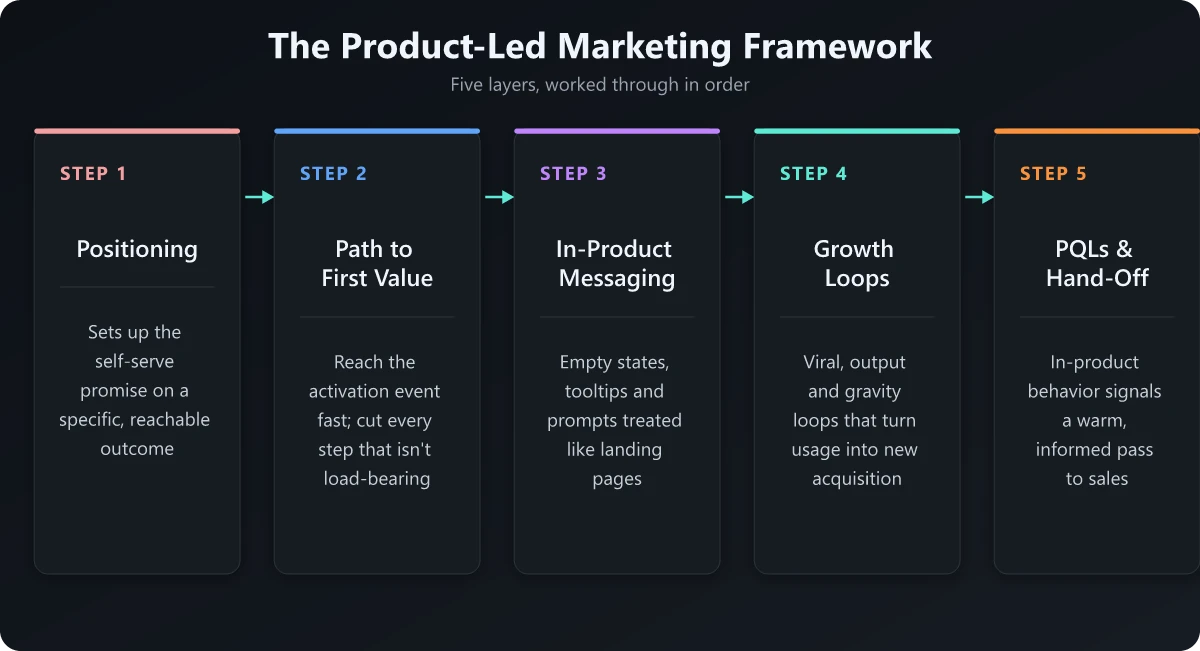
1. Positioning That Sets Up the Self-Serve Promise
Before anything else, you have to nail what the product is for and who it’s for. In product-led marketing this matters more, not less, because there’s no rep to course-correct a confused visitor.
Your product positioning has to do two jobs in seconds: tell the right person they’re in the right place, and make the value sound reachable on their own. If the positioning implies a complicated enterprise rollout, nobody self-serves. No amount of funnel testing rescues this layer either, since an experiment can only optimize a promise someone already wrote, which is the practical split I mapped in why positioning work and funnel experiments are different jobs.
Anchor it on a real, specific outcome. Not “the platform for modern teams.” Something a person can picture themselves achieving today.
2. A Frictionless Path to First Value
This is the heart of product-led marketing. The single most important question is: how fast can a new user reach a moment where they think “okay, this is genuinely useful”?
That moment is your activation event. For Calendly it’s getting your first meeting booked without the back-and-forth. For Canva it’s making something that looks good in minutes. Find yours and protect it ferociously.
- Map the exact steps from signup to first value
- Count every step and kill the ones that aren’t load-bearing
- Remove anything that asks for effort before delivering payoff
- Defer the credit card, the long forms, and the “invite your team” nags until after the aha moment
Time to value is the metric I obsess over. Cut it in half and almost every other number improves.
3. In-Product Messaging as a Marketing Channel
In a product-led world, your most important marketing copy lives inside the product. Empty states, tooltips, onboarding checklists, upgrade prompts, and celebration moments are all real estate that traditional marketers ignore.
Treat them like landing pages. An empty dashboard is not a dead end, it’s a chance to show the user what success looks like and hand them the first step. The same care you’d put into a hero headline belongs on that empty state.
This is where marketing and product genuinely merge, and it’s why product-led marketers need to think like product managers. It also connects directly to customer onboarding, which in a PLG model is no longer a CS-only concern. Onboarding is the conversion event.
4. Loops That Turn Usage Into Acquisition
Funnels run out. Loops compound. The reason product-led companies grow so efficiently is that usage feeds new usage. There are three loops worth building deliberately:
- Viral loops - a user invites collaborators because the product is better with others in it (think shared docs and workspaces)
- Output loops - the thing a user creates carries the brand out into the world (a design, a scheduling link, a published page)
- Data and gravity loops - the more a user puts in, the more valuable and sticky the product becomes, which fuels word of mouth
Your job as a marketer is to notice which loop your product naturally supports and then reduce the friction inside it. Don’t bolt on a referral program and call it product-led. Find the loop that already wants to exist.
5. Product-Qualified Leads and the Hand-Off to Sales
Self-serve is not the whole story for most B2B products. Some accounts are too big and too valuable to leave entirely to a checkout button. The bridge is the product-qualified lead (PQL) - a user whose in-product behavior signals they’re ready for a bigger conversation.
Instead of a sales rep cold-calling a name from a form, they reach out to someone who has already hit activation, invited their team, and bumped into a usage limit. That’s a warm, informed conversation. Getting this right is core to any modern SaaS growth strategy, because it’s how product-led acquisition and sales-led expansion stop fighting and start feeding each other.
How to Measure Product-Led Marketing
You cannot manage what you refuse to measure honestly. The trap in product-led marketing is celebrating signups, which are the easiest number to inflate and the least meaningful.
Here’s the hierarchy of metrics I actually watch, roughly in order of importance:
- Activation rate - the percentage of new users who reach first value
- Time to value - how long it takes them to get there
- Free-to-paid conversion - of activated users, how many upgrade
- Product-qualified leads - high-intent accounts surfaced for sales
- Net retention and expansion - whether value compounds over time
Notice that total signups isn’t on the list as a headline metric. A flood of signups that never activate is just expensive noise. If you’re setting targets around this, my guide on product marketing OKRs walks through how to frame goals that drive real outcomes instead of vanity.
Common Ways Product-Led Marketing Goes Wrong
I’ve watched smart teams stumble in the same predictable spots. Save yourself the bruises.
Treating it as a pricing toggle. Adding a free plan does not make you product-led. If the path to value is still buried behind setup and confusion, you’ve just given away access to a bad first experience.
Ignoring activation. Marketing optimizes the top of the funnel, product owns activation, and nobody owns the seam between them. That seam is exactly where product-led marketing lives. Own it.
Forgetting the buyer. In B2B, the person who loves the product is often not the person who signs the contract. You still need sales enablement and business-case materials for the eventual buying committee. Product-led does not mean buyer-blind.
Mistaking a tool for a strategy. Onboarding software, in-app guides, and PLG analytics are useful, but they don’t decide what your aha moment is or why anyone should care. That’s still strategy work, and it’s still your job.
Conclusion: Make the Product Do the Talking
Product led marketing is not a trend or a software category. It’s a discipline built on a simple, demanding idea: the fastest way to convince someone your product is worth it is to let them feel it working.
That means your real marketing assets are the signup flow, the empty state, the first outcome, and the moment a user wants to bring a colleague in. Get those right and you build a growth engine that gets cheaper and stronger the more it runs. Get them wrong and no campaign budget will save you.
So pick one product-led moment this week. Map the path to first value, cut a step, and instrument activation. Start there. If you’re still figuring out where this discipline fits in the bigger picture, my honest take on what product marketing actually is is a good next read. The product can sell itself, but only if you do the work to let it.
Frequently Asked Questions
What is product-led marketing?
Product-led marketing is a strategy where the product itself becomes the primary way you acquire, activate, and convert users. Instead of relying only on ads and sales calls, you use free trials, freemium plans, in-product moments, and shareable outputs to let people experience value before they pay.
What is the difference between product-led growth and product-led marketing?
Product-led growth (PLG) is the overall go-to-market motion where the product drives acquisition and expansion. Product-led marketing is the marketing discipline inside that motion. It shapes positioning, onboarding moments, in-product messaging, and the loops that turn usage into demand.
Does product-led marketing work for B2B?
Yes, but with a twist. Many B2B products start bottoms-up with individual users, then layer sales on top for larger accounts. Product-led marketing handles the self-serve acquisition and activation, while sales handles enterprise expansion.
What metrics matter most in product-led marketing?
Activation rate, time to value, free-to-paid conversion, product-qualified leads, and expansion or retention. Vanity metrics like total signups matter far less than how many users reach a meaningful first outcome.
How do I start with product-led marketing if I have a sales-led product?
Start small. Pick one high-intent moment, build a self-serve path to value around it, and instrument activation. You do not need to rip out your sales motion. Most successful PLG companies run product-led and sales-led motions side by side.