Replit vs Lovable: Which App Builder Fits a Marketer?
Replit vs Lovable for a marketer who does not code: a decision table by project type, what each entry plan meters, and what the free plans let you publish.
Which builder should a marketer pick when the job is a campaign page, and which when it is an app with logins and a database? That is the real Replit vs Lovable question for anyone who writes briefs for a living and wants to ship the thing too.
Short answer (as of November 2026): pick Lovable for a website, landing page or small web app, with one credit balance covering building, hosting and in-app AI. Pick Replit when the app needs logins, a database and back-end work, or a language other than JavaScript. Pick Claude Code when you want to own and run the code yourself.
My view, as a marketer who writes the brief and then builds it: the choice follows from what you are shipping and from how each plan meters usage, not from a same-prompt test. A test tells you which tool had a better afternoon. The billing model tells you what next month costs.
Replit vs Lovable: Decision Table by Project Type
| What you are shipping | Better fit | Why, from the vendors’ own pages |
|---|---|---|
| A campaign page or landing page | Lovable | One credit balance covers building, hosting on Lovable Cloud and AI features (Lovable pricing) |
| A small web app the team will share | Lovable | Workspaces have unlimited members on every plan and no per-seat price (Lovable plans docs) |
| An MVP with sign-ups, logins and stored data | Replit | Every project includes a pre-configured database, and Replit Auth is built in (Replit vs Lovable page) |
| An internal tool, automation or data pipeline | Replit | Replit says you can build these “in any programming language without setup” (same page) |
| A one-off demo you will throw away | Either free plan | Replit Starter’s link lasts 30 days; Lovable Free gets 5 build credits a day, up to 30 a month |
| A site you want to own, host and edit as files | Claude Code | No builder in the loop; see the hub below |
If the last row is you, Claude Design vs Claude Code covers where Lovable and Replit sit next to Anthropic’s tools. Replit is one of the app builders I use (my Replit Core pricing guide says so too); this post is written from the two vendors’ published pages, not from a side-by-side build.
Entry Plan Billing: Lovable Pro vs Replit Core
The two entry plans look close on price and work very differently. Every figure below is from the vendors’ pages, read on 5 November 2026, in US dollars. Prices and limits change, so check each link before you pay.
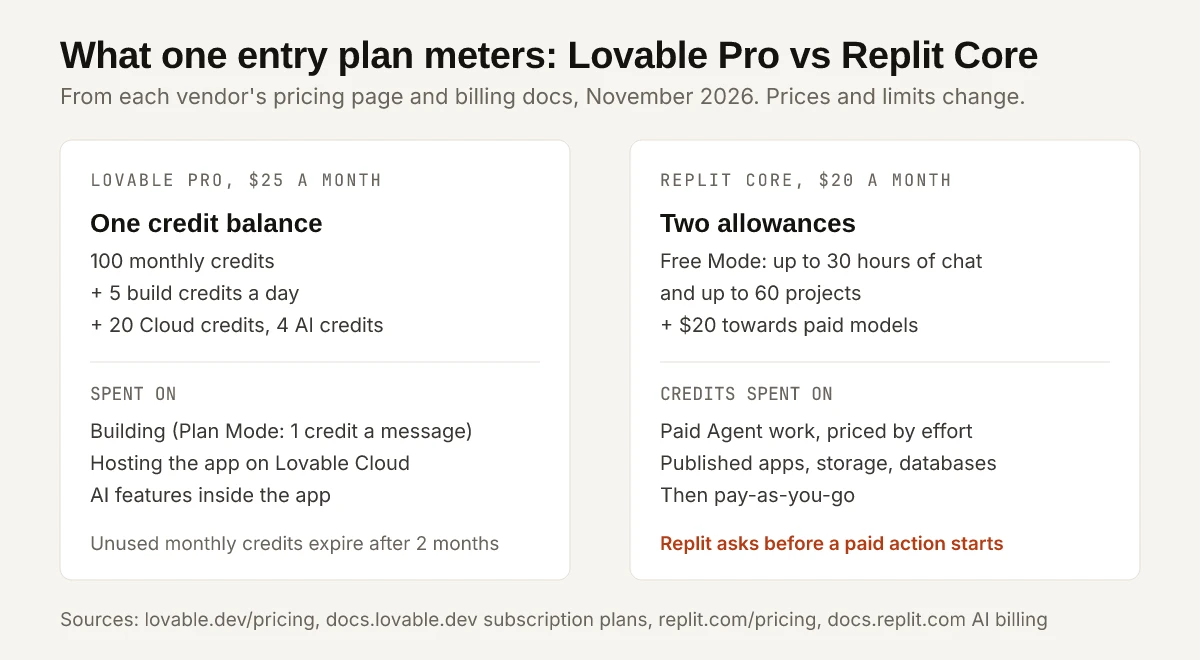
| Lovable Pro | Replit Core | |
|---|---|---|
| Monthly price | $25 for 100 credits | $20 |
| Billed annually | $250 a year ($21 a month) | $18 a month |
| Included allowance | 100 monthly credits, 5 build credits a day, 20 Cloud credits, 4 AI credits | ”Up to 30 hours of chat on Free Mode”, “Up to 60 projects on Free Mode”, “$20 towards more powerful models” |
| How a request is charged | Default Mode varies with task complexity; Plan Mode is 1 credit per message | Paid modes use “effort-based pricing based on request complexity” |
| Before you spend | Usage limits and alerts on Pro | ”Replit asks for confirmation before a paid action starts” |
| Past the allowance | Top-ups and auto top-up on Pro | Monthly credits “that also let you pay-as-you-go” |
| Unused allowance | Monthly credits expire 2 months after issue | Rollover for two months is described for Pro only |
| Next plan up | Pro scales by credits: 200 for $50, 400 for $100 | Pro at $100 a month ($90 annual), up to 15 collaborators |
Sources: Lovable pricing, Lovable subscription plans, Replit pricing, Replit AI billing docs, Replit Starter plan docs. Replit’s pricing page adds that “Prices are subject to tax depending on your location.”
Two differences matter most for a marketer’s budget:
- What the money buys. Lovable’s credits pay for three jobs at once: building, running the published app, and AI features inside it. Replit splits the plan into a Free Mode allowance for everyday Agent work and dollar credits for paid modes, which also “cover Agent and other Replit cloud services like published apps, storage, and databases”.
- What you can predict. Lovable publishes example prompts with their credit cost, so you can estimate a month in prompts. Replit prices paid work by effort and asks before it starts, so the check happens per action rather than up front. Replit publishes no per-prompt figure I could find on these pages, so there is no like-for-like “prompts per dollar” number for the two.
For Lovable’s per-prompt examples and how far 100 credits go, my Lovable vs Bolt billing breakdown has the table; I have not repeated it here.
Free Plans: What You Can Publish on Each
Free plans are where most marketers start, and the publishing rules differ more than the build allowances.
| Free plan rule | Replit Starter | Lovable Free |
|---|---|---|
| Build allowance | Daily Agent credits up to a monthly cap | 5 build credits a day, up to 30 a month |
| What happens at the cap | Credits reset daily, up to the monthly cap | No daily credits for the rest of the calendar month; they resume on the 1st at 00:00 UTC |
| Build depth | Lite build only; Full build needs Core | Daily chat allowance included |
| Published apps | 1, and “This published link will automatically go down after 30 days” | Publish to invited people only, up to 10 people per project |
| Builder badge | ”Made with Replit” badge with your referral link | ”Edit with Lovable” badge; removal starts at Pro |
Sources: Replit Starter plan docs, Replit AI billing docs (the plan table lists “1 (30-day)” published apps on Starter), and Lovable subscription plans.
Lovable’s docs give the worked case for the free cap themselves: on Free “you receive daily build credits for the first 6 days each month (6 x 5 = 30), then none until the next month starts”.
What this means for a campaign page:
- A page that must stay up past a month needs Replit Core rather than Starter, whose link goes down after 30 days. Lovable’s plan docs list no 30-day limit on Free.
- A page on your own domain needs Lovable Pro or above. The Replit plan pages cited here do not list custom domains by plan, so check Replit’s custom domain docs before you commit.
- A page without the builder’s badge needs a paid plan on either tool.
Logins, Databases and Teams
For anything beyond a page, these are the published differences:
- Database and sign-in. Replit’s comparison page says every project includes “a pre-configured, production grade DB” and built-in Replit Auth, and its pricing page lists “Database rollback up to 28 days” on Pro.
- Teams. Lovable says workspaces support “unlimited members on all plans” and plans are priced by credits, not seats, with per-member credit limits on Pro and Business. Replit’s AI billing table lists 5 collaboration seats on Core and 15 on Pro.
- Ownership. Lovable’s pricing FAQ answers “Who owns the projects and code?” with “You do.”
- Model choice. Replit’s docs say that in Power or Max modes you can “select Auto to let Replit choose a model for paid work”.
Moving Between Replit and Lovable
You are not locked in by the first choice:
- Lovable to Replit. Replit’s comparison page carries an “Import app from Lovable” button next to “Get started”.
- Out of Lovable generally. Lovable lists Git sync with GitHub, GitLab and Bitbucket on every plan, so the code can sit in a repository you control.
- Out of either into your own stack. Once the code is in a repository, a coding agent such as Claude Code can take over. My build notes for this Astro site show that route end to end.
Do Replit and Lovable Sites Rank on Google?
Ranking depends on what HTML the crawler receives, not on which builder made the page. I covered client-side versus server rendering, and Lovable’s switch for new apps, in why vibe-coded sites often fail to rank. Check your published page with that test before you put campaign budget behind it.
Paying for Replit or Lovable From India
This post prices both tools in US dollars from their web pages. For checkout routes, rupee prices and tax, read the Replit pricing guide linked above and Lovable’s web and iPhone price lists.
Replit vs Lovable Is a Question About What You Ship
The choice gets easier once you name the output. A campaign page or a light web app fits Lovable’s single credit balance, where hosting and building draw from the same pool. An app with logins, stored data or a non-JavaScript back end fits Replit’s built-in database and auth, with Free Mode for everyday work and credits for paid runs. Read each plan’s metering line before the feature list, because that line decides next month’s bill. Then re-check both pricing pages on the day you pay, because prices and limits change.
Frequently Asked Questions
Is Replit better than Lovable?
Neither wins outright. Lovable bills one credit balance for building, hosting and in-app AI, which suits a campaign site or a small web app. Replit pitches a built-in database, Replit Auth and any programming language, which suits an app with logins and back-end work.
Which is cheaper, Replit or Lovable?
On list price, Replit Core is $20 a month ($18 billed annually) and Lovable Pro starts at $25 a month ($21 billed annually), as of November 2026. The two meter usage differently, so the cheaper plan depends on how much paid work your project needs.
Can I move a Lovable app to Replit?
Replit's own comparison page shows an Import app from Lovable button. Lovable also lists Git sync with GitHub, GitLab and Bitbucket on every plan, including Free, so the code can leave Lovable through a repository.
Can I publish an app for free on Replit or Lovable?
Yes, with limits. Replit's Starter plan gets one free published app whose link goes down after 30 days and carries a Made with Replit badge. Lovable's plan table lists Publish to invited people only, up to 10 people per project, on Free, and custom domains and removing the Edit with Lovable badge start at Pro.