Analyst Relations: What It Is and How a PMM Runs It (2026)
Analyst relations explained: what AR is, who owns it, when to start, how to tier analysts, and what a Magic Quadrant or Forrester Wave submission demands.
Analyst relations (AR) is the practice of managing a company’s relationships with industry research firms like Gartner, Forrester, and IDC so those analysts describe the product accurately to the buyers who ask them for advice. It covers briefings, inquiry calls, research submissions, and the intel that comes back.
A Gartner inquiry request lands in a shared marketing inbox. Nobody is quite sure who should answer it, so it sits for four days, then PR forwards it to product marketing, who forwards it to the founder, who books the call and improvises. That is how most companies under a few hundred people do analyst relations, and it is why they conclude the whole thing is a waste of money.
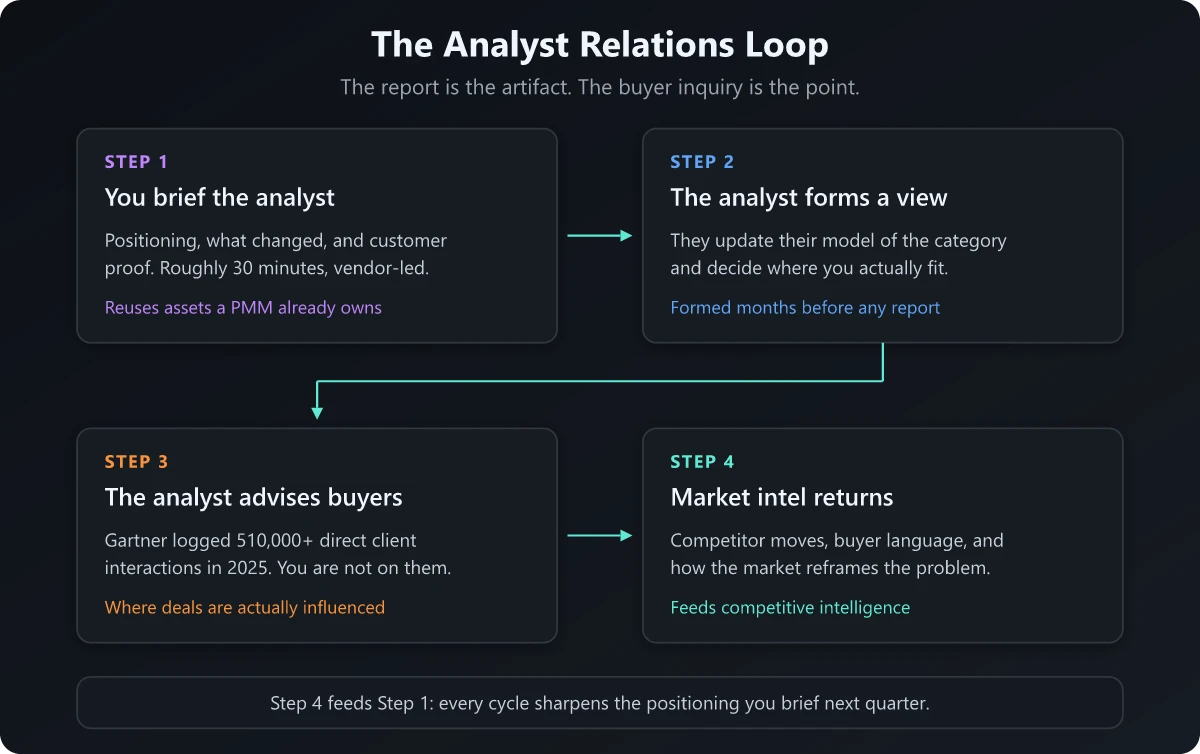
Here is the position I will defend in this post: analyst relations is not a PR program you bolt on, it is a distribution channel for the positioning and messaging your product marketing team already owns. The report is the least important output. What matters is the answer an analyst gives when your prospect calls them and asks who to buy from, and that answer is shaped months earlier by whoever briefed them.
What Is Analyst Relations?
Analyst relations is the ongoing work of keeping industry analysts accurately informed about your product, category, and customers so their published research and their private advice both reflect reality. It is a communications discipline with a competitive intelligence function attached.
Four activities make up almost all of it:
- Briefings. You present to the analyst. Typically 30 minutes, vendor-driven, no obligation on the analyst to respond with an opinion.
- Inquiries. The analyst’s paying clients call the analyst for advice. You are not on these calls. This is where deals are influenced.
- Research submissions. Structured evaluations such as the Gartner Magic Quadrant and the Forrester Wave, with questionnaires, demos, and reference customers.
- Intel return. What the analyst tells you about the market, your competitors, and how buyers are actually framing the problem.
Most guides on the topic stop after the first and third bullets. The second one is the entire reason the program exists.
Why Analyst Relations Matters More Than the Report Itself
The scale of the private advice channel is the part that gets missed. In its fiscal 2025 Form 10-K, Gartner reports a network of more than 2,400 business and technology experts, steady contact with over 13,000 distinct client enterprises, and more than 510,000 direct client interactions in 2025.
Read those three numbers together and the strategic picture changes:
- Half a million conversations a year happen between analysts and buying organizations. Almost none of them are public.
- 13,000 client enterprises are paying specifically for the right to ask “who should we buy from?”
- A single covering analyst may repeat their view of your product dozens of times a quarter, to named buyers, in rooms you will never enter.
That is why treating AR as report-chasing is a category error. A Magic Quadrant dot is a lagging artifact of a view the analyst already formed. The leading indicator is whether the analyst can describe your differentiation correctly without notes, and that is a product positioning problem before it is a PR problem.
It also runs the other way. Analysts talk to your competitors’ customers and your lost deals, which makes them one of the highest-signal inputs into competitive intelligence analysis that a PMM can get without running the interviews personally.
Who Owns Analyst Relations, PMM or PR?
There is no universal answer, but there is a reliable pattern by company size.
| Company stage | Who typically owns AR | What usually breaks |
|---|---|---|
| Under ~200 people | Product marketing, informally | No cadence, briefings improvised deal by deal |
| 200 to 1,000 | Product marketing, formally, with PR support | Ownership contested between PMM and comms |
| Enterprise | Dedicated AR team under comms or PMM | AR drifts from the product story it is meant to carry |
The split that actually works is by substance versus logistics. PR or comms is well suited to scheduling, contracts, tracking coverage, and managing the analyst calendar. The content of the briefing is product marketing work, because the inputs are already sitting in a PMM’s drive: positioning, messaging pillars and proof, the competitive landscape, the roadmap narrative, and the customer proof points.
My view is that if you have no dedicated AR headcount, the function belongs to whoever owns the product story rather than whoever owns the media list. Handing it to PR by default is how companies end up briefing analysts with a press release.
When to Start an Analyst Relations Program
Starting too early is the most common and most expensive mistake, because analyst attention is not a resource you can re-spend. A bad first briefing sets a view that takes a year of cadence to move.
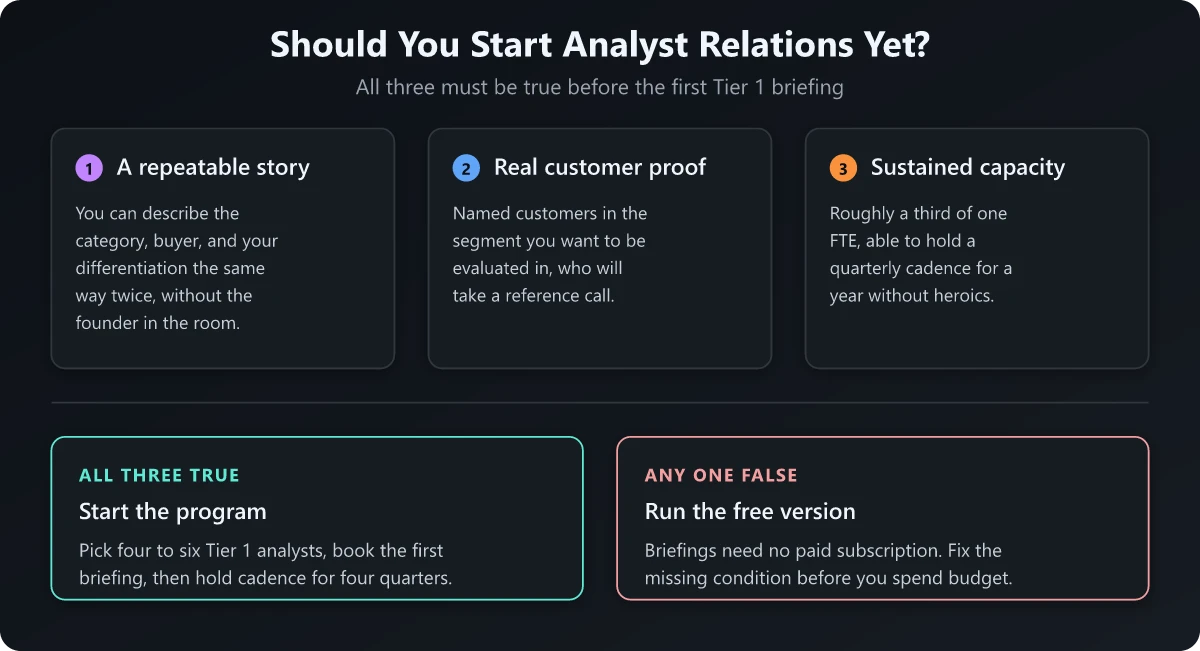
Three conditions should all be true before you book the first briefing:
- A repeatable story. You can describe the category, the buyer, and your differentiation the same way twice, without the founder in the room. If your positioning is still moving quarter to quarter, wait. A quick test is the first sentence of your press release boilerplate: it should name the category and the buyer, and only 22 of the 95 B2B software and AI boilerplates I measured did both.
- Real customer proof. Named customers in the segment you want to be evaluated in, who will take a reference call. Analysts weight customer evidence far above roadmap claims.
- Sustained capacity. Someone can hold a quarterly cadence for a year without it being an emergency. Analyst relations rewards consistency and punishes bursts.
On capacity, a16z’s guide to engaging with analysts puts the commercial relationship at roughly 25 to 30 percent of one full-time employee’s time, covering six to ten analysts with about four engaged regularly, over a three to five year horizon. Insight Partners’ AR primer, written by a former Forrester senior analyst, suggests engaging three to four times a year and flags sub-$5 million revenue as early for paid relationships.
Those two numbers together are the honest budget conversation: AR is roughly a third of a person, indefinitely. If you cannot fund that, run the free version described below rather than a half-committed paid one.
How to Tier Analysts and Set a Cadence
Every guide says “build relationships with analysts.” None of them say which analysts, how often, or what to send. This is the model I would give a PMM inheriting an AR program with no structure.
| Tier | Who belongs here | Cadence | What you send | What you ask for |
|---|---|---|---|---|
| Tier 1 | Analysts who own your exact category and write the evaluations you want to be in | Quarterly briefing, plus ad hoc on major launches | Full narrative update, new customer proof, roadmap under NDA | Nothing on the first three touches. Later, a fact check on how they describe you |
| Tier 2 | Adjacent-category analysts your buyers also read, and regional analysts in target markets | Twice a year | Condensed update, one customer story | Their read on where the adjacent market is heading |
| Tier 3 | Independent analysts, newsletter authors, and practitioner influencers with real buyer audiences | Opportunistic, when there is genuine news | Product access, data, an early look | Honest public commentary, not coverage |
Two rules make the model work.
- Never open with an ask. The first two or three touches with a Tier 1 analyst are pure information transfer. Vendors who lead with “can we be in your report” get filed as noise.
- Send the same core narrative to every tier. Different depth, identical substance. Analysts compare notes across a market, and inconsistency between what you told two of them is a credibility problem you will not be told about.
If you are already maintaining a competitive battlecard, most of the Tier 1 briefing content exists. AR is largely a reuse exercise, which is exactly why it belongs with product marketing.
How to Run an Analyst Briefing
A briefing is not a demo and not a pitch. The analyst’s job in the room is to update their mental model of your market, so the session should be built around what is new and what is proven.
A 30-minute structure that holds up:
- 3 minutes. Who you are, category, size signals. No company history.
- 10 minutes. What changed since last time: launches, segment shifts, notable wins and why they were won.
- 10 minutes. Customer evidence. Specific deployments, specific outcomes, named where permitted.
- 5 minutes. Where you think the market is going, framed as a view you will be held to.
- 2 minutes. Logistics only. Next cadence, any submission deadlines.
What consistently damages a briefing:
- Arguing with the analyst’s read of the market instead of noting it and following up with evidence.
- Roadmap-heavy sessions with thin current-customer proof.
- Sending a different narrative than the one on your website and in your launch materials.
- Treating the briefing as an inquiry. If you want the analyst’s advice, that is a separate paid format their clients buy, and asking for it inside a briefing puts the analyst in an awkward position.
Magic Quadrant and Forrester Wave: What the Process Demands
Both flagship evaluations are analyst-controlled, criteria-first processes. You cannot buy a position in either.
Gartner’s Magic Quadrant methodology applies “a uniform set of evaluation criteria” and sorts providers into four types, in Gartner’s own words:
- Leaders “execute well against their current vision and are well positioned for tomorrow.”
- Visionaries “understand where the market is going or have a vision for changing market rules, but do not yet execute well.”
- Challengers “execute well today or may dominate a large segment, but do not demonstrate an understanding of market direction.”
- Niche Players “focus successfully on a small segment, or are unfocused and do not out-innovate or outperform others.”
One underused detail from that same page: Gartner’s interactive Magic Quadrant lets clients adjust the weightings applied to each evaluation criterion and generate a customized graphic. Your buyer can re-weight the chart around what they care about. A vendor strong on two criteria a specific buyer weights heavily is not stuck with the default picture, which is a genuinely useful thing for sales to know.
The Forrester Wave methodology is more prescriptive about timing, and the published numbers are worth planning against:
- The process runs approximately 18 weeks from kickoff to publication.
- Vendors get approximately four weeks to return the questionnaire.
- Strategy briefings happen within the two weeks after the questionnaire due date.
- Initial scores arrive approximately six to seven weeks after the questionnaire due date.
- Vendors receive a courtesy preview of the document about five days before release.
- For Wave evaluations kicking off on or after July 1, 2024, vendors are ranked in three categories: Leader, Strong Performer, and Contender.
Read that timeline as a resourcing warning. An eighteen-week process with a four-week questionnaire window and reference customers to line up is a meaningful chunk of a PMM’s quarter, and it collides with whatever launch is already booked. Decide before you say yes.
Analyst Relations Metrics Worth Reporting
AR is often measured by activity count, which tells a leadership team nothing. These are the measures that survive scrutiny.
| Metric | What it tells you | How to capture it |
|---|---|---|
| Accuracy of description | Whether the analyst can state your differentiation correctly | Ask for a fact check; count corrections needed per cycle |
| Inclusion and movement | Whether you are in the evaluations your buyers read, and which direction you moved | Track per report, per cycle |
| Deal influence | Whether analyst material shows up in real opportunities | Add an “analyst report referenced” field in CRM, populated by reps |
| Intel captured | Whether the program feeds anything back | Count usable competitive or market insights logged per quarter |
| Sentiment trend | Whether the view of you is improving | Log analyst commentary each touch and review the trend |
The deal-influence one is the only metric that will hold a budget conversation, and it is the one almost nobody instruments. A single CRM field costs an afternoon to add and turns AR from a faith-based program into a reportable one. It pairs naturally with win-loss analysis, since the same buyers who cite an analyst report are the ones who can tell you how much it actually mattered.
Analyst Relations Best Practices, and What Wastes the Program
- Run the free version first. Briefings do not require a paid subscription. Many analysts will take a briefing from a vendor they do not cover yet.
- Keep one narrative. The story an analyst hears should match the website, the deck, and the launch.
- Feed intel back into the org. An AR program that never produces a competitive insight for the product team is a cost center.
- Encourage customer reviews on peer platforms. Gartner Peer Insights reviews come from your customers, not from you, and they sit alongside analyst opinion in the buyer’s research.
- Do not argue scores. Correct facts, provide evidence, and let the criteria do their work. Arguing a score damages the relationship that determines next year’s position.
- Do not go quiet after a bad placement. The vendors who move are the ones who kept the cadence through a disappointing cycle.
Conclusion: Treat Analyst Relations as Distribution, Not PR
Analyst relations pays off when you stop thinking of it as chasing a dot on a chart and start thinking of it as putting your positioning in front of the people your buyers call for advice. Gartner alone logged more than half a million direct client interactions in a single year. Your product story is either accurate in those conversations or it is not, and the only lever you have is the quality and consistency of what you brief.
For a PMM, that makes analyst relations one of the highest-leverage uses of assets you already maintain. The positioning, the messaging pillars, the proof points, and the competitive picture are all built. Analyst relations is the channel that carries them into a room you cannot otherwise reach, which is why it sits naturally inside what product marketing actually owns.
Start with the readiness gate. If you clear it, pick four Tier 1 analysts, book the first briefing, and hold the cadence for four quarters before you judge the program.
Frequently Asked Questions
What is analyst relations?
Analyst relations (AR) is the practice of managing a company's relationships with industry research firms such as Gartner, Forrester, and IDC so those analysts describe your product accurately to the buyers who ask them for advice. It covers analyst briefings, inquiry calls, research submissions like the Magic Quadrant and the Forrester Wave, and the competitive intelligence that flows back to your team.
Who owns analyst relations in a company?
It depends on size. At enterprise scale AR is usually a dedicated team sitting under corporate communications or product marketing. Below roughly 200 people there is rarely a dedicated AR person, and the work lands on product marketing by default, because a PMM already owns the positioning, messaging, competitive intel, and roadmap narrative that every analyst conversation runs on. PR can own scheduling and logistics, but the substance of a briefing is product marketing work.
How do you start an analyst relations program?
Start only once you have a repeatable product story, named customers who will act as references, and someone with time to sustain a quarterly cadence. Then pick four to six analysts who actually cover your category, book a first briefing built from your existing positioning deck, and hold a regular cadence. Do not open with a request for coverage. Analysts remember vendors who show up consistently with real customer evidence, not vendors who appear once asking to be in a report.
What is an analyst briefing?
An analyst briefing is a scheduled session, commonly 30 minutes, where a vendor presents its strategy, product, and customer proof to an analyst. It is one-directional by design: you inform the analyst, and the analyst is not obliged to give advice back. Getting the analyst's opinion is a separate format called an inquiry, which is a paid service that the analyst's clients buy.
How do you get into a Gartner Magic Quadrant?
You cannot buy inclusion. The analyst who runs the market sets inclusion criteria first, usually covering revenue, customer count, geographic reach, and functional scope, and then evaluates every vendor who meets them. The practical path is to brief the covering analysts consistently, make sure Gartner knows your product exists and how it is used, and be ready with the data those criteria ask for when the research cycle opens.