Content Marketing Framework for B2B: Map the Buyer Journey
A content marketing framework built for B2B and product teams. Map each content type to a buyer-journey stage and buying question, then run the distribution loop.
Most content teams pick topics before they decide who the content is for or what job it has to do. The blog calendar fills up, posts ship, and six months later nobody can say which piece influenced a single deal. A content marketing framework fixes that, but only if it is built around the buyer, not around content types in the abstract.
Here is the claim this guide defends: a content marketing framework should be organized by the buyer’s journey and your go-to-market motion, so every piece answers a specific buying question and carries its own metric. That is the version I use from a product marketing seat, where content is judged on whether it moves pipeline and retention, not on how much of it exists.
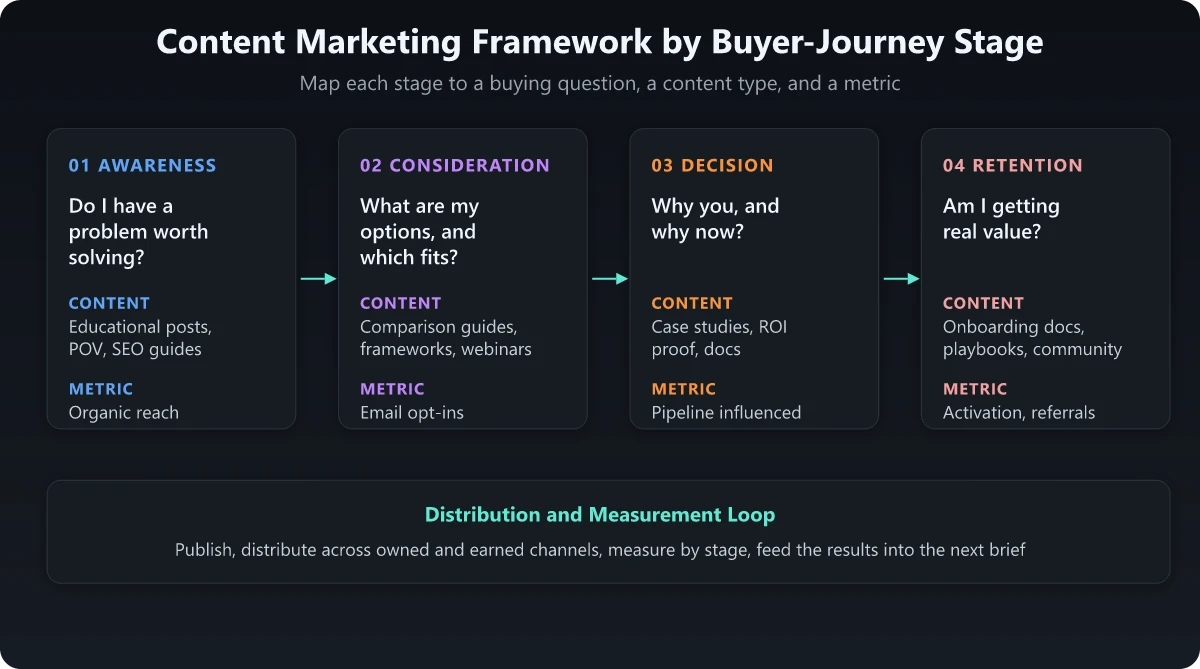
A content marketing framework is a repeatable system for deciding what to publish, who it is for, and how it moves a buyer toward purchase. The useful version maps each content type to a buyer-journey stage and the question the buyer is asking there, then wraps a distribution plan and a measurement loop around it so the output ties to pipeline, not traffic.
What Is a Content Marketing Framework?
A content marketing framework is the operating layer that turns a content strategy into specific, repeatable briefs. The strategy decides which topics you own and why. The framework decides how any given piece gets built: which stage of the journey it serves, which question it answers, and how you will know it worked.
The distinction matters because having a strategy is not the bottleneck. In the Content Marketing Institute’s B2B research, 97% of marketers say they have a content strategy, yet 23% still name aligning content with the buyer’s journey as a challenge. The gap is almost never the plan. It is the missing operating layer that connects each piece to a real buying moment.
A framework worth using has four moving parts:
- Stages - the steps a buyer moves through, from first awareness to renewal
- Buying questions - the actual question in the buyer’s head at each stage
- Content types - the format that answers that specific question
- Metrics - one number per stage that tells you the content is doing its job
Everything else - editorial calendars, briefs, tooling - hangs off those four parts.
Why Map Content to the Buyer Journey, Not Content Types
Most content plans start from formats: we need more blog posts, a podcast, some videos. That is backwards. Format is the last decision, not the first. When you start from the buyer’s question, the format becomes obvious and the content stops being generic.
This is the core of the framework, and where the product marketing lens earns its keep. On the launches I run, the content that actually moves deals is the content that answers a question a buyer was already asking. A comparison guide lands because someone is mid-evaluation. A case study lands because someone is trying to justify the purchase internally. The same words published at the wrong stage do nothing.
Mapping to the journey also forces a decision most content plans avoid: what NOT to make. If a proposed piece does not answer a live buying question at a named stage, it does not get a brief. That single rule kills more wasted content than any editorial process.
The Content Marketing Framework, Stage by Stage
Here is the full mapping. Each stage gets one buying question, the content types that answer it, and the metric that proves it worked. This is the table I hand a team when we build a quarter’s plan.
| Stage | Buying question | Content types | Stage metric |
|---|---|---|---|
| Awareness | Do I have a problem worth solving? | Educational posts, point-of-view pieces, SEO guides | Organic reach, branded search |
| Consideration | What are my options, and which fits? | Comparison guides, frameworks, webinars, templates | Return visits, email opt-ins |
| Decision | Why you, and why now? | Case studies, ROI proof, product docs, battlecards | Demo requests, pipeline influenced |
| Retention and advocacy | Am I getting real value? | Onboarding docs, playbooks, community, expansion guides | Activation, expansion, referrals |
Awareness: earn attention before you sell
At the top, the buyer may not even know they have a nameable problem. Content here is educational and opinionated, not promotional. The job is to be found and to be credible, so this is where SEO and a genuine point of view do the work. Do not try to close here. Trying to sell at the awareness stage is the fastest way to lose the reader.
Consideration: help them build a shortlist
Now the buyer knows the problem and is comparing approaches. This stage rewards content that helps them think: comparison guides, decision frameworks, and honest breakdowns of the options, including yours. A case study that leads with the customer’s situation fits this stage, because it answers the buyer’s question of whether a company like theirs has had this problem; the version that leads with the measured result stays in the Decision row. This is also where a defined set of messaging pillars keeps every piece saying the same thing about why your approach is different.
Decision: remove the last reasons to say no
By the decision stage the buyer is trying to justify a choice, often to other people. Content becomes proof: case studies, ROI math, documentation that shows the product is real, and internal-champion enablement. For B2B and especially SaaS, this stage is underweighted almost everywhere, which is exactly why it is the highest-leverage place to invest.
Retention and advocacy: content is still the product experience
The journey does not end at the sale. Onboarding guides, playbooks, and community content decide whether a customer activates, expands, and eventually refers. This is where content marketing overlaps with lifecycle marketing, which manages the relationship across the whole customer journey rather than just up to the deal.
Build the Distribution Loop
A framework that stops at “create the content” is half a framework. At a DR-11 or early-stage site, distribution is the actual ranking and pipeline lever, not production volume. Every piece needs a plan for how it reaches its stage’s audience before it gets written.
- Owned channels - your blog, email list, product surfaces, and docs. Highest control, so anchor here first.
- Earned channels - search, communities, partners, syndication, and word of mouth. Slower to build, but compounding.
- Product-led distribution - for SaaS, the product itself distributes content through in-app guidance and templates. This is the through-line in any serious SaaS demand generation motion, where in-product behavior signals intent better than a form fill.
Match the channel to the stage. Awareness content is built to be discovered, so it leans on search and community. Decision content is built to be delivered, so sales and email carry it to a specific account at the moment it is needed.
Close the Measurement Loop
The last part is the loop back. Each stage already has a metric in the table above; the discipline is reviewing them together and letting the results rewrite the next brief. A piece that earns reach but no opt-ins has an awareness-to-consideration gap. A stack of case studies that never gets attached to deals has a distribution problem, not a content problem.
Run the review on a fixed cadence:
- Monthly - which pieces moved their stage metric, and which stalled
- Quarterly - rebalance the plan toward the stage that is leaking, then rebuild briefs from the journey map
- Per brief - before anything is written, name the stage, the buying question, and the metric it will move
That loop is what separates a content marketing framework from a content calendar. The calendar tells you what ships next week. The framework tells you why, and how you will know if it worked.
Two things make that loop harder in SaaS than the table suggests. The buying cycle is long and multi-touch, so last-touch attribution misreports which pieces worked; how to measure SaaS content marketing covers the model I would defend in a board review, including what cannot be attributed at all. And at the awareness stage, the pieces that earn citations are the ones carrying a claim someone could argue with, which is the difference between publishing volume and publishing thought leadership content.
Common Mistakes That Break the Framework
- Starting from formats. Deciding you need a podcast before you know which buying question it answers. Format is the last call, not the first.
- Front-loading awareness. Piling budget into top-of-funnel volume while the decision and retention stages, where deals are actually won and kept, run on nothing.
- Publishing without distribution. Treating “hit publish” as the finish line. If no channel is assigned before writing, the piece was never going to reach anyone.
- Measuring the whole program on traffic. Traffic is an awareness metric. Judging a decision-stage case study by pageviews guarantees you underinvest in the content that closes.
- Reinventing every brief. The point of a framework is that the same buyer-journey logic applies to every piece. If each brief starts from a blank page, you do not have a framework yet.
If you want to see where your competitors are strong and weak across these same stages before you build your plan, run a content marketing competitor analysis first and map their coverage onto this journey.
Putting the Content Marketing Framework to Work
A content marketing framework is only useful if it changes what you publish next week. The version here does that by refusing to brief any piece that cannot name its stage, its buying question, and its metric. Build the journey map, fill the four-part table for your own product, assign a channel to every piece, and review the metrics on a cadence. Do that and content stops being a volume game and becomes a system that moves pipeline and retention.
This content marketing framework sits inside the broader operating system of the function. If you want the layer above it - how positioning, launches, enablement, and competitive intel connect - my operating system for running product marketing end to end is where this content model plugs in. Start with the buyer’s question, and the rest of the framework follows.
Frequently Asked Questions
What is a content marketing framework?
A content marketing framework is a repeatable system for deciding what content to create, who it is for, and how it moves someone toward a purchase. A useful one maps every content type to a buyer-journey stage and the specific buying question a person is asking at that stage, then adds a distribution plan and a measurement loop so the whole thing ties back to pipeline instead of traffic.
What should a content marketing framework include?
Four parts: buyer-journey stages (awareness, consideration, decision, retention), the buying question at each stage, the content type that answers it, and a metric per stage. Wrap that in a distribution plan for owned and earned channels and a measurement loop that feeds results back into the next brief.
What is the difference between a content strategy and a content marketing framework?
A content strategy is the high-level decision about what topics you own and why. A content marketing framework is the operating layer underneath it: the repeatable rules for turning that strategy into specific briefs, mapped to funnel stage and buying question, so the same thinking applies to every piece instead of being reinvented each time.
How do you map content to the buyer journey?
Write down the question a buyer is actually asking at each stage. Awareness: do I have a problem worth solving. Consideration: what are my options and which fits. Decision: why you and why now. Retention: am I getting real value. Then pick the content format that answers that exact question and assign it a metric.
What is the best content marketing framework for a B2B SaaS team?
One anchored to the buyer journey and your go-to-market, not to content types in the abstract. For B2B SaaS, weight the decision and retention stages heavily, because product content like docs, ROI proof, and onboarding guides converts and expands accounts more reliably than top-of-funnel volume alone.