White Paper vs Case Study: Pick by the Buyer's Question
White paper vs case study comes down to your buyer's question. Compare sourced lengths, costs and timelines, and see why three guides disagree on the funnel.
A B2B buyer asks two questions a case study can answer: “has a company like mine had this problem?” and “did it pay back?” A white paper usually answers the question that comes before both: is there a better way to solve this problem at all? Which of those questions the buyer is asking is a better test for white paper vs case study than the funnel stage.
The first case study question comes early, while the buyer is still deciding whether the problem is worth fixing, and the second comes at the end, when someone has to defend the purchase. Three guides written on exactly this comparison disagree about which end of the funnel a case study belongs to.
What Is the Difference Between a White Paper and a Case Study?
A white paper is a long, research-backed document that usually argues for a better way to solve an industry problem; a case study is a short before-and-after account of one customer’s result. The first changes how a buyer frames the problem, and the second proves the fix worked for a company like theirs.
| White paper | Case study | |
|---|---|---|
| Core message (Graham) | “Here’s a better way to solve this problem" | "Here’s a customer who loves our stuff” |
| What it carries | Research, data and an argument about a whole industry | One customer’s before-and-after result, in their words |
| Length (Venngage, 2026) | 6 to 12 pages, roughly 2,500 to 5,000 words | 2 to 5 pages, or 800 to 1,500 words |
| Length (TREW, 2019) | About 2,000 words or 6 pages | Around 800 words |
| Length (Graham, 2022) | 5 to 12 pages | 2 pages |
| Time to create (Graham, 2022) | 4 to 12 weeks | 2 to 6 weeks, depending on approvals |
| Time to create (TREW, 2019) | Up to six weeks | ”may require an extended timeline” for customer approvals |
| Cost (Graham, unchanged since 2019) | About $6,000 | About $2,000 |
| Shelf life (TREW 2019, Graham 2022) | 1 to 2 years (TREW and Graham) | 2+ years (TREW); 1 or 2 years (Graham) |
| Gate it? (TREW, 2019) | Yes: “should also be gated by forms” | No: “not typically gated by a form” |
Treat each figure in the table as one guide’s estimate. Venngage’s guide (Danesh Ramuthi, updated 25 February 2026) opens its length answer with “There is no strict standard for the length of white papers or case studies” before it offers “a general rule of thumb”. TREW Marketing’s comparison is by Morgan Norris, dated 5 December 2019. Gordon Graham, who wrote White Papers For Dummies, last updated his comparison in April 2022, though its $2,000 and $6,000 prices were already on the page in July 2019.
TREW’s gating advice is the row to question before you copy it: a form hides the argument from anyone who will not fill it in, and answer engines do not fill in forms. I would publish the argument and gate only the dataset, and my customer story production guide adds the case study version of that rule: never let a gated PDF hold the only copy of a number.
White Paper vs Case Study in the Funnel: Where Three Guides Split
The same guides also say where each format belongs in the funnel, and they do not all agree.
| Guide | White paper | Case study |
|---|---|---|
| Venngage, updated Feb 2026 | ”best suited for the top of the sales funnel" | "best suited for the later stages of the funnel” |
| TREW, Dec 2019 | ”can be an effective way to target people at all stages of the funnel" | "best suited for audiences at the top or middle of the funnel” |
| Graham’s comparison table, Apr 2022 | ”Earlier in sales cycle" | "Later in sales cycle” |
| Graham’s guide to white paper types, Sep 2025 | Backgrounder: “best for prospects at the end of the customer journey”; problem/solution: “best for prospects at the start of the customer journey” | Not covered |
On the case study, Venngage and Graham say late and TREW says earlier. On the white paper, TREW declines to pick one stage, and Graham’s own taxonomy puts one type at each end of the journey. Each guide is describing a real document, and they are describing different ones:
- TREW’s case study exists to “create awareness of a problem and show the reader a solution that worked for a real-life customer”. That is a recognition job, which TREW assigns to the top and middle of the funnel.
- Venngage’s case study is for prospects “narrowing down their options”, who “need real-world evidence that your solution has successfully addressed similar challenges”. That is a proof job, and it works when a choice has to be defended.
- Graham’s backgrounder “details the features and benefits of a specific product or service”, and he notes that the people most likely to find one “already have your company or your product in mind”. TREW describes a similar late document: a white paper that could “focus on advanced product uses, targeting someone at the bottom of the funnel or even an existing customer”.
When to Use a White Paper vs a Case Study
Name the buyer’s question first and the format follows from it. That is the rule my buyer-journey content framework applies to every format. Its stage table files case studies under the Decision stage, which is where a case study that leads with the result belongs; one that leads with the customer’s situation answers an earlier question, so it gets its own row below.
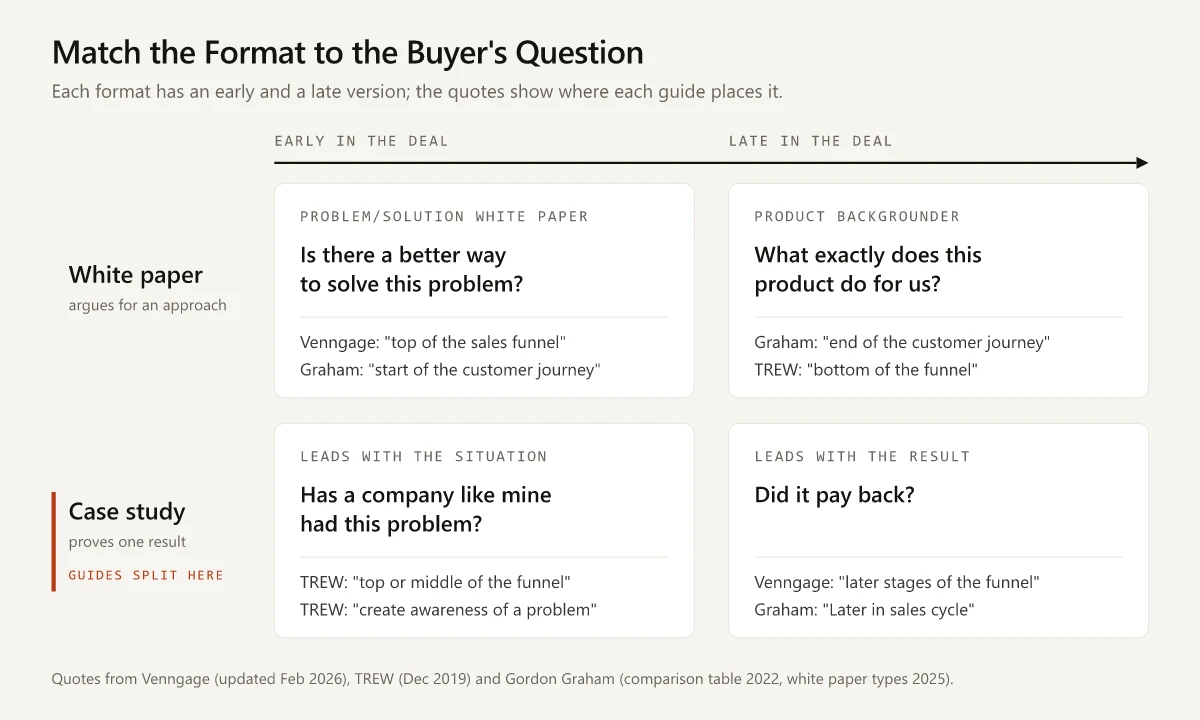
| What sales hears | The question underneath | Make this | What it leads with |
|---|---|---|---|
| Prospects describe the problem in terms your product does not address | ”Is there a better way to solve this problem?” | Problem/solution white paper | A widespread problem and why past fixes fell short |
| Prospects agree with the problem but say they are not like your other customers | ”Has a company like mine had this problem?” | Case study | The customer’s industry, size and the event that forced a change |
| Shortlisted evaluators ask how it works before the final pick | ”What exactly does this product do for us?” | Product backgrounder white paper | Features, each tied to a business benefit |
| The champion asks for numbers to take to finance | ”Did it pay back?” | Case study | A before number, an after number and the time window |
The two case-study rows can come out of one customer interview, and my customer story guide notes that teams tend to label the metric-led version a case study and the situation-led one a customer story. Lead with the customer’s situation and a reader recognizes their own company in the first lines; lead with the measured result and a champion can paste it into a business case. Publish the first where buyers research, and hand the second to the person who has to defend the spend.
Agree who owns each version before the interview is booked. My customer marketing vs product marketing matrix gives case studies to customer marketing by default, with product marketing filing the story angle and the proof point it must carry.
Graham’s third white paper type, the numbered list, has no fixed row: he says you can use one “anywhere in the customer journey”.
When a white-paper question and a case-study question come up equally often, start with the case study. On Graham’s figures it is the faster and cheaper of the two, and in CMI’s 2025 B2B benchmarks (980 B2B respondents, surveyed June to August 2024) 45% named e-books and white papers, which CMI counts as one category, among the most effective content types, behind 53% for case studies and customer stories. A short version of the case study can go into the white paper later.
Put a Case Study Inside a White Paper, Not the Reverse
Graham states the rule in a quick tip on his site: “You can include a case study in a white paper. But you can’t include a white paper in a case study.” The same tip puts a case study at 1,000 to 1,500 words and a white paper at “three or four times that long”.
His method, from the quick tip above and a longer piece on using a case study inside a white paper:
- Condense each case study to about 50 words: “one sentence for the problem”, “one for the solution” and “one for the results”.
- In a problem/solution white paper, place it “towards the end”, after you have presented your answer to the problem.
- Set it apart from the body text: the quick tip suggests sidebars, and the longer piece shows a circular text box for the 50-word version and sidebars for four case studies of under 300 words each.
His outline of the problem/solution type in the types guide shows why the end is the right spot. That paper “describes a widespread problem, and how every attempt to solve it has been unsatisfactory”, then “recommends a new, improved solution in generic terms”, and finally “shows how your product truly solves the problem best”. The 50-word case study lands in that last stretch, where a product claim needs a customer behind it.
Cut the 50-word version from the case study after the customer has approved it, so the white paper only repeats facts that are already signed off. End the white paper and the full case study with the same About paragraph your press releases carry, and check that its first sentence names a category and a buyer.
White Paper vs One-Pager: The Third Format
When the reader will give you one page and no more, a white paper and even a two-page case study are too long, and a one-pager is the format I would reach for. It suits an executive deciding whether to take a meeting or a champion forwarding proof to finance.
| One-pager | What goes on it | Question it answers | Free builder |
|---|---|---|---|
| Case study one-pager | Customer details, challenge, solution, three measurable results, a quote | ”Did it pay back?”, for a reader who will not open the full story | Case study template |
| Product one-pager | Product, problem, solution, differentiators, use cases, proof, a call to action | ”Is this worth a meeting?” | Product one-pager template |
Both builders run in the browser with no signup and export a PNG plus an optional US Letter PDF.
A one-pager can carry a white paper’s conclusion, but not the argument behind it. Graham makes the related point about case studies: “you can’t sum up a whole white paper in 50 words.” Give the one-pager the conclusion and one number, and link the white paper for the reader who wants the full argument.
White Paper vs Case Study Comes Down to the Buyer’s Question
Venngage, TREW and Graham place the case study at different ends of the funnel, and each is right about the document it has in mind. White paper vs case study stops being a stage debate once the buyer’s question is on the table: “is there a better way?” calls for a white paper, “has a company like mine had this problem?” calls for a case study that leads with the situation, and “did it pay back?” calls for one that leads with the number.
Pull every deal that stalled last quarter and write down the question each one got stuck on. The format that answers the most common one is your next asset.
Frequently Asked Questions
What is the difference between a white paper and a case study?
A white paper usually argues for a better way to solve an industry problem using research and data; a case study shows one customer's before-and-after result with your product. Gordon Graham's comparison puts a case study at 2 pages and a white paper at 5 to 12.
Is a case study top of funnel or bottom of funnel?
Both, depending on what it leads with. TREW puts case studies at the top or middle of the funnel and Venngage at the later stages: one that leads with the customer's situation helps early, and one that leads with a measured result helps when the purchase has to be defended.
Case study vs white paper: which should you create first?
Create the one that answers the question your deals stall on. If buyers do not yet see the problem the way your product solves it, start with a problem/solution white paper; if they see it but doubt it applies to them, start with a case study, which Graham prices at about a third of a white paper.
What is the difference between a white paper and a one-pager?
A white paper makes an argument over several pages, 6 to 12 in Venngage's guide. A one-pager puts a product or a customer result on a single page for a reader who will not open the long version, so it can carry a white paper's conclusion but not its argument.
How long is a white paper compared to a case study?
Venngage's guide puts white papers at 6 to 12 pages, roughly 2,500 to 5,000 words, and case studies at 2 to 5 pages, or 800 to 1,500 words. TREW gives about 2,000 words for a white paper and around 800 for a case study.