Thought Leadership Content: A Test Before You Publish
Most thought leadership content is published and cited by nobody. Run a three-part test on any draft: a disputable claim, evidence you own, a named byline.
Almost every B2B marketing team publishes something it files under thought leadership content, and almost none of it is treated as authoritative by the people it was written for. In the 16th annual B2B content marketing survey from Content Marketing Institute and MarketingProfs, published as B2B Content and Marketing Trends: Insights for 2026 and fielded 24 June to 14 August 2025 among 1,015 mostly North American B2B marketers, 4% rated their thought leadership program as leading and 7% as advanced. Everyone else sat at established or below.
Buyers grade it lower still. The 2024 Edelman-LinkedIn B2B Thought Leadership Impact Report surveyed nearly 3,500 management-level professionals across seven countries, and less than half said the overall quality of thought leadership they read is good, with only 15% describing it as very good.
The usual explanation for that gap is craft: sharper headlines, tighter edits, better design. My read is that the gap is structural and sits upstream of the writing. A piece carries authority when it makes a claim an informed reader could argue with, rests on evidence the publisher owns, and carries a named human byline. Most of what gets published fails all three at once, which is why it ships on schedule and gets cited by nobody.
What is thought leadership content? Thought leadership content is published work that advances a specific, disputable point of view about how a market works, backed by evidence the publisher owns and signed by a named expert. It is judged on the originality of the claim and the proof behind it, not on format or production quality.
Below is the test I would run on any draft before it publishes, the formats that can carry each kind of claim, four worked public examples, and what to do in the common case where you have no original data yet.
What Is Thought Leadership Content?
Thought leadership content is published work whose value comes from the idea inside it rather than from the product sitting next to it. The thought leadership meaning that holds up operationally is narrower than the phrase suggests: content that advances a position about how a market works, supported by proof the publisher can produce and a competitor cannot copy.
The cleanest way to define thought leadership is by what a reader carries away. If the takeaway is “this vendor exists and does X,” that is product content. If the takeaway is “I now think about this problem differently,” it qualifies.
| Content type | What the reader takes away | Who could have written it |
|---|---|---|
| Product content | This vendor sells X and it works this way | Only you, and nobody disputes it |
| How-to and SEO content | I know how to do the task now | Anyone working from the same brief |
| Brand content | I know what this company stands for | Only you, and it persuades nobody |
| Thought leadership | I changed how I think about the problem | Only someone holding the evidence |
If a competitor could publish the same piece next month with a different logo on it, the piece was never thought leadership.
Thought Leadership Is One Slot in the Content Plan
Thought leadership is one slot inside a wider content marketing framework rather than a replacement for it. The framework maps content types to buying-journey stages and buying questions. Thought leadership occupies the earliest stage, before a buyer has named a category, written a requirement, or asked finance for money.
It also has to agree with your positioning. A piece arguing that a category is obsolete, published by a company whose product positioning puts it squarely inside that category, reads as confusion rather than conviction. The claim inventory and the positioning statement are the same argument at two different altitudes.
Why Most Published Thought Leadership Earns Nothing
Two findings from the same CMI and MarketingProfs survey explain most of the failure rate.
The first is who writes. 37% of B2B marketers said fewer than 5% of employees with specialized knowledge or expertise actively contribute to their thought leadership. The people holding the operating detail are not in the document. So the writing gets done by people who have to source their evidence from other people’s published content, which produces a restatement by construction.
The second is what gets counted. 80% measure thought leadership success by audience engagement, meaning views, downloads and shares. Only 38% track brand authority signals such as speaking invitations, media opportunities and publication citations. Engagement is a production metric that any competent post earns. Citation is the authority metric, and it is the one fewest teams watch.
Those two findings compound. The expertise stays out of the document, and nothing on the scorecard registers that anything is missing.
The failure modes repeat:
- The category explainer that repeats a definition already available in the first three results
- The survey of other people’s surveys, where every number carries someone else’s footnote
- The trend roundup with ten predictions, none specific enough to be wrong
- The brand-voice essay with no author, so there is nobody for the reader to agree or disagree with
Each one is a decision made before a word was written.
The Three-Part Test for Thought Leadership Content
The test is three questions. Each has a yes or no answer, and a no is a rewrite instruction rather than an editing note. A draft that fails any one of them can still be useful content. It will not carry authority.
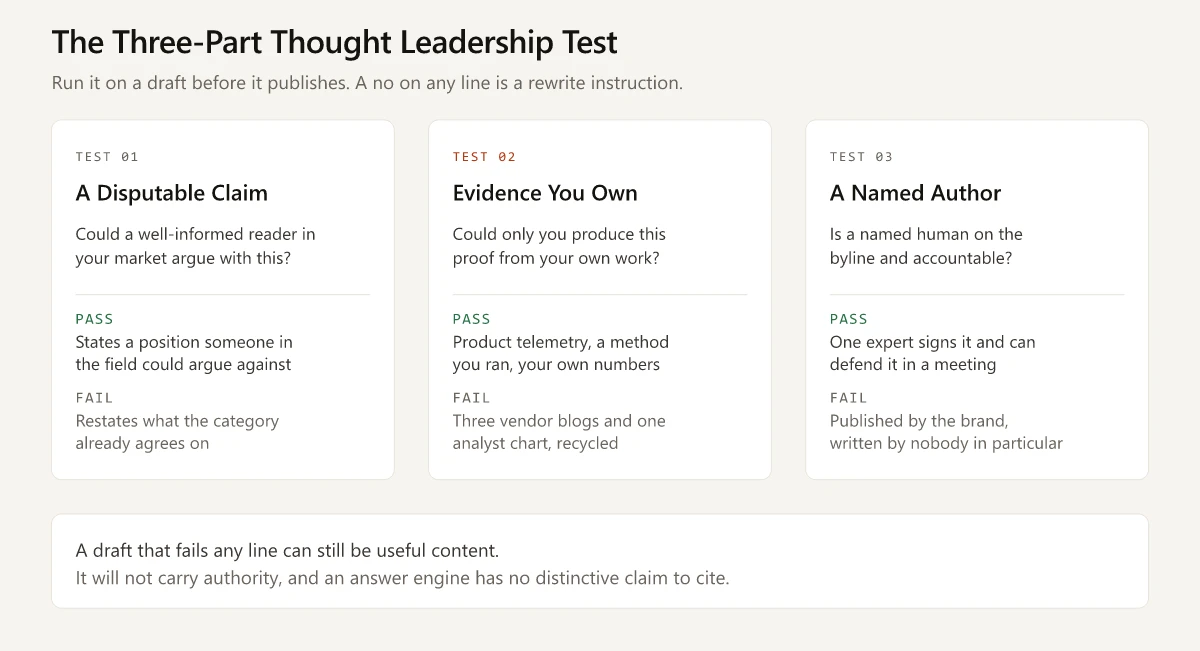
Test 1: Could an Informed Reader Disagree?
Write the claim as one sentence, then ask whether a competent practitioner in your market could read it and say “no, that is wrong.” If nobody could, you have written a description.
“AI is changing how B2B teams buy software” fails. Nobody in the market disputes it, which means nobody has a reason to quote it, link to it, or bring it into a meeting. “Buying committees now run three parallel evaluations before contacting any vendor, so first-call discovery scripts are asking questions the buyer answered six weeks ago” is disputable. Someone can produce a counter-example, which is exactly why it earns attention.
Buyers say the same thing in the research. Joe Kingsbury, Global Chair of Edelman Business Marketing, published findings from the 2025 report on 26 June 2025 showing that 81% of hidden buyers say high-quality thought leadership helps them understand previously unrecognized challenges or opportunities. Recognition of something already understood is not what they are shopping for.
The same page undercuts the safest-possible-take instinct directly. Asked what matters most at the moment of purchase, only 41% of hidden buyers picked “the safest choice,” while 85% named the vendor’s understanding of their business challenges, 76% named understanding of industry trends and 74% named domain expertise. Blandness is not the low-risk option it feels like in a review cycle.
How to fix a failing draft: find the sentence in it that your own sales team argues about internally, and make that the thesis.
A claim sentence that passes has four parts, and writing it before anything else forces the rest of the draft to behave:
Because [a condition that is true in this market],
[a named group] should [do a specific thing]
instead of [the current default],
and the proof is [the evidence you own].
If any bracket cannot be filled, the piece is not ready to be written.
Thought Leadership Insights Versus Opinions
The word insight gets attached to both, and only one of them survives a skeptical reader. An opinion is a preference you hold. A thought leadership insight is a finding you produced by examining something specific, and the sentence carries what you examined.
One question separates them: what did you look at to arrive at this?
“Onboarding should be self-serve” is a preference. Nothing was examined, and any competitor can write the same words. The finding version looks like this: “In 30 win-loss interviews run last quarter, buyers who switched from a competitor named the migration path rather than price as the deciding factor.” Same subject, different status, because the second sentence tells the reader exactly what to doubt.
Thought leadership insights also age differently. A preference stays true for as long as the author holds it. A finding gets re-run next year, which is what turns a one-off post into a recurring asset the market starts waiting for.
Test 2: Do You Own the Evidence?
Ownership is what makes a claim uncopyable. A competitor can restate your argument in a week. They cannot restate your data.
Owned evidence takes these forms:
| Shape | What it is | Example of the output |
|---|---|---|
| Telemetry | Aggregated behavior from your own product | A distribution nobody outside the company can compute |
| A method you ran | A process your team executed, published with results | A playbook with the numbers it produced |
| Operating detail | Your own costs, staffing, decisions, mistakes | A teardown with the real invoice in it |
| A reachable sample | A population only you can survey at scale | Original percentages with a disclosed method |
Borrowed evidence is the default failure. A post citing three vendor blogs and one analyst chart is arguing with materials every competitor has equal access to, which is why it reads interchangeable no matter how well it is written.
Buyers say the same. In the 2024 Edelman-LinkedIn edition, 55% of decision-makers cited strong research and data as a top characteristic of high-quality thought leadership, one of the three attributes that edition named.
Test 3: Is a Named Human Accountable?
A byline does two jobs. It gives the reader a track record to check, and it forces a scope decision, because a named author will not sign a sentence they cannot defend in a customer meeting. That single constraint removes most of the filler before an editor ever sees it.
Brand-voice essays fail this test by default. There is nobody to agree with, nobody to follow, and nobody who loses anything if the argument turns out to be wrong.
The named author has to be the person with the expertise, not the person with the most senior title. And ghostwriting is fine as long as the source material comes from the named author, which in practice means a recorded interview rather than a draft sent for approval.
Types of Thought Leadership Content
Most published lists of types of thought leadership content are lists of formats. Formats are a distribution decision made after the claim exists. Picking the format first is how teams end up with a well-produced webinar about nothing.
The useful version of the list maps each format to the kind of claim it can carry and the way it usually breaks.
| Format | The claim it can carry | How it fails |
|---|---|---|
| Original research report | A benchmark or distribution nobody else has | 200 anonymous respondents, no method disclosed |
| Operating teardown | What a real system cost and why | Sanitized in review until no number survives |
| Published method or playbook | A repeatable process you actually ran | A generic five-step diagram with no results |
| Position essay | An argument against category consensus | Contrarian about something nobody believed |
| Recurring index or data product | A number the market starts quoting | Published once, then abandoned |
| Executive interview | A judgment call with the reasoning shown | Ghostwritten platitudes under a founder’s name |
| Conference talk | An argument defended live under questions | A product demo with a title slide |
| Long-form thought leadership articles | A sustained case with primary citations | 2,000 words restating the category |
The pattern across the failure column: each one is a format that lost its claim somewhere in production. The webinar was booked, the research was commissioned, the essay was scheduled, and the argument was supposed to arrive later.
Thought Leadership Examples Checked Against the Test
Four public examples where the tests are checkable from the outside. Three of them required no research budget at all.
| Example | The disputable claim | The owned evidence | The byline |
|---|---|---|---|
| Datadog, State of DevSecOps | Severity scores overstate real risk | Telemetry from tens of thousands of applications | Company name, no individual author |
| Gong Labs | Reps talk too much, and there is a ratio | 326,000 recorded sales calls | Dan Morgese |
| 37signals cloud exit | Cloud rental costs more than owning hardware | The company’s own infrastructure invoices | David Heinemeier Hansson |
| Edelman and LinkedIn | Buyers you never meet decide the deal | A recurring survey of ~2,000 global professionals | Edelman and LinkedIn, no individual author |
Datadog Publishes What Its Customers’ Systems Actually Do
The State of DevSecOps 2026 report, released 26 February 2026, reported that 87% of organizations have at least one known exploitable vulnerability in deployed services and that only 18% of vulnerabilities labeled critical remain critical once runtime context is applied. The report is built on telemetry from tens of thousands of applications, plus additional datasets used for specific findings, rather than a survey.
The claim is disputable. Anyone running a vulnerability program can dispute whether runtime context should down-rank a CVSS score, and plenty do. The evidence is unavailable to any competitor without the same install base. That combination is why security teams quote the number in internal reviews.
It is also one of two examples here that fail the third test. The announcement quotes Andrew Krug, Datadog’s Head of Security Advocacy, but the research itself carries the company name and no individual researcher, which costs it the personal expertise signal. The dataset is distinctive enough to carry the piece without one, which is the trade a research-led program can afford and an opinion-led program cannot.
Gong Labs Turns Its Own Product Data Into a Number People Argue About
Dan Morgese, Director of Content Strategy and Research at Gong, published an analysis of 326,000 sales calls of at least ten minutes and reported that the average talk-to-listen ratio across all calls sits at 60% talking to 40% listening. Named author, disclosed sample, dataset that exists only because the company records the calls.
Sales leaders have argued about the right ratio for years, which is the point. A claim that ends the argument is less valuable than a claim that gives both sides a number to argue over.
37signals Published Its Own Infrastructure Bill
On 21 February 2023, David Heinemeier Hansson published We stand to save $7m over five years from our cloud exit, stating that the company spent $3.2 million on cloud in 2022, just under $1 million of which went on S3 storage left out of the first phase, and putting the replacement for the remaining $2.3 million at roughly $600,000 of hardware and about $840,000 a year to run.
No original research was commissioned. The evidence was a finance line item the company chose to publish while every peer treated the same number as confidential, down to a service-by-service breakdown of the 2022 bill posted the month before. Publishing the arithmetic is what let outsiders check it and argue with it. Operating detail is badly underused as a source of B2B thought leadership, because most companies have some and few publish it.
The Report About Thought Leadership Is Itself the Example
The Edelman and LinkedIn B2B Thought Leadership Impact Report has run since 2017 and reached its seventh edition in 2025, drawing on nearly 2,000 global professionals, visible and hidden decision-makers alike. That sample is hard for a single vendor to replicate, and each edition publishes a disputable thesis. On the byline it lands where Datadog does: the report is signed by two company names rather than a person, and the individual name quoted earlier in this piece belongs to a companion essay, not to the research.
It also shows how a recurring dataset becomes the number a market quotes by default, and what a gap costs. The archive is not unbroken. It skips 2023 and folds 2017 and 2018 into a single edition, and every miss is an opening for someone else’s number to become the default.
How Do You Build Thought Leadership With No Original Data?
You look for evidence the company already generates and never publishes. Most companies have more publishable evidence than they think, and treat it as internal by habit rather than by decision.
Ordered by how quickly each one produces a claim you can defend:
- Win-loss interviews. Thirty conversations with buyers who chose you and buyers who chose someone else produce a ranked list of real decision drivers. The program is worth running for its own sake; win-loss analysis is a standard product marketing function, and the published version costs one extra week of writing.
- Support and onboarding records. Your ticket queue holds an ordered list of the failure modes buyers hit in month one. Nobody outside your company has that list, and every prospect wants it before signing.
- A method your team ran. Publish the process with the numbers it produced, including the parts that did not work.
- Product usage data. Aggregated and anonymized behavior from your own product produces benchmarks nobody else can compute. This one takes the longest because of the review it needs, and it has the longest shelf life.
- A structured sample of your own users. A survey of your customer base or community is original research even at a few hundred responses, as long as you publish the sample size, the fielding window and the question wording.
- Public data recombined. Two public datasets that nobody has joined produce an original finding without any proprietary access at all. Job postings, pricing pages, app-store listings, regulatory filings and public financials sit there uncombined. The join and the method are the contribution, and both are publishable.
Customer conversations you are already having qualify too, provided somebody writes down the pattern. A customer discovery program that logs the same objection across 40 calls has produced a finding, whether or not anyone treated it as one.
Aggregate and anonymize anything customer-derived before it leaves the building, and publish the method next to the number, because a percentage with no denominator is decoration.
How to Build a Thought Leadership Content Strategy
A thought leadership content strategy is not an editorial calendar with better topics on it. It is a list of claims, an owner for each claim, an evidence source attached to each claim before writing starts, and a publishing rhythm the owners can actually hold.
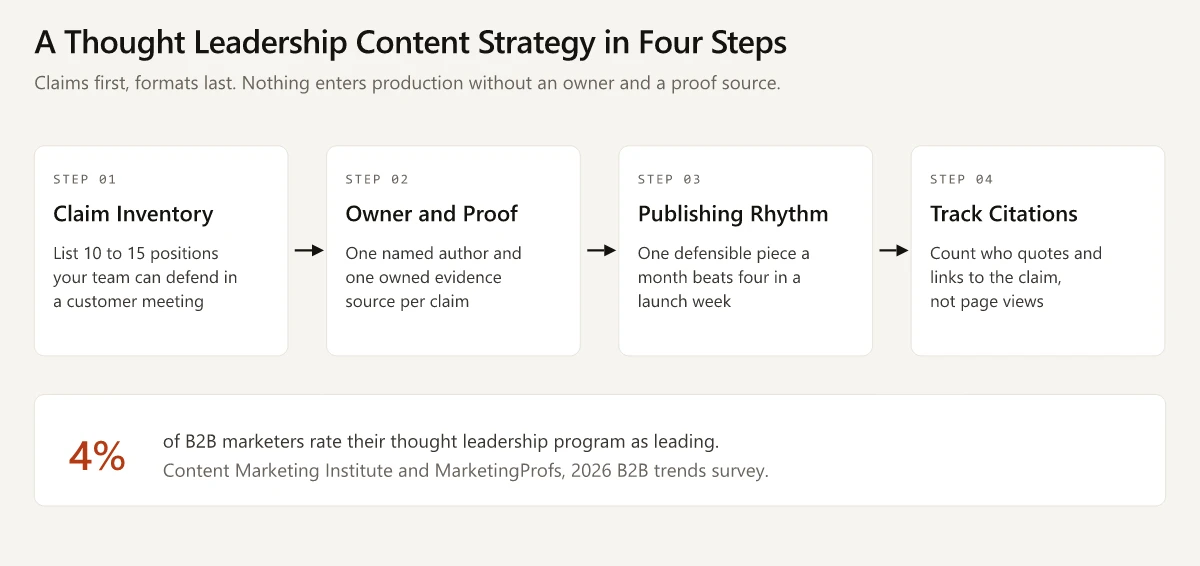
Build the Claim Inventory First
Get 10 to 15 claims on paper that somebody at the company can defend in a customer meeting. Run the session with sales engineers, support leads and the founders rather than with marketing alone, because the disputable claims live wherever the operating detail lives.
Score each claim on two axes: how strongly the company believes it, and whether evidence exists to support it. Only the top-right quadrant gets written. Everything else goes on a list of things to gather evidence for.
The inventory has to agree with your brand messaging framework. A claim that contradicts the messaging leaves two teams briefing the market differently, which reads as disorganization rather than nerve.
Give Every Claim a Named Owner
One person per claim, named on the byline, responsible for defending it publicly. Three to five named authors is a healthier program than one executive account carrying everything, because a single-author program collapses the day that person changes jobs.
The owner does not have to write the draft. They have to be interviewed, review the argument, and be willing to answer for it on a call.
Attach Evidence Before Anything Is Written
No writing starts until the claim has a source next to it in the inventory. This one step removes most of the failure rate, because a claim with no available evidence simply does not enter production, instead of entering production and getting padded with borrowed statistics.
Set a Publishing Rhythm You Can Hold
One defensible piece a month beats four in a launch week followed by a quiet quarter. Strategic thought leadership compounds through recurrence, and a recurring publication that skips two cycles loses the habit it built in its audience.
Set the rhythm by counting evidence, not ambition. Two evidenced claims a quarter means a quarterly rhythm.
Watch Citations, Not Views
Track who quotes the claim, who links to it, which analysts repeat it, and whether it shows up in sales calls without being sent. Views tell you the distribution worked. Citations tell you the argument did.
Review the inventory once a quarter against two questions. Did at least two new evidenced claims get added, or did the same claims come back wearing new headlines? And can anyone in the field name a piece they sent to a buyer without being asked to?
For developer audiences most of that reach happens on platforms the company does not control, and who owns each of those surfaces decides whether the work is repeatable or personal.
B2B Thought Leadership Reaches Buyers You Never Meet
The strongest practical case for b2b thought leadership is reach into a stakeholder your sales team will never book a meeting with.
The 2025 Edelman-LinkedIn report examined what it calls hidden buyers, the people in finance, legal, compliance, procurement and operations who neither use the product nor sign the contract but can stop the deal. Kingsbury’s summary of the findings reports that 71% of hidden buyers say they have little or no interaction with sales teams, while 63% spend more than an hour a week consuming thought leadership, close to the rate for target buyers.
What that reach converts into, among hidden buyers unless noted:
| Finding | Share |
|---|---|
| More receptive to sales and marketing outreach from consistent publishers | 95% |
| More likely to advocate for a proposal during an RFP | 79% |
| Say it is more effective than traditional sales material at showing value | 71% |
| Trust it more than product sheets when assessing capability | 64% |
| Say it helps them persuade other members of the buying group | 52% |
| Say it helps them convince C-level executives (hidden decision-influencers) | 51% |
| Say a senior executive has encouraged them to consider a vendor based on its thought leadership | 35% |
That last row describes the mechanism most programs are actually buying. The content does not close the deal. It arms the person inside the account who has to defend the choice in a room you are not in, which is what a messaging pillar does for a sales rep, one layer further out.
Thought Leadership and AI Answer Engine Citations
Answer engines made the ownership test measurable, because they publish their sources. Profound analyzed 680 million citations across ChatGPT, Google AI Overviews and Perplexity from August 2024 through June 2025 and found Wikipedia the single most-cited source in ChatGPT at 7.8% of citations, with Reddit leading in Google AI Overviews at 2.2% and in Perplexity at 6.6%.
Read that as a competitive statement. On ChatGPT, Wikipedia is the single most-cited domain in the dataset by a wide margin, and no other source is close. Definitional answers already have an incumbent, and the only reason an engine reaches past it for a vendor page is a number, a method or a claim that exists nowhere else. A benchmark from your own telemetry has no incumbent at all.
The three tests double as an answer-engine strategy. A disputable claim gives a model something specific to attribute. Owned evidence gives it a number with a source. A named author gives it an expertise signal to weigh. The tactical layer sits in brand visibility in AI search engines; the supply side of it is having something to cite.
Mistakes That Kill a Thought Leadership Program
Most of these are process defects that surface as writing defects.
| Mistake | What it looks like on the page | The fix |
|---|---|---|
| Hedging until nothing is disputable | ”can”, “may” and “in certain cases” stacked in one sentence | Name the condition under which the claim holds |
| Gating the argument | The thesis sits behind a form | Publish the argument, gate the dataset if you must gate something |
| Single-author dependency | The whole program is one executive’s social account | A second and third author, each on a claim of their own |
| Reporting reach only | A monthly deck of views, downloads and shares | Add citations, inbound links and unprompted sales usage |
| Chasing the news cycle | A reaction post to every announcement in the category | One evidenced claim outlasts ten timely opinions |
Gating is the trade most often made against a program’s own purpose. A claim nobody can read cannot be quoted by a journalist, repeated by an analyst, or cited by an answer engine. Choosing the form fill over the citation is defensible when the piece exists to fill pipeline, but that piece is a demand-generation asset wearing thought leadership styling, and it should be measured as one.
Start With One Claim You Can Defend
Thought leadership content fails upstream of the writing, which is good news, because the fix costs a meeting rather than a budget cycle. Pull the five people who talk to customers into a room, write down the claims they argue about, and find which ones already have evidence sitting in a ticket queue or a call recording.
Then pick one and put a name on it. Write the claim sentence before anything else.
Frequently Asked Questions
What is thought leadership content?
Thought leadership content is published work that advances a specific, disputable point of view about how a market works, backed by evidence the publisher owns and signed by a named expert. It is judged on the originality of the claim and the proof behind it, not on format or production quality.
What is the difference between thought leadership and content marketing?
Content marketing is the whole system of publishing to attract and convert an audience. Thought leadership is one slot inside it, aimed at the earliest stage of the buying journey, before a buyer has named a category or a budget. A how-to guide can be excellent content marketing and carry no thought leadership at all.
What are the types of thought leadership content?
Original research reports, operating teardowns that publish real numbers, published methods and playbooks, position essays that argue against category consensus, recurring data products or indexes, executive interviews, conference talks, and long-form articles. The format is a distribution choice made after the claim exists.
How do you build a thought leadership content strategy?
List 10 to 15 claims your team can defend, assign each one a named author, attach an evidence source to each before writing starts, set a publishing rhythm the authors can hold, and track citations and inbound links rather than views. A calendar without a claim inventory is a production schedule.
What makes B2B thought leadership effective?
Reaching stakeholders sales never meets. In the 2025 Edelman-LinkedIn B2B Thought Leadership Impact Report, 71% of hidden buyers in finance, legal, compliance, procurement and operations said they have little or no interaction with sales teams, and 79% said consistent high-quality thought leadership makes them more likely to advocate for a proposal during the RFP process.