Developer Community Strategy: Who Owns It, How to Measure
A developer community strategy that starts with the surfaces you do not own, names an internal owner for each one, and reports numbers that show the product moved.
The question that reaches a product marketer when a developer community strategy goes on the roadmap is usually about platform. Discord or a forum, who staffs it on a Sunday, whether a hosted community platform is worth the licence. The question that decides whether the program is still funded in twelve months is a different one: which number you put in front of a finance team, and whose calendar the work comes out of.
Start with where developers say they already spend time. The 2025 Stack Overflow Developer Survey asked 30,190 respondents which community platforms they had used considerably or consistently in the past year. Stack Overflow came in at 84.2%, public GitHub at 66.9%, Reddit at 53.7% and Discord at 38.9%. Company forum: 6.2%.
My position is narrower than the usual framing. The platform decision is the cheapest line in the document to reverse. The two that are not cheap to reverse are which surfaces you have to work without owning them, and which product number the community is graded on, and this post is built around those two.
What a Developer Community Strategy Has to Decide
A developer community strategy is a written answer to three questions, in this order.
- Which surfaces your developers already use, and which of those you can influence without owning.
- Who inside the company owns each surface, who supplies input to it, and who is graded on the result.
- Which product event the program reports against, and what that event cannot prove.
Tooling, moderation policy, badges, swag budget and the name of the Discord all follow from those three, and every one of them is cheap to reverse later. Moving from a Discord to a forum costs an export, a redirect and an announcement; the threads keep their content and the members keep their handles.
Ownership and measurement do not reverse at that price. Reassigning a surface means reopening a negotiation with two managers and editing somebody’s performance review, and it stalls when one of them never agrees. Changing the reported number after a finance team has seen the first version costs the program its standing with the only audience that renews its budget. That asymmetry is why the three questions run in the order above.
Two definitions are worth pinning before the rest of the document, because teams argue past each other on them:
- Community means people talking to each other about your product somewhere you can read it. One-to-many broadcast is content.
- Program means the staffed, budgeted version of that, with a named owner and a reporting line.
The division of labour between developer relations and marketing sits in the developer marketing operating model, which carries the artifact-level ownership table this post deliberately does not repeat. That table covers positioning, docs, talks and packaging. This one covers surfaces.
Developers Participate on Surfaces You Do Not Own
The survey question was “Which community platforms have you utilized considerably or consistently in the past year, and which would you like to use next year? Select all that apply.” Here is the answer set, for 30,190 respondents.
| Community platform | Share of respondents |
|---|---|
| Stack Overflow | 84.2% |
| GitHub (public) | 66.9% |
| YouTube | 60.5% |
| 53.7% | |
| Stack Exchange | 46.5% |
| Discord | 38.9% |
| 37.2% | |
| Medium | 29.3% |
| Hacker News | 19.6% |
| X | 17.1% |
| Slack (public) | 15.7% |
| Dev.to | 11.5% |
| Company forum | 6.2% |
The caveat belongs ahead of the conclusion here. Stack Overflow runs this survey, and its published methodology states that respondents “were recruited primarily through channels owned by Stack Overflow” and that “highly-engaged users on Stack Overflow were more likely to notice the prompts to take the survey”. The 84.2% figure for Stack Overflow itself is inflated by who was asked. What survives that is the distance between the general-purpose surfaces and the company-run one, which no sampling story explains away at a gap that size.
Participation is thinner than a platform list suggests. Asked how frequently they participate in Q&A on Stack Overflow, 32,183 respondents produced a distribution the survey summarises as “A combined 68% of respondents do not participate or rarely participate in Q&A”. Adding the four most frequent buckets in that chart - 5.9% weekly or a few times a month, 2.4% a few times a week, 1.0% daily, 0.6% multiple times a day - gives 9.9% who take part at least a few times a month.
That distribution is what makes a member count misleading as a headline number.
- On the one surface where participation has been measured at this scale, the regular posters are a single-digit slice. A program measured on posts per week is reporting on that slice and calling it the community.
- A community you launch is competing for the posting time of people who, on the surface they use most, already answer questions rarely.
Scale is the likeliest reason GitHub keeps turning up as a default meeting place. GitHub’s Octoverse 2025 report puts “180 million-plus developers” on the platform, with more than 36 million joining during the year and 1.128 billion contributions to public and open source repositories, up 13% year over year. Supabase runs organisation-level GitHub Discussions with categories for Questions, Troubleshooting, Feature Requests and Show and tell, which puts the conversation next to the code rather than one login away from it.
The Developer Community Surface Map
Each surface is good at a different job and supports a different product-linked measure. My position is that moving an audience off a surface it chose costs more than staffing that surface would have, and the last column is where that shows up.
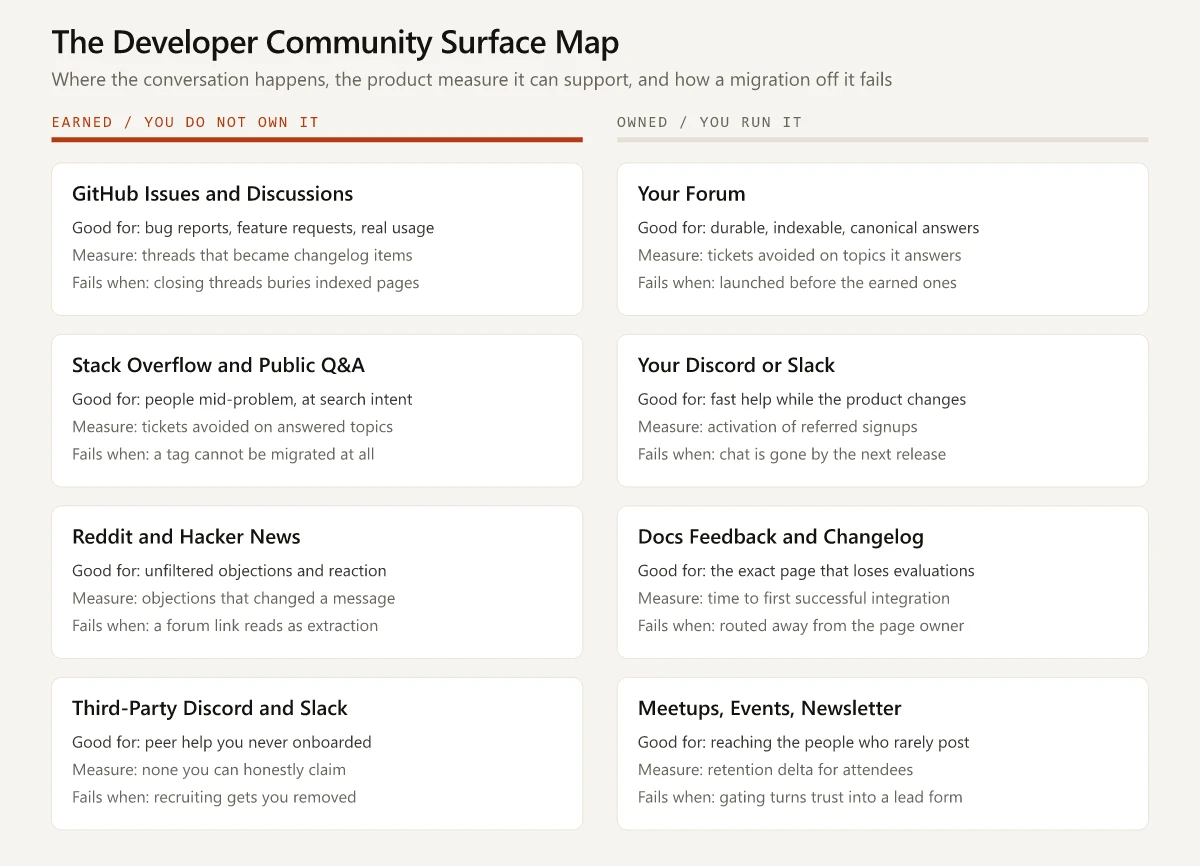
| Surface | Good at | Product-linked measure it supports | Failure mode when you try to migrate the audience |
|---|---|---|---|
| GitHub issues and discussions | Bug reports, feature requests, evidence of real usage | Public threads that became shipped changelog items | Closing discussions to push people to a forum buries the thread a search engine had already indexed |
| Stack Overflow and public Q&A | Catching people mid-problem, at the moment of search intent | Tickets avoided on topics with a canonical public answer | You cannot migrate a tag; unanswered questions stay ranked under your product name |
| Reddit and Hacker News | Unfiltered objections and launch reaction you would never get in a call | Objections that changed a messaging line | Dropping a link to your forum into a thread reads as extraction and gets treated that way |
| Third-party Discord and Slack | Peer help among users you never onboarded | None you can honestly claim | Recruiting from someone else’s server gets you removed from it |
| Your forum | Durable, indexable answers with a canonical URL you control | Tickets avoided on topics where your own thread is the answer that ranks | Launching one before the earned surfaces are staffed splits the same small pool of askers |
| Your Discord or Slack | Fast help for early users while the product still changes weekly | Activation of community-referred signups | Chat is not indexable, so the answer given at 11pm is gone by the next release |
| Docs feedback and changelog | Finding the specific page that loses evaluations | Time to first successful integration | Routing docs complaints into a forum hides them from the people who can fix the page |
| Meetups, events, newsletter | Reaching people who read everything and post nothing | Retention delta for accounts that attended | Gating a meetup recording behind a form converts a trust surface into a lead form |
The column that changes plans is the last one. Every migration failure in that table has the same shape: the audience chose the surface for a property your replacement does not have, usually indexability or the fact that other users are already sitting there. Who owns each of these is the next argument, and it gets its own table below.
Inside Five Vendor-Run Developer Forums
Owned forums are worth building. They are rarely the thing the strategy deck describes. On 2026-09-07 I opened the public category listing of five vendor-run developer forums and recorded the topic counts each one publishes on its own front page. For each forum I compared every category it lists, then took the product category with the highest count and the largest social or showcase category alongside it.
| Forum | Product category with most topics | Topics | Social or showcase category | Topics |
|---|---|---|---|---|
| Grafana | Grafana | 8,253 | Community Matters | 113 |
| HashiCorp | Terraform | 7,305 | HashiCorp User Groups, Events, and Meetups | 91 |
| Postman | Help Hub | 11,781 | Show and Tell | 31 |
| MongoDB | Working with Data | 5,982 | Community Highlights | 31 |
| Vercel | Help | 6,415 | Showcase | 575 |
In four of those five, on the day I read them, the product category carried more than 70 times the topics of the social category: Grafana 8,253 against 113, HashiCorp 7,305 against 91, Postman 11,781 against 31, MongoDB 5,982 against 31. Grafana is the narrowest of the four, at 73 to 1. Grafana’s forum header describes the job plainly: “Official Grafana Labs community forums. Get technical support for open source Grafana, Loki, and Tempo.”
Vercel sits apart in this set at roughly eleven to one, with a Feedback category at 657 topics and a Discussions category at 553 carrying real volume alongside Help. Docker’s forum does not offer the comparison at all: its eight categories are Announcements, General, Docker Desktop, Docker Hub, Docker Engine, Image Builds, Support and Archive, with no showcase, introductions or jobs section to count.
Caveats belong next to that table, because a count is easy to over-read.
- These are lifetime topic totals read on a single day, not activity, and they keep climbing after the reading. A category created in 2019 and one created last year are not comparable on volume.
- Where a forum lists several social categories I took the largest. HashiCorp lists five, totalling 149 topics, and taking its biggest rather than its smallest moves that row from 521 to 1 down to 80 to 1. The comparison holds either way; the smaller number is the one worth publishing.
- Category names are a rough proxy for intent. Some social conversation happens inside product categories, and some support questions land in showcase threads.
- Five forums is a sample I picked, not a random draw. The numbers are checkable on the linked pages; a pattern across the wider set is not something this count establishes.
What I take from it: budget an owned forum as a support and documentation surface with support-shaped staffing, and expect peer-to-peer conversation to keep happening on GitHub, Reddit and chat regardless of what you build. That framing also decides who pays for it.
How to Measure a Developer Community Against the Product
Community measurement usually stops at the community’s own health: members, posts, engagement rate, monthly active. Those numbers answer whether the community is alive. They do not answer the question a marketer gets asked in a quarterly review, which is whether the product moved.
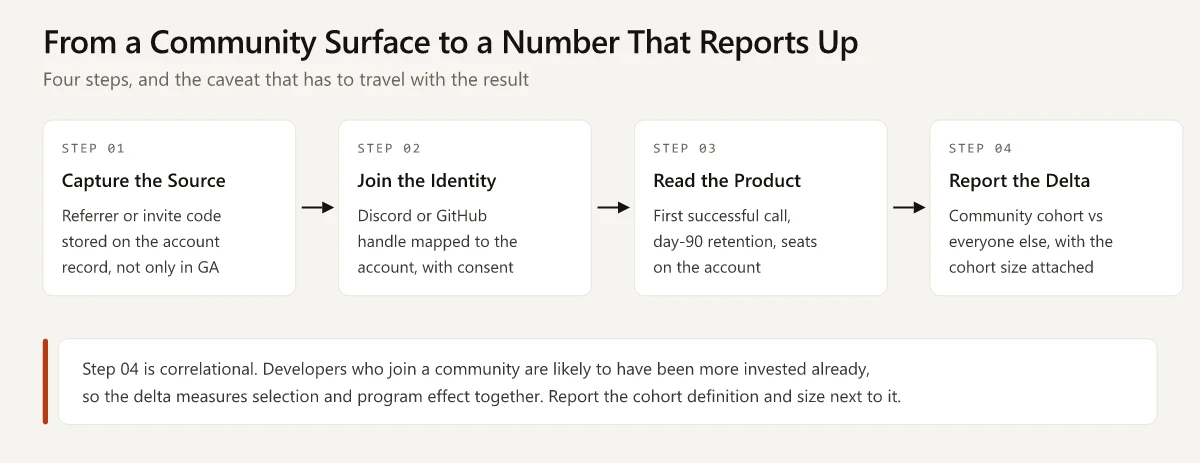
Five measures do answer it. Each one needs a specific piece of instrumentation, and each one has a limit that belongs on the same slide.
Behavioural measures tell you what people did, not why they stopped. Pairing them with a developer experience survey is how you get the perceptual half of the picture.
| Measure | What it counts | Instrumentation it needs | What it cannot prove |
|---|---|---|---|
| Activation of community-referred signups | Share of accounts arriving from a community surface that reach first successful use | Referrer or invite code captured at signup and stored on the account record, not only in analytics | That the community caused the activation; these people self-selected |
| Time to first successful integration, community versus everyone else | Median and 90th percentile days from signup to first non-error production call | An identity join between community handle and account email, plus the first-call event | Direction of causation; faster users are also likelier to join a community |
| Support deflection on answered topics | Ticket volume per 1,000 active accounts on topics that have a canonical public answer, against topics that do not | Topic tags shared between the ticket system and the forum or Q&A surface | Absolute savings, since you cannot count the tickets nobody filed |
| Retention delta for community-linked accounts | Day-90 retention for accounts with at least one linked community identity, against the rest | The same identity join, plus a retention definition agreed with finance | Anything at all, if the cohort is small or skewed to enterprise accounts |
| Changelog provenance | Count of shipped changes traceable to a specific public thread | A field on the ticket or pull request naming the originating thread URL | Revenue impact; it shows influence on the roadmap, not on the P&L |
Four of those five are correlational, for two different reasons. Three of them compare cohorts of people, and developers who join a community are likely to have been more invested already, so the comparison measures selection and program effect together without separating them. Support deflection compares topics rather than people, and its confound is that the topics which acquire a canonical answer tend to be the easier ones to answer.
Ways to get closer to causal, in increasing order of cost:
- Compare cohorts by time. Look at accounts created before a surface existed against accounts created after, holding the acquisition channel constant. Weak, cheap, better than nothing.
- Hold a group back. Invite half of a defined signup cohort to the community and leave the other half uninvited for a quarter. Uncomfortable to propose, and the version most likely to survive a real challenge.
- Use provenance instead of statistics. Changelog provenance is an audit trail rather than a correlation, which is why I would report it alongside the cohort numbers. If your release notes already credit the thread that prompted a change, most of the instrumentation exists; the practice is covered in the SaaS release notes guide.
If a quarterly review has room for one number, report the activation rate of community-referred signups against the same-quarter baseline for everyone else, with the cohort definition written next to it. It is the measure that fails soonest when the program is not working, which is what makes it worth reporting. The wider question of which numbers survive that room is covered in product marketing metrics.
The Developer Community Ownership Map
A developer community program is unusual in that the work is split across three functions by default and graded on none of them. DevRel answers in the Discord, support answers in the forum, and product marketing has to produce the number. Nobody’s performance review is attached to the program itself, so it disappears at the first headcount review.
Name one owner per surface who is graded on it, one input supplier who has a deadline rather than a veto, and one escalation path.
| Surface | Owner, graded on it | Supplies input | Escalation when it breaks |
|---|---|---|---|
| GitHub issues and discussions | Engineering manager for the repo | DevRel on triage tone, support on recurring issues | Product on anything needing a roadmap decision |
| Stack Overflow and public Q&A | Support lead | Engineering on correctness | DevRel when an answer needs an author with a name |
| Reddit and Hacker News | DevRel | Product marketing on claims, legal on anything contractual | Communications on a launch-day thread |
| Third-party Discord and Slack | Individual attendance, not a function | Nobody. It is not yours | None. You are a guest |
| Your forum | Support lead | DevRel on programming, product marketing on categories | Product marketing when answer rate drops |
| Your Discord or Slack | DevRel | Support on the rota | Support lead when volume outgrows the rota |
| Docs feedback and changelog | Product marketing with the docs owner | Engineering on accuracy | Engineering on anything that is a bug |
| Meetups, events, newsletter | DevRel | Product marketing on claims and sequencing | Finance on budget |
| The measurement model and the reported number | Product marketing | Data or analytics on the joins | Finance on the retention definition |
Whoever reports the number decides what the program is judged on, which is what makes the last row the one to negotiate hardest. If it lands with the same person who runs the Discord, the reported number will describe the Discord.
Community input also needs a route into product decisions that does not depend on anyone’s memory. Public threads are unstructured and skewed toward whoever posts most, so treat them as one input among several rather than as the customer voice, and pair them with the structured methods in the voice of the customer breakdown. Where you need a small group of named accounts giving structured feedback on a schedule, that is a customer advisory board, a different program with a different budget line.
Community Health Metrics Still Belong in the Report
Dropping health metrics because they do not tie to the product is the opposite mistake. They are the leading indicators, and they move weeks before the product-linked numbers do.
| Health metric | Why it leads | Where to read it |
|---|---|---|
| Time to first response | Predicts whether a second question ever gets asked | Forum software reports it; chat needs a bot |
| Share of questions with an accepted answer | An unanswered thread indexed under your product name is a liability | GitHub Discussions marks answers in Q&A categories |
| Share of answers written by non-employees | Shows the community doing work you would otherwise pay for | Tag employee accounts and count the difference |
| Repeat contributors per month | Separates a community from a queue of one-time askers | Forum or GitHub contributor exports |
| Question resolution rate by topic | Points at the docs page that needs rewriting | Topic tags on threads and tickets |
The Orbit Model is one published framework for this style of measurement, released under an MIT licence with love, reach, gravity and impact as its four metrics, and orbit levels as a member classification built on top of the love metric. Impact is the one that reaches for outcomes, and it is defined there as “the outcomes that happen thanks to the operation of the community”, which is closer to the product half than the rest of the model gets. Its own README states the project is no longer under active development, which is worth knowing before a team adopts it wholesale. Its structure is still a reasonable starting point for the health half of a report; it was never built to answer the product half.
Report both halves on one page, with the health metrics as the leading block and the product-linked measures as the trailing block. Mixing them into a single score hides which one moved.
A 90-Day Developer Community Strategy
This assumes a product that already exists, developers already talking about it somewhere, and one or two people to do the work. Instrumentation comes before volume, because a program you cannot measure gets judged on member count by default.
| Phase | Weeks | Deliverable | Test that it worked |
|---|---|---|---|
| Inventory | 1-2 | Every surface where your product name appears, with volume, response time and whether anyone from the company is present | You can name the surface holding the most unanswered questions |
| Ownership | 2-4 | One named owner per surface, one input supplier, one escalation path, agreed with those managers | Each owner can state their surface and their measure without looking it up |
| Identity join | 3-6 | A mapping from community handle to account record, with a documented consent basis | You can produce a list of accounts with a linked community identity |
| Baseline | 5-8 | Activation rate, day-90 retention and median time to first successful integration, split by whether the account has a community identity | You have a delta with a stated cohort size |
| Staff the earned surfaces | 6-10 | A rota answering GitHub and public Q&A within a stated response target | Time to first response drops and is reported weekly |
| One owned surface | 9-12 | Either a forum or a chat server, launched with the support rota already in place | Share of questions with an accepted answer clears a bar you set before launch, which for me is 80% in month one |
| Report | 12-13 | One page: health metrics leading, product-linked measures trailing, caveats attached | A finance reviewer can restate what the number does not prove |
If a week slips, keep the order and move the dates. Ownership before instrumentation, because an unowned surface produces data nobody acts on. Instrumentation before launching anything new, because the baseline stops existing the moment you change the inputs.
How Developer Community Programs Lose Their Budget
Six ways the funding goes, each one an ordinary-looking decision on the day it gets made.
- Reporting member count. It rises during a layoff and during a spam wave, so a finance reviewer learns to discount every number sitting next to it on the page.
- Answering the easy questions and leaving the hard ones. The skipped threads are the ones an evaluator reads before committing, and the pattern is visible at a glance on any category page that shows reply counts.
- Giving the community program to whoever has the most spare capacity. Capacity is not a qualification, and the assignment gets reversed the next time that person is busy.
- Publishing a response-time target the rota cannot hold on a Friday. A stated target that slips becomes evidence against the program in the same review that funded it.
- Building the identity join with no consent basis. A Discord handle attached to an account record is personal data under the GDPR definition and the join itself is processing, so document the basis before the dashboard exists rather than after.
- Reporting a cohort delta with no cohort size. A retention gap computed on 40 accounts will be challenged, and the challenge will be correct.
The denominator is what makes the first one survivable. Put it next to every community number you report, every time, including the ones that flatter you.
Your First Move on a Developer Community Strategy
Search your product name plus the word error, and read the first two pages of results as a stranger would. Note every thread with no answer, every answer written by someone who does not work for you, and every surface where the conversation is happening with nobody from your company in it.
You now have an inventory nobody had to commission and nobody can argue with, because every line of it is a URL. Assign an owner to the surface holding the most unanswered questions, give that owner one product-linked measure to report by the end of the quarter, and leave the platform question alone until both of those exist.
Frequently Asked Questions
What is a developer community strategy?
A developer community strategy is a written answer to three questions: which surfaces your developers already use, who inside the company owns each surface, and which product event the program reports against. Platform choice comes last and is the cheapest decision to reverse.
How do you measure a developer community?
Measure it against the product, not against itself. Track activation of community-referred signups, time to first successful integration for community members versus everyone else, support tickets avoided on topics with a public answer, and retention for accounts with a community-linked user. Most of those are correlational unless you hold a cohort back.
Who should own a developer community?
Split it by surface rather than giving one person all of it. Developer relations owns relationships and public presence, support owns answer quality and response time, and product marketing owns the measurement model and the number that reports up. Name one person per surface who is graded on it.
Should we build our own developer community platform?
Only after you have staffed the surfaces where your developers already are. In the 2025 Stack Overflow Developer Survey, 6.2% of 30,190 respondents named a company forum among the community platforms they had used considerably or consistently in the past year, against 84.2% for Stack Overflow and 66.9% for public GitHub.
How long does it take to build a developer community?
Plan a quarter to get instrumentation and ownership in place before judging the program on volume. The first 90 days should produce a surface inventory, one named owner per surface, an identity join between community handles and account records, and a baseline activation rate to compare against.