Customer Advisory Board: Setup, Scorecard, 5 Ways It Dies
How to run a customer advisory board as an instrumented program: member criteria, a copy-paste charter, an hour-by-hour agenda, and a 7-metric ROI scorecard.
A customer advisory board is a standing group of senior customers, usually eight to fifteen, that meets on a fixed cadence under NDA to give a vendor strategic input on roadmap, pricing, and market direction. It runs on a written charter with defined membership terms and rotation, and it is distinguished from every other feedback format by one obligation: the vendor has to report back on what it did with the input.
HubSpot’s 2026 Customer Advisory Board is a named 51-person cohort of leaders drawn from marketing, sales, revenue operations, customer experience, and technology, published in full with the next application window already dated (HubSpot, February 2026).
Companies do not publish a roster that specific for a program they expect to quietly drop. A standing room of senior customers who talk to you on the record is one of the few high-fidelity input channels left, which is why the serious ones treat it as infrastructure rather than an event.
Here is the position I will defend in this post: a customer advisory board is an instrumented program, not a semi-annual offsite. If you cannot produce a number for what two meetings a year returned, you do not have a board, you have a catering line item with good intentions. The setup half is table stakes. The operating half is where boards live or die. A board with no instrumentation cannot be diagnosed, so it degrades quietly for three or four cycles and then gets cut in a budget round nobody saw coming.
What Is a Customer Advisory Board?
A customer advisory board is a governed forum, not a recurring meeting. Eight to fifteen senior customers sit on it, under NDA, on a fixed cadence, advising on roadmap, pricing and market direction. What separates it from every other customer conversation is the written charter behind it: fixed membership terms, a rotation schedule, and a stated obligation on the vendor to report back on what it did with the input.
Four things routinely get called a CAB. Only one of them is:
| Format | Membership | Cadence | The vendor owes members |
|---|---|---|---|
| Customer advisory board | Named, senior, fixed term | 2 to 4 sessions a year | A written answer on every ask |
| User group or community | Open, self-selecting | Continuous | Nothing formal |
| Focus group | Recruited per session, often paid | One-off | Nothing after the session |
| Beta or design partner program | Product-specific, tactical | Per release | Access to the build |
The three rows above are separate programs with separate exit conditions, and picking the wrong one is common enough to be worth its own decision table: see design partner vs beta customer for the trigger that routes you to each. The board sits at the strategic end of a broader listening system. It is one input in a voice of the customer program, and the most expensive one per data point, which is exactly why it needs measuring.
Some companies use “customer council” for the same thing. Others split the two: an executive board for strategy, an operator-level customer council for workflow detail. Either naming works. Put your choice in the charter.
Who Belongs on a Customer Advisory Board (and Who Does Not)
Selection is the one setup decision you cannot fix later. Wrong seniority produces feature requests instead of strategy, and no agenda design rescues it.
Who belongs:
- Decision makers, not day-to-day users. The person who signs the renewal or owns the budget line. Users belong in a customer council or a beta program.
- Accounts with a stake in your direction. Deep enough usage that your roadmap changes their plans.
- At least two accounts that are not delighted. A board of champions produces applause. Include customers who have escalated, if they are still invested.
- Range across segment and maturity. Enterprise and mid-market, early and late tenure, one adjacent industry.
- People who will actually speak. Ask a nominee one hard question in the screening call. If they hedge there, they will hedge in the room.
Who does not:
- Anyone whose renewal is at risk this quarter. That is a save conversation, and mixing the two poisons both.
- Your loudest advocate, if they are already on three panels. Advocacy and advisory are different jobs.
- Resellers, agencies, and implementation partners. Their incentives differ from an end customer’s. HubSpot’s public CAB program page rules them out explicitly, alongside anyone who has previously served on the board.
- Anyone your account team wants in the room to be upsold.
HubSpot’s published criteria are a useful floor to copy: a current paid subscription, a decision-making role, meaningful hands-on product experience, availability for at least 75% of meetings, and a signed NDA, for a 12-month term at an estimated 8 to 10 hours of participation.
That 75% attendance floor is the detail worth stealing. It turns a vague expectation into a measurable condition of membership, which becomes the first metric on the scorecard below.
What Goes in a CAB Charter
The charter is a one-page document you send to every nominee before they accept. It prevents about half the failure modes in this article, and it is the easiest step to skip because nothing breaks on the day you skip it.
Copy this, fill the brackets, and put it in the invitation email:
[COMPANY] CUSTOMER ADVISORY BOARD CHARTER

1. PURPOSE
The board advises [COMPANY] on product direction, category strategy,
and pricing. It is an advisory body. It does not set roadmap, and
[COMPANY] retains all decision rights.

2. MEMBERSHIP CRITERIA
- Active paying customer, [minimum tier or ARR band]
- Sponsor-level decision maker: [titles]
- Live deployment for at least [6] months
- Not a reseller, agency, or implementation partner
- Available for at least 75% of scheduled sessions

3. SIZE AND COMPOSITION
[10-12] member accounts, one primary seat each. Composition target:
[X] enterprise, [Y] mid-market, no more than [2] per vertical.

4. TERM AND ROTATION
[12]-month term, renewable once. At least [one third] of seats
rotate each cycle. Rotation is automatic, not a performance judgment.

5. CADENCE AND COMMITMENT
[2] in-person sessions and [2] virtual sessions per year.
One 30-minute pre-interview before each session.
Estimated total commitment: [14-16] hours per year.

6. CONFIDENTIALITY
All members sign a mutual NDA. Unreleased roadmap shared in session
is confidential. Member-to-member commercial information is not
recorded, summarized, or shared outside the room.

7. COMPETITIVE CONFLICT
Direct competitors will not be seated in the same cycle where their
markets overlap materially. Where overlap is partial, competitively
sensitive topics move to a one-to-one session.

8. WHAT MEMBERS GET
Early access to product plans, direct executive time, peer network,
and a written response to every request raised, within 30 days.

9. WHAT MEMBERS DO NOT GET
Preferential pricing, support SLAs, or guaranteed roadmap placement.
Membership is not a commercial concession.

10. EXIT
Members may step down at any time. Seats lapse after two consecutive
missed sessions. [COMPANY] confirms continuation in writing each cycle.
Recompute the hours in clause 5 against your own cadence before you send this to anyone. Two four-hour in-person sessions, two virtual sessions, and four 30-minute pre-interviews land nearer 14 hours than HubSpot’s all-virtual 8 to 10. Understating it is the first broken promise a member notices.
Clause 9 does more work than it looks. Without it, the first thing a member asks for is a discount, and the board becomes a negotiation channel.
The CAB Agenda, Hour by Hour
The rule that separates a good session from a bad one is talk-time split: members hold roughly 80% of the floor, the vendor 20%. Invert it and you have run a briefing, not a board.
Here is a four-hour session that holds the ratio:
| Time | Block | Who holds the floor | Output |
|---|---|---|---|
| 0:00 - 0:10 | Welcome, charter, rules of engagement | Host (10 min) | NDA reminder, this session’s decision on screen |
| 0:10 - 0:40 | Closing last cycle’s loop | Host (30 min) | Every prior ask shown as shipped, scheduled, or declined with a reason |
| 0:40 - 1:50 | Member problem round | Members (70 min) | 6 to 8 uninterrupted minutes each, no vendor rebuttal |
| 1:50 - 2:05 | Break | Members (15 min) | Unstructured peer time, deliberately protected |
| 2:05 - 3:05 | Deep dive on one live decision | Members (60 min) | A ranked position on a real roadmap or pricing choice |
| 3:05 - 3:50 | Peer exchange, vendor listens only | Members (45 min) | The block members come back for |
| 3:50 - 4:00 | Commitments and owners | Host (10 min) | Named owner and date against every ask raised |
That is 50 minutes of vendor talk-time against 175 minutes of member talk-time, near enough to 80/20.
Three details that carry the agenda:
- The pre-interview. A 30-minute one-to-one with each member two weeks before the session. It surfaces what they actually want to discuss, so the agenda comes from their input rather than your slides.
- Loop closure goes early. Putting it at 0:10 tells the room last cycle’s asks were real. Putting it at the end means it gets cut when you run long.
- One decision beats five topics. A board is most valuable when it is arguing about a live choice with a deadline.
How to Measure Customer Advisory Board ROI: The CAB Scorecard
This is the half a board program usually has no numbers for, and the exposure is real. A board is usually a small line item owned by one person, which makes it one of the easiest things in the plan to cut when budgets tighten. “The customers really enjoyed it” does not survive that conversation.
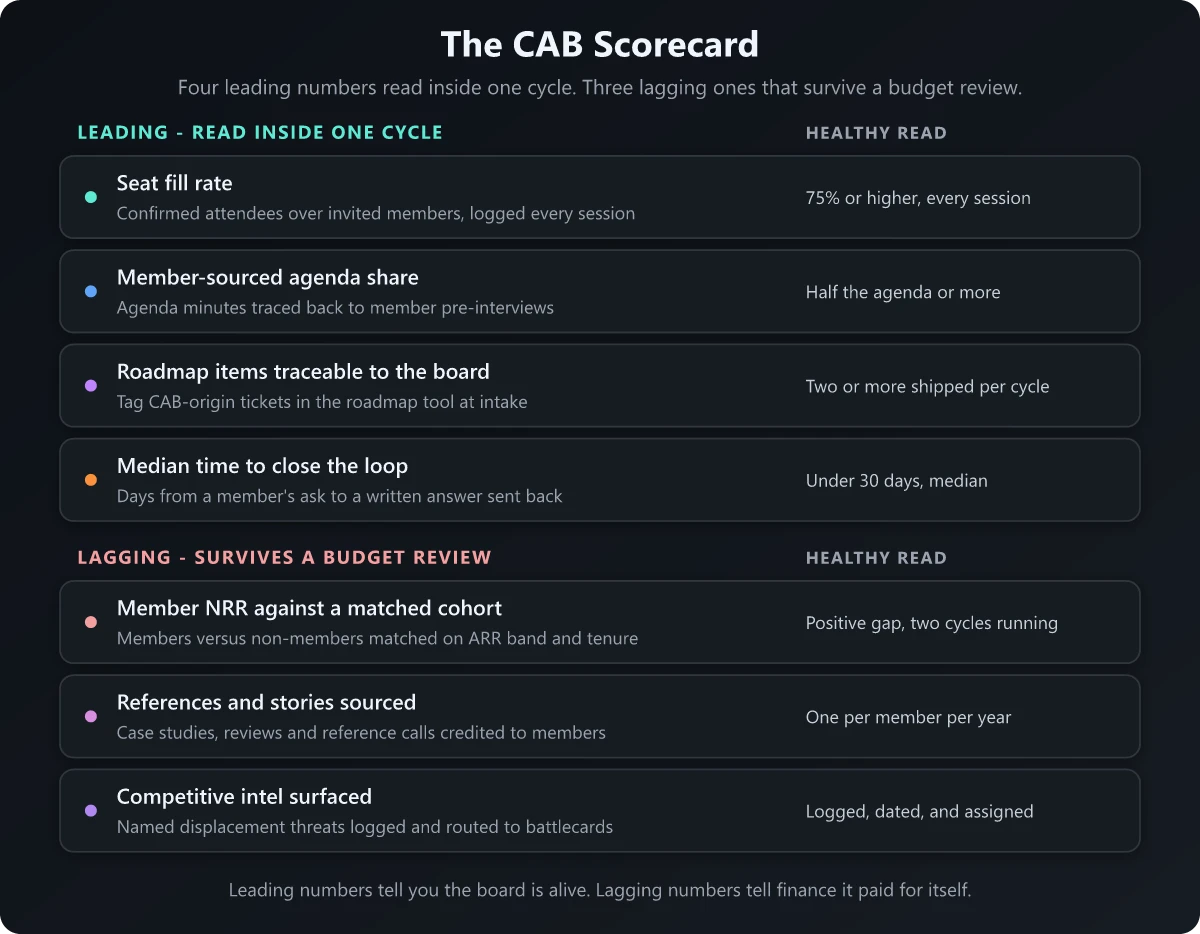
The scorecard has two halves. Leading indicators tell you inside one cycle whether the board is alive. Lagging indicators are what you take into a budget review. Both belong in your standing product marketing metrics reporting.
Four Leading Indicators You Can Read Inside One Cycle
- Seat fill rate. Confirmed attendees divided by invited members, logged every session. Healthy read: 75% or higher. This is the number HubSpot turned into a condition of membership, and it is the earliest signal of decay.
- Member-sourced agenda share. Agenda minutes traceable to a member pre-interview, divided by total agenda minutes. Healthy read: half the agenda or more. When it falls, you have started running your meeting instead of theirs.
- Roadmap items traceable to the board. Tag CAB-origin tickets at intake in whatever tool holds your roadmap. Healthy read: two or more shipped per cycle. Without intake tagging this is unrecoverable later, so instrument it before session one.
- Median time to close the loop. Days from a member raising an ask to a written answer landing back with them. Healthy read: under 30 days. Use the median, because one fast answer hides ten slow ones.
You can read all four eight weeks in, with no revenue data at all.
Three Lagging Indicators That Survive a Budget Review
- Member NRR and expansion against a matched cohort. The load-bearing one. Method below.
- References and stories sourced. Case studies, review-site posts, and reference calls credited to board members. Healthy read: one per member per year. Every board member should end their term having produced at least one reusable asset, which is why a customer success story template belongs in your post-session workflow.
- Competitive intel surfaced. Named displacement threats and evaluations logged, dated, and routed into battlecards. Board members will tell you who else is in their building months before it shows up in a deal. That intel is worth more when it feeds the same repository as your win-loss analysis questions.
On references: the formal proof sources are collapsing. TrustRadius’s 2026 B2B Buying Disconnect report, based on responses from 1,862 technology buyers surveyed in January 2026, found analyst reports were used by only 13% of buyers, a 63% decrease since 2022. Your board is a concentrated supply of the customer-voice evidence that is displacing them.
The Matched-Cohort Method
“Our CAB members renew better” is the claim every program makes and no program can defend. Of course they renew better. You invited your healthiest, most engaged, best-adopted accounts. Without a control group, the number measures your invitation list, not your board.
The fix is a matched cohort.
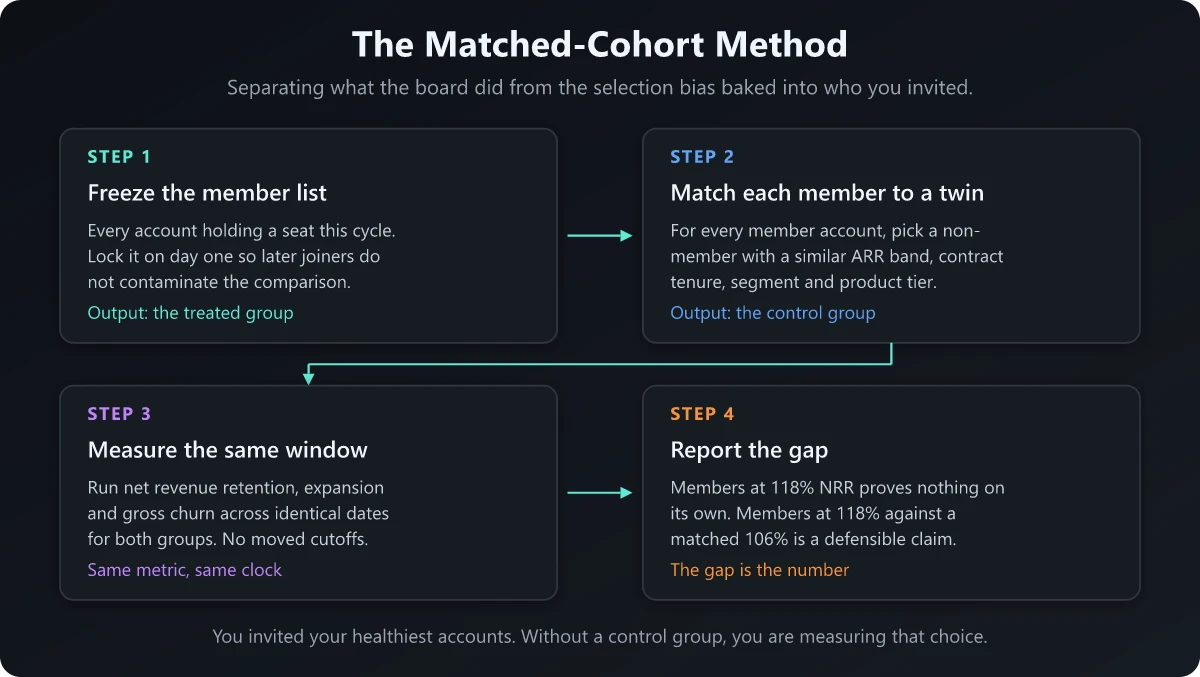
- Freeze the member list on day one of the cycle. Later joiners contaminate the comparison.
- Match each member to a twin. For every member account, pick a non-member with a similar ARR band, contract tenure, segment, and product tier. One-to-one matching is enough, no statistics package required.
- Measure both over identical dates. Net revenue retention, expansion, and gross churn, same window, no moved cutoffs.
- Report the gap. Suppose members land at 118% NRR. Alone that proves nothing. Members at 118% against a matched cohort at 106% is a twelve-point gap you can put in front of a CFO.
The gap matters more than the level because retention varies enormously inside a single segment. SaaS Capital’s 2025 retention research shows a fourteen-point spread between the top and bottom quartiles of net revenue retention inside a single ACV band for private B2B SaaS companies. A spread that wide inside one band means an unmatched comparison can produce any answer you want.
Run the comparison over two consecutive cycles before claiming a trend, and put the matching criteria on the same slide as the result. A number whose method is visible survives scrutiny.
The Five Ways a Customer Advisory Board Dies
Boards rarely fail loudly. They decay through one of five patterns, each with an observable symptom that shows up well before the damage.
| Failure mode | First observable symptom | The fix |
|---|---|---|
| 1. Attendance decay | Members stop replying to the calendar invite for weeks, then accept late. Acceptance latency rises before attendance falls | Track days-to-accept per member. Call anyone over ten days personally, not by email |
| 2. Two members own the room | Two names appear in every session summary. Others speak only when addressed | Enforce the timed problem round. Ask silent members a direct question by name in the pre-interview, then hand them the floor first |
| 3. Asks go into a black hole | Median time-to-close-the-loop drifts past 30 days. Members start prefacing requests with “I know you probably can’t” | Written disposition on every ask within 30 days, including a reason for the ones you decline. Declines close loops too |
| 4. Membership never rotates | Same seats for three cycles. Discussion drifts to legacy grievances that new customers do not share | Automatic term expiry in the charter. Rotate at least a third of seats each cycle so rotation is never a judgment on a person |
| 5. The agenda gets captured | Vendor talk-time climbs past 40%. Member-sourced agenda share falls below half | Rebuild the agenda from pre-interviews only. Cut every slide that is not a decision the board is being asked to weigh in on |
Failure mode 5 arrives dressed as helpfulness. Product wants a demo slot, sales wants ten minutes on the new tier, an executive wants to present the vision, and the member problem round shrinks to make room. The scorecard catches it a cycle before anyone stops attending.
Close the Loop or You Are Funding an Expensive Focus Group
Everything above is logistics except this. Closing the loop is the mechanic that makes a board different from a focus group, and it is the step that quietly decides whether the board survives.
The mechanic is unglamorous:
- Capture every ask in the room, named to the member, on screen where they can see it recorded.
- Assign a named owner and a date before the session ends. “Product will look at it” is not an owner.
- Send a written disposition within 30 days. Every ask gets one of four statuses: shipped, scheduled with a target, under evaluation with a decision date, or declined with a reason.
- Open the next session with that list. Publicly, before anything else.
The status that builds the most credibility is “declined, and here is why.” Members are senior operators who make trade-off calls all day, so a clear no with reasoning reads as respect. Silence reads as the board being decorative, and senior people stop spending calendar time on decorative things.
It is the same discipline that makes customer enablement work. Credibility comes from follow-through the customer can observe, on a clock they can measure.
Customer Advisory Board Best Practices That Change Outcomes
Skip the generic advice. These are the practices that move the scorecard:
- Run a pre-interview before every session. Half your agenda should come from these calls. It is the highest-leverage 30 minutes in the program.
- Put one live decision on the table. A choice with a real deadline and real trade-offs. Members can smell a rhetorical question.
- Protect unstructured peer time. The break and the dinner are not filler. Peer access is much of why senior people accept the seat at all.
- Never sell in the room. No pricing conversations, no upsell, no account team ambush. One breach and members stop being candid for the rest of the term.
- Instrument before you invite. Roadmap intake tags, an ask log with owners and dates, and the frozen member list must exist before session one. Retrofitting is not possible.
- Rotate on the calendar, never on a judgment call. Automatic term expiry means nobody has to be told they were not adding value.
- Harvest references at the moment they appear. Ask for the case study, the review, or the reference call when a member says something good in session, not six months later. Who chases that reference afterwards is a live customer marketing versus product marketing boundary worth settling before session one.
- Give the board a named executive sponsor who attends every session. When the sponsor starts sending a delegate, the program has entered failure mode 1 whether attendance has moved or not.
- Report the scorecard on your normal cadence. A quarterly slide with seven numbers turns a soft program into a defensible one.
What Good and Bad Customer Advisory Boards Look Like
Two public programs show the range of legitimate shapes.
HubSpot runs the structured-cohort model. A formal application window, a 12-month term, a 75% attendance requirement, a signed NDA, and quarterly virtual sessions of up to two hours. It also publishes the cohort: the 2026 Customer Advisory Board announcement, dated February 2026, names all 51 members and dates the next application window for September 2026. Publishing the roster recognizes members publicly and makes rotation normal.
G2 runs the small-and-senior model. G2’s Executive Advisory Board, announced in July 2023, seated 13 named marketing executives from customer accounts including IBM, HubSpot, SAP, UiPath, and ZoomInfo, convened for strategic input on G2’s solutions and go-to-market. Small enough that every member speaks in every session.
Neither shape is wrong. The differences that matter:
| Signal | Working board | Dying board |
|---|---|---|
| Charter | Written, sent before acceptance | Verbal, “we’ll figure it out” |
| Agenda source | Member pre-interviews | Internal stakeholder requests |
| Talk-time | Members hold ~80% | Vendor presents most of the day |
| Loop closure | Written disposition inside 30 days | Asks resurface unanswered next session |
| Rotation | Automatic term expiry | Same members for years |
| Measurement | Seven-metric scorecard, matched cohort | Attendance count and a satisfaction survey |
| Executive sponsor | Attends every session | Sends a delegate |
The bad version is rarely obvious from inside. It looks like a pleasant meeting with good customers. The scorecard makes the difference legible before the budget conversation does it for you.
Run the Board Like an Instrumented Program
A customer advisory board earns its cost through the discipline between sessions. The setup half is a solved problem: eight to fifteen senior customers, a one-page charter, an 80/20 agenda built from pre-interviews, a fixed term with automatic rotation. You can stand that up in six weeks.
The operating half is what almost nobody builds, and it is entirely within your control. Instrument the four leading indicators before session one. Build the matched cohort so your retention claim survives the selection-bias objection any competent CFO will raise. Watch for the five failure modes at the symptom stage, when acceptance latency is rising and member-sourced agenda share is slipping, rather than at the stage where three people show up.
Do that and the customer advisory board stops being the program you defend every planning cycle and becomes the one you cite in other arguments. Run one full cycle against the scorecard and you will know more about your board’s health than an attendance count will ever tell you.
Frequently Asked Questions
Do customer advisory board members get paid?
Usually not. The standard currency is access rather than cash: early product previews, direct executive time, peer networking, and speaking slots. HubSpot's public CAB program page lists exactly those benefits and no honorarium. Hosts normally cover travel and accommodation for in-person sessions. My own view is that paying members directly is a mistake, because it converts candid advice into a paid deliverable.
How often should a customer advisory board meet?
Two in-person sessions a year is the classic executive cadence, and four virtual sessions a year is the operator cadence. HubSpot runs quarterly virtual meetings of up to two hours each. Whichever you pick, the interval between sessions matters more than the session itself, because that is where you close the loop on what members asked for.
How many members should a customer advisory board have?
Eight to fifteen accounts is the working range for a strategic board where every member is expected to speak. Below eight, one absence guts the session. Above roughly fifteen, the quiet members stop contributing and you are running a briefing, not a board. Larger programs exist but they operate as cohorts split into working groups.
What is the difference between a customer advisory board and a focus group?
A focus group is a one-off research session with participants recruited for a specific question, often anonymously and sometimes paid. A customer advisory board is a standing group of named senior customers with a charter, a term, and an obligation on the vendor to report back on what it did with their input. The obligation to close the loop is the structural difference.
Is it worth it to be on an advisory board?
It is worth it when the vendor closes the loop and the peer network is real. The genuine returns for a member are early visibility into a roadmap they depend on, direct access to the vendor's executives when something breaks, and a room full of peers solving the same problems. If the vendor treats sessions as a roadmap presentation, the seat is not worth the calendar time.