Developer Marketing Strategy: A PMM Operating Model
Developer marketing is marketing to developers as the buyer. The PMM operating model: why gated content backfires, what replaces the MQL, who owns the docs.
The phrase developer marketing gets attached to three unrelated jobs. One is marketing a software product to developers, who evaluate it by reading code and calling an API before any human gets involved. Another is real-estate advertising for property and home developers. The third is personal branding, where an engineer markets themselves for freelance work. This guide covers the first and nothing else.
What is developer marketing? Developer marketing is the practice of taking a technical product to market when the buyer, or the person who can veto the buy, writes code. It covers positioning, documentation, free tiers, developer education, community, and technical proof. The defining constraint: the audience evaluates the product by using it before speaking to anyone.
My position on the discipline is narrower than the glossary pages allow. Developer marketing is standard B2B product marketing with three mechanisms swapped out - the gated asset, the MQL, and engineering’s sole ownership of the documentation - and everything else transfers intact. Positioning, launch sequencing, pricing packaging, competitive work and sales enablement all still apply.
The documentation swap is the one with survey evidence behind it. In the 2025 Stack Overflow Developer Survey, 33,454 respondents answered how they had learned to code in the past year, and technical documentation came first at 67.8%, well ahead of blogs or podcasts at 34.8%. Check who on your team has commit access to the docs repo, then check who staffs the blog.
What Is Developer Marketing?
Developer marketing is a function, not an audience segment inside demand generation. It exists because a technical buyer runs an evaluation that never touches a sales conversation, and because the artifact that wins or loses that evaluation is usually a documentation page.
The three come apart cleanly once you name who each one serves.
| The phrase can mean | Who it serves | What the work actually is |
|---|---|---|
| Marketing to software developers | API, infrastructure, devtool and platform companies | Docs, free tiers, education, community, technical proof |
| Marketing for property developers | Real-estate and construction firms | Listings, brochures, model-home campaigns, local media |
| Developers marketing themselves | Freelance and contract engineers | Portfolio site, personal brand, client outreach |
Only the first row is a discipline with its own operating rules, and it is the one this guide uses throughout.
What sits inside the function: positioning and messaging for a technical buyer, documentation strategy, free-tier and packaging decisions, developer education, community programs, technical content, launch, and enablement for the moments a salesperson does appear. It is the same charter described in what product marketing is, pointed at an audience that can read your source.
What sits outside it: the correctness of the API reference, SDK maintenance, and support ticket resolution. Those belong to engineering and support. Developer marketing that tries to own them ends up arguing about return types instead of adoption.
Developer relations is the neighboring function rather than a synonym for this one. The division of labor between the two gets its own section below.
Why Developer Marketing Breaks the Standard B2B Playbook
The playbook does not break because developers are difficult. It breaks because the standard B2B funnel assumes the buyer cannot try the product until a human lets them, and a developer holding an API key and a copy-paste code block can reach a first response before a sales call is booked.
| Standard B2B move | What happens with developers | Run this instead |
|---|---|---|
| Gate the guide behind a form | Tab closed; the same answer exists ungated on a docs site | Publish ungated, put the account CTA at the bottom |
| ”Book a demo” as the primary CTA | Reads as proof there is no self-serve product | A free tier and a quickstart that returns a real response |
| Score MQLs on content downloads | Scores students, competitors and job seekers | Score product events: first successful call, weekly active |
| Personas built from job titles | Titles do not predict what a developer adopts | Adoption paths built from stack, runtime and use case |
| Superlatives above the fold | Triggers an immediate check against the docs | Numbers, limits, and a copy-paste code block |
| Sales follow-up within 24 hours | Ends the evaluation and the relationship | A documented product-qualified threshold before outreach |
The technical buyer is not a niche any more. Postman’s 2025 State of the API Report found that 82% of organizations have adopted some level of an API-first approach, with 25% operating as fully API-first, and that 65% now generate revenue from their APIs. The person choosing your SDK is choosing a revenue-bearing dependency, which is why they behave less like a lead and more like a procurement committee of one.
There is a second reason the old scoring model fails. In the same survey, 89% of developers use generative AI in their daily work, so a growing share of the evaluation happens by asking a model rather than reading your homepage. Content behind a form is invisible to that path entirely.
Developer Marketing vs Developer Relations: Who Owns What
DevRel is usually the people-facing arm: advocates, talks, community moderation, sample code, the person answering at 11pm. Product marketing owns the written positioning, the packaging, the measurement model, and the narrative the advocates repeat. Neither one owns the API reference. When the two functions disagree about where developers are losing time, a developer experience survey is the instrument that settles it with evidence rather than anecdote.
| Artifact | Default owner | Who supplies the input |
|---|---|---|
| Positioning and messaging for the product | Product marketing | DevRel supplies the objections it hears |
| Quickstart and getting-started path | Product marketing | Engineering supplies the code |
| API reference and SDK docs | Engineering | Product marketing flags unclear pages |
| Sample apps and starter templates | DevRel | Product marketing picks the use cases |
| Conference talks and workshops | DevRel | Product marketing supplies the claims |
| Community moderation and answers | DevRel | Support supplies the recurring issues |
| Education curriculum and course outline | Shared | Product marketing owns the job it teaches |
| Launch narrative and changelog framing | Product marketing | Engineering supplies what shipped |
| Competitive claims and comparison pages | Product marketing | DevRel pressure-tests them |
| Free tier limits and packaging | Product marketing | Finance and engineering set the ceiling |
| Program metrics and reporting | Product marketing | Engineering supplies the events |
The owner writes the artifact and is graded on it, while the input supplier has a deadline rather than a veto. Every competitive claim in a talk or a blog post traces back to a comparison page product marketing maintains, so a correction updates one source instead of six. Without both of those in place, the table stops being an ownership map and becomes a record of who to blame.
In a company with one technical marketer, all of it lands on that person and the table is a sequencing tool rather than an org chart. The 11th annual State of Developer Relations report, administered by DevRel.Agency and published for 2024, put “drive awareness and adoption of our products/services” as the main purpose of a developer program at 66.1%, ahead of building and nurturing a developer community at 51%, which tells you where a single seat should spend its first quarter.
The Five Surfaces a Developer Program Runs On
A developer marketing strategy comes down to five owned surfaces, each with a named owner and one deliverable you can point at this quarter.
- Documentation. The reference, the quickstart, the concept pages, the migration guides. Treat the quickstart as a landing page and pull its traffic next to your homepage in analytics before you decide which of the two gets the next rewrite.
- The free tier or trial. The thing that lets someone reach a working result without a conversation. MongoDB’s pricing page lists a free forever tier at $0 per hour with 512MB of storage, and Netlify lists a Free plan at $0 forever. Both exist so an evaluation can start at midnight.
- Developer education. Structured learning that teaches a job, not a feature. Vercel publishes the Next.js Learn course as sixteen free chapters that build a working dashboard app.
- Community and support. Forums, Discord, issue trackers, and the public answers your team leaves on other people’s platforms. DigitalOcean’s community tutorials are open to anyone and rank for problems that have nothing to do with buying a server. That reach off the product page is the point.
- Technical proof. Benchmarks, architecture write-ups, status history, security pages, and the public handbook. GitLab’s handbook publishes company operations in the open, which is a trust artifact aimed at exactly this audience.
Assign an owner per surface on one page. The failure I would watch for is a program that staffs community and education while nobody has edit rights to the docs, because the docs are where the decision gets made.
Positioning a Technical Product for the Person Who Reads the Docs
Positioning does not change shape for this audience. What changes is the evidence standard: every claim on the page has to be checkable inside the product in under an hour, because someone will check it.
A claim survives contact with a technical reader when it contains a number, names the boundary, or names the case the product does not cover.
| Claim type | Weak claim | Rewritten so a developer can check it |
|---|---|---|
| Speed | ”Blazing fast ingestion" | "Sustains 50k events per second per project; the limit is documented” |
| Simplicity | ”Get started in minutes" | "Four lines of code and one environment variable to first response” |
| Coverage | ”Works with your stack" | "Official SDKs for Python, Go, Node and Rust; community SDKs elsewhere” |
| Reliability | ”Enterprise-grade uptime" | "99.95% contractual SLA, with three years of public status history” |
| Cost | ”Affordable at any scale" | "Free to 10GB, then $0.05 per GB-month, with a calculator on the pricing page” |
The template I would use fits on one line per field: for [developer role] building [system], [product] is the [category] that [capability], because [mechanism]. Unlike [named alternative], it [difference the reader can test in a sandbox].
Name a real alternative rather than “legacy tools”, because a developer already knows what they would otherwise use and vagueness reads as evasion. Write the mechanism rather than the benefit, since the mechanism is what tells an engineer whether the benefit is plausible.
The test is cheap. Hand the page to two engineers who do not work on the product and ask each to name one claim they could verify in ten minutes. If neither can, the page is adjectives. The broader method for building this is in the product positioning guide; the developer variant just tightens the evidence bar.
Why Gated Content Backfires With Developers
Gating works when the asset is scarce and the buyer cannot get the answer elsewhere. Neither condition holds here, and losing the gate is the first of the three swaps. The answer is in someone’s docs, someone’s GitHub issue, or a model’s response, and none of those ask for a work email.
Stripe’s documentation is the reference implementation of the opposite approach. The full API reference, quickstarts and use-case guides are readable without an account, and Stripe ships machine-readable .md versions of documentation pages plus a stripe docs command in its CLI so the content is legible to agents and terminals as well as browsers.
What that buys is citation. When a developer asks a model how to accept a payment, the ungated page is the one that can be quoted.
Here is the decision rule I would put in a strategy doc.
| Asset | Gate it? | Why |
|---|---|---|
| Docs, reference, quickstart | Never | This is the evaluation; a gate reads as a broken product |
| Sample repos and SDKs | Never | Distribution is the point |
| Benchmarks and architecture posts | Never | Gated proof is treated as unproven |
| Free tier signup | Yes, as an account | The account is the thing the developer wanted |
| Live workshop or certification seat | Yes, minimally | A seat is finite; ask for name and email only |
| Enterprise security questionnaire | Yes | A real buying-stage document with a real reviewer |
The “we need leads” objection is fair and has a better answer than a form. A free tier signup produces an identified user, a first product event, and an account you can measure, which is strictly more information than an email address attached to a PDF download. That is the same logic behind product-led marketing, applied to an audience that will not tolerate the alternative.
There is a trust dimension too. The 2025 Stack Overflow survey on AI found that 46% of developers actively distrust the accuracy of AI tools against 33% who trust it, with only 3.1% saying they highly trust the output. A developer who distrusts the generated answer goes looking for the primary source. Make sure the primary source is your docs and not a competitor’s.
Designing the Free Tier So It Converts
The free tier is a pricing decision that product marketing owns. Get its shape wrong and it produces a support queue instead of adoption. If the limits in your product were set by whoever wrote the rate limiter, that decision has already been made without you.
| Design decision | The shape that works | What breaks if you get it wrong |
|---|---|---|
| What the limit meters | A dimension that grows with use: storage, throughput, seats. MongoDB caps its free tier at 512MB rather than expiring; Netlify meters a monthly credit allowance | A 14-day clock on a product that takes three weeks to integrate is a countdown to abandonment |
| How the limit reads | One line a developer can check against their own numbers in ten seconds | If it takes a spreadsheet, they assume they will exceed it and price you out before trying |
| Whether a card is required | No card to reach a working result | A card requirement turns a five-minute experiment into an expense approval the experimenter cannot sign |
| What sits above the free tier | A self-serve paid tier, buyable with the same card | A ceiling that ends in “contact sales” reads as lead capture, and it makes the free tier look like bait in hindsight |
| Where the limit sits | High enough that a real project runs into it inside a quarter | A ceiling nobody reaches teaches the developer nothing about what the paid product is for |
One shape worth checking in an existing tier is that last row: a ceiling nobody ever reaches. The threshold I would use is 2%, so if fewer than that share of free accounts hit the limit in a quarter, the tier is a cost center with a marketing story attached rather than a stage anyone graduates from. The mechanics of setting that ceiling sit inside the wider SaaS pricing models decision.
What Replaces the MQL in Developer Marketing
The MQL fails here for a mechanical reason: it measures interest in content, and a content download tells you nothing about whether the product was ever run. That is the second swap, and the replacement is a small set of product events, each of which already exists in your logs.
The field has largely moved. In the same State of Developer Relations report, active users were the top measure of program success at 44.3%, followed by content engagement at 37.8%, with revenue influenced and developer satisfaction tied at 17.5%. Newsletter signups came in at 3.7%, down from 11.8% the year before.
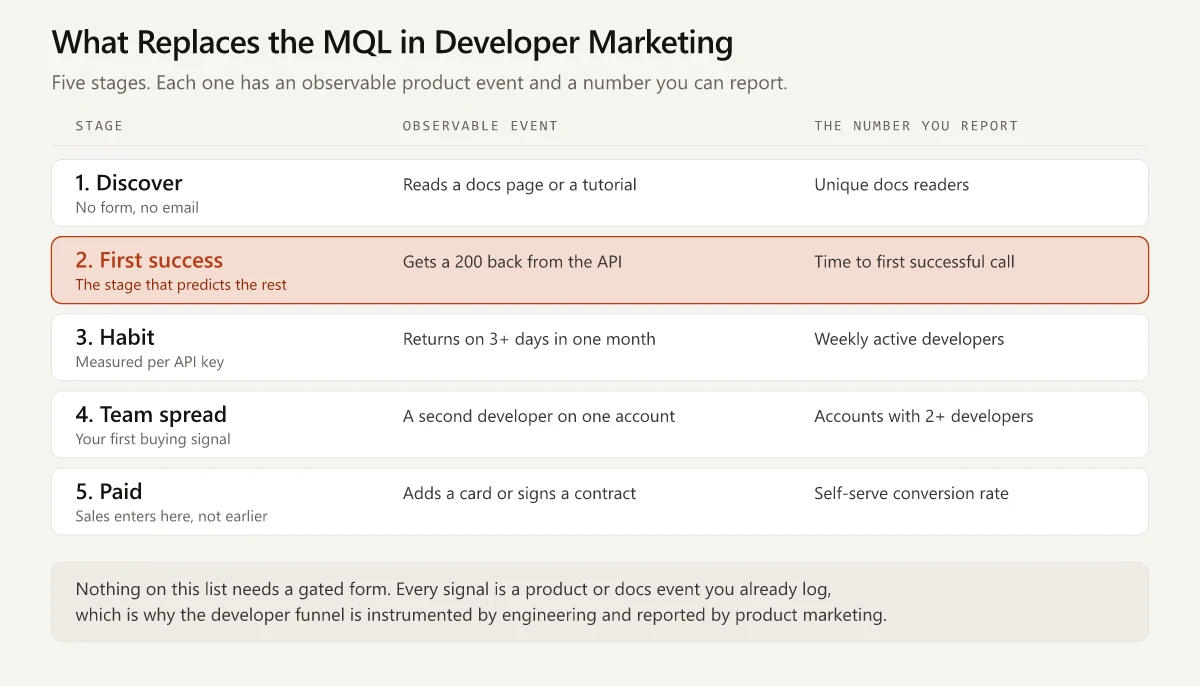
Read the highlighted row first. Time to first successful call is the number I would put on the wall, because it is the only stage where marketing, docs and engineering can all see the same failure at the same time.
Instrumenting it is less work than it sounds.
| Stage | Event to log | Where it comes from | Who reports it |
|---|---|---|---|
| Discover | Docs page view, tutorial read | Docs analytics | Product marketing |
| First success | First non-error API response per key | API gateway logs | Engineering, read by PMM |
| Habit | Three or more active days in a month | Product analytics | Product marketing |
| Team spread | Second unique developer on an account | Auth or key management | Product marketing |
| Paid | Card added or contract signed | Billing | Finance and PMM |
Report time to first successful call as a median and a 90th percentile, because the average hides the people who gave up. Never let sales contact anyone before the team-spread stage without a written exception, because early outreach on a free tier is the fastest way to lose a champion.
The wider question of which numbers survive a leadership review is covered in the product marketing metrics breakdown. The developer version of that list is deliberately short: one number per stage, reported monthly.
Docs and Developer Experience Belong Partly to Marketing
Documentation is the highest-leverage marketing surface in a technical company, and in a lot of the orgs this guide is written for, no marketer has edit rights to the repo it lives in. Check yours before you plan anything else in this section. That is the third swap.
The split is not “marketing takes the docs”. Engineering keeps everything where being wrong is a bug. Product marketing takes the pages where being unclear is a lost evaluation.
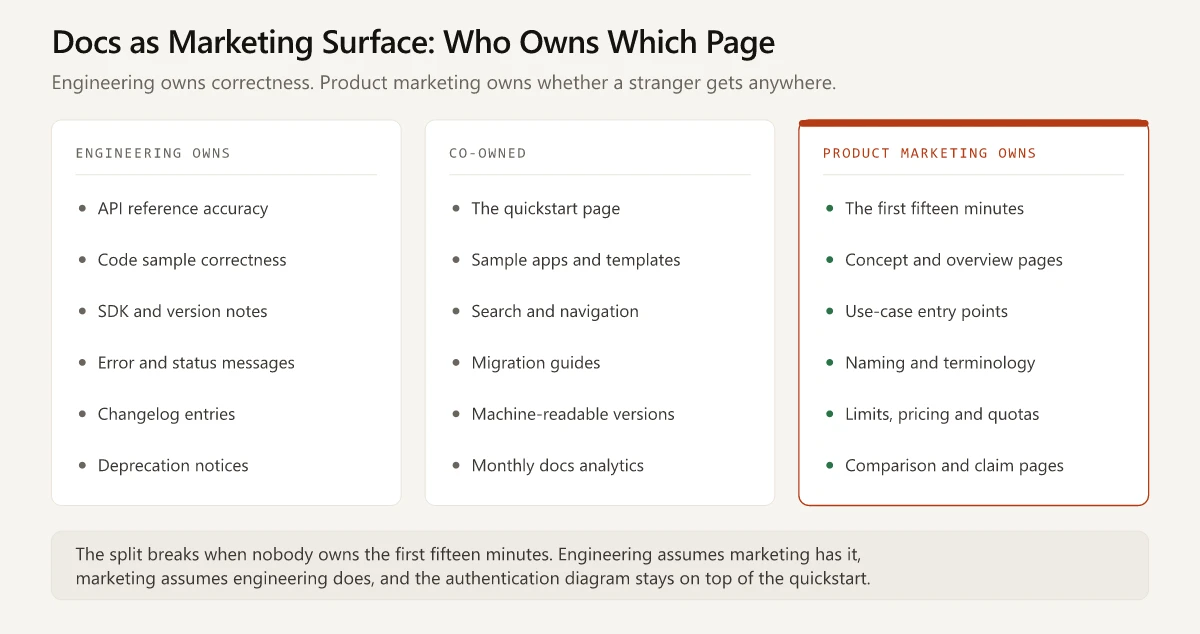
The single deliverable I would fight for is a written spec for the first fifteen minutes, in this order:
- What the product does in one sentence, without the word platform.
- What you need before you start: an account, a key, a runtime version.
- One copy-paste block that returns real output on the first run.
- What that output means, in plain language.
- The next three things worth trying.
- Limits and pricing, visible without leaving the page.
The quickstarts I would rewrite first put an authentication diagram above that first code block, which answers a question the reader has not asked yet.
There is a new failure mode worth budgeting against. Postman surveyed more than 5,700 developers, architects and executives, and 41% of respondents said they rely on AI to generate API documentation. In the Stack Overflow AI data, the single biggest frustration with AI tools, named by 66% of respondents, was “AI solutions that are almost right, but not quite”. Documentation produced the same way carries the same problem, and almost-right costs more in a quickstart than in code, because the reader has no compiler to catch it. Somebody has to run the quickstart end to end on a clean machine every release, and product marketing is the function with the strongest incentive to volunteer.
Machine-readable docs are now part of the job. Publishing plain-text or Markdown versions of key pages, keeping an OpenAPI spec current, and writing concept pages that answer a full question in one place all raise the odds that an answer engine quotes you rather than a third-party tutorial from 2021. The same discipline shows up in any modern SaaS product marketing strategy, just applied to a docs site instead of a website.
Developer Marketing Channels Ranked by What They Return
Channel choice follows from where the audience already learns. Asked how they had learned to code in the past year, Stack Overflow’s respondents ranked technical documentation first at 67.8%, then other online resources such as search and forums at 58.7%, Stack Overflow itself at 51.4%, video at 50%, AI coding tools at 44%, and blogs or podcasts at 34.8%. That is a ranking of learning habits rather than buying behavior, so read it as where attention already sits, not as how a developer evaluates a vendor.
| Channel | What it returns | Real cost | How it fails |
|---|---|---|---|
| Docs and reference | Evaluation completions, citations in AI answers | Ongoing editorial time | Owned by nobody, so it rots |
| Community surfaces | Answers that keep working, plus support deflection | Staffing on other people’s platforms | Measured on its own health, not the product’s |
| Search and answer engines | Compounding discovery on problem queries | Content plus technical SEO | Written for keywords, not for tasks |
| Open source and sample repos | Trust, plus a fast path to first success | Engineering hours, issue triage | Abandoned repo with stale dependencies |
| Public Q&A and forums | Long-tail discovery from other people’s questions | Named humans answering | Marketing voice; the audience detects it instantly |
| Video and conference talks | Depth, credibility, reusable clips | High production and travel | Measured on views instead of adoption |
| Structured courses | Skilled users who become internal champions | Large upfront build | Product tour dressed as education |
| Newsletter | Retention of people who already signed up | Low | Treated as the acquisition metric |
| Paid ads | Reach in a saturated auction | High CPM, low trust | Points at a gated asset |
The pattern in that table is that every channel fails the same way: by being measured on its own vanity number instead of on movement through the five stages. A conference talk that produced 40 first successful calls beats a webinar that produced 400 registrations.
For the acquisition side of the argument, the trade-offs between building an audience and buying one are the same ones covered in demand generation versus lead generation.
How to Build a Developer Marketing Strategy in 90 Days
A first developer marketing strategy fits on two pages. Assuming a product that already exists and a team of one or two, this is the sequence I would run.
| Phase | Weeks | Deliverable | Test that it worked |
|---|---|---|---|
| Baseline | 1-3 | Run your own quickstart on a clean machine, timed. Pull docs traffic and first-call data | You have a median time to first successful call |
| Positioning | 3-5 | One page: who it is for, what it replaces, the three claims a developer can verify | Two engineers read it without objecting |
| Ungate | 5-7 | Remove every form in front of evaluation content. Move the CTA to account creation | Zero gated assets in the evaluation path |
| Quickstart rebuild | 6-10 | Rewrite the first-run page against the six-item spec | Time to first successful call drops |
| Instrument | 8-11 | Wire the five events into one dashboard with named owners | Weekly numbers without a manual pull |
| One proof asset | 10-12 | A benchmark, a migration guide, or an architecture write-up with real numbers | It gets linked by someone outside the company |
The order matters more than the calendar. Positioning before content, because unclear positioning produces content nobody can act on. Ungating before rebuilding, because a rebuilt quickstart behind a form is wasted work. Instrumentation before campaigns, because a campaign you cannot measure will be judged on registrations.
If the product is new to the market rather than newly marketed, the sequencing overlaps with a standard SaaS launch plan; the difference is that the developer version treats the docs site as the launch surface rather than the press release.
Seven Mistakes That Cost a Developer Program Its Credibility
Each of these is recoverable, and each takes longer to recover from than it took to cause.
- Staffing an SDK for a language your audience does not write. Read the language breakdown in your own API logs before the next one gets funded, because an unused SDK still needs a maintainer every time the API changes.
- Letting the published code samples fall behind the shipped API version. A copy-paste block that returns a deprecation warning on the first run costs more trust than a missing page would.
- Deprecating an endpoint without publishing the migration guide the same day. The people hit hardest are the ones who integrated deepest, and that is the cohort you cannot replace.
- Publishing benchmarks without the methodology and the config files. An unreproducible benchmark is read as a marketing claim.
- Shipping a comparison page that misstates a competitor’s current limits. Someone will screenshot it, and the correction will travel further than the page.
- Leaving questions in a public community channel unanswered. Those threads get indexed, so a stranger searching your product name later finds a page of silence attached to it.
- Ignoring the changelog. A stale changelog tells an evaluator the product is unmaintained faster than any competitor could.
Number five is worth its own guardrail: verify every competitive claim on the day you publish, and again quarterly. Technical audiences check.
Where to Start Your Developer Marketing Program
Open your own quickstart on a machine with no credentials, set a timer, and try to get a real response back. Write down every place you had to guess, every page that assumed knowledge you did not have, and the exact minute you would have quit if you did not work there.
That list is your first developer marketing roadmap, and it will be more accurate than any strategy deck you could have written instead. Everything in this guide - the ungating, the event model, the docs ownership split - exists to shorten the gap between someone landing on that page and getting something back.
Start the timer.
Frequently Asked Questions
What is developer marketing?
Developer marketing is the practice of taking a technical product to market when the buyer, or the person who can veto the buy, writes code. It covers positioning, documentation, free tiers, developer education, community, and technical proof. The defining constraint is that the audience evaluates the product by using it before speaking to anyone in sales.
What is a developer marketing strategy?
A developer marketing strategy is a written plan for five surfaces: documentation, the free tier, developer education, community, and technical proof. For each one it names an owner, a first deliverable, and the product event that proves it worked. A plan that lists channels without naming those events is a channel budget, not a strategy.
How is developer marketing different from B2B marketing?
Three mechanisms change. Gated assets stop working because the answer is available ungated somewhere else. The MQL stops working because a content download tells you nothing about whether the product was ever run. And documentation becomes a marketing surface that product marketing partly owns. Positioning, launch, pricing, and sales enablement all transfer from standard B2B product marketing unchanged.
Should developer marketing use gated content?
Almost never for anything a developer needs in order to evaluate the product. Stripe publishes its full API reference at docs.stripe.com with no account, and MongoDB Atlas gives a free 512MB cluster at zero cost. The only defensible gate is the signup that creates the account, because the account is the thing the developer wanted anyway.
What metrics should a developer marketing team report?
Report one number per funnel stage: unique docs readers, time to first successful API call, weekly active developers, accounts with two or more developers, and self-serve conversion rate. In the 11th annual State of Developer Relations report, published by DevRel.Agency for 2024, active users were the top measure of program success at 44.3%, while newsletter signups had fallen to 3.7% from 11.8%.