Product Marketing Metrics: The KPIs That Prove Impact (2026)
The product marketing metrics that prove impact to leadership, from a PMM: which KPIs to track, which vanity metrics to drop, and how to pick your set.

Most product marketing dashboards are full of numbers that no executive has ever asked about. Content downloads, webinar registrations, impressions, deck views. They go up and to the right, they feel like proof, and they change exactly zero minds in the room where budget gets decided. I have built those dashboards, and I have watched them fail to save a single headcount conversation.
The uncomfortable truth is that most product marketing metrics measure activity, not impact. And that gap matters more every year: 30.7% of companies increased their investment in product marketing in the last year, and rising investment always brings a demand for proof. If you cannot show impact in numbers leadership already values, the next budget cycle gets harder. This guide is the set of product marketing metrics I actually track, grouped by what each one proves.
The Problem With Most Product Marketing Metrics
The core mistake is measuring what is easy instead of what matters. Impressions and downloads are easy to pull and satisfying to watch, so they fill the dashboard. But they are inputs, not outcomes, and leadership funds outcomes.
A useful test I apply to every metric before it earns a spot: if this number doubled, would anyone outside marketing care? If a metric can double while pipeline, adoption, and revenue stay flat, it is a vanity metric. Track it privately if it helps you optimize, but keep it off the dashboard you show the business.
The product marketing metrics worth promoting all share one trait: they connect your work to a number the company was already trying to move.
The Product Marketing Metrics That Prove Impact
Here is the core set, grouped by what each group proves. This is the table I put in front of leadership instead of an activity report.
| Metric | Group | What it proves |
|---|---|---|
| Influenced pipeline | Revenue | Your work touches deals that become money |
| Win rate | Revenue | Positioning and enablement help close |
| Enablement content adoption | Sales | Reps actually use what you build |
| Sales cycle length | Sales | Enablement removes friction from deals |
| Feature adoption | Product | The features you market get used |
| Retention / churn | Product | What you market keeps customers |
| Launch goal attainment | Launch | Launches hit pre-set targets, not vibes |
| Competitive win rate | Market | You win the deals you compete in |
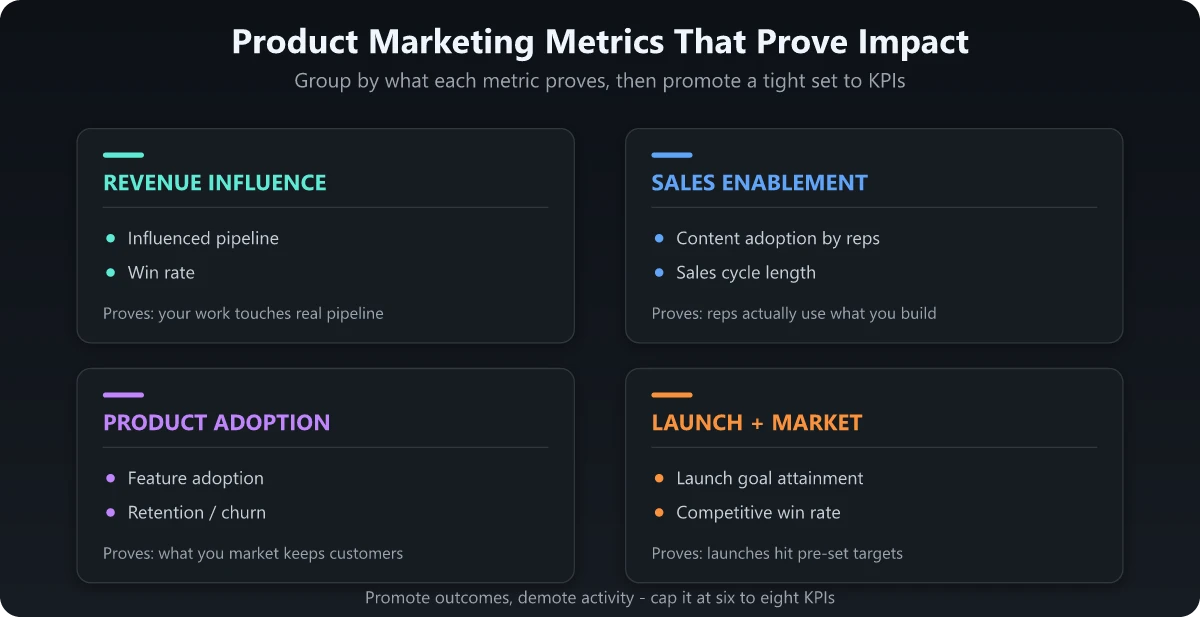
You do not track all eight forever. You pick the ones that match what your leadership is worried about this year, and you promote those to KPIs. The rest stay as supporting context.
Revenue and Pipeline Influence
This is the group that ends the “what does product marketing actually do” conversation. Influenced pipeline is the dollar value of open and closed deals that touched your work: your positioning, your campaign, your enablement asset. It is harder to attribute than a form fill, which is exactly why it is credible when you get it right. Attribution only works if the campaigns underneath it can be grouped at all, which makes a campaign naming system a machine can parse the unglamorous prerequisite for every number in this section.
Win rate is the other half. If your positioning and competitive work are landing, the rate at which qualified opportunities become customers should move. When win rate climbs after a repositioning, that is the clearest signal product marketing had impact.
These two are worth the attribution headache because they speak the language of the room. Pair them with the sourced-versus-influenced discipline I cover in product marketing OKRs so the numbers hold up under scrutiny.
Two cautions on this pair. Attribution is only one of three ways to measure impact, and the three routinely disagree: marketing mix modeling vs attribution vs incrementality covers which to trust when they do. And a win rate is only comparable to itself until you fix the denominator, which is why published SaaS win rate benchmarks are mostly unusable as targets.
Sales Enablement Adoption
You can build the best battlecard in the company, but if reps never open it, it produced nothing. Enablement content adoption - the share of reps actually using your one-pagers, decks, and battlecards - is the metric that tells you whether the work is landing where it is supposed to.
Sales cycle length is the downstream proof. When the right content reaches reps at the right stage, friction drops and deals move faster. A shortening cycle after an enablement push is a real, defensible result.
High adoption signals your content is relevant; low adoption is a warning you are building things nobody wants, no matter how polished. My sales enablement KPIs guide breaks down how to instrument this properly.
Product Adoption and Retention
Product marketing does not stop at the sale. If you run campaigns to drive usage of a feature, feature adoption is the direct measure of whether that worked. Define “adopted” against your product’s real usage pattern, then track the lift from your campaigns. Which population you divide by is what decides the number, and the feature adoption rate denominator table walks through the realistic choices.
Retention and churn close the loop. The features and value you market are supposed to keep customers, so retention is a slow but honest verdict on whether your positioning matched reality. Marketing that oversells produces a bump in adoption and a spike in churn, and this metric is where that shows up.
Launch Impact
Launch metrics are where most product marketing measurement falls apart, because the goal gets set after the launch instead of before. Fix the sequence and the metric becomes powerful.
- Set the target first. Before the launch, agree on what success is: pipeline generated, adoption of the new feature, trials started, whatever fits the launch tier.
- Measure against that number. Launch goal attainment is simply hit-or-miss against a pre-agreed target.
A launch that “generated 400 signups” means nothing on its own. A launch that “hit 130% of its 300-signup goal” is a result. The pre-set target is what turns a launch report into a launch metric.
How to Choose Your Product Marketing Metrics
More metrics is not more credibility. The teams that prove impact to leadership track a tight set, not a sprawling one.
My rule of thumb:
- Cap it at six to eight KPIs. Anchor them in pipeline contribution, sales adoption, and retention. Beyond that, no one can see what actually moved.
- Match them to leadership’s current worry. If the board is focused on retention, lead with adoption and churn. If it is pipeline, lead with influenced pipeline and win rate.
- Promote outcomes, demote activity. Keep your activity metrics for your own optimization, but only show the business the outcome metrics.
- Set targets before the period, not after. A metric with no pre-agreed target is a story, not a KPI.
If you want the wider framework these metrics plug into, start with what is product marketing and the product marketing framework that ties strategy to measurement. Content is the line item that survives this cut least often, because the influence is real and the attribution is not; how to measure SaaS content marketing separates the leading indicators from the lagging ones so the number you show is defensible.
The Takeaway
The point of product marketing metrics is not to prove you were busy. It is to prove you moved a number the company already cared about. That means retiring the vanity metrics that fill most dashboards and promoting the handful that connect your work to pipeline, sales adoption, product adoption, and launches that hit pre-set goals.
Pick six to eight, match them to what leadership is worried about this quarter, and set every target before the work starts, not after. Do that, and your product marketing metrics stop being an activity report nobody reads and start being the reason the function gets funded.
Frequently Asked Questions
What are the most important product marketing metrics?
The ones that map to revenue and adoption, not activity. A strong core set is influenced pipeline, sales enablement adoption (are reps using your content), product adoption of the features you market, launch impact against pre-set goals, and competitive win rate. Track a tight set of these rather than a long list of impressions and downloads leadership does not care about.
What is the difference between product marketing metrics and KPIs?
Metrics are anything you can measure; KPIs are the few metrics you are held accountable to. Every product marketing KPI is a metric, but most metrics should not be KPIs. The discipline is choosing the handful of product marketing metrics that actually indicate impact and promoting only those to KPI status on your dashboard.
How do you measure product marketing success?
Tie your metrics to outcomes leadership already values: pipeline and revenue influence, whether sales adopts your enablement, whether the features you market get adopted and retained, and whether launches hit their goals. Set the target before the launch or quarter, then measure against it. Success is hitting a pre-agreed number, not producing a big activity report after the fact.
How many product marketing KPIs should you track?
Keep it tight - roughly six to eight KPIs anchored in pipeline contribution, sales adoption, and retention. More than that and no one, including you, can see what actually moved. A short, outcome-focused set is far more persuasive to leadership than a sprawling dashboard of everything you can measure.