Emergent Pricing in India: Plans, Credits and Hosting Costs
Emergent pricing checked from India on 21 November 2026: Standard is $20 a month for 100 credits, and one live app on Starter hosting takes 50 of them a month.
Once an app is live on Emergent’s Standard plan, hosting takes half of each month’s credits. Standard includes 100 credits a month, and Emergent’s help pages charge 50 credits a month to keep one web app live on Starter, the smallest publishing tier. Emergent pricing starts at $20 a month for that plan, and the hosting fee comes out of the same credit balance that pays for building.
I loaded Emergent’s pricing page logged out from an Indian connection on 21 November 2026 (Cloudflare’s trace returned loc=IN) and read its help pages on credits, publishing tiers, billing and refunds the same day. After reading them, my advice is to budget Emergent in credits left after hosting, and to treat the dollar price of the plan as the second number you check.
Emergent’s plans as of 21 November 2026, from emergent.sh/pricing and its help pages:
- Free: $0 a month, “10 free monthly credits”, and no publishing to production.
- Standard: $20 a month, or $17 a month in the page’s annual view, with 100 credits a month.
- Pro: $200 a month, or $167 a month in the annual view, with 750 credits a month.
- Business and Enterprise: “Custom”, through “Book a demo”.
- Top-up credits: packs from 250 credits for $50 up to 10,000+ credits for $2,000.
- Hosting: 50 to 1,100 credits a month for each live web app, by publishing tier.
Prices and limits like these change, so each figure below carries the page it came from.
Emergent Pricing Plans: Free, Standard, Pro, Business and Enterprise
The pricing page has two tabs. Individual holds Free, Standard and Pro; Enterprise holds Business and Enterprise. In the page’s HTML, each paid card carries two prices: the one shown when the page loads, and an annual price that stays hidden until you flip the Annual switch.
| Plan | Price shown on load | Annual view | Credits | What the card adds |
|---|---|---|---|---|
| Free | $0 / month | n/a | ”10 free monthly credits” | Core platform features, web and mobile apps, “One-click LLM integration” |
| Standard | $20 / month | $17 / month, “Save $36" | "100 credits per month” | Private project hosting, extra credits as needed, GitHub integration, fork tasks |
| Pro | $200 / month | $167 / month, “Save $396" | "750 Monthly Credits" | "1M context window”, “Ultra thinking”, system prompt edit, custom AI agents, high-performance computing, priority support |
| Business | Custom | n/a | Not stated | Role-based access control, single sign-on, shared team workspaces, real-time co-editing |
| Enterprise | Custom | n/a | Not stated | User-level credit limits, audit logs, self-hosted database support, apps in your own cloud (VPC) |
The savings labels match twelve months at the lower price: 12 x ($20 - $17) = $36 and 12 x ($200 - $167) = $396. That puts a year of Standard at $204 and a year of Pro at $2,004 by my arithmetic. The page itself prints no yearly total and no tax line.
Emergent’s help pages add two plan rules the cards leave out. Emergent’s FAQ describes Maxx mode, the higher-effort setting, as “Pro-only”, and says pushing code to GitHub needs Standard or above. The plans and free tier page says only Standard and Pro can publish apps to production and use custom domains.
Where Emergent Credits Go Each Month
Every Emergent action draws on one credit balance. Emergent’s guide to how credits work lists what spends them:
- Code generation: each prompt that writes or changes your app’s code, with bigger changes costing more.
- Testing: automated tests run on your app, priced per run.
- Making your app live: a “fixed monthly tier fee (Starter, Launch, Grow, Scale, or Elite)”.
- Connections to other services, scheduled jobs and background workers.
- Heavy database work, such as large queries and bulk inserts.
- LLM calls your app makes at runtime through Emergent’s Universal LLM Key.
A single prompt can use “anywhere from a handful of credits” for a small visual change “to hundreds” for a full feature that is tested and made live. Turning on Maxx mode makes the agent plan and check more, and the guide says it “uses significantly more credits than a normal prompt”.
The Universal LLM Key ties your app’s own runtime use to your credit balance. Emergent’s managing credit usage reference says it gives your app “access to 44+ models across 7 providers at platform per-token rates with no markup”, funded from your Emergent credits and billed there rather than to your own OpenAI or Anthropic account. An app that calls a model on every visit draws down the same credits you build with.
Hosting an Emergent App: The Fixed Monthly Fee
Emergent’s page on putting an app live puts the cost plainly: “A live web app costs 50-1,100 credits per month (depending on your publishing tier) while it’s running.” The tiers, from Emergent’s publishing plan levels:
| Publishing tier | Web-only app, credits a month | App with a mobile app, credits a month | CPU | Memory | Emergent’s typical use |
|---|---|---|---|---|---|
| Starter | 50 | 60 | 0.05 vCPU | 200 MB | Prototypes, low-traffic APIs, internal tools |
| Launch | 125 | 135 | 0.5 vCPU | 2 GB | Small production apps, hobby projects |
| Grow | 225 | 235 | 1 vCPU | 4 GB | Production web apps, moderate concurrency |
| Scale | 450 | 460 | 2 vCPU | 8 GB | High-traffic services, background workers |
| Elite | 1,100 | 1,110 | 4 vCPU | 16 GB | Compute-intensive workloads, ML inference |
The rules around that fee:
- It is a fixed monthly amount per published app, “not per hour of uptime”, and you need at least 50 credits to start any published app.
- The extra 10 credits for an app with a mobile app apply “since 16 October 2026” and include up to 10 iOS and Android builds a month.
- The same page gives yearly Starter figures of 500 credits for a web-only app and 600 with a mobile app (“600 instead of 500 on Starter”). Twelve monthly fees come to 600 and 720 credits by my arithmetic, so the yearly figures are lower. The page does not say how to choose yearly billing.
- Republishes, replacements and rollbacks are free. Publishing the project as a separate app starts a second tier fee.
- Taking an app offline stops only that app’s hosting charge. Your plan, credit balance and code stay as they were.
Starter has a limit of its own: the tier page says it “is not suitable for production apps under meaningful load” and points those apps to Launch or higher.
What 100 Emergent Credits Buy After Hosting
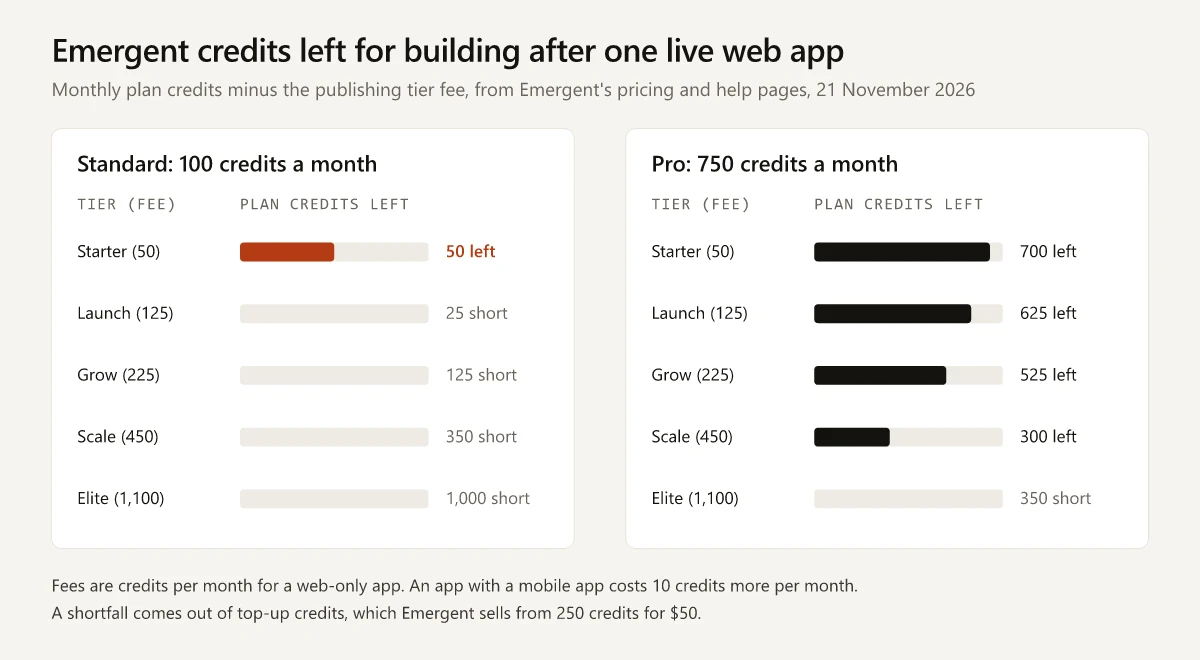
Subtract one live web app’s tier fee from each plan’s monthly credits and you get what is left for building, testing and runtime calls:
| One live app on | Standard (100 credits) | Pro (750 credits) |
|---|---|---|
| Starter, web only (50) | 50 left | 700 left |
| Starter, with a mobile app (60) | 40 left | 690 left |
| Launch, web only (125) | 25 short | 625 left |
| Grow, web only (225) | 125 short | 525 left |
| Two apps on Starter, web only (100) | 0 left | 650 left |
What the table shows:
- On Standard, the one tier its own credits can carry is Starter, the tier Emergent calls unsuitable for production load. A Launch-tier app on Standard runs 25 credits short every month, so the smallest top-up pack (250 credits for $50) covers that shortfall for ten months before any building, since top-up credits never expire.
- Two Starter apps use all 100 of Standard’s credits, so any building on top of them comes from top-ups.
Emergent Credit Prices: Plans vs Top-Ups
At the price shown on load, Standard’s plan credits and top-up credits both cost $0.20 each. The annual view brings Standard to $0.17, and Pro’s plan credits cost more per credit than top-ups in either view. The per-credit column is my arithmetic from the pricing page and the managing credit usage reference:
| Where the credits come from | Price | Credits | Per credit | When unused credits expire |
|---|---|---|---|---|
| Standard, price shown on load | $20 a month | 100 | $0.20 | At renewal |
| Standard, annual view | $17 a month | 100 a month | $0.17 | At renewal |
| Pro, price shown on load | $200 a month | 750 | $0.27 | At renewal |
| Pro, annual view | $167 a month | 750 a month | $0.22 | At renewal |
| Smallest top-up pack | $50 | 250 | $0.20 | Never |
| Largest listed top-up pack | $2,000 | 10,000+ | $0.20 at 10,000 | Never |
Pro’s extra $180 a month buys features as well as credits: the 1M context window, Ultra thinking and Maxx mode. If you need only more credits, Standard plus top-ups costs less. Standard plus three 250-credit packs costs $20 + 3 x $50 = $170 for 850 credits, against $200 for Pro’s 750, and the 750 top-up credits in that mix never expire.
Top-ups “are non-refundable”, per the same reference, which names only the smallest and largest pack sizes plus “custom volumes”. For larger teams it mentions “annual prepaid bundles with volume discounts” through support, with no published rate.
Do Emergent Credits Roll Over?
Plan credits do not roll over. At each renewal the balance “refills to the full amount included in your plan”, and the managing credit usage reference sets out three credit types:
| Credit type | Rolls over? | Expires? |
|---|---|---|
| Monthly subscription credits | No, refill to cap each cycle | Yes, cleared at renewal |
| Purchased top-up credits | Yes, permanent | Never |
| Promotional or boost credits | Yes, until expiry | Yes, on the date shown |
Emergent spends expiring credits first. What happens near zero, from the same reference:
- A low-balance notice appears in the app below 5 credits, and the how-credits-work guide adds an email alert below 20% of your monthly allowance.
- At zero, builds and publishes pause. “There is no overage billing”, work already written stays saved, and the build resumes after a top-up.
- You can set a maximum credits per prompt in Settings > Billing. An agent run planned above that cap asks for your approval or a smaller task.
- With fewer than 50 credits at renewal, the balance “may” go negative to finish a build. If it stays negative after the next billing check, “typically within 24-48 hours”, the published app “may be taken down”.
Lovable handles leftover plan credits differently, keeping them for a limited time while the subscription is active, as my Lovable price breakdown for India records from Lovable’s docs. Bolt meters tokens rather than credits, and Lovable vs Bolt compares those two units for a team.
Emergent Pricing in India: Dollars on the Page, Razorpay at Checkout
The page I loaded from India on 21 November 2026 showed dollars only. The pricing page’s HTML had no rupee sign, INR, UPI, Razorpay or tax wording, and the rendered page showed the same $0, $20 and $200 cards. India shows up in Emergent’s payment methods and regional billing page instead:
| Question | What Emergent’s billing page says |
|---|---|
| Which processor handles India? | Razorpay: “India-specific: UPI, Netbanking, cards, wallets. INR-optimized.” |
| Can you choose the processor? | No: “You cannot manually pick a processor.” Changes go through support |
| What currency do you see? | The processor and display currency follow your IP, browser language and region; INR is one of the listed display currencies |
| Is tax included? | ”Razorpay (India): Taxes may be included; no GST invoice is provided.” |
| GST invoice for a business? | ”GST/VAT invoices are not issued, and invoices cannot be edited after issuance.” |
| What appears on your statement? | ”AGIONE TECHNOLOGIES PRIVATE LIMITED or RAZORPAY*EMERGENT” |
| Who is the India entity? | ”The India-region legal entity is AGIONE TECHNOLOGIES PRIVATE LIMITED; the US entity is Emergent Labs Inc.” |
What the pages leave open for a buyer in India:
- The page describes the routing for credit purchases, and it does not say which processor bills a monthly plan from India. The cancellation and refunds page mentions the Stripe customer portal for plans bought through Stripe Checkout.
- No public page gives a rupee amount. The billing page says the Buy Credits page in your workspace “shows the live, region-specific price including any applicable taxes or gateway surcharges”, which you see only after you sign in.
- Emergent’s mobile help page says its native app “is not currently distributed on the App Store or Google Play”, and a search of Apple’s India App Store on 21 November 2026 found no builder listing, so there is no store price in rupees to set against the web price. The rupee items under Emergent Labs Inc on the India App Store, such as “Monthly Standard” at ₹1,999, belong to Wingman, which Emergent’s help describes as a “separate product” from the app builder.
If your company needs a GST invoice for its books, this page rules one out. Replit’s route is close to Emergent’s, with UPI through Razorpay announced in Replit’s own changelog, and the Replit price in India guide has its checkout details.
Cancelling Emergent and Getting a Refund
The cancellation and refunds page covers what happens to each kind of credit and to your live apps:
| On cancellation | What Emergent’s page says |
|---|---|
| When it takes effect | At the end of the current billing period; you keep access and subscription credits until then |
| Unused subscription credits | Expire at period end, but you may get “a prorated dollar refund of unused subscription credits”, with published app usage subtracted |
| Top-up credits | Kept, usable on the Free plan; “final and non-refundable once purchased” |
| Live apps | ”live published versions will stay up only while credits cover the tier fee” |
| How to claim a refund | Email support with your account email and billing date; review in 1-2 business days, payout in 5-10 business days |
| Chargebacks | Filing one before contacting support suspends the account |
The page also says Emergent “occasionally” offers discounted plans for students, educators or non-profits to people who contact support before cancelling. The pricing page lists no student plan.
Is Emergent Free?
Yes. The Free plan costs $0 and comes with 10 credits, which you can spend building in the workspace, though the plan cannot publish an app to production.
Emergent’s own pages describe the free credits in two ways, and they disagree on three other points as well:
| Question | One Emergent page | Another Emergent page |
|---|---|---|
| How free credits arrive | Pricing page: “10 free monthly credits” | Plans help: “10 credits on your first day”; FAQ: “daily credit grants (10 on day one)“ |
| Team pricing | Emergent’s homepage FAQ: “$250/month for teams” | Pricing page: Business at “Custom”, with “Book a demo” |
| A renewal threshold for negative balances | Managing credit usage: under 50 credits at renewal the balance may go negative, and the app “may be taken down” if it stays negative after the 24-48 hour check | FAQ: a publish charge can take the balance negative, and “there is no separate renewal takedown threshold” |
| Custom agents | Plans help: “Both Standard and Pro support custom agents” | Pricing page: “Create custom AI agents” listed on the Pro card |
The plans help page also says free users “may qualify for a free frontend-only published app”, without saying who qualifies. Read the pricing page as the price list and the help pages for the metering rules, and ask support where the two conflict before you rely on either.
Which Emergent Plan Fits Your Build
| Your situation | Plan that fits | Why, from the numbers above |
|---|---|---|
| Trying the builder before paying | Free | 10 credits and no production publishing |
| One prototype or internal tool kept live | Standard | Starter hosting leaves 50 credits a month for building |
| One app with real traffic | Standard plus top-ups, or Pro | Launch costs 125 credits, 25 more than Standard includes |
| Several live apps, or heavy building | Pro | 750 credits cover a Launch app and leave 625 |
| More credits but none of Pro’s features | Standard plus top-ups | 850 credits for $170 against Pro’s 750 for $200, and top-ups never expire |
| A team that needs SSO or role-based access | Business, by demo | Priced as “Custom” on the Enterprise tab |
Whether an AI app builder suits the job at all is a separate question, and my comparison of Claude Design, Claude Code and app builders sorts marketing work by where the finished file has to live. If the app is a marketing site, run the crawler check in my guide to vibe-coded website SEO before you pay for a bigger publishing tier.
Emergent Pricing Comes Down to Credits Left After Hosting
Emergent pricing reads as $20 and $200 a month, but each live app takes a fixed 50 to 1,100 credits from the same balance that pays for building.
Before you subscribe, pick the publishing tier your app needs, subtract its fee from the plan’s credits, and set a per-prompt credit cap in Settings > Billing before the first build.
Frequently Asked Questions
Is Emergent free?
Yes, the Free plan costs $0. Emergent's pricing page lists 10 free monthly credits, while its help pages describe 10 credits on your first day, and the Free plan cannot publish an app to production.
How much does it cost to keep an Emergent app live?
Emergent's help pages put a live web app at 50 to 1,100 credits a month, set by its publishing tier: Starter 50, Launch 125, Grow 225, Scale 450 and Elite 1,100. An app that includes a mobile app costs 10 credits more per month.
Do Emergent credits roll over?
Monthly subscription credits do not roll over: they refill to the plan's cap at each renewal. Purchased top-up credits never expire, and promotional credits expire on the date Emergent shows.
Can I pay for Emergent with UPI in India?
Emergent's billing help says credit purchases from India go through Razorpay, which it lists with UPI, netbanking, cards and wallets. It does not say which processor bills a monthly plan from India, so UPI is confirmed only for credit purchases, and you cannot choose the processor yourself. The same page says no GST invoice is provided.
What is the Emergent price in India?
On 21 November 2026, emergent.sh/pricing showed dollar prices only to a logged-out visitor in India: Standard $20 a month and Pro $200 a month, or $17 and $167 a month in its annual view. Emergent's billing help says the Buy Credits page in your workspace shows a region-specific price, with INR among its display currencies.