Codex Pricing: Plans, Credits and the Cost of One Task
Codex pricing from OpenAI's pages on 21 November 2026: plans from $0 to $500 a month, credits per million tokens for each model and what one coding task costs.
Two different products answer to “Codex pricing”. One is OpenAI’s coding agent, sold inside ChatGPT plans. The other is Codex at codex.io, an API for digital asset data with its own price list; everything below is about OpenAI’s.
I read OpenAI’s Codex pricing page, its help articles and its API price list on 21 November 2026. The plan price is the first number on that page, and to me it is the less useful number in Codex pricing: once a session passes the plan’s included allowance, the meter switches to credits per million tokens, and the model you pick moves the price of the same task about 100 times.
| Plan | Price (USD, as of 21 November 2026) | What Codex includes |
|---|---|---|
| Free | $0 a month | GPT-6 Luna at Standard speed in the desktop app, subject to rollout |
| Go | $8 a month | Same Codex line as Free |
| Plus | $20 a month | Web, CLI, IDE extension and iOS; code review and Slack; GPT-6.2 Astra, GPT-6.2 Sol, GPT-6.1 Sol, GPT-6.1 Terra and GPT-6 Luna |
| Pro | $100, $200 or $500 a month | Everything in Plus; Ultrafast mode on Pro $500 |
| Business | $20 per user per month billed annually, $25 monthly | 2+ users, admin controls, ChatGPT credits |
| Enterprise and Edu | Contact sales | Everything in Business plus enterprise security and controls; credits on flexible-pricing workspaces |
| API key | API token prices | CLI, SDK and IDE extension; no cloud features |
Source: OpenAI’s pricing page (developers.openai.com/codex/pricing redirects there). The Plus card names GPT-6.1 Sol and GPT-6 Luna; the page’s Feature availability section adds GPT-6.2 Astra, GPT-6.2 Sol and GPT-6.1 Terra on Plus. OpenAI changes these plans and rates often, so recheck the page before you pay. For the same tiers set against Claude Code’s plans, see what each price tier buys in Codex and Claude Code.
How Much Does Codex Cost per Month?
Codex costs between $0 and $500 a month on a personal ChatGPT plan. The price buys an allowance, and the allowance is shared: the pricing page opens with “ChatGPT Work and Codex share pricing, credits, and usage limits.”
What the Pro tiers add on the Codex side, from OpenAI’s pages on 21 November 2026:
- Pro plans “currently have no five-hour limit”, per the pricing page.
- The pricing page’s Pro card lists Ultrafast on Pro $500 only, and the Pro tiers article says “Among Pro plans, Ultrafast is available only on Pro 500.”
- Two newer pages say more for Pro $200. The GPT-6.2 launch note of 17 November 2026 says “Pro $200 subscribers can use Ultrafast with Sol”, and the Business rate card adds that Pro $200 “includes GPT-6.2 Sol Ultrafast in Codex using existing plan limits”. If Ultrafast is why you pick a tier, check the model picker after you subscribe.
- At launch, buying credits on Pro 100 or Pro 200 “does not unlock Ultrafast”, per the Pro tiers article.
- Fetched from India on 22 November 2026, the Pro card on ChatGPT’s plan page read “Up to ₹52,900 in monthly API credits to build your own apps and agents.” Its footnote reads “First grant is prorated. Unused credits expire at the end of the applicable billing cycle.” and adds that the benefit “is subject to change or discontinuation”.
How much more each Pro tier allows than Plus is a separate question, and my Go vs Plus vs Pro comparison tracks the multiples OpenAI and the press have published.
Codex Pricing per Token: Credits per Million Tokens
Credits are what you pay once the plan’s allowance runs out. The pricing page says “Credits are the unit used to pay for eligible usage on credit-based plans”, and it quotes them per million tokens at Standard speed:
| Model | Input (credits per 1M) | Cached input (credits per 1M) | Output (credits per 1M) |
|---|---|---|---|
| GPT-6.2 Astra | 200 | 10 | 1,000 |
| GPT-6.2 Sol | 50 | 2.5 | 250 |
| GPT-6.1 Sol | 50 | 2.5 | 250 |
| GPT-6.1 Terra | 25 | 1.25 | 125 |
| GPT-6 Astra | 250 | 25 | 1,250 |
| GPT-6 Sol | 50 | 5 | 250 |
| GPT-6 Luna | 2.5 | 0.25 | 12.5 |
| GPT-5.6 Sol (promotional rate) | 100 | 10 | 500 |
Source: the “Token rates” table on the pricing page linked above, 21 November 2026. The Business rate card lists the same rates for these models.
Read the table with these rules from the same page:
- GPT-6 Astra costs 100 times GPT-6 Luna on every column: 250 against 2.5 credits per million input tokens.
- “Codex credit billing has no separate cache-write charge.”
- “GPT-5.6 Sol’s promotional pricing is available at least through November 21, 2026.” The Codex page gives no later date; OpenAI’s API pricing page says the API promo for GPT-5.6 Sol runs until 30 November 2026.
- GPT-6.2 Astra and GPT-6.2 Sol launched on 17 November 2026, and the launch note says GPT-6.2 Sol “lets you complete more tasks on the same paid plan” than GPT-6.1 Sol. GPT-6.2 Sol and GPT-6.1 Sol carry the same credit rate. The pricing page lists both GPT-6.2 models on Plus, Pro, Business, Enterprise and Edu.
One pattern I found by setting this table beside OpenAI’s API pricing page: every credit rate above is exactly 25 times the model’s standard short-context API price per million tokens. GPT-6.2 Sol is 50 credits against $2 for input and 250 credits against $10 for output. That is my arithmetic across two pages, and OpenAI does not present it as a credit price.
What One Codex Task Costs in Credits
OpenAI’s Business rate card prints the formula: “Total credits = (input tokens / 1,000,000 x input rate) + (cached input tokens / 1,000,000 x cached input rate) + (output tokens / 1,000,000 x output rate)”.
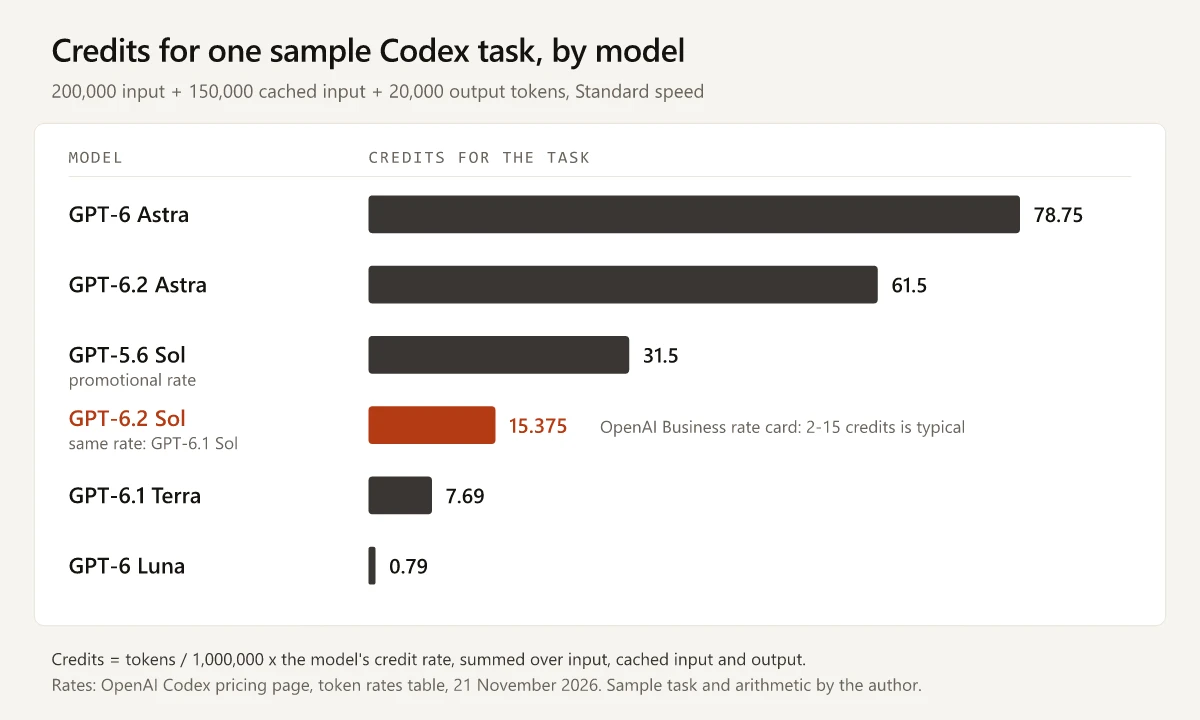
Here it is applied to one sample task of my own construction: 200,000 input tokens, 150,000 cached input tokens and 20,000 output tokens, at Standard speed. The token counts are an illustration, not a measurement.
| Model | Input | Cached input | Output | Credits for the task | Tasks per 2,500 credits |
|---|---|---|---|---|---|
| GPT-6 Astra | 50 | 3.75 | 25 | 78.75 | 31 |
| GPT-6.2 Astra | 40 | 1.5 | 20 | 61.5 | 40 |
| GPT-5.6 Sol (promotional rate) | 20 | 1.5 | 10 | 31.5 | 79 |
| GPT-6.2 Sol or GPT-6.1 Sol | 10 | 0.375 | 5 | 15.375 | 162 |
| GPT-6.1 Terra | 5 | 0.1875 | 2.5 | 7.69 | 325 |
| GPT-6 Luna | 0.5 | 0.0375 | 0.25 | 0.79 | 3,174 |
My arithmetic from the token-rate table above, rounded to two decimals where shown; the last column rounds down to whole tasks. 2,500 credits is the size of OpenAI’s student grant, covered below.
How to read the result:
- The sample lands at 15.375 credits on GPT-6.2 Sol, a little above the range the Business rate card gives: “A typical Codex task using GPT-6.2 Sol may consume between 2 and 15 credits per task.” The pricing page prints the same 2-15 range for GPT-5.6 Sol, a model with twice GPT-6.2 Sol’s credit rate, so treat the range as rough.
- Per token, output costs 5 times input on GPT-6.2 Sol (250 against 50 credits per million), so 20,000 output tokens cost 5 credits, half the cost of 10 times as many input tokens.
- Cached input is cheap: 150,000 cached tokens add 0.375 credits on GPT-6.2 Sol. OpenAI’s own tips for stretching the allowance, on the pricing page, start with controlling prompt size and limiting source material.
- The pricing page warns that “Tasks that look similar can consume different amounts of your allowance” and adds “Model choice, context, reasoning, tool use, retrieval, and caching all affect usage”, so the model you pick drains the included allowance at different rates too. Treat any per-task figure as an estimate.
Fast and Ultrafast Multiply Codex Usage
Speed modes cost more of the same allowance or credits. The pricing page lists two multipliers per model, one for included usage and one for “purchased credits and Enterprise pay-as-you-go usage”:
| Model | Fast, included | Fast, credits | Ultrafast, included | Ultrafast, credits |
|---|---|---|---|---|
| GPT-6.2 Astra, GPT-6.2 Sol | 2x | 2x | 6x | 3x through 28 February 2027, then 6x |
| GPT-6.1 Sol | 2.5x | 2x | 8x | 6x |
| GPT-6 Astra | 2.5x | 2x | 8x | 6x |
| GPT-6.1 Terra, GPT-6 Sol, GPT-6 Luna | 2.5x | 2x | Not listed | Not listed |
Source: “Speed multipliers” on the pricing page, 21 November 2026. The GPT-6.2 credit rate moves to 6x “starting March 1, 2027 (Pacific time)”, and “Included usage stays at 6x throughout.”
What you get for the multiplier, per OpenAI’s speed docs:
- Fast on GPT-6.2 Astra “generates tokens at about 1.5 times the speed of Standard”, for 2x the usage.
- Ultrafast on GPT-6.2 Astra and Sol “generates tokens at up to 4.5 times the speed of Standard”, for 6x the included usage.
- With an API key, “ChatGPT credit multipliers apply only when you sign in with ChatGPT”; API Ultrafast has its own prices.
Applied to the sample task on GPT-6.2 Sol (my arithmetic): 15.375 credits at Standard, 30.75 on Fast, 46.125 on Ultrafast while the 3x credit rate lasts, and 92.25 from 1 March 2027.
What a Codex Credit Costs in Dollars
OpenAI does not put a dollar price on a credit for personal plans. The pricing page says “Credit purchase prices and applicable discounts depend on your plan or agreement”, and the credits article adds: “Available purchase amounts, prices, payment methods, spending limits, and feature availability can vary by account, region, and plan.”
The one credit-to-dollar figure I found on OpenAI’s pages is in its student offer terms: once the offer is applied “you should see 2,500 credits, which is equivalent to $100.” That works out to $0.04 a credit, the same 25-to-1 ratio as the API comparison above. On that equivalence, the sample task is about $0.62 on GPT-6.2 Sol, $2.46 on GPT-6.2 Astra and about 3 cents on GPT-6 Luna (my arithmetic). Your checkout price for credits may differ.
Credits start only after your plan’s included usage is spent and “expire 12 months from purchase” (180 days for purchases in Japan after 13 November 2026). Refunds, Free and Go eligibility and where your reset time appears are in my guide to ChatGPT usage limits by plan.
Codex Pricing for Teams: Business, Enterprise and Edu
ChatGPT Business is “$20 / user / month”, “2+ users, billed annually”, and “$25 per user per month when billed monthly”, per the pricing page. What OpenAI’s Business rate card, linked above, adds on Codex, read 21 November 2026:
| Question | What the rate card says |
|---|---|
| What a standard seat includes | ChatGPT and Codex, sharing one allowance and credit pool with ChatGPT Work, Workspace Agents, Excel, PowerPoint and Word |
| What happens at the limit | Standard seats use included limits first; if the workspace has bought credits, eligible usage continues from the shared pool |
| Codex-only seats | ”Usage-based Codex-only seats include Codex usage only and require workspace credits from first use” |
| Average monthly cost | About $100 to $200 per developer per month, varying “significantly” with the model, concurrent instances, automations and fast mode |
| Code review | ”Code review uses GPT-5.3-Codex” |
Enterprise and Edu are priced through sales. The pricing page says Enterprise and Edu workspaces “with flexible pricing have no fixed rate limits” and scale usage with credits, while those without flexible pricing have “the same per-seat usage limits as Plus for most features.”
Codex With an API Key
An API key moves Codex off the ChatGPT allowance entirely. The pricing page says API-key sessions “use separate API pricing, not your ChatGPT allowance”, in the “CLI, SDK, or IDE extension”, with “No cloud-based features (GitHub code review, Slack, etc.)”. On OpenAI’s API pricing page, gpt-6.2-sol lists $2 per million input tokens, $0.10 cached and $10 output at standard short-context rates, plus cache-write prices that Codex credit billing does not charge. The sample task’s tokens come to $0.615 at those three rates before any cache writes (my arithmetic). OpenAI’s pricing card pitches the key route for “automation in shared environments like CI”; my Codex vs Claude Code comparison, linked near the top, sets the key routes for both side by side. Creating that key and funding it are separate steps, since API usage is paid from the API organization’s prepaid credits, and how an OpenAI API key is paid for covers the minimum credit purchase and which ChatGPT plans include API credits.
Is Codex Free? Student Credits and Yearly Billing
| Question | Answer from OpenAI’s pages, 21 November 2026 |
|---|---|
| Is Codex free? | Yes, on the Free plan, in the desktop app only and subject to rollout (see the plan table above); image generation “isn’t available on the Free plan” |
| Is there Codex student pricing? | No student plan on the pricing page. Verified university students “in the United States and Canada” can claim $100 in credits for Codex, one offer per student, and the credits “expire 12 months after the grant date” |
| Is there a Codex yearly plan? | Not for individuals: “Pro is billed monthly. Annual billing and payment for multiple months in advance are not available.” Business has an annual plan; Enterprise is also sold annually, through sales |
Sources: the pricing page and the Pro tiers article, both linked above, the FAQ on ChatGPT’s plan page (“annual plans for Business and Enterprise”), and OpenAI’s student offer terms.
The student offer requires residence in the US or Canada at the time of claiming, so it does not reach students in India; the other routes to a cheaper ChatGPT plan are in my roundup of ChatGPT Plus free-trial routes.
Codex Pricing in India
On 21 November 2026, OpenAI’s pricing page for Codex, fetched from India, listed every plan and rate in US dollars and showed no rupee figure. ChatGPT’s own checkout sets rupee prices for Go, Plus and Pro, and I keep them, with the GST treatment, in every ChatGPT plan priced in rupees. Credits are a separate purchase, and the credits article says their prices “can vary by account, region, and plan”, so the dollar equivalence above is no guide to a rupee credit price.
Which Way to Pay for Codex, by Reader Type
| You are | Pay this way | Why, from OpenAI’s pages |
|---|---|---|
| Curious, with no budget | ChatGPT Free | GPT-6 Luna in the desktop app at $0, subject to rollout |
| Coding a few sessions a week | Plus at $20 | OpenAI’s Plus card: “Power a few focused coding sessions each week”, with web, CLI, IDE and iOS |
| On Plus, running out once in a while | Plus, then credits | Plus and Pro users “can purchase additional credits to continue working without needing to upgrade” |
| Running long sessions most days | Pro at $100 or $200 | No five-hour limit on Pro |
| Paying for Ultrafast speed | Pro $500, or Pro $200 for Sol Ultrafast | Ultrafast on Pro $500; the GPT-6.2 note adds Sol Ultrafast on Pro $200 |
| A team of two or more | Business at $20 a seat, billed annually | Admin controls, SAML SSO and a shared credit pool |
| Running Codex in CI | An API key | Billed at API prices, with no cloud features |
Codex Pricing: Pick the Model Before the Plan
The plan sets how much work is included; the token-rate table sets what everything past it costs. Past the allowance, OpenAI’s pricing page and Business rate card list the same credits per token, and the same sample task runs from 0.79 credits on GPT-6 Luna to 78.75 on GPT-6 Astra before Ultrafast multiplies it again. That spread is the part of Codex pricing you control from the model picker. Before you upgrade, open the usage dashboard and check which model is spending your allowance.
Frequently Asked Questions
How much does Codex cost?
As of 21 November 2026, Codex comes with ChatGPT plans: Free at $0 and Go at $8 a month get GPT-6 Luna in the desktop app, subject to rollout; Plus at $20 adds the web, CLI, IDE extension and iOS; Pro costs $100, $200 or $500 a month. Business is $20 per user per month billed annually or $25 billed monthly, for 2+ users. Usage past your plan's allowance is paid in credits.
Is Codex free?
Partly. OpenAI's Codex pricing page lists ChatGPT Free at $0 with GPT-6 Luna at Standard speed in the desktop app, subject to rollout. The web, CLI, IDE extension, cloud code review and Slack start at Plus, $20 a month.
How many credits does a Codex task use?
It depends on the model and the tokens. OpenAI's Business rate card says a typical Codex task on GPT-6.2 Sol may use 2 to 15 credits, though the pricing page gives the same range for GPT-5.6 Sol, so treat it as rough. At OpenAI's published rates, a task with 200,000 input, 150,000 cached input and 20,000 output tokens works out to 15.375 credits on GPT-6.2 Sol and about 0.79 credits on GPT-6 Luna.
How much is one Codex credit in dollars?
OpenAI's pricing page says credit purchase prices depend on your plan or agreement, and its credits article says prices can vary by account, region and plan. The one equivalence I found on OpenAI's pages is in its student offer terms: 2,500 credits, which is equivalent to $100.
Is there a Codex yearly plan?
Not on personal plans. OpenAI's Pro tiers article says Pro is billed monthly and annual billing is not available, and Plus is priced per month. ChatGPT Business offers annual billing, at $20 per user per month for 2+ users; Enterprise annual pricing is through sales.