Branding vs Positioning: The Difference and How to Align
Branding vs positioning, explained by a PMM: positioning is the strategic choice you make inside, branding is how the market sees it. Here is how they align.
The fastest way to spot a confused company is to ask two questions back to back: “What do you stand for?” and “Who do you beat and why?” A company with a strong brand but muddy strategy nails the first and fumbles the second. That gap is the whole branding vs positioning problem in one exchange.
I have sat in rooms where a team spent six weeks perfecting a wordmark and a color system, then could not tell me which competitor they were trying to unseat. The identity was gorgeous. The strategy underneath it was a fog. They had branded a decision they had never actually made.
Here is why that ordering matters more than it looks. Most of your buyers form their opinion of you long before they ever speak to you. 6sense’s 2024 Buyer Experience Report found that 81% of buyers choose a preferred vendor prior to speaking with sales. That means positioning - whether you make the shortlist - and branding - whether you are remembered - do their work while you are absent from the room. If they contradict each other, the buyer decides against you and you never even know the meeting was lost.
Branding vs Positioning: The Core Difference
Here is the cleanest way I know to separate them.
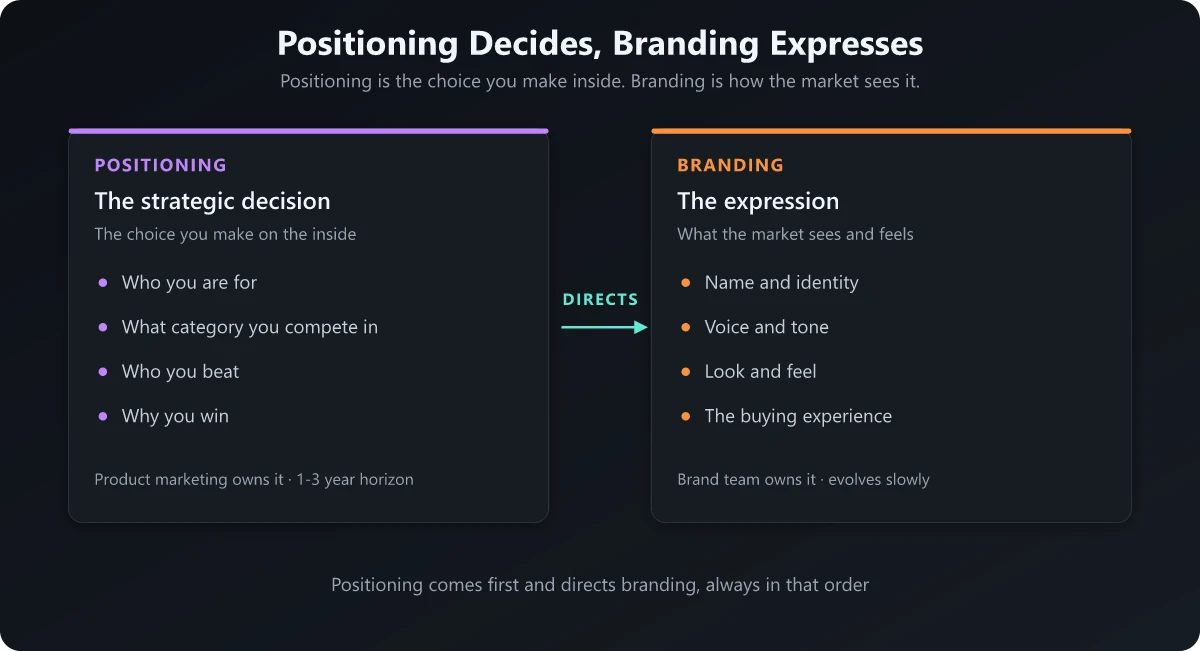
Positioning is the strategic decision. It is the choice you make on the inside about who you are for, what category the buyer should compare you in, what alternatives you beat, and why you win against them. It is a decision, not a document, and it exists whether or not you have written it down.
Branding is the expression of that decision. It is everything the market sees and feels: the name, the visual identity, the voice, the tone, the experience of using and buying the product. Branding is what makes the positioning tangible.
The simplest test I use: if it is a choice about where you compete and why you win, it is positioning. If it is something the outside world can see, hear, or feel, it is branding. One is the argument; the other is how you dress the argument up so a market remembers it.
That distinction is why the branding vs positioning question is really about sequence, not preference. Positioning comes first because it decides what the branding is supposed to express.
Positioning decides, branding expresses
Think of positioning as the script and branding as the performance. A brilliant performance of a bad script is still a bad play. A great script performed flatly still has a chance, because the underlying story is sound.
Positioning answers the strategic questions that a good product positioning exercise forces you to lock: the best-fit customer, the competitive alternative, the differentiated value, and the market category. Branding then takes those answers and makes them feel like something a human wants to be associated with.
The trap is doing them in the wrong order. When branding runs ahead of positioning, you get a confident identity attached to a decision nobody made, and the confidence only makes the confusion more expensive to fix later.
Branding vs Positioning: A Side-by-Side Comparison
When I onboard a new team, I put this table on the wall. It settles most of the definitional arguments before they start.
| Dimension | Positioning | Branding |
|---|---|---|
| What it is | A strategic decision | The expression of that decision |
| Core question | Who are we for, what do we beat, why do we win? | What do we look, sound, and feel like? |
| Where it lives | Inside the company, on one page | Outside, everywhere the market touches you |
| Made of | Best-fit customer, category, alternatives, differentiated value | Name, logo, colors, voice, tone, experience |
| Direction | Directs the branding | Expresses the positioning |
| Owner | Product marketing | Brand or creative team |
| Time horizon | 1 to 3 years | 5 to 10 years, evolves slowly |
| Fails when | Vague, hedged, everything to everyone | Polished but disconnected from strategy |
Notice the direction row. Positioning points at branding, not the other way around. When a company lets its visual refresh or its new tagline quietly redefine what it stands for, the tail is wagging the dog, and the strategy drifts without anyone deciding it should.
The other row I point at is “fails when.” Each discipline has its own failure mode, and the two failures look nothing alike from the outside.
What Breaks When One Is Strong and the Other Is Weak
The branding vs positioning relationship becomes obvious the moment they fall out of sync. Each imbalance produces a specific, recognizable kind of broken company.
Strong brand, muddy positioning
This is the more seductive failure, because it looks like success. The company has a memorable name, a sharp identity, and a confident voice. People recognize it and even like it.
But ask a prospect what the company actually does better than the alternative, and they pause. The brand is loud and the argument is empty. Buyers remember you without being able to place you on a shortlist, which means the brand equity has nowhere to convert.
I have watched this drain marketing budgets for years. You keep amplifying a message that does not make a case, so awareness rises while win rates do not. The fix is never more branding. It is going back and making the underlying market positioning decision you skipped.
Sharp positioning, weak brand
The opposite imbalance is less common and less fatal, but it caps your ceiling. The strategy is razor sharp. The team can tell you exactly who they beat and why. But the identity is forgettable, the voice is generic, and the experience feels like every other tool in the category.
Here the argument is sound but nobody wants to repeat it. Great positioning that is expressed blandly does not travel. It does not get remembered in the hallway conversation where a champion sells you internally while you are not in the room.
The fix here is genuine branding work: a distinct voice, a point of view, an identity that makes the sharp positioning feel like a movement rather than a memo. Strong positioning gives the branding team something true to dramatize, which is the best gift you can hand a creative team.
Both muddy
The worst and most common case. No clear decision about who you are for, dressed in an identity assembled by committee. Every asset argues with the next one, and the buyer does the exhausting work of figuring out what you are for a few seconds before deciding not to bother.
How Positioning Directs Branding in Practice
Positioning is not an abstraction that sits in a slide. When it is done well, it cascades into concrete branding decisions. Here is the chain I walk teams through.
Start with the locked positioning: the best-fit customer, the alternative you beat, and the differentiated value. Everything below is downstream of those three answers.
- The name and category cue. Your positioning names the market category the buyer should compare you in. Branding decides how much of that category to signal in the name, the tagline, and the homepage hero. In a multi-product company that same call scales up into brand architecture, where you are choosing between one master brand and a portfolio of separate ones. A homepage hero line earns the tagline label by lasting, and of the 12 B2B hero lines I compared from 2022 to 2026, none from October 2022 appeared anywhere in the same site’s October 2026 HTML.
- The voice. If you are positioned against a slow, bureaucratic incumbent, the brand voice should feel fast and human. If you are positioned as the safe enterprise choice, a scrappy voice actively undercuts the strategy.
- The visual identity. Positioning against “expensive and complex” points toward a clean, approachable, uncluttered identity. Positioning as the premium category leader points somewhere more restrained and considered.
- The proof and the experience. The differentiated value in your positioning is what the branded experience has to make feel real, from the demo to the onboarding to the invoice.
This is also where a documented value proposition earns its keep. It is the bridge sentence between the internal positioning decision and the customer-facing brand language, translating “what we beat and why” into a headline a buyer actually reads.
When this chain is intact, the branding is not decoration. It is the positioning made visible, and every touchpoint reinforces the same claim.
How to Pressure-Test Alignment
You do not need a rebrand to check whether your branding and positioning agree. You need a handful of honest questions and the willingness to sit with awkward answers.
The homepage-to-sales-call test
Read your homepage hero, then sit in on three sales calls. If the promise on the homepage and the pitch on the call describe two different companies, your branding and positioning have drifted apart. The homepage is expressing one strategy and the sales team is quietly running another.
This gap is one of the loudest signals that positioning was never locked, or that branding evolved past it without permission.
The “who do you beat” test
Ask five people across the company - a founder, a rep, a marketer, an engineer, a CS lead - two questions: who is our best-fit customer, and who do we beat and why. If you get five different answers, you have a positioning problem no amount of branding can paper over. Alignment starts inside before it can show up outside.
The consistency audit
Line up the touchpoints a buyer actually crosses and check that they tell one story.
| Touchpoint | What to check | Red flag |
|---|---|---|
| Homepage hero | Names the category and the differentiated value | Generic “all-in-one platform” language |
| Sales deck | Same category and same alternative as the homepage | Reps use their own deck instead |
| Product experience | Delivers the value the brand promises | Onboarding contradicts the pitch |
| Voice across channels | Sounds like one company | Ads, docs, and support feel like three brands |
If any row contradicts another, the branding is no longer faithfully expressing the positioning, and the buyer feels the dissonance even if they cannot name it.
For a repeatable way to keep these expressions in sync as you scale, a documented set of brand guidelines is what stops the voice and identity from fragmenting across teams. And when the underlying claims themselves need structure, a clear set of messaging pillars keeps every asset arguing the same three or four points instead of improvising new ones.
Getting the Sequence Right
The practical takeaway is an order of operations. Decide, then express, then keep them coupled.
- Lock the positioning first. Do the forced-specificity work: best-fit customer, competitive alternative, differentiated value, market category. This is a decision, and it is the hardest part precisely because it is a choice to exclude.
- Brief the branding from the positioning. The creative team should receive the locked positioning as an input, not invent the strategy through moodboards. Their job is to make a true thing feel inevitable.
- Audit the coupling on a cadence. Positioning shifts when the market shifts. Branding should follow it deliberately, not drift ahead of it. Review both together, not in separate meetings owned by separate teams.
If you want the wider operating system these two pieces plug into, the product marketing framework shows how positioning, messaging, and brand fit alongside launch and enablement rather than floating on their own.
Conclusion
The branding vs positioning debate dissolves the moment you stop treating them as competitors. Positioning is the strategic decision you make on the inside about who you are for and why you win. Branding is the expression of that decision, everything the market sees and feels. Positioning comes first and directs branding, always in that order.
Get the sequence backward and you brand a decision nobody made, ending up with a confident identity wrapped around a blurry strategy. Get it right and the two compound: sharp positioning gives the brand a true story to tell, and strong branding makes that story impossible to forget while you are out of the room.
So do the unglamorous work first. Make the positioning decision, brief the branding from it, and pressure-test the coupling on a cadence. The companies that win the branding vs positioning question are the ones who decided who they were before they decided how to look.
Frequently Asked Questions
What is the difference between branding and positioning?
Positioning is the strategic decision about who you are for, what category you compete in, what you beat, and why you win. Branding is the expression of that decision - the name, identity, voice, and experience the market actually sees. Positioning is made on the inside; branding is what shows up on the outside. Positioning comes first and directs branding.
Does positioning come before branding?
Yes. Positioning is the underlying decision, and branding is how you dress it up for the market. If you brand before you have decided who you are for and what you beat, you get a polished identity attached to a blurry strategy. The logo looks great and the pitch still confuses people.
Can you have strong branding but weak positioning?
This is one of the most common failure modes. A company invests in a beautiful identity, a memorable name, and a confident voice, but nobody can explain what it actually competes against or who it is best for. The brand is memorable and the message is empty, so buyers remember you but cannot place you on their shortlist.
Who owns branding vs positioning in a company?
In most B2B SaaS companies, product marketing owns positioning, with sign-off from the founder or CMO. Branding usually sits with the brand or creative team under the CMO. The two functions have to stay tightly coupled, because branding that drifts from positioning slowly rewrites the strategy without anyone deciding to.
How do branding and positioning work together?
Positioning decides the strategy and branding expresses it. Positioning answers who you are for, what you beat, and why you win. Branding turns those answers into a name, identity, voice, and experience the market can feel. When they are aligned, everything a buyer touches tells the same story. When they drift apart, the brand promises one thing and the product delivers another.