Sales Enablement Strategy: A PMM's Build-Order Framework
A sales enablement strategy that ties every asset to a deal stage and a metric. The build order a PMM ships: audit, map, build, connect to pipeline, measure.
Most sales enablement fails the same way: a folder full of decks nobody opens, a battlecard from two quarters ago, and a training deck reps clicked through to get back to selling. It is a content dump, not a strategy. The tell is that no one can name which asset moved which deal. A sales enablement strategy is the opposite of a content dump - it is a plan that ties every asset to a deal stage and a metric, so you can prove it changed how reps sell and not just that you shipped it.
That gap is expensive at the top. The Highspot State of Sales Enablement 2025 report found that 55% of organizations are unable to effectively drive their go-to-market initiatives. I have run enablement as a PMM, and the pattern behind that number is almost always the same: the content exists, but nothing connects it to the moment in the deal where it would actually help. This is the build order I use to fix that, in the sequence a PMM actually ships it.
The short version: A sales enablement strategy is the content, training, tools, and process that move reps through the funnel - built in this order: audit what reps lack, map each gap to a deal stage, build the four elements, tie every asset to a stage and a metric, then measure and cut what does not move deals. Build content first and you get a library. Build from the deal backward and you get a strategy.
What Is a Sales Enablement Strategy?
A sales enablement strategy is the plan for the content, training, tools, and process that equip a sales team to move deals through each stage of the funnel. The word doing the work in that sentence is plan. A pile of assets is not a strategy any more than a pile of bricks is a house.
The difference between the two is a single question you should be able to answer for any asset:
- Content dump: “We have a battlecard.” (Where does it live? Who uses it? At what stage? Does it change the win rate?)
- Strategy: “Reps pull the Competitor X battlecard during technical eval, when the buyer asks about integrations. Deals that use it close 9 points higher than deals that do not.”
The second version has a stage, a trigger, an owner, and a metric attached. That is the whole game. Everything below is how to get every asset to look like the second bullet.
The 4 Elements of a Sales Enablement Strategy
A complete strategy has four elements. Miss one and the other three underperform, because they depend on each other.
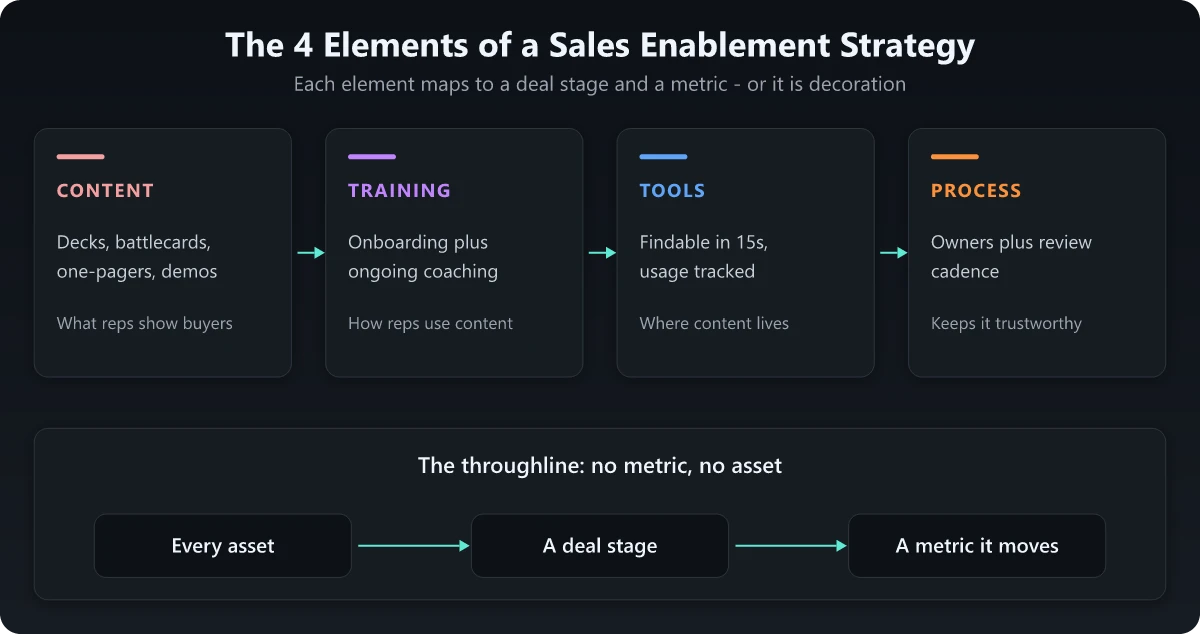
- Content - the decks, one-pagers, battlecards, case studies, and demo scripts reps use in front of buyers. This is the visible layer, and the one most teams mistake for the whole strategy.
- Training - onboarding for new reps and ongoing coaching for tenured ones. Content nobody knows how to use is shelfware. Managers already carry the load here: the same Highspot report notes managers spend 13 hours per week coaching reps, so your training layer either directs that time or wastes it.
- Tools - the platform where content lives, is findable in seconds, and where usage is tracked. If a rep cannot find the asset in 15 seconds they build their own, and your metrics go blind. The sales enablement software guide breaks down the categories.
- Process - who owns each asset, the review cadence, and how gaps get flagged and filled. This is the least glamorous element and the one that decides whether the other three stay current.
Think of content and training as what reps touch, and tools and process as what keeps them trustworthy. A framework that stops at the first two is why so much enablement ages into the stale library reps quietly route around.
Step 1: Audit What Your Reps Actually Lack
Do not start by making content. Start by finding the gaps, because building assets nobody asked for is how the content dump gets created in the first place.
My audit is deliberately low-tech:
- Interview 5 reps and 2 managers. Ask two questions: what do you wish you had in front of a buyer, and what did you stop using because it was wrong or hard to find? The second question is more useful than the first.
- Sit in on 3-5 call recordings. You will hear the exact objection reps fumble and the exact question they cannot answer. That is your content backlog, written by your buyers.
- Inventory what already exists across Drive, Slack, Notion, and random decks. Most teams have more content than they think and less that is current than they hope.
- Map the shadow content. The decks reps built themselves are the sharpest signal you have. They are reps telling you, in their own time, exactly where your official content failed them.
The output of this step is not a plan yet. It is a list of concrete gaps, each tied to a rep complaint or a lost-deal moment. Resist the urge to fix them in the order you found them.
Step 2: Map Each Gap to a Deal Stage
Now put every gap where it actually costs you money. A missing security one-pager does not hurt at discovery, it hurts at technical eval when a deal stalls waiting on it. Stage placement is what turns a random backlog into a priority list.
Every stage has a dominant question in the buyer’s head. Your content answers that question or it does not belong at that stage.
| Deal stage | Buyer’s question | Gap it exposes |
|---|---|---|
| Discovery | Do they understand my problem? | Discovery framework, industry point of view |
| Demo | Does it do what they claim? | Tailored demo script, proof-point slides |
| Technical eval | Will it work in our stack? | Security one-pager, integration list |
| Business case | Can I justify this internally? | ROI model, segment case studies |
| Procurement | Are the commercials clean? | Pricing guide, approved discount matrix |
| Competitive | Why you over the alternative? | Battlecard, win stories, landmine questions |
Grounding each gap in a stage does two things. It tells you what to build first (the stage where you lose the most deals), and it sets you up for the differentiator in Step 4, where the stage becomes the link between an asset and a metric. For the buyer-side inputs this depends on, an accurate ICP and buyer persona is the prerequisite - stage-mapped content built for the wrong buyer still misses.
Step 3: Build the Four Elements in Priority Order
With gaps mapped to stages, build in the order that produces usable value fastest. Do not ship all forty assets on day one - sales will reject the firehose and you will have taught them to ignore enablement.
The priority order I use:
- First, the highest-leverage content for your weakest stage. If you lose most deals at competitive, the battlecard and win stories come first. If reps stall at business case, the ROI model leads.
- Then the training that makes that content land. A battlecard without a 20-minute session on how to use it is a document, not enablement.
- Then the tool layer that makes it findable and measurable. Even a well-tagged Notion or Guru beats a great asset buried in Drive.
- Then the process - an owner and a review date on every asset, so what you built in month one is still true in month four.
For the full deliverable list across onboarding, launch, and competitive, the sales enablement checklist is the companion to this step. The launch package specifically should be standardized so every release ships with enablement attached, which the product launch checklist covers.
Two of these deliverables are big enough to have their own build process. Customer proof is one, and getting a customer story approved and published fails far more often at the permission stage than at the writing stage. The annual kickoff is the other, and an hour-by-hour sales kickoff agenda is where most of a year’s enablement narrative gets set or wasted.
Step 4: Tie Every Asset to a Deal Stage and a Metric
This is the step that separates a strategy from a library, and the one generic enablement guides skip. Every asset gets three tags: the stage it serves, the buyer question it answers, and the metric it should move. No metric, no asset.
Here is the map I keep for the core assets. It is the single artifact I would hand a new PMM inheriting an enablement program:
| Asset | Deal stage | Rep gap it closes | Metric it should move |
|---|---|---|---|
| Discovery framework | Discovery | Weak qualification, shallow pain | Discovery-to-demo conversion |
| Tailored demo script | Demo | Generic, feature-dump demos | Demo-to-eval conversion |
| Security one-pager | Technical eval | Deals stall waiting on answers | Cycle length at eval stage |
| ROI model | Business case | Buyer cannot sell it internally | Deal size, close rate |
| Competitor battlecard | Competitive | Losing to a named rival | Competitive win rate |
| Objection library | All stages | Fumbled objections | Win rate by tenure bucket |
When an asset cannot name the metric it moves, that is your signal it is content for content’s sake. Either find its metric or do not build it. This is also what makes enablement defensible in a budget review: you are not reporting how many decks you made, you are reporting which assets show up in winning deals.
Step 5: Measure Sales Enablement and Cut What Does Not Move Deals
You cannot manage what you do not measure, and you cannot defend a budget on activity. The honest way to measure sales enablement is comparative: look at outcomes for reps who used an asset or completed a training versus those who did not.
The metrics that matter split into two speeds:
- Leading indicators (move in days): content usage rate, rep confidence on the top objections, training completion paired with a certification pass. Watch these weekly so you can course-correct fast.
- Lagging outcomes (move in a quarter): win rate, ramp time, deal size, cycle length. Report these to leadership, always as a split - used the asset versus did not, completed the training versus skipped it.
Report influence, not causation. A rep wins the deal, not the battlecard, so anyone claiming a precise enablement ROI number is guessing with confidence. The durable version is comparative: deals that engaged this asset close at a higher rate than those that did not. The sales enablement KPIs guide covers the full dashboard and the attribution traps in depth.
Then do the part most teams skip - cut what does not move deals. Your usage data will show a bottom 10 assets nobody touches. Retire them. Stale content piled on top of good content is how sales stops trusting the whole library.
Sales Enablement Content Strategy: The Part Most Teams Get Wrong
A sales enablement content strategy is not “make more content.” It is the discipline of assigning every asset a stage, a buyer question, an owner, and a review date - and being willing to retire assets that stop earning their place.
The failure mode is treating content as a production target. More decks feels like progress and reports well internally, but volume is exactly what buries the three assets that actually move deals. The teams that get this right ship fewer, sharper assets and review them on a cadence:
- Battlecards: monthly (competitive intel goes stale fastest)
- Pitch deck: quarterly
- Case studies: quarterly, rotating which are featured
- Onboarding content: twice a year
- One-pagers: every release cycle
Set the review date on the asset itself at creation. When a rep opens a battlecard stamped “last reviewed 11 months ago,” it has already lost their trust, and a content strategy is mostly the work of keeping that from happening. A cadence only holds if the rebuild is cheap, which is why the one-pager belongs in a fill-and-export one-pager builder rather than a locked design file: refreshing it each release costs about five minutes instead of a ticket to your designer.
How a Sales Enablement Strategy Fails
Most enablement dies from a small number of repeatable mistakes. I have made several of these myself.
- Content-first, deal-never. Building assets before auditing gaps, so the library grows and the win rate does not.
- No stage map. Assets exist but reps cannot match them to the moment they need them, so they build their own.
- Measuring completion, not competence. A 100% training completion rate next to reps who still fumble the top objection is a measurement failure.
- No owner, no review date. Content ages into the stale pile, and one wrong battlecard teaches reps to distrust all of them.
- Reporting activity. Assets shipped and hours trained always go up and prove nothing. Seasoned revenue leaders see through them in one QBR.
Every one of these traces back to the same root cause: enablement built as a content exercise instead of a pipeline exercise. Fix the root cause and the symptoms mostly disappear.
The Bottom Line
A sales enablement strategy is not a content library with better folders. It is the discipline of building from the deal backward - auditing what reps lack, mapping each gap to a stage, building the four elements in order, tying every asset to a metric, and cutting what does not earn its place. The content dump and the strategy can contain the exact same assets. The difference is whether anyone can tell you which one moved which deal.
If you take one thing from this: the next time you are about to build an asset, name the deal stage it serves and the metric it should move before you open the deck. If you cannot name both, you are about to add to the content dump. Do that consistently and enablement becomes the function sales asks for by name, instead of the team they quietly work around. For how this fits the wider PMM remit, see SaaS product marketing strategy and what a product marketing manager does.
Frequently Asked Questions
What is a sales enablement strategy?
A sales enablement strategy is the plan for the content, training, tools, and process that equip reps to move deals through each stage of the funnel. Unlike a content library, a real strategy ties every asset to a specific deal stage and a pipeline metric, so you can prove it changed rep behavior and not just that you shipped it.
What are the elements of a sales enablement strategy?
Four elements: content (the decks, battlecards, and one-pagers reps use), training (onboarding and ongoing coaching), tools (the platform where content lives and usage is tracked), and process (who owns what, on what review cadence). Each element maps to a deal stage and a metric, or it is decoration.
How do you build a sales enablement strategy?
Start from the deal, not the content. Audit what reps actually lack, map each gap to the pipeline stage where it costs deals, build the four elements in priority order, tie every asset to a stage and a metric, then measure and cut what does not move deals. Building content first and hoping it gets used is the failure mode.
How do you measure sales enablement?
Compare outcomes between reps who used an asset or completed a training and those who did not: win rate, ramp time, deal size, and cycle length. Report influence, not causation. Track leading indicators (content usage, rep confidence) weekly and lagging outcomes (win rate, ramp time) quarterly.
What is the difference between sales enablement content and a content dump?
A content dump is assets published into a shared drive with no map to when a rep needs them. A sales enablement content strategy assigns every asset to a deal stage, a buyer question it answers, an owner, and a review date. The difference is not volume, it is whether reps can find the right asset at the right moment and whether it moves the deal.