Product Naming: A 7-Criteria Elimination Process (2026)
A product naming process built on elimination: four hard-fail gates, three weighted criteria, and the rename migration cost that no naming guide prices for you.
Week three of the product naming exercise. Forty-odd candidates on the board, color-coded by whoever argued hardest. Legal has replied with “run a search and consult counsel.” The launch date has not moved. Two directors are debating whether a word feels premium.
Nobody in that room has a generation problem. Everyone can produce names. What nobody can produce is a reason to reject thirty-eight of them that survives being challenged on Friday.
The claim I will defend here: product naming is a constraint-elimination problem, and the constraint that kills the most names is the one almost nobody prices, which is what it will cost to change the name later. Every guide ranking for this term optimizes for the moment before launch and goes quiet on everything after it. That is where the expensive mistakes live.
Product naming in 2026: the short answer
Run every candidate through seven criteria in this order. The first four are pass/fail gates that eliminate a name before any scoring starts. The last three are scored 0 to 3 and weighted.
- Trademark class conflict (gate). Is there a confusingly similar mark already registered on related goods or services?
- Domain and handle availability (gate). Can you hold the exact .com and the one social handle your buyers actually use?
- Category collision (gate). Does a live product inside your own category already use this word?
- SERP occupancy (gate). Does an established entity already own page one of search for the bare term?
- Say it and spell it (weight x2). Can a prospect hear it on a cold call and type it correctly from memory a day later?
- Three-year portfolio fit (weight x2). Does it still work beside the next two things you plan to ship?
- Rename migration cost (weight x3). How many live surfaces would a rename have to touch?
Any gate failure eliminates the name outright. Survivors are ranked out of 21 weighted points. The scoring rubric and a copyable version of the sheet are below.
Why naming a product is an elimination problem
The hard part of a naming project is rejection, not generation. Teams do not lack candidates. They lack a criterion that lets a junior PMM tell a founder no.
Order matters for that reason. Score all forty candidates on eight soft attributes and you get a spreadsheet where every candidate clusters near the middle and the loudest person wins. Gate first and the list collapses to a handful in an afternoon.
The gates are not theoretical. In December 2025 the Ninth Circuit affirmed a temporary restraining order barring OpenAI, Io Products, Sam Altman and Jony Ive from using the “IO” mark in connection with the marketing or sale of products related to IYO’s products, in a case brought by a company called IYO. The court’s reasoning reads like a naming checklist written by a judge: the marks “only differ by one letter and are pronounced identically,” and the goods were related because “both companies describe their products as replacing traditional computers and providing a more natural way to interact with artificial intelligence.” The panel was explicit that the order “does not prevent all uses of the ‘IO’ mark” and “would not encompass IO using the ‘IO’ mark in connection with unrelated products.” Relatedness is doing all the work. The Ninth Circuit memorandum in IYO v. IO Products is gate one and criterion five failing together, after a launch video had already gone out.
Naming is a go-to-market decision with legal, engineering and support consequences. It belongs in the same conversation as product positioning, not in a separate creative track that hands over a word at the end. It also sits downstream of one earlier call, because whether the thing gets its own brand or a master-brand prefix changes which candidates are eligible in the first place.
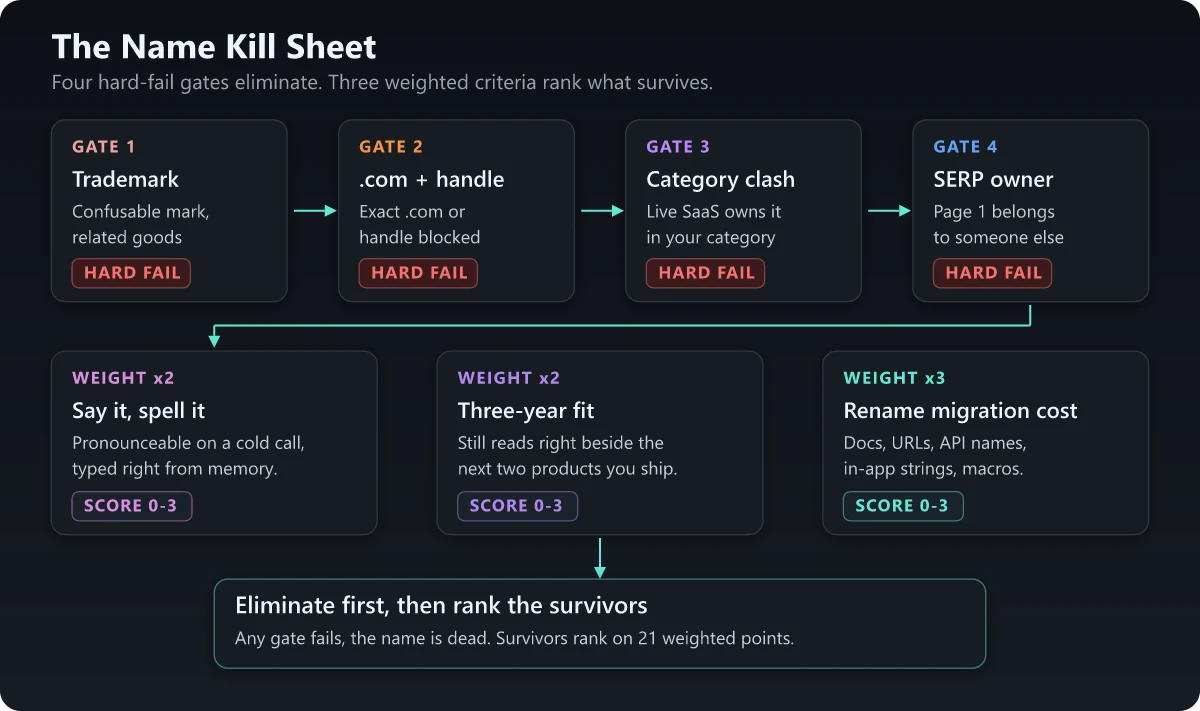
The Name Kill Sheet: a scored product naming framework
This is the sheet. Seven rows, four of them gates, three of them scored and weighted.
| # | Criterion | Type | Fails when | Score |
|---|---|---|---|---|
| 1 | Trademark class conflict | Gate | A confusingly similar mark exists on related goods or services | Pass / fail |
| 2 | .com and primary handle | Gate | You cannot hold the exact .com or the one handle your buyers use | Pass / fail |
| 3 | Category collision | Gate | A live product inside your own category already uses the word | Pass / fail |
| 4 | SERP occupancy | Gate | An established entity owns page one for the bare term | Pass / fail |
| 5 | Say it and spell it | Weight x2 | Sales cannot say it cleanly, buyers cannot spell it back | 0 to 3 |
| 6 | Three-year portfolio fit | Weight x2 | It breaks the moment you ship the next two products | 0 to 3 |
| 7 | Rename migration cost | Weight x3 | Too many live surfaces already carry the name | 0 to 3 |
How to score rows 5 to 7
Keep the rubric blunt. A four-point scale with written anchors stops the scores drifting toward the middle.
| Score | Meaning |
|---|---|
| 0 | Disqualifying in practice. Fix it or drop the name. |
| 1 | Real friction. You will be working around this every quarter. |
| 2 | Acceptable. Minor cost, no ongoing tax. |
| 3 | Clean. No cost, and in some cases an advantage. |
Then read the total:
- Multiply each score by its weight and add the three for a number out of 21.
- Under 12: a name you will regret.
- 12 to 17: workable, with a named cost you have written down.
- Over 17: worth taking to counsel.
The copyable version
NAME KILL SHEET                      Candidate: ______________________

GATES (any FAIL eliminates the candidate)
[ ] 1. Trademark class conflict ......... PASS / FAIL   Notes:
[ ] 2. .com + primary handle ............ PASS / FAIL   Notes:
[ ] 3. Category collision ............... PASS / FAIL   Notes:
[ ] 4. SERP occupancy ................... PASS / FAIL   Notes:

SCORED (0-3 each)
5. Say it and spell it .......... [ ]  x2 = [ ]
6. Three-year portfolio fit ..... [ ]  x2 = [ ]
7. Rename migration cost ........ [ ]  x3 = [ ]
                                  TOTAL = [ ] / 21

DECISION:  ELIMINATED  /  SHORTLIST  /  TAKE TO COUNSEL
Gate 1: trademark class conflict, and when a collision is survivable
“Consult an attorney” is correct advice and useless as a filter, because it does not tell you which of your forty candidates to send. Here is the part you can do yourself before anyone bills you.
Trademarks are registered against classes of goods and services. The USPTO uses the Nice Classification, and its current-edition class headings page confirms there are 45 classes, with 1 to 34 covering goods and 35 to 45 covering services. Two of them decide most software cases.
| Class | What the USPTO says | Your product sits here if |
|---|---|---|
| Class 9 | ”Downloadable software and non-downloadable software recorded on computer media are both considered goods and are classified in Class 9” | You ship a desktop app, a mobile app, an installable agent or an SDK |
| Class 42 | ”Providing on-line non-downloadable software is considered a computer service in Class 42 because it is generally provided for use on a temporary basis” | You ship SaaS, a hosted API or a web app |
Both quotes come from the Trademark Manual of Examining Procedure. Most modern products need both classes, which doubles the fee and doubles the surface area for a conflict.
Two collisions, two very different verdicts:
- Identical mark, unrelated goods: usually survivable. The USPTO’s likelihood of confusion page spells it out: “This is how identical trademarks with different owners can be registered for Dove soap and Dove ice cream bars, or Delta faucets and Delta air transportation services.”
- Similar mark, related goods: fatal, whatever the class number says. The USPTO groups classes into coordinated classes because “international classes and U.S. classes are grouped or ‘coordinated’ if the goods or services in one are closely related to the goods or services in another.” Relatedness beats the class number, which is how IYO won a temporary restraining order against far better-resourced defendants and kept it on appeal.
The practical gate:
- Search the exact term, plus obvious phonetic variants, in Class 9 and Class 42 and their coordinated classes.
- Fail the candidate on any live mark that is similar in sound, appearance or meaning and sits on goods a buyer would expect from the same company.
- Pass it, with a note, on a same-name hit in a genuinely unrelated industry.
- Budget for filing before you fall in love. The USPTO goods and services page puts the base filing fee at “$350 for each class,” so a Class 9 plus Class 42 filing starts at $700 per candidate, per jurisdiction.
- Cap how many you clear. Two candidates through counsel is a normal spend. Nine is a budget conversation, which is another reason to gate hard first.
Gate 2: .com, the handle, and the honest .io and .ai tradeoff
Treat the exact-match .com as a gate. The reason is unglamorous: it is the fallback every prospect types when they half-remember your name.
The supply picture is not improving. The DNIB quarterly report for Q2 2026 puts the .com domain name base at 166.6 million registrations, inside 401.6 million across all top-level domains. Any single English word you like is registered, and probably parked.
That pushes teams toward .io and .ai. Both are country-code domains: IANA’s root database lists .io under the British Indian Ocean Territory and .ai under the Government of Anguilla, which makes their long-term availability a sovereign policy question rather than a commercial one. The UK signed an agreement with Mauritius concerning the Chagos Archipelago on 22 May 2025, so this is live rather than hypothetical. My read: a ccTLD is fine for a product surface and a poor choice for the address your invoices and contracts point at.
Handles are a separate check with hard limits of their own:
- X handles must be “more than 4 characters long and can be up to 15 characters or less,” per X’s help documentation. Anything longer becomes a variant nobody will guess.
- If you ship a mobile app, App Store Connect requires an app name that “must be at least two characters and no more than 30 characters,” with a subtitle that “can’t be longer than 30 characters,” per Apple’s app information reference.
- For a developer tool, check the package registry. npm’s package name guidelines require a name that “is unique,” “does not contain uppercase letters,” and “is not spelled in a similar way to another package name.” A CamelCase brand becomes a lowercase package name whether you like it or not.
- Handles do not come with a redirect. X states that “once you change your username, your previous username will immediately be available for use by someone else,” which is a rename cost most teams discover on the day.
Fail the candidate if the exact .com is unreachable at a price you would actually pay, or the primary handle for your buyer’s platform is held by an active account.
Gate 3: an existing product inside your own category
Teams skip this gate because it feels like a competitive-analysis task rather than a naming one.
Three shipped products make the point. One word, three companies, one overlapping audience.
| Product | What it is | Sold to |
|---|---|---|
| Stripe Atlas | ”Incorporate your start-up” | Founders |
| MongoDB Atlas | Managed cloud database service | Developers |
| ChatGPT Atlas, shipped 21 October 2025, since deprecated | ”A new web browser built with ChatGPT at its core” | Both |
Notice what all three had to do. None of those products can be called “Atlas” in a sentence and be understood, so every mention carries a parent-brand prefix, permanently. That prefix is the collision tax, paid in every headline, every ad and every SDR email.
Fail the candidate if a product your buyer has plausibly heard of, in your category or an adjacent one they buy from, already uses the word. Pass it if the collision sits in an industry they never touch. The check takes twenty minutes: search the term with your category noun attached, scan the two big software review directories, and search the marketplace listings you plan to publish into.
Gate 4: SERP occupancy and the permanent search tax
If the word already has an owner in search, you have bought a permanent SEO liability along with the name. Search the bare term and score what comes back:
- Pass: no dominant entity owns the term, or you already do.
- Pass with a note: the first screen belongs to a completely different vertical, so a category qualifier will separate you.
- Fail: an encyclopedia entry, a dictionary, a major publisher or an established brand owns the first screen in a vertical close enough to confuse buyers.
A failed gate here means you will never rank for your own product name without paying for it, and you will fund brand-defense ads indefinitely.
A coined word clears this gate almost automatically, which is the underrated argument for inventing a term. It also costs more up front in awareness spend, and that trade belongs in your brand guidelines rather than in somebody’s memory.
The three scored criteria
Names that clear all four gates are legitimate candidates. Now you rank them.
Criterion 5: say it and spell it (weight x2)
Two separate tests, and both are done out loud.
- Cold-call pronounceability. Have an SDR say the name in a live call opener, three times, without explaining it. If the prospect asks “sorry, what?” the score is 1 or lower. The Ninth Circuit’s finding that “IO” and “IYO” are “pronounced identically” is a reminder that how a name sounds is a legal fact as well as a sales one.
- Spell-from-memory. Say the name once to five people outside the company. A day later, ask them to type it into a browser. Count exact matches. Four or five out of five is a 3. Two or fewer is a 1.
- Automatic deductions. Silent letters, dropped vowels, doubled consonants, creative substitutions, and any name whose spelling only makes sense once you have seen it written.
Criterion 6: three-year portfolio fit (weight x2)
Score the name against the roadmap you actually have, not the product you are shipping this quarter.
- 3: it works as a family. You can ship two more things beside it without the naming logic breaking.
- 2: it is a clean standalone name that will sit awkwardly but tolerably next to future products.
- 1: it only makes sense for this one feature set, and the roadmap already contradicts it.
- 0: it describes something you are about to stop doing.
Descriptive names score worst here, for the same reason they read best on launch day. This is the tension you already manage in a brand messaging framework: the more specific the language, the faster it expires.
Criterion 7: rename migration cost, the row nobody prices
This is the row naming guides leave out, and the reason the sheet is weighted the way it is.
A rename is a coordinated change across every surface that has ever carried the old string. Score this row by counting how many of them are already live.
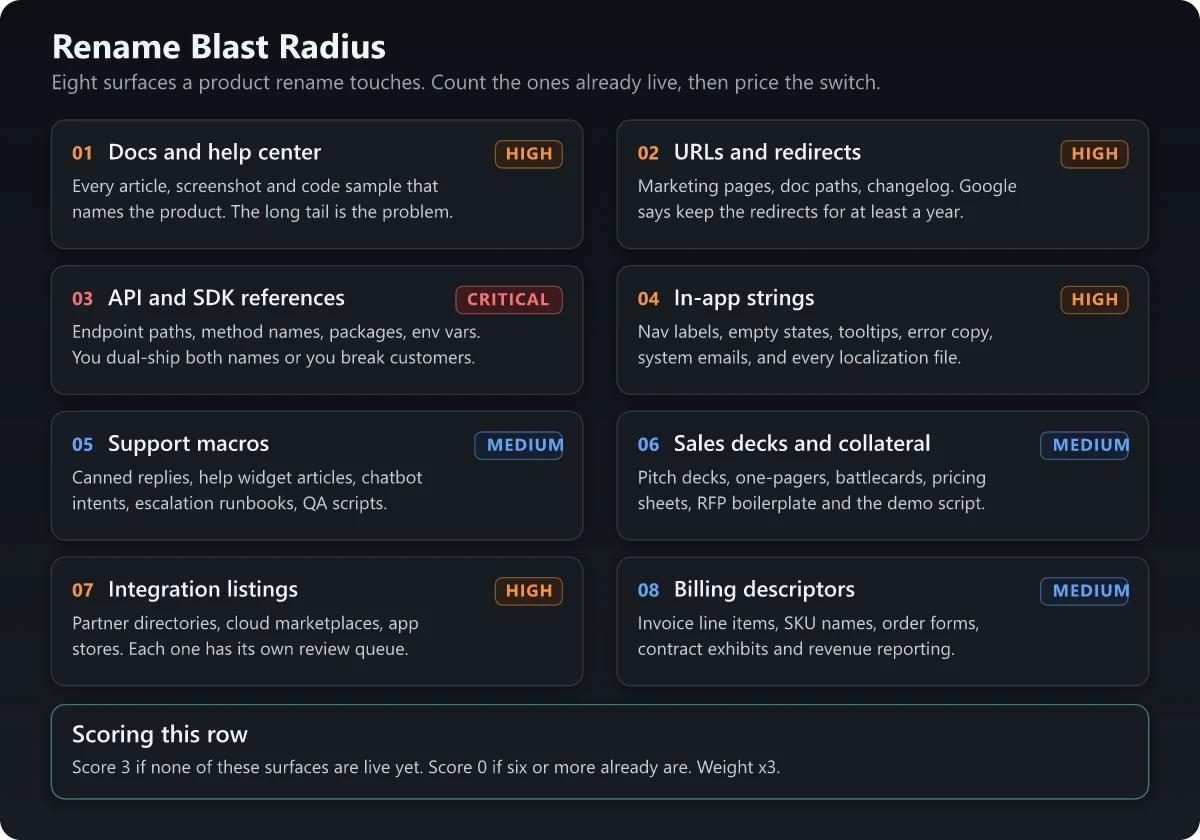
| Surface | What actually changes | Cost band |
|---|---|---|
| Docs and help center | Every article, screenshot, code sample and search synonym | High |
| URLs and redirects | Marketing pages, doc paths, changelog, canonical tags, sitemaps | High |
| API references and SDKs | Endpoint paths, method names, package names, env vars, error strings | Critical |
| In-app strings | Nav labels, empty states, tooltips, system emails, every localization file | High |
| Support macros | Canned replies, help widget articles, chatbot intents, escalation runbooks | Medium |
| Sales collateral | Decks, one-pagers, battlecards, pricing sheets, RFP boilerplate, demo script | Medium |
| Integration listings | Partner directories, app stores, cloud marketplaces, each with a review queue | High |
| Billing descriptors | Invoice line items, SKU names, order forms, contract exhibits, revenue reports | Medium |
Scoring rule: 3 if none of these are live yet. 2 if one or two are. 1 if three to five are. 0 if six or more are.
Two rows deserve a note:
- API references break; they do not redirect. Renaming a marketing page is a permanent redirect, and the status code your host actually sends may not be the 301 you wrote into the ticket: two lines of
vercel.jsonon this site return 308 on every permanent redirect. Renaming a method signature means dual-shipping both names through a deprecation window and carrying the maintenance until the old one dies. That is why the row is banded critical. - URLs have a published floor rather than an estimate. Google’s site-move guidance puts a floor of about a year on how long the redirects have to stay up. Budget a year of redirect infrastructure and several weeks of degraded search visibility, per rename. The full 301 map, the Change of Address step and the brand-term recovery curve belong to the migration itself, and I have laid those out in the rebranding rollout plan; this row only exists so you can price the rename before you pick the name.
Three renames worth studying
| Rename | Blast radius they accepted |
|---|---|
| Azure Active Directory to Microsoft Entra ID, July 2023 | Almost none, by design. The announcement states that “capabilities and licensing plans, sign-in URLs, and APIs remain unchanged” and “no action is needed from you.” They renamed the brand and left the interfaces alone. |
| Bard to Gemini, February 2024 | One consumer surface, with a stated rationale: “Gemini represents our most capable family of models. To reflect this, Bard will now simply be known as Gemini.” |
| Max back to HBO Max, announced 14 May 2025 | A full round trip two years after dropping HBO, because returning the HBO brand “will further drive the service forward.” |
Companies that size can absorb a round trip. Most cannot, which is the argument for pricing the cost before you commit. The sequencing for a fold-back like the first two, from freezing the old name in code to re-issuing enablement, is a separate exercise I have set out in house of brands vs branded house; this table only prices it.
The product naming process: four weeks from brief to locked name
Here is how to name a product in four weeks using the sheet above. Four weeks is enough for a feature or a product inside an existing portfolio, and the schedule matters because a product naming strategy that ignores the launch date gets overruled by it.
Week 1: brief and constraints.
- Write one page: what the name has to do, who says it out loud, what it must not imply, and what ships beside it in three years.
- Confirm the trademark classes you need and the jurisdictions that matter.
- Agree the decision rule while nobody is attached to a word: gates eliminate, weighted score ranks, one named person breaks ties.
Week 2: generate wide, gate hard.
- Produce 40 or more candidates, deliberately mixing coined, arbitrary and compound forms.
- Run gates 1 to 4 on all of them. Expect four to eight survivors.
- Do not discuss aesthetics this week. The gates are objective and the debate is a distraction.
Week 3: score and pressure-test.
- Score the survivors on criteria 5 to 7 and rank them.
- Run the spell-from-memory test on the top three with people outside the company.
- Have two AEs use the top two in live calls and report back.
Week 4: clear and lock.
- Take the top two to counsel for a clearance search in the classes you identified.
- Register the .com, the handles and the package names for both before you announce a winner internally.
- Write the rationale down in one paragraph. In eighteen months somebody will ask why, and the person who knows will have changed jobs.
Then hand the locked name into the launch plan. It touches the messaging hierarchy, the enablement kit and the release comms, so it belongs inside your product launch checklist rather than arriving the week before go-live.
Product naming best practices that survive contact with GTM
Most best-practice lists on this topic are style advice. These are the ones that change decisions.
- Check the class before the mood board. Legal constraints do not care how good the presentation was.
- Buy the domain before the shortlist meeting. Registrations are cheap relative to a naming project, and showing leadership a name you cannot secure is how projects restart.
- Test the name in the buyer’s mouth, not on a slide. Reading and hearing are different tests, and only one of them happens on a sales call.
- Prefer names you can leave. A low migration cost is an option you keep. A name embedded in your API is a commitment made on behalf of every customer.
- Separate the product name from the category name. Own the product name, rank for the category term, and never conflate the two.
- Do not let the name outlive the product it describes. If a descriptive name is going to age out, plan the product sunset or the rename budget at the same time you plan the launch.
What are the 7 categories of brand names?
These are name types, and they are separate from the seven criteria above. There is no single official list, but this is the set most naming teams work with.
| Type | What it is | Trademark strength |
|---|---|---|
| Descriptive | States what the product does | Weak, hard to register |
| Suggestive | Hints at a benefit without stating it | Moderate |
| Arbitrary | A real word with no connection to the product | Strong |
| Coined or fanciful | An invented word with no prior meaning | Strongest |
| Acronym | Initials of a longer phrase | Weak on its own |
| Eponymous | Named after a founder or person | Varies |
| Compound | Two real words fused into one | Moderate to strong |
The taxonomy that carries legal weight is narrower. The USPTO’s guidance on strong trademarks ranks marks as fanciful (“invented words” that “only have meaning in relation to their goods or services”), arbitrary (“actual words that have no association with the underlying goods or services”), suggestive (“words that suggest some quality of the goods or services, but don’t state that quality”), descriptive, and generic, which “aren’t even trademarks.”
The practical read:
- Coined and arbitrary names clear gates 1 and 4 more easily and cost more to make familiar.
- Descriptive names are cheap to explain and expensive to keep, because they are hard to protect and they age with the roadmap.
Lock the name you can defend
Product naming goes wrong when it runs as a taste exercise with a legal review bolted on at the end. Run it as an elimination process and the hard parts resolve in order: four gates cut forty candidates to a handful in an afternoon, three weighted criteria rank the survivors, and the deciding number is written down before anyone gets attached.
The row that does the most work is the last one. A rename touches docs, URLs, API references, in-app strings, support macros, sales collateral, marketplace listings and billing descriptors, and Google alone will ask you to hold the redirects for at least a year. That cost is knowable before launch and almost never counted, which is exactly why it carries the heaviest weight on the sheet.
Run your current shortlist through the Name Kill Sheet this week and count how many survive the four gates. The ones that do are names you can defend to a founder, to counsel, and to the engineer who would have to rename the endpoint.
Frequently Asked Questions
What is an example of a product name?
Stripe Atlas, MongoDB Atlas and ChatGPT Atlas are three shipped product names built on the same word, each one carrying a permanent parent-brand prefix so buyers can tell them apart. That prefix is what a crowded name costs you: nobody in those categories can say just Atlas and be understood.
What are some good product name ideas?
Generating candidates is rarely the bottleneck. The harder problem is rejection: a long candidate list with no defensible reason to cut any single name from it. A better use of the time is running the ideas you already have through hard-fail gates: trademark conflict on related goods, exact .com and handle availability, a live competitor in your own category using the word, and who currently owns page one of search for it.
What are the 7 categories of brand names?
There is no single official list, but the seven types most naming teams work with are descriptive, suggestive, arbitrary, coined or fanciful, acronym, eponymous and compound. The taxonomy that actually carries legal weight is the USPTO spectrum of fanciful, arbitrary, suggestive, descriptive and generic, where fanciful and arbitrary marks are the strongest and generic terms cannot be registered at all.
How do you name a product?
Write a naming brief that states what the name has to do, generate candidates in bulk, then eliminate rather than debate. Run each candidate through four pass/fail gates before you score anything, rank the survivors on weighted criteria, and clear the top two with counsel and with sales before you lock one.
What are product naming best practices?
Check the trademark class before the mood board, buy the exact .com before you show leadership a shortlist, test the name by saying it aloud on a call rather than reading it on a slide, and price the rename before you launch. A name you can change cheaply in year one is worth more than a name you love and cannot move in year three.