House of Brands vs Branded House: The Per-Launch Decision
House of brands vs branded house, decided per launch: the four models, a comparison table, an 8-criteria naming scorecard and the real cost of a new brand.
Week six of a launch cycle, the deck is in review, and slide 11 has the new module on it. Someone senior asks the question that quietly eats the next two weeks: does this thing get its own name? That is house of brands vs branded house, shrunk from a boardroom identity exercise down to a single launch, and it is the only version of the question most product marketers ever get to answer.
The short answer. A branded house puts every product under one master brand with descriptive names underneath it, the way Google Maps, Google Cloud and Google Workspace all lead with Google. A house of brands runs independent brands that stand on their own reputation while the parent stays off the packaging, the way Tide, Pampers and Gillette do for P&G. A branded house buys compounding: every launch feeds one brand’s awareness, one domain’s search authority, one set of collateral. A house of brands buys separation: different buyers, different price points, contained reputational risk, and the option to sell one brand without touching the rest. Almost every real company runs a hybrid and decides which model applies product by product.
Here is the claim I will defend for the rest of this post: brand architecture is not a decision you make once. Every page currently ranking for this term reasons top-down at the corporation level and resolves a question you will never personally decide, like whether P&G should restructure its portfolio. The decision you actually own recurs several times a year and is much narrower: does this new product or feature earn its own name, or does it ship under the master brand? Every standalone name you grant is a permanent tax. Not a launch cost. A recurring annual line item you agree to fund forever, or a migration you will eventually pay to undo.
Two things below are worth taking even if you skip everything else: an eight-criterion scorecard that converts the argument into a number, and a cost sheet of what a standalone brand obligates you to fund every year after launch day.
What brand architecture means, and the four models
Brand architecture is the set of rules deciding which things in your portfolio get their own name, which inherit the master brand, and how those names relate to each other in market. It governs naming, endorsement and visual hierarchy, and it settles the only question that matters at the point of purchase: which brand is the buyer being asked to trust?
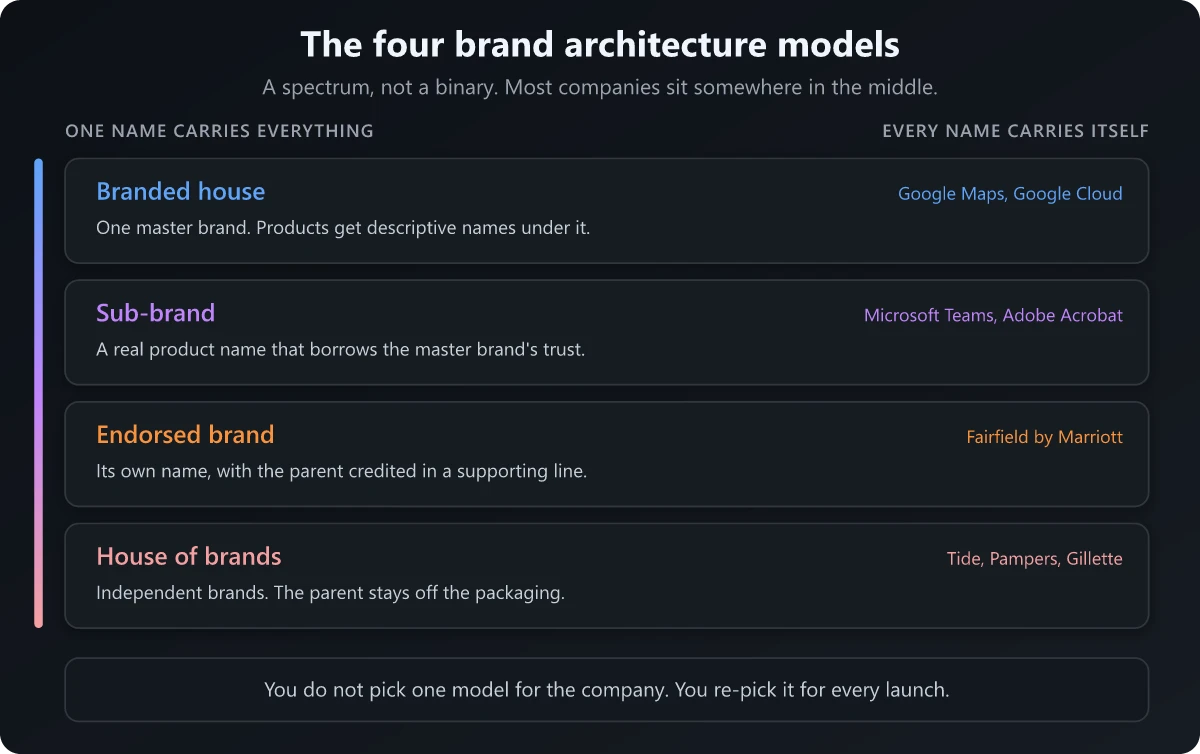
There are four brand architecture types, and they sit on a spectrum rather than in separate boxes.
| Model | What the buyer sees | Who carries the trust | Typical example |
|---|---|---|---|
| Branded house | One master brand with descriptive product labels | The master brand, entirely | Google Maps, Google Cloud |
| Sub-brand | A real product name tied to the master brand | Mostly the master brand | Microsoft Teams, Adobe Acrobat |
| Endorsed brand | Its own name plus a “by parent” line | Split, weighted to the child | Fairfield by Marriott |
| House of brands | Independent brands, parent invisible | The child brand alone | Tide, Pampers, Gillette |
What is a sub-brand? A sub-brand is a named product that is not allowed to leave home. It has enough identity to be asked for by name and enough dependence that removing the master brand from the lockup would strip most of its credibility. Microsoft Teams is a sub-brand, because nobody bought it for the word Teams.
The test is blunt. If you deleted the parent name from every surface tomorrow, would anyone still know what the thing is? Answer yes and you have a real brand. Answer no and you have a sub-brand, and you should stop paying standalone-brand prices for it.
House of brands vs branded house: the advantages and disadvantages that change your quarter
The symmetrical pros-and-cons lists on most brand architecture pages are accurate and useless, because they are written for a CMO restructuring a portfolio. Here is the same comparison rewritten around the things that show up in a product marketer’s week.
| Dimension | Branded house | House of brands |
|---|---|---|
| Awareness spend | Compounds. Every launch pays into one brand. | Splits. Each brand buys awareness from zero. |
| Search authority | One domain accumulates links and rankings. | Every new domain starts with nothing. |
| Sales enablement | One deck, one battlecard set, one objection library. | Duplicated per brand, and reps carry more. |
| Pricing latitude | Constrained. A cheap tier drags the master brand down. | Free. Each brand can own a different price point. |
| Risk containment | None. One incident lands on every product. | High. Trouble in one brand rarely travels. |
| Buyer clarity | Strong when buyers overlap, confusing when they do not. | Strong when buyers differ, wasteful when they do not. |
| M&A absorption | Cheap to fold in, expensive in lost equity. | Preserves acquired equity, costs integration leverage. |
| Exit optionality | Near zero. You cannot sell a feature. | Real. A standalone brand can be spun out. |
Exit optionality is the row people underrate, and Unilever paid it a very public compliment. In March 2024 the company announced it would separate its Ice Cream business, a portfolio whose brands together delivered turnover of EUR 7.9 billion in 2023 and which included Wall’s, Magnum and Ben & Jerry’s. That separation has since completed, with the business now operating standalone as The Magnum Ice Cream Company.
None of that is available if the ice cream had shipped as “Unilever Frozen Desserts.” You cannot demerge an adjective.
The cost of that optionality is paid every day in the other direction. The Coca-Cola Company markets 200+ brands, and P&G runs five sector business units across 10 product categories. Both companies fund awareness for dozens of names that share nothing but an owner, deliberately, because retail shelf economics reward it. Software economics usually do not.
The example roster, handled fast
The branded house vs house of brands examples that fill page one are the same handful of companies every time. Here they are, with the part that is actually instructive.
- Apple is close to a pure branded house: iPhone, iPad, Mac, Apple Watch, Apple Music. The instructive bit is the carve-out. Apple owns Beats and still runs it under its own name, to the point that its newsroom credits an executive as “vice president of Apple Music and Beats”. Even the strictest branded house keeps an exception for an acquired brand with its own audience.
- Google and Alphabet give two different answers inside one company. Google is a branded house. Alphabet behaves like a house of brands: Waymo’s own site notes it “was established under Alphabet”, and nothing about the Waymo brand asks you to think about Search.
- P&G and Unilever are the textbook house of brands. You buy Tide, not P&G, and the parent name appears mainly in small print and annual reports.
- Coca-Cola is a house of brands with a flagship strong enough to disguise it. Sprite, Fanta, Costa Coffee and Topo Chico share an owner, not a name. Its product, price, place and promotion decisions are laid out row by row in Coca-Cola’s 4 Ps grid.
- Marriott runs endorsement at scale. Its brand list includes Fairfield by Marriott, Delta Hotels by Marriott and Homes & Villas by Marriott Bonvoy, each keeping its own name while renting the parent’s trust for the booking decision.
Notice what that roster cannot tell you. Every entry is a decades-long portfolio position arrived at through acquisitions, spin-offs and accidents of history. None of it is a decision anybody will ask you to make on Thursday. The useful question sits one layer down.
Where endorsed brands sit between the two
The difference between branded house and endorsed brand comes down to who is being asked to carry the promise.
In a branded house, the master brand is the product name and everything after it is a descriptor. In an endorsed brand, the product has a name that could survive on its own and the parent appears in a supporting role, usually as a “by” or “from” line. The endorsement lends credibility without making the parent accountable for the entire promise.
Endorsement is the cheapest useful compromise in B2B software. It lets an acquired product keep its recognition and its existing search results while every new buyer immediately learns who owns it. It also degrades gracefully in both directions: you can strengthen the endorsement or quietly drop it without a migration, because the child name never changed. That optionality is easy to undervalue at the moment you are choosing, because its payoff only shows up in the migration you never had to run.
Hybrid brand architecture is the normal state, not a cop-out
Almost every company past Series B runs a hybrid brand architecture. The useful version of hybrid is not “we do a bit of both.” It is a written rule about which tier a thing lands in and who has the authority to decide.
Without that rule, hybrid means every naming decision gets relitigated from scratch and the answer tracks seniority rather than logic. The rule belongs in the same document as your brand guidelines, next to the logo lockups it will govern.
House of brands vs branded house is a decision you make every launch
Before the naming brief, before anyone opens a thesaurus, run the launch through five questions. Answered honestly, they kill most requests for a new name.
- Does it serve a genuinely different buyer? Not a different persona inside the same account. A different budget holder who would never have appeared in your CRM otherwise.
- Does it need a different pricing motion? Self-serve against enterprise, usage-based against per-seat, free against six figures. Master brands stretch badly across price extremes.
- Does it carry a different risk profile? A product touching regulated data, or one that could fail loudly and publicly, is sometimes worth isolating from the master brand on purpose.
- Could it survive on its own demand-gen budget? If the plan depends on master-brand traffic to find its first hundred users, it is not a brand. It is a page.
- Does it need its own review-site category to be found? In B2B this is concrete. G2 says it evaluates the number of products in a space, 10 at minimum, when considering a new category. If your thing cannot name nine credible competitors, there is no category for it to be discovered in, and a standalone name buys you nothing.
Four no answers and one enthusiastic founder is not a case for a new brand. It is a case for a good feature name and a better launch plan.
The sub-brand or master brand launch scorecard
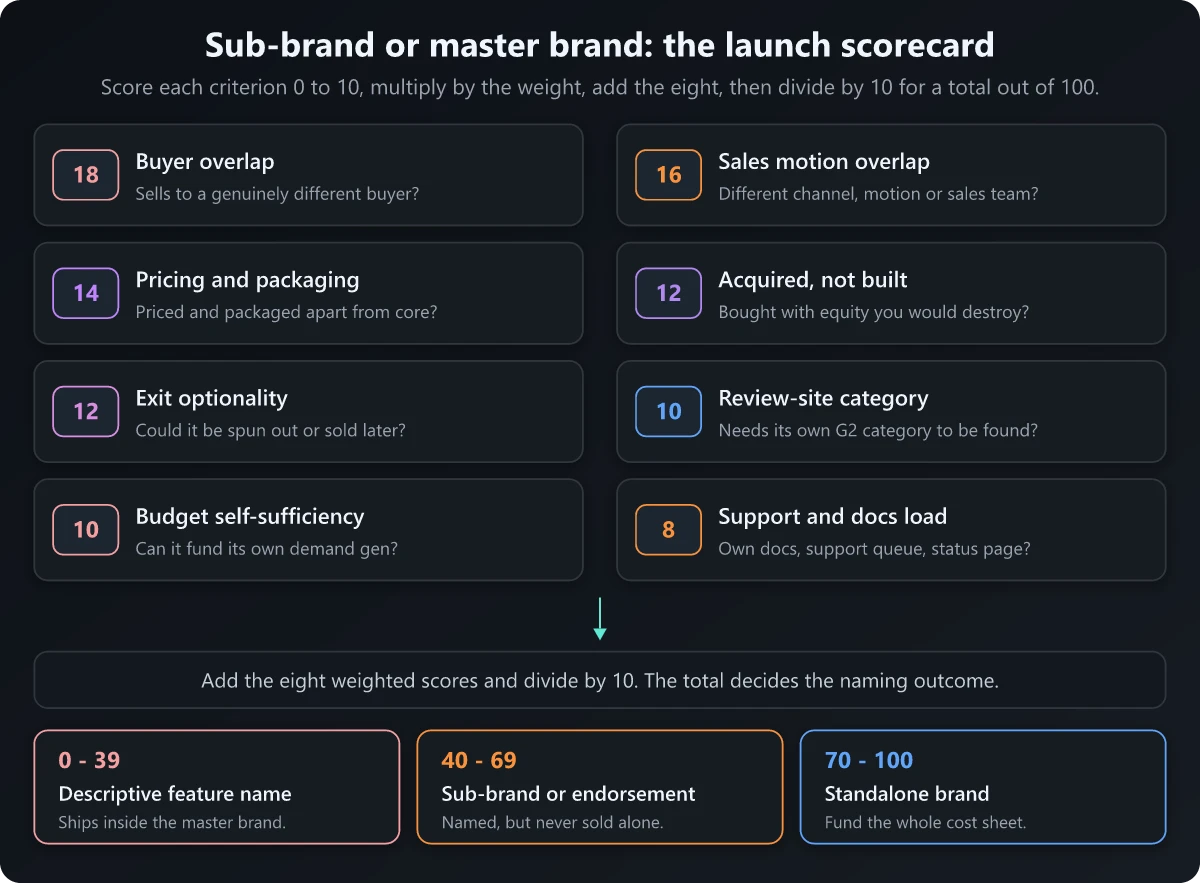
Questions are easy to argue with. A number is harder. Score each criterion 0 to 10 for the specific thing you are launching, multiply by the weight, add the eight results, then divide by 10 for a total out of 100.
| # | Criterion | Weight | A 10 looks like | A 0 looks like |
|---|---|---|---|---|
| 1 | Buyer overlap | 18 | A budget holder who buys nothing else from you | The same admin who already owns your core product |
| 2 | Sales motion overlap | 16 | Different channel, quota and rep skill set | Same reps, same call, one more upsell slide |
| 3 | Pricing and packaging separation | 14 | Its own price book, contract and renewal date | A tier or add-on inside an existing SKU |
| 4 | Acquired, not built | 12 | Bought with real recognition and inbound demand | Built internally in the last two quarters |
| 5 | Exit optionality | 12 | Plausibly sellable or spinnable within five years | Structurally inseparable from the core platform |
| 6 | Review-site category need | 10 | A real category exists with credible competitors | The nearest category is one you already rank in |
| 7 | Budget self-sufficiency | 10 | Has demand-gen budget that survives a bad quarter | Depends on master-brand traffic for first users |
| 8 | Support and docs burden | 8 | Needs its own docs, support queue and status page | Lives inside the existing help centre |
Read the total like this:
- 70 to 100 - it earns a standalone brand. Go to the cost sheet below and confirm you can fund all of it.
- 40 to 69 - sub-brand or endorsement. It gets a name; it never gets sold alone.
- Under 40 - descriptive feature name inside the master brand. Spend the naming energy on the value proposition instead.
The weights are the actual argument. Buyer overlap and sales motion carry 34 of the 100 points between them, because they are the two variables that genuinely change how a launch is executed, and everything else is downstream of them. If your organization weights it differently, change the numbers. Just write them down before the launch that will be decided by them, not after.
Sub-brand, endorsed brand, or descriptive feature name
Each band on the scorecard commits you to something different, and the reversal cost is the column nobody prices in advance.
| Outcome | What you commit to | What you keep | Reversal cost |
|---|---|---|---|
| Descriptive feature name | A docs page and a pricing-page row | All master-brand equity and traffic | Near zero |
| Sub-brand | A lockup, a nav entry, a battlecard section | Shared domain, shared demand gen | Low: rename the page, keep the URL |
| Endorsed brand | Its own name plus a “by” line | Its equity survives, your credibility transfers | Moderate: add or drop the endorsement |
| Standalone brand | Everything on the cost sheet below | Independence and exit optionality | High: a full migration |
One boundary is worth naming explicitly. This decision is whether, not what. Whether a thing earns its own name is a portfolio and economics question that should be settled before a single candidate name exists. What the name should be, including the brief, generation, legal screening and selection, is a separate exercise entirely. Running it first is how teams end up defending a name they fell in love with instead of a decision they can justify.
The standalone brand cost sheet
If the score clears 70, this is the invoice. Most of these line items are annual, and none of them go away after launch week.
| Line item | What it actually commits you to |
|---|---|
| Trademark registration and renewal | USD 350 per class for a base US application. In the EU, the basic online fee is EUR 850 for one class, EUR 50 for a second and EUR 150 for each class beyond that, renewable every 10 years. Multiply by every class and every market you sell in. |
| Domain and web presence | A second domain, a second site or subfolder, a second design system to keep in sync, and a second privacy page, cookie banner and accessibility statement. |
| Search authority from zero | A new domain inherits none of your rankings. Google’s own guidance on site moves is a fair proxy for how slowly search equity travels: it says a medium-sized move can take “a few weeks or more” and advises keeping redirects in place for at least a year so signals transfer. |
| Review-site presence | To appear on a G2 Grid, a product needs at least 10 reviews in that category, and the category needs at least six products with 10+ reviews and 150+ reviews overall. Your master brand’s reviews do not count toward any of it. |
| Collateral and enablement | Its own deck, one-pagers, demo script, objection handling and battlecards, plus onboarding for every rep who now carries two stories. |
| Analyst coverage | A separate briefing cycle, a separate vendor profile, and separate inclusion criteria in every evaluation. That is a real addition to your analyst relations calendar, not a rounding error. |
| Paid brand defence | Competitors can bid on the new brand name, because Google Ads will not restrict using trademarks as keywords. You now defend two brand terms instead of one, forever. |
| Support and documentation | A docs tree, a support queue, a status page and a release-notes channel that somebody has to keep writing. |
Run that list against a feature that scored 38 and the decision resolves itself in about a minute.
How to fold a sub-brand back under the master brand
This is the section every competing page skips. Assume you will get one of these calls wrong, because everybody does, and folding a name back under the master brand is ordinary maintenance rather than an admission of failure. Atlassian has modelled it recently.
- Atlassian merged two separately branded products into one, and the announcement is unusually plain about it: “We’ve taken the best of Jira Work Management and Jira Software to make a single project management tool ready to help any team go from good to great. And (throwback alert!) we’re calling it, simply, Jira.”
That is the template for the whole exercise. Two other recent fold-backs, Azure AD to Microsoft Entra ID and Bard to Gemini, are costed out surface by surface in the rename migration table. The migration playbook:
- Freeze the old name in code, not just in marketing. Product IDs, API strings and SKU codes should keep working untouched, and the announcement should say so in its opening paragraph. Integration owners read a rename as a breaking change until somebody tells them in writing that it is not.
- Redirect at the URL level, one to one. Map every old page to its closest new equivalent instead of dumping the lot on a homepage, and hold those redirects for a year or more.
- Keep the old name findable for a full renewal cycle. A “formerly known as” line on the new page, in the docs and in the help centre catches every buyer still searching the retired term.
- Rewrite the review-site profile before the rename ships. Reviews attach to a listing, and merging listings is slow enough that starting late costs you a whole quarter of visibility.
- Re-issue enablement on the day, not the month after. Battlecards and decks carrying a dead name are the longest-lived artifacts in any company.
- Brief analysts before the market hears it. A rename that surprises an analyst reads as instability rather than focus.
The marketing side of a fold-back is a week of work. The search index takes far longer to agree with you, which is exactly why Google’s own advice is to hold the redirects for a year. If the product itself is going away rather than being absorbed, that is a different exercise with its own sequence, closer to a product sunset than a rename.
When the fold-back is company-wide rather than one product, those six steps expand into a full T-90 rebranding rollout with a systems inventory and a tiered customer comms matrix behind them.
House of brands vs branded house: the call you make on Monday
House of brands vs branded house looks like a strategy question and behaves like an operations question. The corporation-level version is settled by history, acquisitions and whoever runs the company. The version you own arrives with every launch, takes twenty minutes to score, and determines whether the business spends the next five years funding a name.
So score the launch. If it clears 70, fund the entire cost sheet and mean it. If it lands in the middle, take the sub-brand or the endorsement and keep your options open. If it lands under 40, give the thing a clear descriptive name and put the energy into positioning, which is where the leverage was the whole time. Positioning is the decision and branding is the expression, and a new brand name is an expensive way to avoid making the first one.
Then write the rule down. Not the answer, the rule. A scorecard nobody can veto is worth more to a product marketing team than any individual naming decision it produces, because it converts a recurring argument into a recurring calculation. That is the difference between running a brand architecture and accumulating a pile of names.
Frequently Asked Questions
Is Apple a branded house or house of brands?
Apple is about as close to a pure branded house as any large company gets. iPhone, iPad, Mac, Apple Watch and Apple Music all carry the Apple name and inherit Apple's trust. The exception is Beats, which Apple owns and still runs under its own name, to the point that Apple's newsroom credits an executive as 'vice president of Apple Music and Beats'.
Is Coca-Cola a branded house or house of brands?
House of brands, with a flagship strong enough that people mistake it for a branded house. The Coca-Cola Company says it markets 200+ brands, and names like Sprite, Fanta, Costa Coffee and Topo Chico share an owner rather than a name. The Coca-Cola trademark is one brand in that portfolio, not the roof over it.
Is Google a branded house or house of brands?
Both, depending on which entity you mean. Google itself is a branded house: Google Search, Google Maps, Google Cloud and Google Workspace all sit under one name. Its parent Alphabet behaves more like a house of brands, holding independent companies such as Waymo, whose own site notes it was established under Alphabet.
What is the difference between branded house and endorsed brand?
In a branded house the master brand is the product name and everything after it is a descriptor. In an endorsed brand the product has a name that could stand on its own, and the parent appears in a supporting role, usually as a 'by' or 'from' line. Endorsement lends credibility without making the parent accountable for the entire promise.
What is meant by brand architecture?
Brand architecture is the set of rules deciding which things in your portfolio get their own name, which inherit the master brand, and how those names relate to each other in market. It covers naming, endorsement, visual hierarchy and, above all, which brand the buyer is being asked to trust at the point of purchase.