SaaS Go-to-Market Strategy: A PMM's Framework for 2026
A practitioner's SaaS go-to-market strategy framework for 2026: pick a motion, nail positioning, sequence channels, and align product, sales, and marketing.
The fastest way to waste a quarter at a SaaS company is to build a great product and then guess how to sell it. I have watched teams ship a genuinely good feature, fire off a launch email, run a few ads, and then stare at a flat dashboard wondering what went wrong. The product was never the problem. The SaaS go-to-market strategy was missing.
A go-to-market strategy is not a launch plan and it is not a marketing calendar. It is the system that decides who you are selling to, why they should care, how they will buy, and how your teams cooperate to make that happen. This post is the framework I use to build one, written for 2026, where buyers are more skeptical, budgets are tighter, and a free trial alone no longer does the selling for you. The marketing calendar and the budget belong one level below the strategy, and my eight-section SaaS marketing plan template builds both from a revenue goal worked back to MQLs.
The context that makes this urgent: B2B customers now dedicate only 17% of their buying journey to meeting with potential suppliers, according to Gartner’s Brent Adamson. Most of the decision gets made while no one from your company is in the room, so your go-to-market strategy has to sell for you in your absence.
Why Most SaaS Go-to-Market Strategy Fails
Most GTM efforts do not fail at execution. They fail at the decisions made before execution.
The first failure is targeting everyone. When a product is positioned for “any team that wants to be more productive,” every message gets watered down to nothing. Nobody feels like the product was built for them, so nobody moves.
The second failure is confusing activity with motion. Running ads, publishing blogs, and sending sequences are activities. A motion is the repeatable path a buyer takes from never having heard of you to paying you. If you cannot draw that path on a whiteboard, you do not have a strategy. You have a to-do list.
The third failure is misalignment. Product builds for one user, marketing speaks to another, and sales pitches a third. I have sat in rooms where three teams described the same product three different ways. Buyers notice that, even if they cannot name it.
The Five Layers of a SaaS Go-to-Market Strategy
I think about GTM as five layers stacked on top of each other. Each one depends on the layer below it. Skip a layer and everything above wobbles.
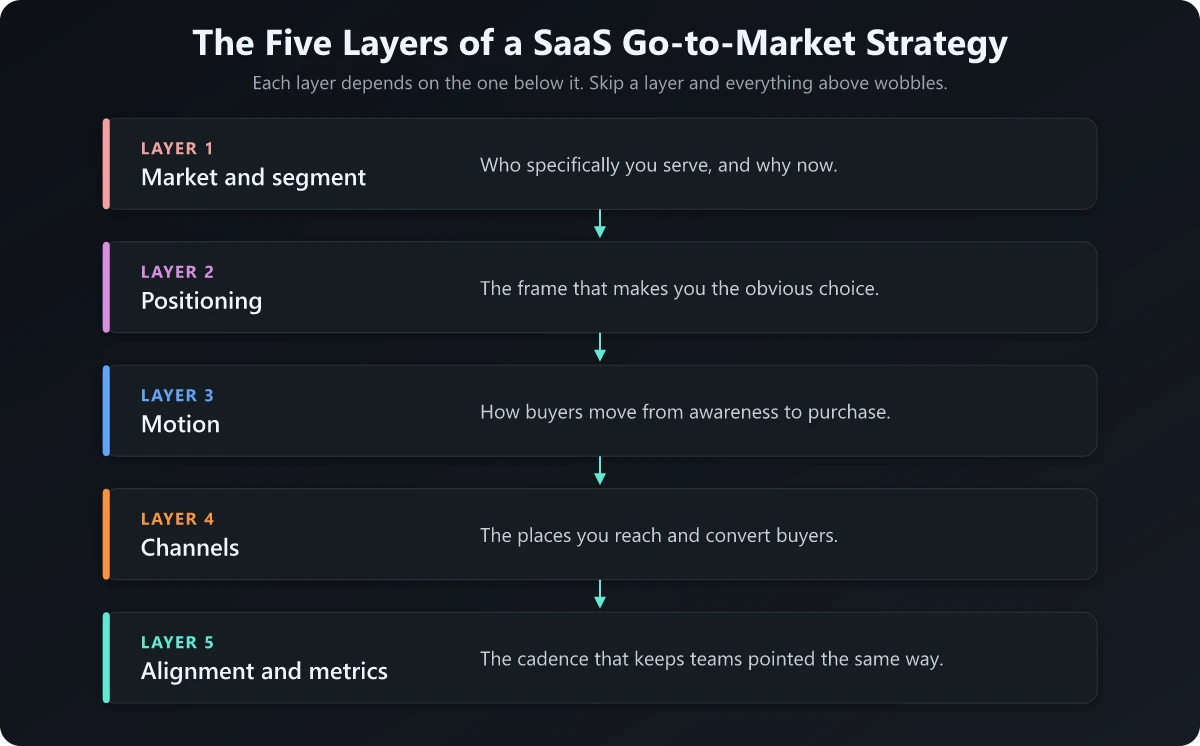
- Market and segment - who specifically you serve and why now.
- Positioning - the frame that makes your product the obvious choice for that segment.
- Motion - how buyers actually move from awareness to purchase.
- Channels - the specific places you reach and convert those buyers.
- Alignment and metrics - the operating cadence that keeps teams pointed the same way.
Let me walk through each one.
Layer 1: Pick a Sharp Segment
Before anything else, you need a defensible answer to “who is this for.” Vague answers produce vague results.
This is where the difference between an ICP and a persona matters. Your ideal customer profile describes the type of company worth selling to, while a buyer persona describes the human inside that company who feels the pain. If you blur the two, your messaging drifts. I break this down further in ICP vs buyer persona, and for B2B teams specifically, building a sharp B2B buyer persona is worth doing before you write a single line of copy.
A sharp segment is narrow enough that you can name the trigger event that makes someone start looking. “Companies that just hired their first RevOps lead” is a segment. “Mid-market companies” is a guess.
Layer 2: Position Before You Promote
Positioning is the decision that quietly shapes every other decision. It is the answer to “what are you, who are you for, and what are you better than.”
I never start writing campaigns until positioning is locked, because positioning determines the words, the comparisons, and the proof. If you have not done this work yet, start with product positioning and a clear value proposition. These are the foundation that everything downstream borrows from.
The test I use is simple. Read your positioning to someone in your target segment. If they say “that is exactly my problem,” you have it. If they say “interesting,” you do not.
Layer 3: Choose Your Motion Deliberately
This is the layer where most strategies quietly drift. A motion is the repeatable engine that turns interest into revenue, and you do not get to pick one casually.
There are three core motions, and the right answer depends on your price point, your buyer, and how much your product can explain itself.
| Motion | Best when | Buyer journey | Main risk |
|---|---|---|---|
| Product-led growth | Low price, fast time-to-value, individual or team adoption | Sign up, get value, upgrade themselves | Plenty of users, weak monetization |
| Sales-led growth | Higher price, complex buying committee, custom needs | Demo, evaluation, negotiation, close | Expensive to scale, slow feedback loop |
| Marketing-led demand gen | Considered purchase, education-heavy category | Discover, learn, request, convert | Pipeline that sales cannot close |
In practice, most companies blend these. A common pattern in 2026 is product-led growth at the bottom and a sales-assist layer on top for accounts that show buying intent. If you want the deeper version of the self-serve motion, product-led growth examples and product-led marketing cover how the product itself becomes the acquisition channel.
The discipline here is to pick a primary motion and resource it properly. Half-funding two motions usually produces two underwhelming engines instead of one good one.
Layer 4: Sequence Your Channels
Channels are where strategy meets the calendar. The mistake I see most often is turning on every channel at once and then being unable to tell what worked.
I prefer to sequence. Start with the one or two channels where your specific segment already pays attention, prove the motion works there, then expand. A SaaS company selling to developers and one selling to CFOs should look nothing alike in their channel mix, even with identical budgets.
For demand-driven motions, the engine that fills the top of the funnel matters most. I lean on the principles in this SaaS demand generation playbook and a clear understanding of demand generation vs lead generation, because confusing the two leads to teams optimizing for form fills that never become revenue.
A useful rule: do not add a channel until your current one has a stable, measurable conversion path. New channels multiply complexity. Add them when you have earned the right to manage that complexity.
Layer 5: Align Teams and Pick Metrics That Matter
The final layer is the one that holds the other four together. A GTM strategy is only as strong as the alignment behind it.
Practically, this means product, marketing, and sales agree on the same segment, the same positioning, and the same definition of a qualified opportunity. Sales enablement is the connective tissue here. Reps need the messaging, objection handling, and competitive context to carry the strategy into real conversations. A simple sales enablement checklist keeps that from becoming an afterthought.
On metrics, pick a small set that maps to your motion rather than a giant dashboard nobody reads. For a product-led motion, activation and free-to-paid conversion lead. For a sales-led motion, pipeline coverage and win rate lead. The point is to measure the few numbers that tell you whether the motion is working.
Building the Strategy Step by Step
Here is the sequence I follow when I build a SaaS go-to-market strategy from scratch. It moves deliberately from decisions to execution.
- Confirm product-market fit signals first. If you are still searching for fit, scaling GTM only spends money faster. The honest test is in what is product-market fit - real demand, retention, and people who would be upset if the product disappeared.
- Define one primary segment with a named trigger event and a clear buyer.
- Lock positioning and the core value proposition before writing any campaign copy.
- Choose a primary motion and a secondary assist, then resource the primary one properly.
- Pick a launch channel mix of one or two channels where your segment already lives.
- Build the enablement and messaging assets so every team tells the same story.
- Define your metric set tied to the motion, not vanity numbers.
- Run, measure, and adjust on a fixed cadence rather than reacting to every dip.
If you want templated starting points for these steps, the go-to-market strategy template gives you the structure, and go-to-market strategy for startups tailors the approach for early teams with limited resources. When those decisions are locked, the free GTM one-pager generator collapses segment, positioning, motion, channels, and metrics onto a single page you can put in front of product, sales, and finance for sign-off before anyone spends budget.
How GTM Strategy Connects to Launch Execution
A strategy that never reaches a real launch is just a document. The handoff from strategy to execution is where momentum is won or lost.
For a new feature or product, I work backward from the launch date and treat the launch as the proof of the strategy, not the strategy itself. A thorough product launch checklist keeps the dozens of moving parts visible, while how to launch a SaaS product walks through the specific moves SaaS launches require.
Two execution pieces punch above their weight. The first is your nurture. A well-built product launch email sequence turns a single launch moment into a multi-week conversion engine instead of a one-day spike. The second is your broader marketing strategy for a new product, which keeps the launch connected to the longer demand engine rather than treating it as a standalone event.
A Quick Sanity Check Before You Launch
Before committing the team, I run the whole strategy through a short gut check:
- Can I name the exact buyer and the trigger that makes them look?
- Does my positioning make a real person in that segment say “that is my problem”?
- Is there one motion I am actually funding, not two I am starving?
- Do product, sales, and marketing describe the product the same way?
- Do my metrics tell me whether the motion is working within one quarter?
If any answer is shaky, fix that layer before you spend the budget. It is far cheaper to fix a strategy on a whiteboard than in market.
The Takeaway
A strong SaaS go-to-market strategy is not a clever campaign or a viral moment. It is a stack of deliberate decisions - a sharp segment, locked positioning, a properly funded motion, a sequenced channel mix, and tight team alignment - that make every downstream tactic land harder.
The teams I have seen win do not have more channels or bigger budgets. They have clarity. They know exactly who they serve, why those buyers should care, and how those buyers move from stranger to customer. Everything else is execution against that clarity.
So before your next launch, resist the urge to jump to tactics. Build the five layers in order, run the sanity check, and only then open the campaign calendar. That sequence is the difference between a flat dashboard and a strategy that compounds.
Frequently Asked Questions
What is a SaaS go-to-market strategy?
A SaaS go-to-market strategy is the plan for how you bring a software product to a specific market and turn strangers into paying customers. It covers who you target, how they buy, the motion you use to sell, and how product, marketing, and sales work together.
What are the main SaaS go-to-market motions?
The three primary motions are product-led growth (the product does the selling through a free trial or freemium tier), sales-led growth (reps run demos and close deals), and marketing-led or demand-gen-driven growth. Most companies blend two of them as they scale.
How is a SaaS GTM strategy different from a marketing plan?
A marketing plan is one input. A GTM strategy is the broader system that decides your target segment, positioning, pricing, sales motion, and cross-team alignment. Marketing executes within those decisions rather than setting them.
When should a SaaS startup change its GTM motion?
Usually when growth from your current motion stalls or your average deal size shifts. Moving upmarket often forces a sales-led layer on top of self-serve, while moving downmarket pushes you toward product-led growth.
Who owns the go-to-market strategy in a SaaS company?
Ownership is shared, but product marketing typically drives the GTM framework and keeps positioning, messaging, and launch coordination consistent across product, sales, and marketing.