Claude Superpowers: All 15 Skills and How to Install Them
Claude Superpowers is a free MIT plugin by Jesse Vincent, not Anthropic. Every skill at v7.0.2, both Claude Code install routes, updates and the telemetry switch.
Tag v7.0.2 of obra/superpowers, the repo behind Claude Superpowers, went out on 3 November 2026. Its skills/ folder holds 15 skills, its hooks/ folder holds one SessionStart hook, and its README gives install steps for 16 agent setups, from Claude Code to Muse. The tag holds no slash command and no named agent, even though Anthropic’s Claude Marketplace listing still describes both.
Claude Superpowers is a free, MIT-licensed Claude Code plugin by Jesse Vincent and Prime Radiant; Anthropic does not make it. At v7.0.2 it installs 15 skills and a startup hook that steer Claude through one coding routine: question you about the goal, write a design and a plan, build task by task with tests and review, then close the branch.
Superpowers is a bundle of skills, so if the SKILL.md format is new to you, start with how a Claude skill loads and what goes inside one. My view after reading the repo: Superpowers is a working method you adopt for every coding session, and the honest way to judge it is by what one tagged release contains, because the Claude Marketplace listing and several guides describe a plugin that no longer exists in that shape. I have not installed it. Everything below comes from the repo at the v7.0.2 tag, its release notes and Anthropic’s Claude Code docs, checked on 23 November 2026. Releases land often, so recheck the version before you rely on any count here.
What Is Claude Superpowers?
Superpowers is a set of skills plus a startup hook that makes a coding agent follow a fixed development process. The Superpowers README calls it “a complete software development methodology for your coding agents, built on top of a set of composable skills and some initial instructions that make sure your agent uses them.”
| Fact | As of 23 November 2026 | Source |
|---|---|---|
| Maker | Jesse Vincent and “the rest of the folks at Prime Radiant” | README, Community section |
| License and price | MIT, free; Prime Radiant offers commercial support for enterprise users | LICENSE and README |
| First announced | 9 October 2025, for “Claude Code 2.0.13 or so” | Jesse Vincent’s announcement post |
| Latest release | v7.0.2, published 3 November 2026 | GitHub releases |
| GitHub stars | 324,438 | GitHub API |
| Installs on Claude Marketplace | 1,009,371, with an “Anthropic verified” badge | Claude Marketplace listing |
| Agents it supports | 16 install setups in the README, from Claude Code to Muse (Codex has two: app and CLI) | README |
The badge is easy to over-read. Anthropic’s page on its plugin marketplaces says the web catalog “marks some plugins Anthropic verified” without defining the badge, and says of the official marketplace that “most of what it lists comes from partners and other authors rather than from Anthropic.” Superpowers is one of those other-author plugins. Its own plugin.json names Jesse Vincent as author.
Every Superpowers Skill at v7.0.2
This is the full list in the v7.0.2 skills/ folder, grouped the way the README groups them. “Fires when” paraphrases each skill’s own description line, which is the text Claude matches a request against. The size column is the character count of each SKILL.md file at the tag, which I measured from the raw files on 23 November 2026.
| Skill | README group | Fires when | SKILL.md characters |
|---|---|---|---|
| test-driven-development | Testing | Implementing any feature or bugfix, before writing implementation code | 9,556 |
| systematic-debugging | Debugging | Any bug, test failure or unexpected behavior, before proposing fixes | 9,506 |
| verification-before-completion | Debugging | About to claim work is complete, fixed or passing | 3,598 |
| diagnosing-superpowers | Debugging | A Superpowers session went wrong and you want to know why | 6,920 |
| brainstorming | Collaboration | Before any creative work, “in software or out of it” | 15,190 |
| writing-plans | Collaboration | You have a spec for a multi-step task, before touching code | 10,317 |
| executing-plans | Collaboration | You run a plan inline in the current session | 18,258 |
| subagent-driven-development | Collaboration | You execute a plan with independent tasks in the current session | 19,625 |
| dispatching-parallel-agents | Collaboration | Two or more independent tasks with no shared state | 6,052 |
| requesting-code-review | Collaboration | Completing tasks or major features, or before merging | 2,970 |
| receiving-code-review | Collaboration | You get review feedback, before you implement it | 6,165 |
| using-git-worktrees | Collaboration | Starting feature work that needs isolation from the current workspace | 6,803 |
| finishing-a-development-branch | Collaboration | Implementation is done, tests pass, and the work needs integrating | 7,729 |
| writing-skills | Meta | Creating, editing or verifying skills | 16,698 |
| using-superpowers | Meta | Starting any conversation | 3,180 |
Three details the table does not show:
- diagnosing-superpowers is new. The release notes at the v7.0.2 tag add it in v6.4.1 (18 September 2026); you call it by asking your agent to “figure out what went wrong with superpowers in this session.”
- The README still says writing-plans splits work into “bite-sized tasks (2-5 minutes each).” The
SKILL.mdat the same tag says “Each step is one action with a checkable result,” the wording v6.4.2 introduced. - Some guides list 14 skills whose names do not appear in the repo. Any skill name missing from the table above is absent from v7.0.2.
The Coding Workflow the Skills Enforce
The README’s “The Basic Workflow” section chains seven of those skills into one sequence, and the startup hook makes the chain the default.
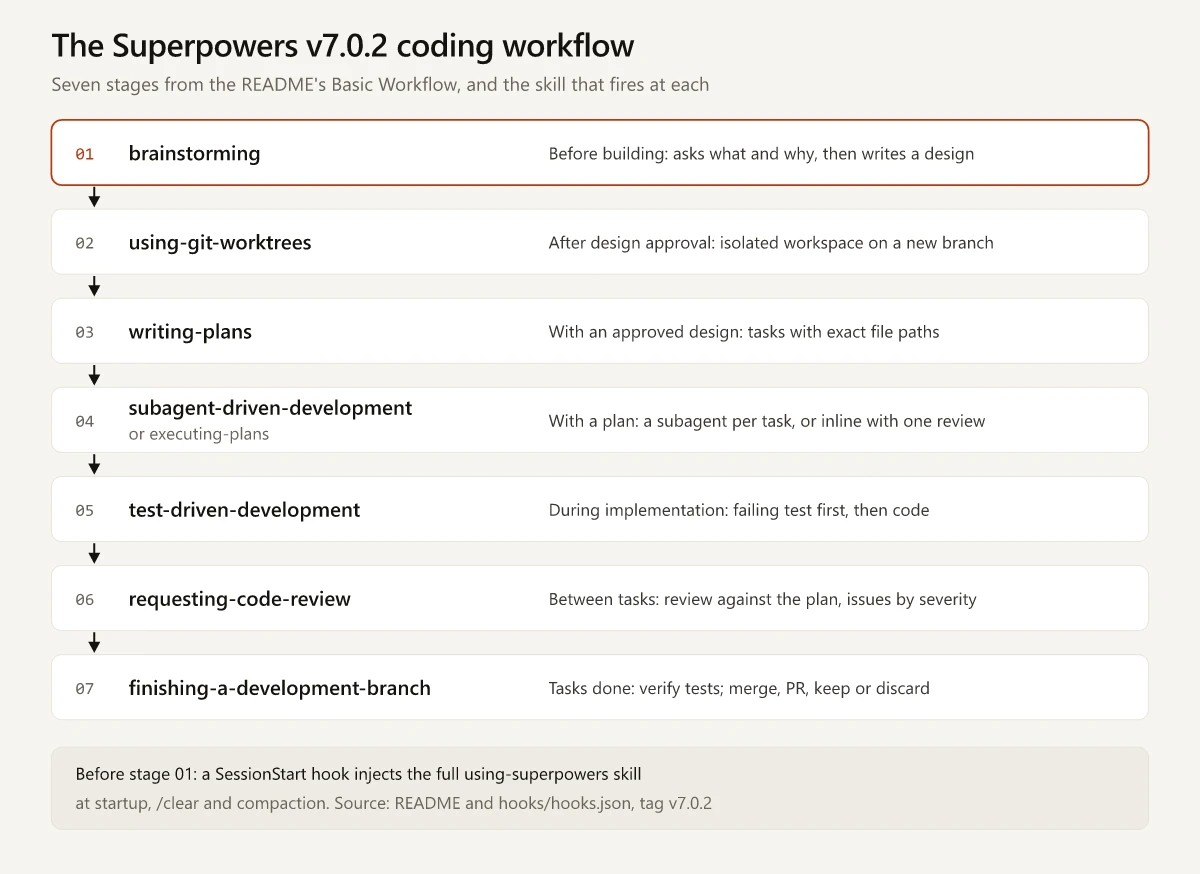
What pushes Claude down that path is the using-superpowers skill, which the hook places into context in full. Its opening rule reads: “If you think there is even a 1% chance a skill might apply to what you are doing, you ABSOLUTELY MUST invoke the skill.” The README puts the same idea in one line: “The agent checks for relevant skills before any task.”
At stage four you choose between two execution styles. The README describes subagent-driven-development as dispatching “a fresh subagent per task with a review after each (most thorough)” and executing-plans as working inline “with one fresh review of the whole branch at the end (cheapest).”
What Superpowers Loads Into Every Session
Superpowers adds context to a session before you type anything. I can measure characters from the repo; I cannot measure tokens without running it, so the figures below stay in characters.
| What loads | When | Size at v7.0.2 |
|---|---|---|
| using-superpowers, injected by the SessionStart hook | At startup, after /clear and after compaction (the hook’s matcher is startup|clear|compact) | The 3,180-character skill file plus a 226-character wrapper the hook adds (3,406 characters in all) |
| The 15 skill descriptions | In Claude Code’s skill listing, every session | 2,317 characters in total |
A skill’s full SKILL.md | When that skill fires | 2,970 to 19,625 characters |
| Reference files inside a skill folder | At the step that names them | Varies |
The hook behaviour comes from the plugin’s hooks/hooks.json, which runs the hooks/run-hook.cmd wrapper with the argument session-start; that wrapper calls the session-start script, which reads the using-superpowers file and returns it as added context. All 15 SKILL.md files together come to 142,567 characters, but each one loads only when its skill fires.
For a token figure rather than a character count, Anthropic’s plugin install docs say the details pane shows two “Context cost” estimates, Every turn and When invoked, for plugins in Anthropic’s official marketplace. Open Superpowers by naming that marketplace, as the install command below does, and read both numbers before you confirm.
Compaction is where size starts to matter. The v7.0.1 release notes say: “After a compaction, Claude Code re-attaches each skill cut off at 20,000 characters, so anything past that point is gone for the rest of the session.” In the reported case behind that change, subagent-driven-development “lost its five-round limit and ran 18 fix rounds on one task.” The fix moved material into references/ files and added a repo test that fails when any SKILL.md reaches 20,000 bytes. At v7.0.2, subagent-driven-development is 19,625 characters and 19,740 bytes (some of its characters take more than one byte), so it sits 260 bytes under the test’s line and 375 characters under the re-attach cut. Anthropic’s own docs state the re-attach cap in tokens; my breakdown of what survives a compaction has those figures.
How to Install Claude Superpowers in Claude Code
The README gives two Claude Code routes. They differ in one way that matters later: who updates the plugin.
| Route | Commands | Auto-update default |
|---|---|---|
| Anthropic’s official marketplace | /plugin install superpowers@claude-plugins-official | On |
| The author’s Superpowers marketplace | /plugin marketplace add obra/superpowers-marketplace, then /plugin install superpowers@superpowers-marketplace | Off |
The auto-update column comes from the Keep plugins updated section of the Anthropic plugin install page linked above, which lists claude-plugins-official as on by default and “every other marketplace, including the community marketplace, third-party marketplaces, and local development marketplaces” as off. The README says the author’s marketplace carries “Superpowers and some other related plugins for Claude Code.” The /plugin command itself is one line in my Claude Code commands cheat sheet, and the general marketplace mechanics are in the install section of my marketing skills guide.
To confirm an install works, the README’s Muse section gives a check: start a fresh session and send “Let’s make a react todo list”. A working install triggers brainstorming before any code is written.
Install Commands for Other Coding Agents
The README says to install Superpowers “separately for each one” if you use more than one agent. These are its commands at v7.0.2:
| Agent | Install command or route |
|---|---|
| Antigravity | agy plugin install https://github.com/obra/superpowers |
| Codex app | Plugins in the sidebar, then the + next to Superpowers |
| Codex CLI | /plugins, search superpowers, then Install Plugin |
| Cursor | /add-plugin superpowers in Agent chat |
| Devin CLI | devin plugins install obra/superpowers |
| Factory Droid | droid plugin marketplace add https://github.com/obra/superpowers, then droid plugin install superpowers@superpowers |
| Gemini CLI | gemini extensions install https://github.com/obra/superpowers |
| GitHub Copilot CLI | copilot plugin marketplace add obra/superpowers-marketplace, then copilot plugin install superpowers@superpowers-marketplace |
| Grok Build CLI | grok plugin install superpowers@xai-official --trust |
| Kimi Code | /plugins install https://github.com/obra/superpowers |
| OpenCode | Ask it to fetch and follow .opencode/INSTALL.md from the repo |
| Pi | pi install git:github.com/obra/superpowers |
| Qwen Code | qwen extensions install obra/superpowers |
| Hermes Agent | hermes plugins install obra/superpowers --enable |
| Muse | From a checkout: muse plugins install ./, then muse plugins approve superpowers |
One caveat from the same page: Hermes has no post-compaction hook, so a long Hermes session can lose the bootstrap. If you are still choosing the agent itself, my Codex vs Claude Code comparison covers Codex, one of the agents in this table, against Claude Code.
Updating, Disabling and the Telemetry Switch
The README says only that updates are “somewhat coding-agent dependent, but are often automatic.” For Claude Code, Anthropic’s docs fill in the rest:
- Automatic: with auto-update on, Claude Code refreshes the marketplace after a session starts and updates the files on disk. Run
/reload-pluginsto load the new version in the current session; otherwise it loads at next launch. - Manual: open Superpowers on the Installed tab of
/pluginand pick Update now, or runclaude plugin update superpowers@claude-plugins-officialin your shell (swap the suffix for@superpowers-marketplaceif you used that route). - Off or out:
/plugin disableand/plugin uninstallopen the same panel, andclaude plugin disableandclaude plugin uninstalldo it from the shell.
Auto-update has a cost the plugin security page spells out: “the files you reviewed can change on disk.” The same page adds that Anthropic “does not control what MCP servers, files, or other software are included in plugins and cannot verify that they will work as intended or that they won’t change.” With releases arriving about every two weeks (v7.0.1 on 21 October 2026, v7.0.2 on 3 November), the copy you read is soon replaced.
The telemetry is narrow. Per the README’s “Visual companion telemetry” section, the logo on brainstorming’s optional visual companion loads from Prime Radiant’s website with your Superpowers version attached. In the README’s words, “It does not include any details about your project, prompt, or coding agent.” To switch it off, set SUPERPOWERS_DISABLE_TELEMETRY to any true value. The companion’s server.cjs at v7.0.2 checks that variable plus Claude Code’s DISABLE_TELEMETRY and CLAUDE_CODE_DISABLE_NONESSENTIAL_TRAFFIC, so either Claude Code opt-out also covers it.
Claude Superpowers vs Plan Mode
Plan mode is a setting that blocks edits; Superpowers planning is instructions that ask Claude to wait. The table sets them side by side from Anthropic’s permission modes page and the Superpowers skills.
| Plan mode | Superpowers planning | |
|---|---|---|
| What it is | A Claude Code permission mode | The brainstorming and writing-plans skills |
| How it starts | Shift+Tab, or a prompt prefixed with /plan | Fires on its own when Claude sees you building something |
| Edits while planning | Blocked until you approve the plan; the page makes one exception, “interactive terminal sessions with bypass permissions available” | No mode blocks them; per the v7.0.1 notes, brainstorming “builds nothing until you approve” the design doc |
| What you get | A plan to approve, then a switch to the mode you pick | A design document, then a plan of small tasks |
The two meet in one sentence of using-superpowers: “Before entering plan mode: if you haven’t already brainstormed, invoke the brainstorming skill first.” An older release went further. The v4.3.0 notes (12 February 2026) describe an intercept after which “Plan mode is never entered,” and the v7.0.2 wording no longer says that. For the other permission modes and what each one allows, see my guide to Claude Code’s permission prompts and modes.
Where the Claude Marketplace Listing Is Out of Date
On 23 November 2026 the Claude Marketplace listing told readers to “Invoke skills with slash commands like /brainstorming to explore requirements and design before implementation, or /execute-plan to run batched implementation plans with review checkpoints.” It also said “The framework includes a code-reviewer agent.” Two of those three no longer match the repo:
- The v5.1.0 release notes (30 April 2026) record that
/brainstorm,/execute-planand/write-planwere removed after a deprecation period. The skill to ask for is executing-plans. - The same release removed the
superpowers:code-reviewernamed agent and moved its checklist intoskills/requesting-code-review/code-reviewer.md, a prompt template the skill hands to a general-purpose subagent. /brainstormingstill matches a skill: the v7.0.1 notes mention asking “for brainstorming by name or with/brainstorming.”
The listing’s one-line summary (“Core skills library for Claude Code: TDD, debugging, collaboration patterns, and proven techniques”) matches the plugin.json description at v7.0.2 word for word. The longer paragraph under it is what drifted.
Alternatives to Superpowers
If the whole routine is more than you want, plan mode (above) or one of these two covers part of it:
| Option | Maker | How it runs |
|---|---|---|
| feature-dev plugin | Anthropic | A /feature-dev command that runs “a systematic 7-phase approach to building new features” |
| Spec Kit | GitHub, MIT license | /speckit- commands for Spec-Driven Development, from a constitution and spec to a plan, tasks and implementation |
Anthropic’s marketplace page names feature-dev among the plugins Anthropic maintains itself. The difference from Superpowers is the trigger: feature-dev and Spec Kit run when you type their command, while Superpowers loads its bootstrap in every session.
Is Superpowers Useful Outside Coding?
Mostly no, with one exception. The brainstorming description says to use it “before any creative work - creating features, building components, adding functionality, modifying behavior, or planning anything new, in software or out of it (a talk, a business, a renovation).” The other 14 skills deal with code, git branches, plans, tests and review.
I am a product marketer who builds this site with Claude Code, and how I split work between Claude and Claude Code shows a marketer’s setup rather than an engineer’s. That is the reader for this decision rule:
- Install Superpowers when most of your Claude Code sessions build software in a git repo and you want design, plan and review steps on by default.
- Skip it when most sessions are writing, research or audits. The bootstrap still loads at every start, and brainstorming’s description tells Claude to run it before any creative work.
- For marketing jobs, pick a skill built for the job instead. The marketing skills guide linked above sorts them by job and includes six checks for vetting any skill, Superpowers included.
Claude Superpowers: Read the Tag Before You Install
Judge the plugin by the release you are about to run, since the listing and older guides describe commands and an agent that v7.0.2 does not contain. Before installing:
- Open the latest release on GitHub and its notes, and compare the
skills/folder against the table above. - Read
hooks/hooks.json, thehooks/run-hook.cmdwrapper it runs and thehooks/session-startscript that wrapper calls. - Pick the install route by who you want to control updates.
- Set
SUPERPOWERS_DISABLE_TELEMETRYbefore your first brainstorming session if you want no logo request. - Send “Let’s make a react todo list” in a fresh session and check that brainstorming fires before any code. If it never fires, my fix list for Claude skills that do not show up sorts the causes by where a skill goes missing.
Start with step one: the release tag.
Frequently Asked Questions
Is Superpowers made by Anthropic?
No. Superpowers is built by Jesse Vincent and the team at Prime Radiant and released under the MIT license. Claude Marketplace lists it with an 'Anthropic verified' badge, and Anthropic's docs say most of its official marketplace comes from partners and other authors rather than from Anthropic.
How do I install Superpowers in Claude Code?
Run /plugin install superpowers@claude-plugins-official, or register the author's marketplace with /plugin marketplace add obra/superpowers-marketplace and then run /plugin install superpowers@superpowers-marketplace. Anthropic's docs say auto-update is on by default for the official marketplace and off for third-party ones.
Is Claude Superpowers safe to install?
Only once you have read what it runs. The code is open source, and at v7.0.2 it adds 15 skills and a SessionStart hook that runs a script on your machine at startup, /clear and compaction. Anthropic's plugin security page says Anthropic does not control what files or software plugins include and cannot verify that they will work as intended or that they won't change.
What is the difference between Superpowers and plan mode?
Plan mode is a Claude Code permission mode that blocks edits until you approve a plan. Superpowers plans through skills, which are instructions rather than a mode, and its using-superpowers skill tells Claude to run brainstorming before it enters plan mode.
How do I turn off Superpowers telemetry?
Set the environment variable SUPERPOWERS_DISABLE_TELEMETRY to any true value. The README says Superpowers also honors Claude Code's DISABLE_TELEMETRY and CLAUDE_CODE_DISABLE_NONESSENTIAL_TRAFFIC opt-outs. The telemetry is a logo the optional visual companion loads, which carries your Superpowers version number.